Friends, this is the promised thread about my and Anthony Fowler's just published:
Thinking Clearly with Data: A Guide to Quantitative Reasoning and Analysis
It has been a decade from conception to finished product. And we are very proud of it.
https://t.co/xOJMBfvMba
1/48
From my work w/ Baliga & Wolitzky: The new possibility that autonomous AI agents are responsible for cyberattacks makes attacking more attractive to human adversaries.
More hard-to-attribute attacks from one source encourage attacks by all other sources.
https://t.co/7e4QpqwToa
One of the most powerful lessons of writing formal models is that the vast majority of what feel like really good ideas turn out to be incoherent--i.e., you cannot write a satisfactory model in which the story that struck you as convincing holds together.
1/
I would love to see more of these folks use AI tools to help them sketch simple models of their ideas. They are going to find that way fewer of them hold together than they believe.
And, perhaps, that would lead them to a bit more rigor and epistemic humility.
8/8
They are doing so in environments where they receive less critical or skeptical feedback from people who have thought and read deeply on the questions than would be optimal.
They often do so with big megaphones and real consequences.
7/
@HarrisPolicy School at UChicago is searching for an assistant professor in AI and policy. Apply if you work on AI tools to improve public policy outcomes or study the behavior and governance of AI and tech systems!
https://t.co/k8hX1lg2Vh
EOE/Vet/Disability
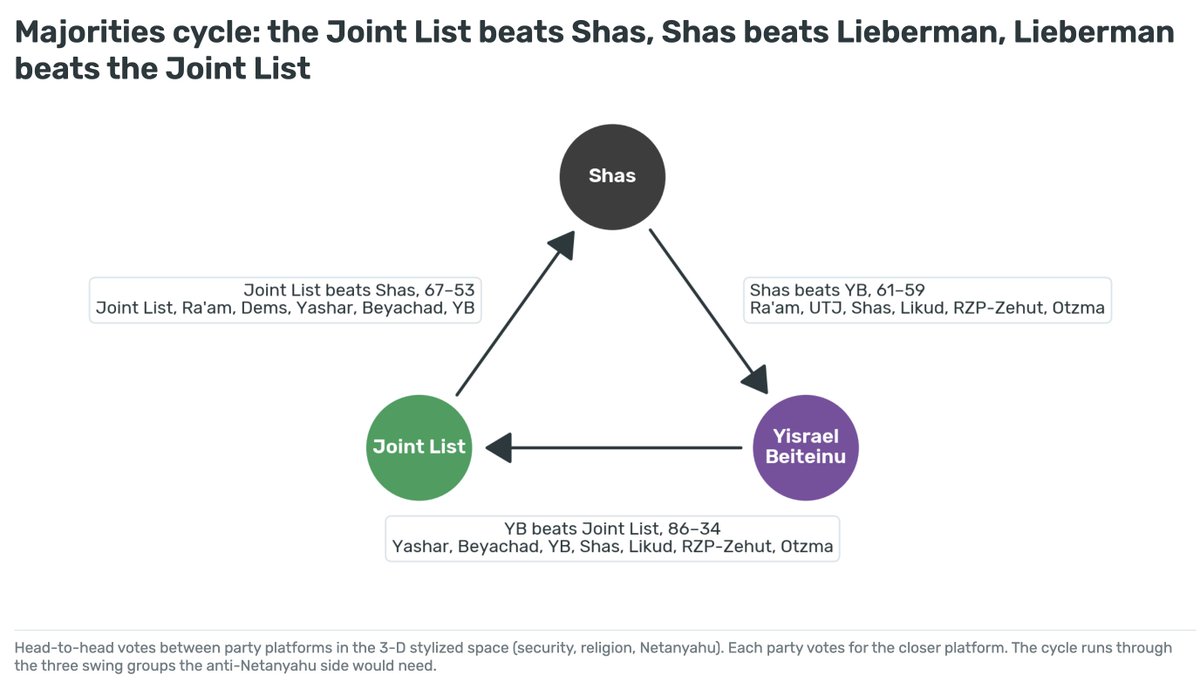
These plots are, however, a nice illustration of the classic results on the so-called "instability" of multidimensional spatial voting due to McKelvey and Schofield.
9/9
I made some plots to help visualize why coalition formation in Israel is so difficult right now
We are witnessing an extremely rare situation that political scientists call a "Condorcet cycle" - a demonstration of Arrow's impossibility theorem in the wild!
But Arrow's Theorem can't be "applied" to any specific case because it is a theorem whose point is that no single non-dictatorial aggregation rule can satisfy all the axioms (normative criteria) across every possible preference profile.
8/