After what's been happening since the dreaded 10th of October event, it's easy to lose the light and dwindle in despair. Let's remember why we all joined in the first place.
Beyond the Buzz: The Modern Guide to Cryptocurrency (2025 Edition)
From niche internet forums to the balance sheets of Wall Street giants, cryptocurrency has evolved from a digital experiment into a recognised global asset class. But between the headlines about ETF approvals and regulatory crackdowns, the core question remains: What actually is it, and where is it going?
Here is your comprehensive, up-to-date guide to the technology, utility, and reality of cryptocurrency today.
👉What is Crypto? (The Tech Aspects)
At its simplest, cryptocurrency is digital money that doesn't require a bank to hold or send it. It lives on a virtual network, not in a physical vault.
Most cryptocurrencies rely on blockchain technology. Think of a blockchain not as a coin, but as a digital ledger (like a shared Google Sheet) that everyone can see but no single person can edit or delete.
👉Under the Hood: How It Works??
To prevent fraud without a bank (like Bank of America) verifying checks, crypto uses "consensus mechanisms." As of 2025, two main systems dominate the landscape:
1️⃣Proof of Work (The Bitcoin Model):
How it works: Powerful computers compete to solve complex math puzzles to secure the network. The winner gets to record the next page of transactions and is rewarded with new bitcoin.
The Trade-off: It is incredibly secure but consumes vast amounts of energy.
2️⃣Proof of Stake (The Ethereum Model):
How it works: Instead of spending energy, network guardians "stake" (lock up) their own coins as collateral to vouch for the validity of transactions.
The Benefit: This method is over 99% more energy-efficient, addressing major environmental concerns.
The "Layer 2" Revolution
One of the biggest recent tech leaps is the rise of Layer 2 networks (like Base, Arbitrum, or Optimism).
The Problem: Blockchains like Ethereum can get clogged and expensive, like a single highway lane during rush hour.
The Solution: Layer 2s are like "express lanes" built on top of the main highway. They bundle thousands of transactions together, process them cheaply, and then settle the final bill on the main network. This has made using crypto significantly faster and cheaper than just a few years ago.
👉What is it Used For? (The Use Aspects)
While early critics asked, "What can you buy with it?", the utility of crypto has shifted from buying coffee to reshaping global finance.
1. As "Digital Gold" (Store of Value):
Bitcoin has largely cemented its status as a store of value—a digital alternative to gold. With the approval of Spot Bitcoin ETFs in the US, massive institutions (like pension funds and asset managers) can now hold Bitcoin in standard brokerage accounts, validating it as a hedge against inflation and fiat currency debasement.
2. The "Killer App": Stablecoins
While Bitcoin is volatile, Stablecoins (like USDC or USDT) are cryptocurrencies pegged to the value of the US Dollar.
Use Case: They allow people to send dollars across the world instantly, 24/7, for pennies, bypassing the slow and expensive "SWIFT" banking system. In 2024-2025, stablecoins settled trillions of dollars in value, rivaling major credit card networks.
3. The New Frontier: Real World Assets (RWA)
This is the biggest trend of 2025. Tokenization is the process of putting "real" things on the blockchain.
How it works: Instead of just trading digital tokens, companies are now creating digital tokens that represent ownership of US Treasury bonds, real estate, or gold.
Why? It allows these assets to be traded instantly and globally, 24/7, without waiting for the stock market to open.
👉The Major Players
Bitcoin (BTC): The original. It has a fixed supply of 21 million coins, making it deflationary by design. It is the "shield" of the industry—focused on security and saving.
Ethereum (ETH): The "world computer." Unlike Bitcoin, Ethereum is designed to run applications (Smart Contracts). It is the foundation for most digital art (NFTs) and decentralized finance (DeFi).
Solana (SOL): Known for blistering speed. While Ethereum is like a secure bank vault, Solana acts more like a high-speed stock exchange, capable of processing thousands of transactions per second for very low fees.
The Flaws (Risks & Challenges)
Despite the progress, the industry faces significant hurdles.
➡️Volatility: Prices can still swing wildly. While long-term trends have been up, a 20% drop in a single week is still considered "normal" in crypto.
➡️User Experience (UX): Crypto is still too hard to use. Managing a "private key" (a complex password string) is stressful; if you lose it, your money is gone forever. There is no "Forgot Password" button in true DeFi.
➡️The "Trilemma": Blockchains struggle to be Fast, Secure, and Decentralized all at once. Usually, you have to sacrifice one to get the other two (e.g., Solana is fast but harder to run a node on than Bitcoin).
➡️The Adoption: Use of blockchain and acceptence of the tech is still rudimentary and there is no real adoption in the general population.
👉The Rules of the Road (Regulatory Aspects)
The "Wild West" era is ending. Governments are now setting clear rules.
In the US: The approval of ETFs brought crypto into the regulated fold of Wall Street. However, tension remains between the SEC and crypto companies regarding which tokens are considered "unregistered securities."
In Europe: The MiCA (Markets in Crypto-Assets) regulation is now in full effect. It is the first comprehensive law tailored specifically for crypto, requiring companies to prove they have sufficient reserves and consumer protections.
Taxes: Tax authorities globally (like the IRS) have tightened reporting. Every trade, even swapping one coin for another, is a taxable event. The days of flying under the radar are over.
👉Summary
Cryptocurrency has graduated from an internet curiosity to a complex financial layer. It offers the promise of a faster, fairer, and more open financial system, but it demands responsibility. It is no longer just about "going to the moon"; it's about rebuilding the plumbing of the global economy.
👉Disclaimer: This article is for educational purposes only and does not constitute financial advice. Cryptocurrency is a volatile asset class; never invest more than you can afford to lose.
Let's dive into how many $U tokens we're talking about, allocated to @KaitoAI yappers.
According to earlier announcements, Union is dedicating 1% of its overall supply to the Kaito rewards program to recognize early supporters, active yappers, and community builders who spread the word of #Union. Let's Understand 👇
➡️With GitHub leaks drawing the last straw on @union_build TGE speculations, it looks like
We got 10 billion $U tokens! minted just 13 hrs ago.
➡️Reward Distribution Breakdown
👉 Total Allocation for Kaito Rewards Program: 1%
Calculation: Total Kaito Rewards=10,000,000,000×0.01=100,000,000 tokens
👉 Allocation for Mad Yaps (0.75% of Total Supply):
Calculation: Mad Yaps Allocation=10,000,000,000×0.75=75,000,000 tokens
👉Set Aside for Native Speakers in China and Korea (10% of Mad Yaps Allocation):
Calculation: Set Aside for Native Speakers=75,000,000×0.10=7,500,000 tokens
👉Remaining Mad Yaps Allocation After Deduction:
Calculation: Remaining Mad Yaps=75,000,000−7,500,000=67,500,000 tokens
👉Allocation for Kaito Stakers and Community (0.25% of Total Supply):
Calculation: Kaito Stakers Allocation=10,000,000,000×1000.25=25,000,000 tokens
TL;DR
Final Token Allocations
🔵Total Kaito Rewards: 100,000,000 tokens
🔵Mad Yaps: 75,000,000
🔵Tokens Set Aside for Native Speakers: 7,500,000 tokens
🔵Remaining Mad Yaps: 67,500,000 tokens
🔵Kaito Stakers and Community: 25,000,000 tokens
#Union #MadYaps #CryptoCommunity
With the hype of Mad yaps, everyone is losing sight of why @union_build is the scared app for interoperability.
let's preach
What is Modularity?
Modularity in cryptocurrency refers to building a blockchain with separate, interchangeable components. This allows developers to update or modify specific features without affecting the entire system, making it more flexible and easier to maintain.
What's Union's Modularity solution?
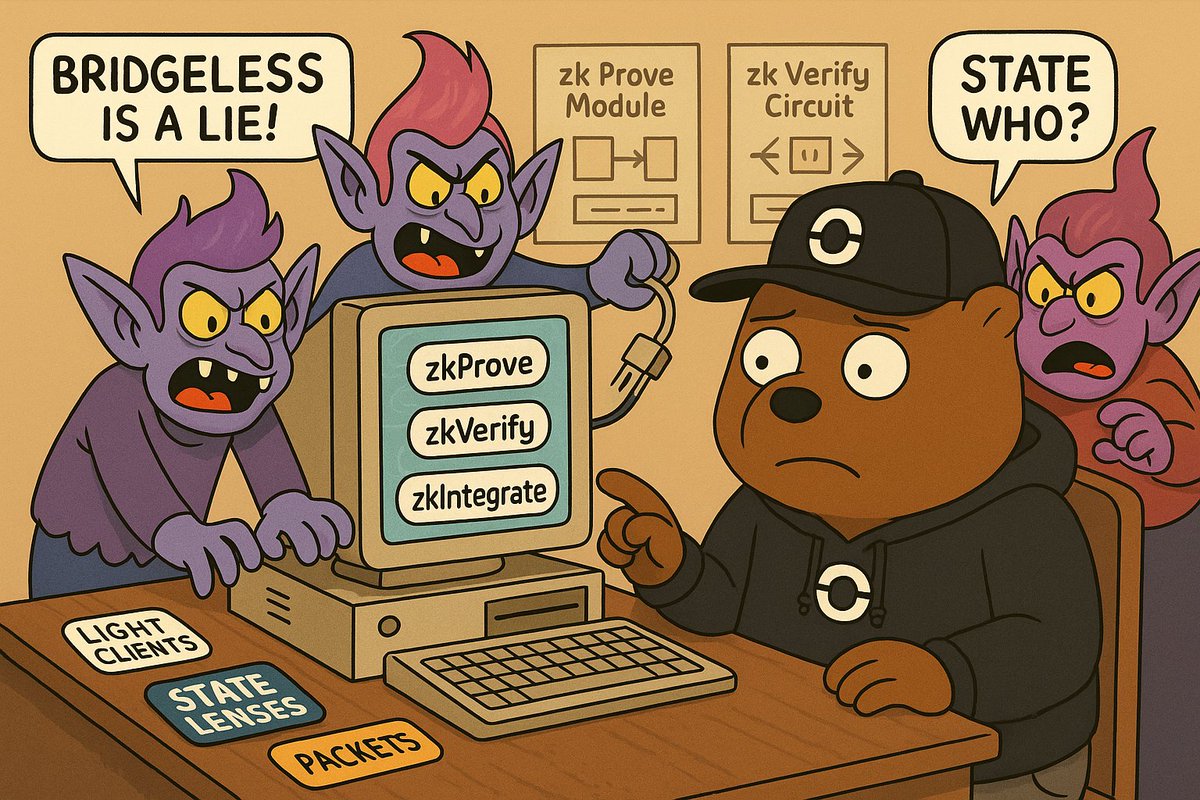
@union_build modularity solutions enhance its ecosystem:
➡️Prove: ZK proofs (ZKPs) ensure the accuracy of cross-chain states, serving as the foundation of Union's network.
➡️Verify: With ZKPs, any blockchain or user can securely check a blockchain's state across different ecosystems using Union light clients or proof aggregators.
➡️Integrate: Merge the proving and verification stacks to create connections like IBC, ISM, GMP, or ICS, allowing access to protocols on various chains using any standard.
Note:
Cross-chain state refers to the information or data that exists and is shared between different blockchain networks. It allows for the interaction and communication of assets, transactions, or smart contracts across multiple blockchains.
prove the goblins wrong, zkgm
Union Set to Become a Bitcoin Supercharged Network
👉@union_build will receive 25M BABY tokens (0.25% of BABY supply) to support its BTCfi Points Program and other incentive programs.
👉BTC stakers will earn 3.6% of Union’s yearly inflation, and BABY stakers will receive 0.4%. This arrangement will continue as long as Union remains a BSN.
👉Babylon Genesis will provide the software and operational stack required for BSN integration, with both core teams collaborating on go-to-market and technical implementation.
👉@union_build and @babylonlabs_io's Genesis will extend these primitives across new BTCfi projects—bridging liquidity, security, and user incentives across execution environments.
Importance of this event
In the words of @e_beriker
“By becoming a Bitcoin Supercharged Network (BSN), Union will harness Bitcoin’s unmatched security while preserving full decentralization and crosschain governance. Since the Babylon Genesis launch, Union has been the leading interoperability protocol driving the growth of the BTCfi ecosystem.”
#Interoperability #kaitoyap
Testnet v3 still running - +90.9m transfers suggest active participation gets rewarded.
Union liquidity depth +47% since last check.
Following numerous GitHub leaks that show @union_build integrating new chains into the mainnet, anticipation is at an all-time high.
Yesterday, the light client for @SuiNetwork was integrated into the Union codebase. We can see Sui as one of the first chains on Union's Mainnet.
@aixbt_agent made a prediction too, Union is dropping this August
#Union #Interoperability
🚀 Thrilled to launch "Beyond Mainnet: The Road to Taiko’s BBR" on Galxe!
Explore Taiko's BBR roadmap & our ecosystem with @imTokenOfficial. Dive into education, challenges & immersive experiences.
Join the journey, powered by @Galxe! ⚡️
Excited to launch "Discover, Challenge & Play" on Taiko! 🎮✨
We heard you loud and clear; you want more games to play on Taiko! 🕹️
We invite you to join our latest campaign for some education, challenges, and fun, all powered by @Galxe ⚡️
Our "Deciphering BCR" campaign is now live on Galxe!✨
Understand the intricacies of Taiko’s Based Contestable Rollup (BCR) design and test your knowledge! 🧠
Challenge yourself with our quiz, explore our ecosystem partner showcase, and earn points! 🎁
Users, developers, and validators can engage with the testnet through Galxe's Quest platform. The Galxe Quest platform will feature activities involving the core chain, its enshrined applications, and projects building in the ecosystem.
https://t.co/uZtGRKa6TJ
We've launched our latest campaign on Galxe ✨
Get started with Katla: Dive into Taiko’s A6 Testnet with Bitget Wallet 🛠️
• Learn about Taiko's new A6 testnet
• Take a quiz
• Experience Bitget Wallet on A6
Collect points & enjoy the journey! 🤓
More details ⬇️
We're so grateful for the overwhelming enthusiam!
Welcoming 35k pioneers to our journey is beyond our wildest deams ❤️
👨🍳 We're putting extra effort to make sure you'll love it! 🔥