1/ How can we make Low-Rank Matrices behave more like Full-Rank Matrices—and achieve higher rank efficiency?
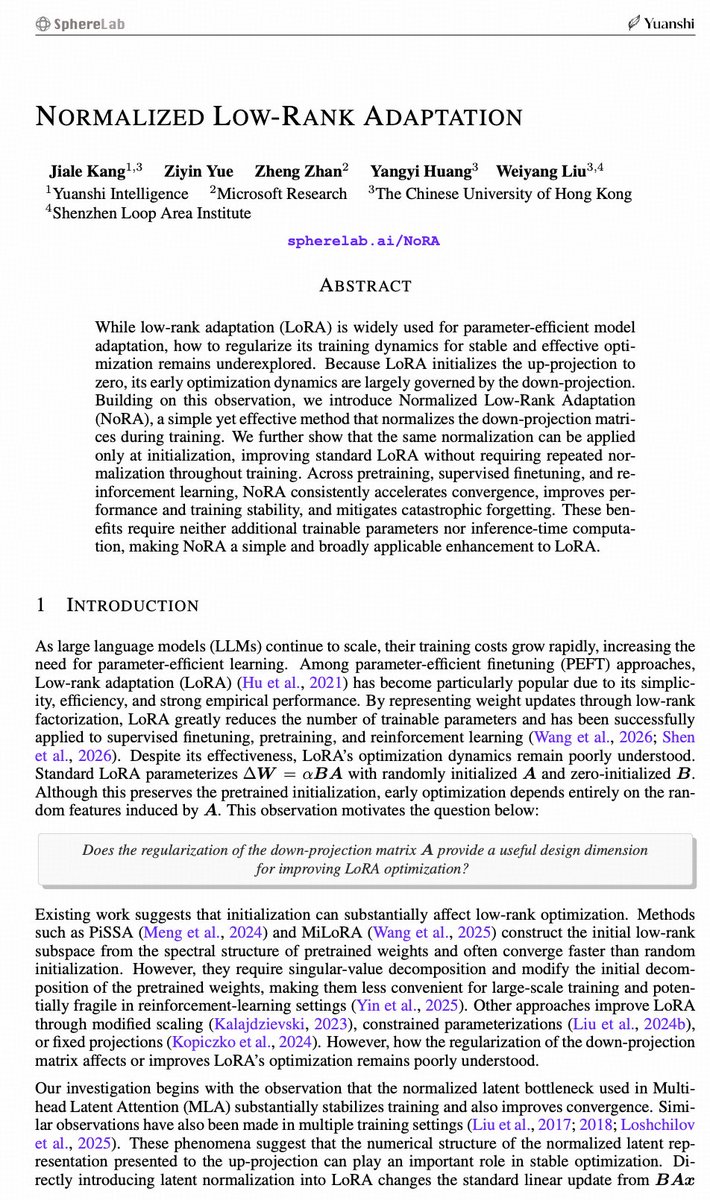
We release our new paper: NoRA: Normalized Low-Rank Adaptation.
Paper: https://t.co/hZXe6C5tP5
“Normalized Low-Rank Adaptation”
LoRA’s early optimization is dominated by its randomly initialized down-projection, which can produce badly scaled gradients.
This paper introduces NoRA, which simply normalizes that projection along the rank dimension to better match full-finetuning dynamics.
Even normalization only at initialization captures most of the gain, improving convergence, stability, and downstream performance with no extra parameters or inference cost.
https://t.co/30KL1tjPap
Great work led by Jiale! NoRA builds on LoRA’s parameterization, with the down-projection matrix normalized. Even more surprisingly, applying this normalization only at initialization is already sufficient to obtain considerable performance gains.
More details in https://t.co/fvGiLWsR8H.
Really enjoyed working with Jiale Kang on this.
Well, it’s interesting to see how much room there still is to improve LoRA in 2026.
One thing that stood out to me is that the gap between PEFT and full finetuning is not just about rank or capacity. Initialization and the scale/normalization of the low-rank projection can fundamentally change its optimization dynamics.
Makes me wonder how many other seemingly “small” design choices in PEFT are still hiding in plain sight.
@Sub_RBala That’s a good question. In principle, with sufficiently long training, the differences introduced by various optimization techniques may eventually diminish. The key question, however, is how to accelerate that process.
1/ How can we make Low-Rank Matrices behave more like Full-Rank Matrices—and achieve higher rank efficiency?
We release our new paper: NoRA: Normalized Low-Rank Adaptation.
Paper: https://t.co/hZXe6C5tP5
Tweet 1:How does one make Low-Rank Adaptation (LoRA) match the optimization dynamics of Full-Rank training? 👩💼
We share NoRA—normalizing the projection weights to bridge the gap between efficiency and performance🚀
https://t.co/Z8ExFULwrF
6/ Huge thanks to my amazing collaborators @ZiyinYue @ZhengZhan13 @YangyiHuang @Besteuler for all the insightful discussions and contributions to this work!
It was a great pleasure working together! 🙌
1/ Sharing a new, interesting project I did during my internship at Microsoft AI Frontiers w/ @JohnCLangford
TL;DR: At decoding time, we feed **previous hidden state** into the input together with token embedding, and it boosts performance for free.
https://t.co/za3cZ4UwWV
In the early morning, @nathancgy4, @Xinyu2ML, @Yulun_Du and I were preparing some showcases for the blog while watching the World Cup. The moment Argentina beat England, I felt something. I looked up, and saw the most unforgettable Beijing sunrise. So I took the photo.
I knew this was no ordinary day, and now it comes and says, "Hello, world!"
Happy hatch day, K3!
Please enjoy it, I have felt 「眩晕瘫坐」 for weeks.
It is a monster model, yet clean in architecture; elegant in optimization, beautiful in MoE desigins.
It has crossed a certain singularity, it is a year of work, in one release.
🚀🚀🚀 This is a Sputnik moment for OSS.
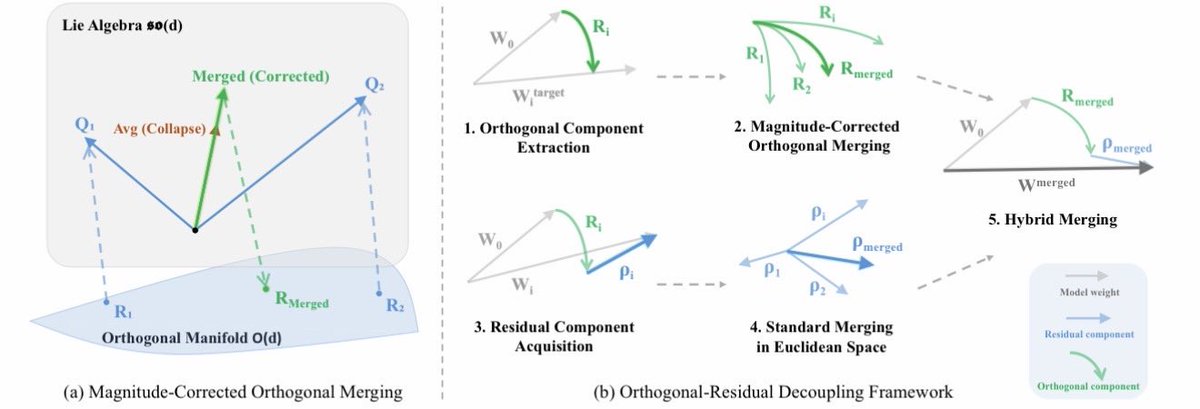
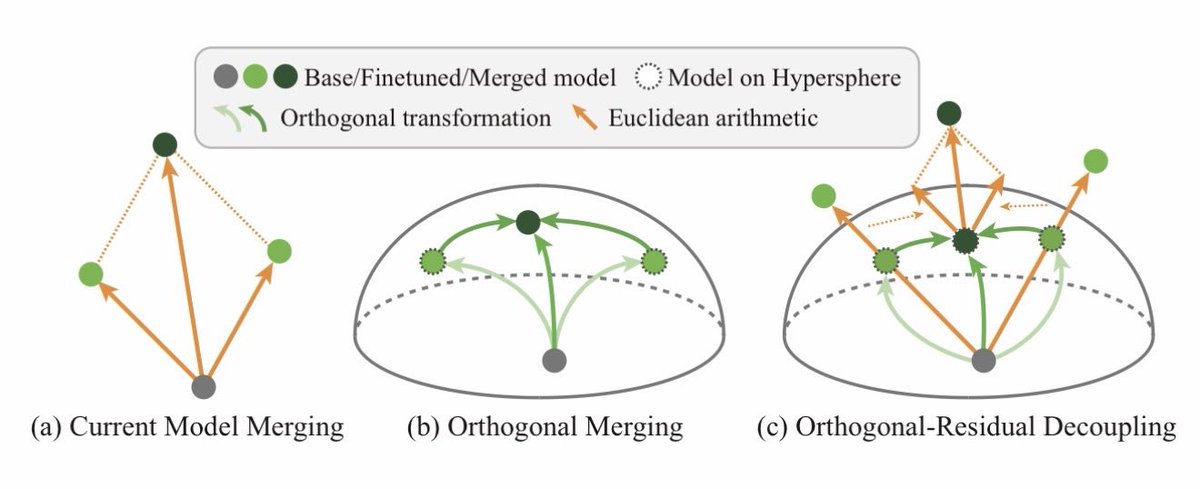
Orthogonal Finetuning (https://t.co/IlBYlgiaae; https://t.co/Mve4Pdptmv) has a unique advantage of preventing catastrophic forgetting. Inspired by this property, we find that merging models within the orthogonal group can effectively reduce model conflicts and preserve both pretraining and downstream knowledge. This is our OrthoMerge framework.
The idea behind OrthoMerge is extremely simple. For OFT-tuned models, we can first map the orthogonal adapters to Lie algebra with inverse Carley transform and then perform merging there. This guarantees the merged model differs from the pretrained model only up to an orthogonal transformation.
A better news is that OrthoMerge can also be applied to non-OFT-tuned models. By solving the orthogonal procrustes problem, we can have the projected component of the adapter onto the orthogonal group. OrthoMerge will then be applied there and the residual component can be merged using conventional merging methods. That said, OrthoMerge can be used together with existing model merging methods!
This is a great example of simple yet effective ideas. Great efforts by my PhD students Sihan Yang and Kexuan Shi. The project is already open-sourced and feel free to give it a try!
Project: https://t.co/Fzjrn0zpaW
Paper: https://t.co/QvFafN1UeY
Code: https://t.co/LjEzcLZ0De
Effortless win — welcome everyone to try MiSS. Code for MiSS lossless LoRA conversion will be updated soon in PEFT, so you can easily adapt it to frameworks like vLLM and Slime.
flash-linear-attention is now seeing over 15,000 daily downloads. 📈
We @SonglinYang4@uniartisan are honored to see fla becoming a piece of the core infrastructure for efficient model archs. Grateful to the community for the trust and support.
https://t.co/VirlvFzgYc