Harriet Walter: “Alan was never a nobody. Even when he was an unknown 32-year-old, when I first met him in the bar at the old Bush theatre, he seemed like somebody. “Oh, I’ve heard about you,” he drawled in that beautiful voice. His searchlight gaze had fallen on me and for that moment he made me feel like somebody.
The first play I did with him was The Seagull at the Royal Court. I didn’t have to act Nina’s fascination with Trigorin. We also did a restoration comedy together. He was brilliantly funny both on and off stage. I don’t think he was easy to direct. He was too much of a director himself. You wanted to do your best for him. Praise from Alan, even then, counted far more than any critic’s review.
I remember a phone call with him around that time, gossiping about any jobs we had been offered. I had plumped gratefully for the first thing that came my way, while Alan recited a list of roles he had turned down. He was paring down his choices with what I soon learned was an acute sense of where he was heading and where he was supposed to be. If this sounds offensive, it wasn’t. He was a rocket that was perfectly prepared but hadn’t yet been launched. When the part of Obadiah Slope in Barchester Chronicles came his way he recognised his moment and he pounced.
Then there was Les Liaisons Dangereuses and then there was Die Hard playing Bruce Willis’s nemesis. Wow! My old mate Alan had become a film star – a fully fledged Somebody – and he took to that status as the proverbial duck to water.
His generosity and kindness were legendary as was his brilliant sense of humour – a unique combination of wry sophistication and silliness that is evident in many of his film roles. When I worked with him again in Sense and Sensibility, although our characters didn’t meet we spent plenty of social time on location.
Alan took care of me, made sure I dined with him and the top cast at the top tier hotel restaurant and paid for the cab back to my not quite top tier hotel some 10 miles away. He threw a birthday party for me in the year my partner died from cancer. He knew it would be a hard one for me.
Alan elevated friendship to an art form. His friends grew in number throughout his extraordinary career but he never dropped his old pals in favour of more starry ones. He was unusually loyal. I marvelled at how he managed to see nearly all of our performances and wine and dine us afterwards. Stardom didn’t change him because he had always been a star, albeit a very well-grounded one.
So much has happened in the world in the 10 years since he died. I miss his piercing intelligence now more than ever. It is terribly sad for all of us that he has gone but I am almost happy for him that he left when he did.”
(‘The Guardian’, 14 January 2026)
David Abraham, a black Jew, boarded a bus in North London, in October 2025.
He touched the payment device with his credit card as normal, but when the Stamford Hill bus driver, Paul Lindo 60, said, “I don’t like Jews,” he was startled and dropped his card in between the touch device and the plastic covering.
Lindo then told him how he hated Jews and locked the passenger inside the bus for more than an hour.
David videoed himself as he couldn’t believe a black man would do this to a black man. The incident was reported to police and the driver was arrested, but amazingly, the @CPSUK Crime Prosecution Service, decided NOT to pursue the case.
The NGO campaign against @antisemitism then provided David with the necessary legal backing to seek justice.
All of a sudden, the CPS changed their minds and decided to prosecute.
Lindo was charged with racially aggravated intentional harassment, for locking Jewish passenger, David Abraham aboard a bus for around an hour and making antisemitic remarks.
Lindo is due at Thames Magistrates' Court on 16th November.
Credit to Campaign Against Antisemitism for standing with victims of antisemitic abuse.
Shame on yhe @CPSUK for once again, failing to do their job and protect members of the public
A doctor rapes a patient.
The victim reports it.
THE DOCTOR ADMITS IT.
He tells a hospital committee that it was a "one off" and he will not do it again.
THE MANAGEMENT SAYS THAT IS OK.
And allow him to carry on working.
THE POLICE TAKE NO ACTION.
The hospital concerned is the BLACKPOOL VICTORIA HOSPITAL.
The same hospital where a 75 year old patient was raped to death and no one was ever convicted for it.
Are women worth nothing to the NHS?
https://t.co/g2YTbKiG47
99% of women and girls in Somalia have been mutilated in the following way: the clitoris is cut off, along with the inner labia. Then the inner flesh of the outer labia is removed before both sides are sewn tightly together, leaving a hole no bigger than a matchstick for urine and menses to trickle through.
All of this is done in childhood, and without any form of anesthesia whatsoever. Sometimes the little girl is given a scrap of leather or a stick to bite down on. The cutters use old razor blades, or sometimes a piece of broken glass.
This is only the beginning of a girl’s pain.
Most wedding nights in Somalia are aided by “the little knife” — that is, the new husband slices his bride open so that he can penetrate her now cut and bleeding scar tissue. Some men, however, simply batter their way through, tearing that tiny hole open by sheer force. When a woman goes into labor, she’s cut open more widely, then sewn back up afterwards so that when sex resumes she will have to be cut open yet again.
This practice leads to countless deaths from infection and a drastic increase in maternal mortality, but Somali men still refuse to marry uncut women, forcing mothers to have their daughters cut or face social stigma. Uncut girls are seen as dirty; the term for clitoris is a playground taunt in Somalia, and girls who are not cut are usually ostracized by their peers.
The Somali government recently debated the legality of this appalling custom, and the parliament largely split along gender lines. Female MPs roundly condemned FGM, while male MPs insisted that having a clitoris made a woman more difficult to penetrate, and quoted the hadith in which Muhammad condoned the practice. These are educated men who nevertheless claim that cutting a girl is necessary in order to control her sexuality, and that an uncut woman will be promiscuous and untrustworthy.
In spite of the Somali government’s continued support for FGM, foreign aid continues to flow into Somalia unobstructed. The West should refuse to give the Somali government so much as a single dollar until they outlaw FGM and take positive steps to combat the problem.
One tactic that has been highly successful involves showing Somali men a video of a girl being mutilated. Because FGM is seen as women’s business, most men have no idea what it entails. Men who watch this video are horrified, and the most common reaction has been “Not my daughter!” This proves that FGM is not hopelessly entrenched in Somali culture. Western pressure and resources could make an enormous difference in the lives of Somali women and girls, and put a stop to this barbaric practice.
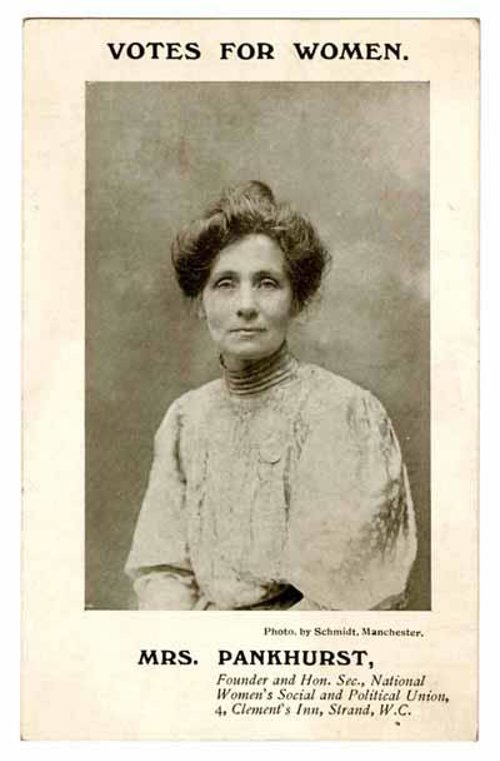
10 October 1903 — “Deeds, not words.”
On this day, Emmeline Pankhurst founded the Women’s Social and Political Union (WSPU) in Manchester, frustrated by the slow progress in winning women the vote.
Its members became known as the Suffragettes, and their campaign grew increasingly militant. Many were arrested and imprisoned, and those who went on hunger strike were subjected to force-feeding.
In 1918, victory came, but only partly. Women aged 30 and over who met certain property qualifications were given the parliamentary vote, enfranchising about 8.5 million women. Younger women still could not vote, even though many had worked throughout the First World War.
It wasn't until 1928 that women finally gained the vote on the same terms as men, from the age of 21.
#OTD #Suffragettes #WomensHistory #BritishHistory