Well said Ian Botham:
“Whitehall is turning England into a tinderbox. Defra’s response to climate change has been to sharply increase vegetation. Over the past 20 years its cuts in upland cattle and sheep grazing led to a 25 per cent increase in highly flammable grass.
Another genius move has been to stop preventative burning of heather. During damp winter months these burns safely prune the dead material which is then replaced by younger plants. It is the dead heather that is combustible. And thanks to Defra we now have 74 per cent more of it. The winter burns used to create firebreaks. Now we have huge expanses of continuous, ageing vegetation. The result is disaster after disaster.
When Downing Street starts asking questions of Defra, jaws will drop. Why did it further restrict winter burns despite the National Fire Chiefs Council warning this risked the lives of "firefighters and the public"? How come it also ignored the pleading of top wildfire scientists not to go ahead?
In 2007, officials said that stopping winter burns would produce "a much increased risk" of wildfires. Which is exactly what we are getting. Rewilded land going up in smoke.
Other countries have learnt the hard way. Australia and California tried suppressing the prescribed burns that indigenous people had used for tens of thousands of years. By some calculations, dozens died before their governments saw sense. What will it take for ours to wake up?
This is a crisis caused by years of Whitehall grabbing power away from the countryside.”
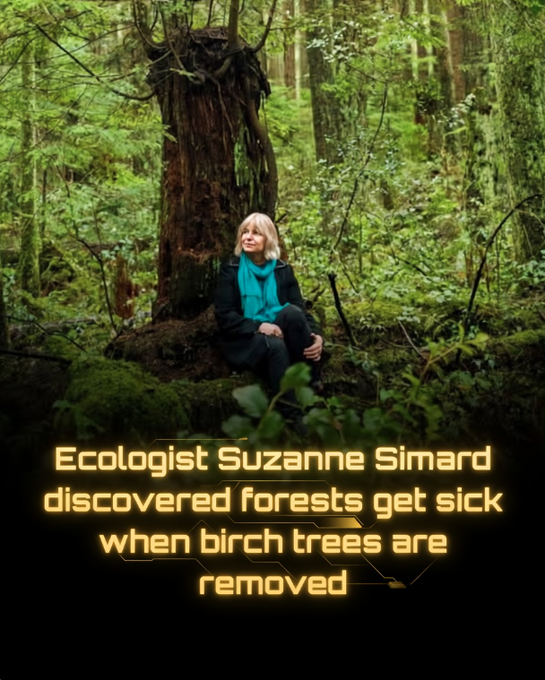
In the 1990s, Canadian ecologist Suzanne Simard made a groundbreaking discovery that challenged everything we thought we knew about how forests work. While studying managed forests in British Columbia, she noticed something puzzling: when birch trees were removed to promote the growth of valuable Douglas firs, the firs did not flourish as expected, they actually struggled and grew more slowly.
Determined to understand why, Simard traced the movement of nutrients using radioactive carbon isotopes. What she found was astonishing. Trees were actively sharing resources through vast underground fungal networks known as mycorrhizae. These delicate, thread-like fungi connect the roots of different trees across the forest floor, forming a complex web that allows the exchange of carbon, water, nutrients, and even chemical signals, sometimes between entirely different species.
She discovered that older, larger trees often serve as central "hubs" or "mother trees," supporting younger saplings by redistributing vital resources and helping the entire ecosystem remain resilient. When these key trees are removed, the underground network weakens, and the health of the remaining forest declines.
Simard’s research overturned the traditional Darwinian view of forests as battlegrounds of ruthless competition. Instead, she revealed a far more sophisticated reality: forests operate as highly cooperative systems where trees communicate, support one another, and even warn neighboring trees about threats like drought, disease, or insect attacks.
What appears to the human eye as a silent, still forest is, in truth, a vibrant, interconnected living network, built not on isolation and rivalry, but on deep connection and mutual aid.
Today the Lady of the Manor was seated upon the loveseat in the library, enjoying a perfectly civilised afternoon tea whilst reading.
Feeling particularly amorous and convinced that romance was required, I crossed the room with what I believed to be considerable charm, finesse and purpose.
Without warning, I dropped gracefully into a squat before her chair, intending to deliver a deep and heartfelt kiss worthy of a Barbara Cartland novel.
At precisely that moment, my trousers surrendered.
The sound was magnificent.
Not a modest tear.
Not a discreet split.
A violent, thunderous ripping noise erupted from somewhere near my belt loop and travelled with alarming enthusiasm southward, as though the garment itself had finally decided it could no longer tolerate my existence.
The effect upon the Lady of the Manor was immediate.
Halfway through a sip of tea, her eyes widened in horror.
Then amusement.
Then complete loss of composure.
A fine spray of Earl Grey was expelled directly into my face.
For a brief moment neither of us moved.
I remained frozen in my romantic pose, soaked and staring.
She stared back.
Then came the laughter.
Not a polite chuckle.
Not even a laugh.
A full-bodied, uncontrollable fit of hysterics that echoed around the library walls.
I attempted to salvage what remained of my dignity.
“Well,” I said, tea dripping from my nose, “that wasn’t the response I’d envisioned.”
This only made matters worse.
The laughter intensified.
Clutching her stomach, the Lady of the Manor was now incapable of speech.
Seeing that the situation could not be recovered, I rose with what dignity remained available to a man whose trousers had catastrophically failed during a romantic advance.
I turned and began a slow retreat from the room.
Behind me the laughter continued.
Halfway down the corridor I could still hear it.
By the time I reached the staircase it had not diminished.
It resumed several times throughout the evening whenever she happened to remember my expression at the moment of structural failure.
My sacrifice for romance, it seems, will never be forgotten.🫖☕️
Sometimes I get in a funk and feel like I’m treading water with my work. It’s hard to see progress every day.
Then I look at some of what I’ve done and ask myself… would 2017 Andrew think this was cool?
If so… I think I’m doing alright.
Today is Lammas, England's forgotten harvest festival.
Celebrated on 1 August for well over 1,000 years, Lammas was one of the most important days in the English calendar.
First recorded in the 9th century, Lammas takes its name from the Old English hlāf-maesse, meaning "Loaf Mass."
Farmers baked the first loaf from the new wheat harvest and took it to church to be blessed in thanksgiving.
For our ancestors, this wasn't simply a religious ceremony. It was a celebration of survival.
A successful harvest meant bread on the table through the coming winter. A poor harvest could bring hunger and hardship. Few days carried greater importance.
In medieval England, Lammas also marked the end of haymaking, the opening of the grain harvest, and in many places the start of harvest fairs, games and community gatherings.
Although Christmas and Easter remain widely celebrated, Lammas has largely disappeared from everyday life, despite being one of England's oldest seasonal traditions.
In a world where abundance is often taken for granted, Lammas reminds us to be thankful for what we have.
Follow @oaksandlions for more on England’s history and heritage.
And tonight I shall leave you with this photo that I took in Whitby, Yorkshire some time ago. I was stood on the cliffs looking out to sea and watching this enormous tanker making its way across the horizon, with an enormous storm chasing it down. The storm completely dwarfing the ship. Nature is always more impressive than we are. Nighty night.
@ThePosieParker Live not far away from Bristol and now only head in to see performances at the hippodrome. I used to love it but now it’s horrid going in. A 30 minute drive to despair. So sad.
How many of these bird facts did you know?
1. Blackbirds are Thrushes. 🐦
2. When young Swifts fledge the nest, they don't land again for 2 or 3 years. 🐦
3. Adult Cuckoos only spend about 8 weeks in the UK each year. 🐦
4. A baby Puffin is called a Puffling. 🐦
I see the Big Pharma fans are now focusing on what is or is not a "safe level" of folic acid in flour.
It's irrelevant. It should not be in flour AT ALL. The small number of people who are folate-deficient to the extent they might give birth to a child with a neural tube defect can, and should, be targeted specifically. We shouldn't be medicating the entire population with uncontrolled levels of pharmaceuticals that THEY DON'T NEED.
Here's what the government says the problem actually is:
"Despite longstanding UK public health advice recommending a daily supplement of 400 micrograms of folic acid before conception and during early pregnancy, uptake remains suboptimal, particularly among younger women and those from lower socio-economic backgrounds"
So they are admitting that their previous policies have failed, but rather than fix them with better targeting policies, they are now medicating the entire population.
It's a bit like the debate over Bovaer in the feed of dairy cattle. The "safe level" argument was irrelevant there, too. It should not be there AT ALL.
Cow burps are not causing global warming!
Folate deficiency in men, children and older women is not causing birth defects in babies!
It's déjà vu all over again. 🧵
I spent quite a lot of time in late 2024 / early 2025 trying to find alternate sources of milk and dairy products after Arla ran their little trial with Morrisons, Aldi and Tesco adding an unnecessary chemical (Bovaer) to dairy cattle feed to prevent the world from *checks notes* burning up in a cow burp driven methane inferno.
And here we are again with folic acid in flour. From December 2026 by order of the Unelected Globalist Bureaucrats and their Westminster puppets, most non-wholemeal flour sold in the UK must have folic acid added to it to reduce the risk of women giving birth to babies with spina bifida.
The more observant amongst you will have noticed that men are not going to give birth to babies, with or without spina bifida, nor are children or women beyond child-bearing age. Not only that, but folic acid (which is a synthetic version of folate, a vitamin which occurs naturally in some foods) is known to be harmful to people in a number of different categories: people with heart stents; people with kidney or liver disease; people who are vitamin B12 deficient, people with cancer; and there is also evidence that it doubles risk of prostate cancer for men.
It's hard to know how to fight against this kind of top-downism but I came to the conclusion during the Bovaer fight (which is by no means won, by the way) that the best approach is twofold:
1. Don't feed the globalist beast. Stop spending money with the companies which support this kind of thing, and call then out for it.
2. Instead, spend your money with smaller, local companies.
Government isn't listening to us, big companies aren't listening to us, so using the money in our pockets to try to influence things is really the only avenue open to us.
With folic acid, the rules on supplementation exclude small mills which produce relatively small volumes of flour. They are still allowed to sell unfortified products to the public.
This webpage by the Real Bread Campaign, highlights small local mills and producers of additive-free bread and flour. Obviously these are small independent businesses or sole traders so you are unlikely to find their products in supermarkets but the map should help you find a vendor near you who you could visit, and local farm shops and farmers' markets may stock their products.
https://t.co/MBs0Zn5pgV
There are some mills which sell unfortified flour direct to the public online - I'll add a couple I know of into the comments. Postage costs mean this isn't a cheap option but you could club together with friends / family / neighbours to order in bulk and reduce the impact of the postage.
Feel free to add any mills you know of or use in the comments. Let's Make Flour Great Again!
1/4
Two minutes is all it took.
Between me leaving the water for wildlife and the birds mobbing it.
Just look at their delight!😍
Drinking and bathing - all that joy from just a turn of the tap from me.
This week will be very hot and most natural sources of water have dried up.
Please provide water for our wildlife.
Day and night.
You'll never find an easier, more satisfying way to save a life.