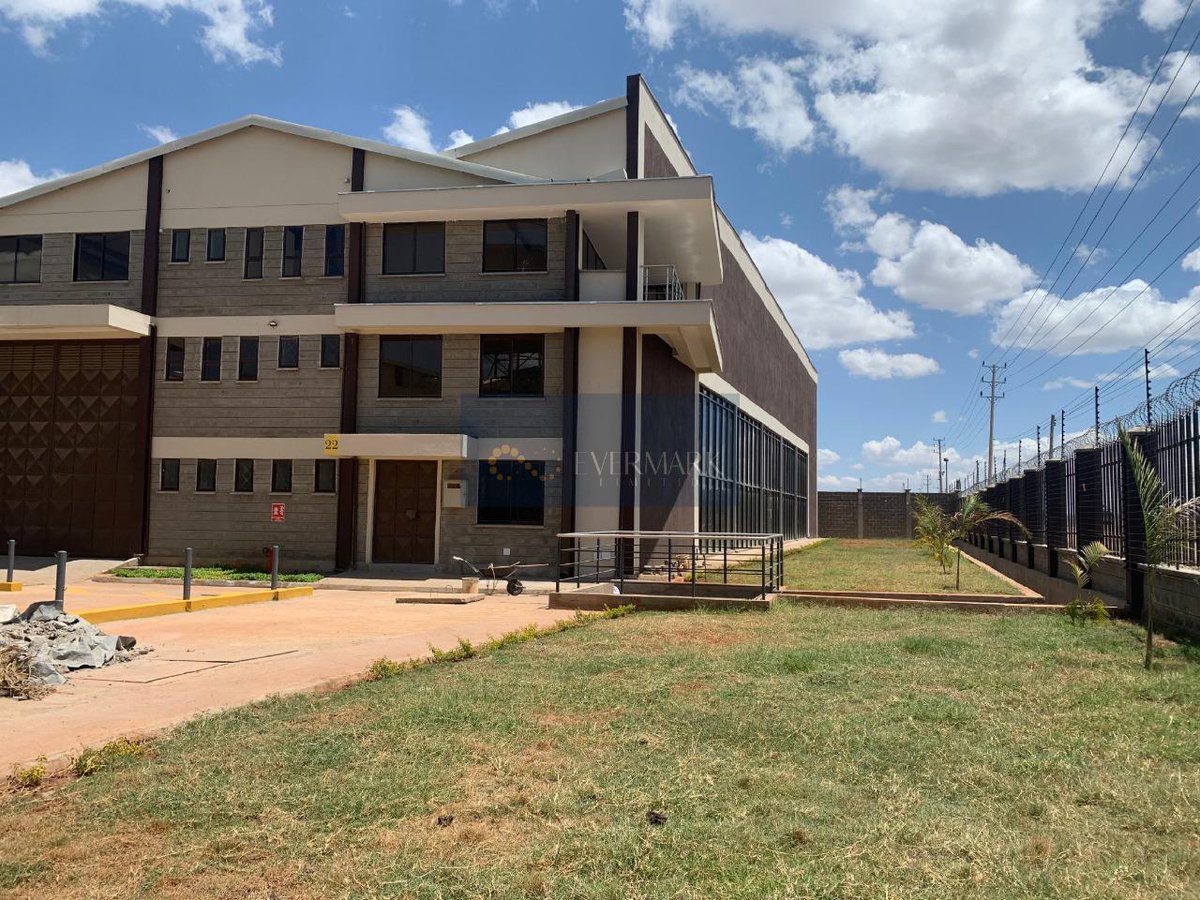
GODOWNS FOR RENT OPPOSITE STEEL PLANT ATHIRIVER.ADJACENT TO MOMBASA ROAD CALL JOB ON 0737916960
Features & Amenities:
•10m clear height at apex, large gates to access each warehouse
•Insulated roofs, clear sheets to enhance natural lighting and cyclones for good ventilation
🚨 The Court of Appeal has ruled that you cannot deny a contract exists and then use that same contract against the other side. Here is the case that shut down a seller trying to have it both ways, and the constitutional idea behind it.
In Al Husnain Motors Ltd v Joseph Matagaro Michira, decided on 31 July 2026, the Court of Appeal confronted a party trying to have it both ways, denying a contract existed while relying on it to allege breach. Beneath the ruling lies a constitutional idea about what a fair hearing actually requires. Here is what it decided. 🧵
🚨🔥 YOUR FAMILY CAN LIVE ON LAND FOR YEARS - THEN ONE DAY A COURT CAN ORDER IT BACK TO SOMEONE ELSE
The Environment and Land Court has delivered a serious reminder to anyone who owns, occupies or has inherited land: a title deed alone may not end the story. In Mildred Akoth Warrakah v Mwafumbiri Mwatsami, a woman sued to evict a family from a 16-hectare parcel in Kwale, relying on a title registered in her late husband’s name after an alleged bank auction. The family fought back, insisting that the land had belonged to their late father, who had lived on and developed it for years, and that the alleged loan, charge and auction used to transfer the land were fraudulent and unlawful. The question before the Court was simple but explosive: could the registered owner lawfully evict a family if the process through which the land was sold was never properly followed?
The Court said NO. Although the Court found the underlying charge valid, it found no evidence that the required statutory notices had been served before the alleged sale. There was also no evidence of a proper auction advertisement, no proof that the land was actually sold by public auction, and no evidence that it had been valued before the alleged sale. The Court found the sale process “shrouded in secrecy” and declared it irregular. The Plaintiff’s case was dismissed, while the family’s counterclaim succeeded. The Court ordered the land to revert to Abdallah Mwamtsame Ali Chuii and issued a permanent injunction protecting the property from interference by the Plaintiff and those claiming through her.
This is the part every mwananchi must remember: land disputes are not always about who has the title deed in their hands today - they can become a fight over what happened before that title was issued. A family can farm land for decades. A buyer can pay millions for a property. An heir can inherit a title. Yet if the transaction that created the title was fundamentally unlawful, the consequences can come years later. If you are buying land, inheriting land, occupying ancestral land, or dealing with land acquired through a bank auction, do not wait for a dispute to teach you the history of that property. Find out now. Because sometimes, the most expensive land document is the one nobody bothered to investigate. 🔥
Please retweet widely, save a friend.
@georgediano@NelsonHavi@joshuamalidzo@MarthaKarua@Thuranira_1
Dear @KRACorporate
I don't like suits. I just wear them because the Advocates dress code has already made that decision for me. As an Advocate of the High Court and a tax consultant, a suit is a licensed equipment. Buying one is painful. Maintaining one is a recurring expense. Dry cleaners know me better than some relatives.
Now, the tax lawyer in me has been musing. The Income Tax Act says expenditure incurred wholly and exclusively in the production of income is deductible. I would say buying and maintaining a suit qualifies as expenditure incurred wholly and exclusively in the production of a lawyer's income I don't wear suits to weddings, I wear them to earn a living. They are compulsory. I can argue that they generate income. Since advocates can't plaster their faces on billboards, isn't a well-tailored suit technically my marketing budget? Clients see the suit before they interact with my services.
So now, can I claim the laundry expenses as business expenses? And since purchase of suits can be "capital in nature", maybe we can lobby to amend the Act to allow us to claim investment allowance on the purchase costs.
In our industry, our wardrobe is actually in the same class as plant and machinery. They are not just clothes. They are income generating assets with a fabric finish.
Can a litigant simply blame their advocate for filing an appeal out of time?
The Court of Appeal's answer in Chemben & 92 Others v Kenya Revenue Authority (Civil Appeal E267 of 2020) [2026] KECA 1535 (KLR) is a firm no.
The Court held that while mistakes by counsel may occur, a litigant has a corresponding duty to remain vigilant and actively follow up on the progress of their case.
Simply alleging that an advocate failed to communicate the outcome of proceedings, without demonstrating any effort to monitor the matter, is not a satisfactory explanation for delay.
Average loan interest rates by top banks in Kenya (June 2026):
StanChart Kenya — 11.5%
Stanbic Kenya — 11.5%
HFC Limited — 13%
Absa Kenya — 13.5%
DTB Kenya — 14%
I&M Bank — 14%
Equity Bank — 14.8%
KCB Bank — 14.9%
Co-op Bank — 15%
NCBA Bank — 15.2%
Sidian Bank — 15.2%
Family Bank — 16%
SBM Bank — 17%
Credit Bank — 19%
CBK data.
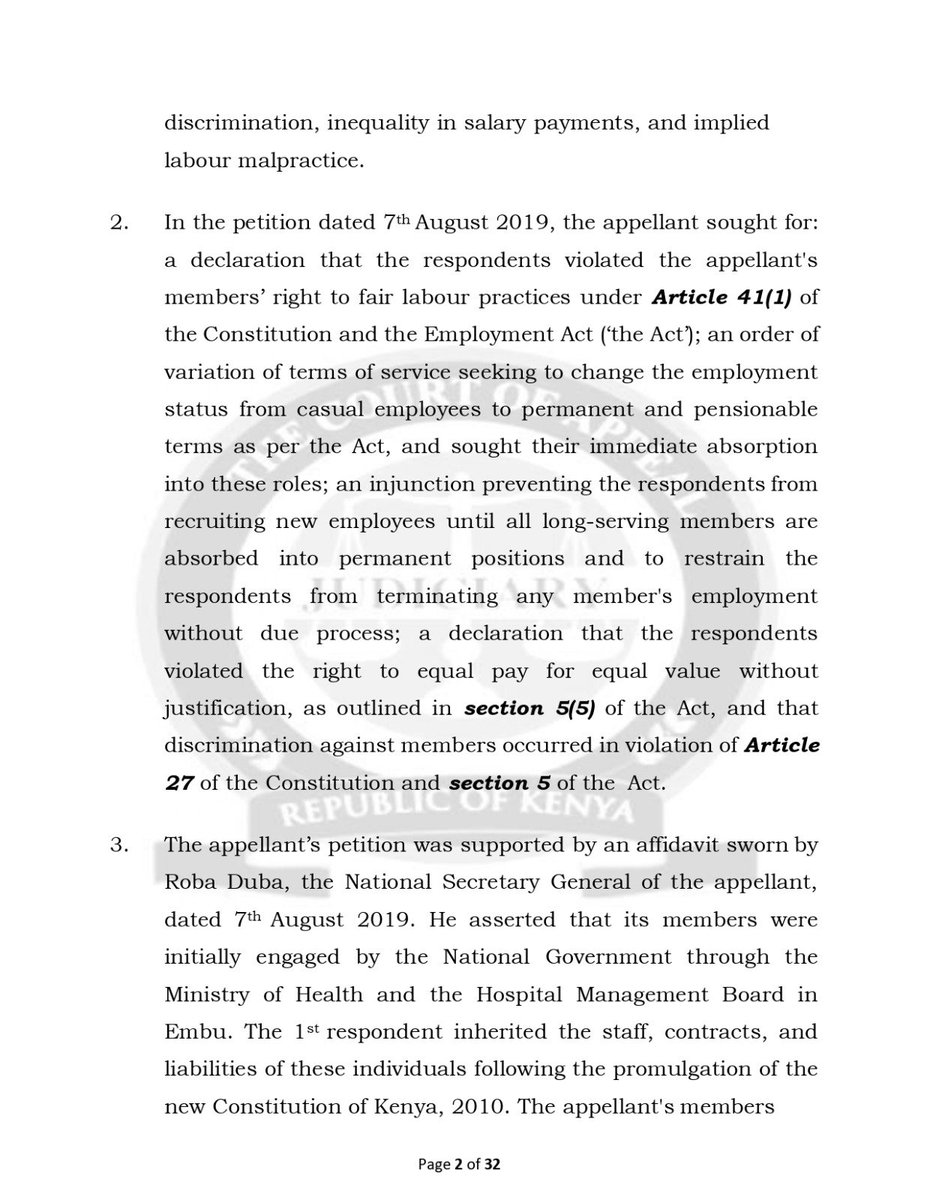
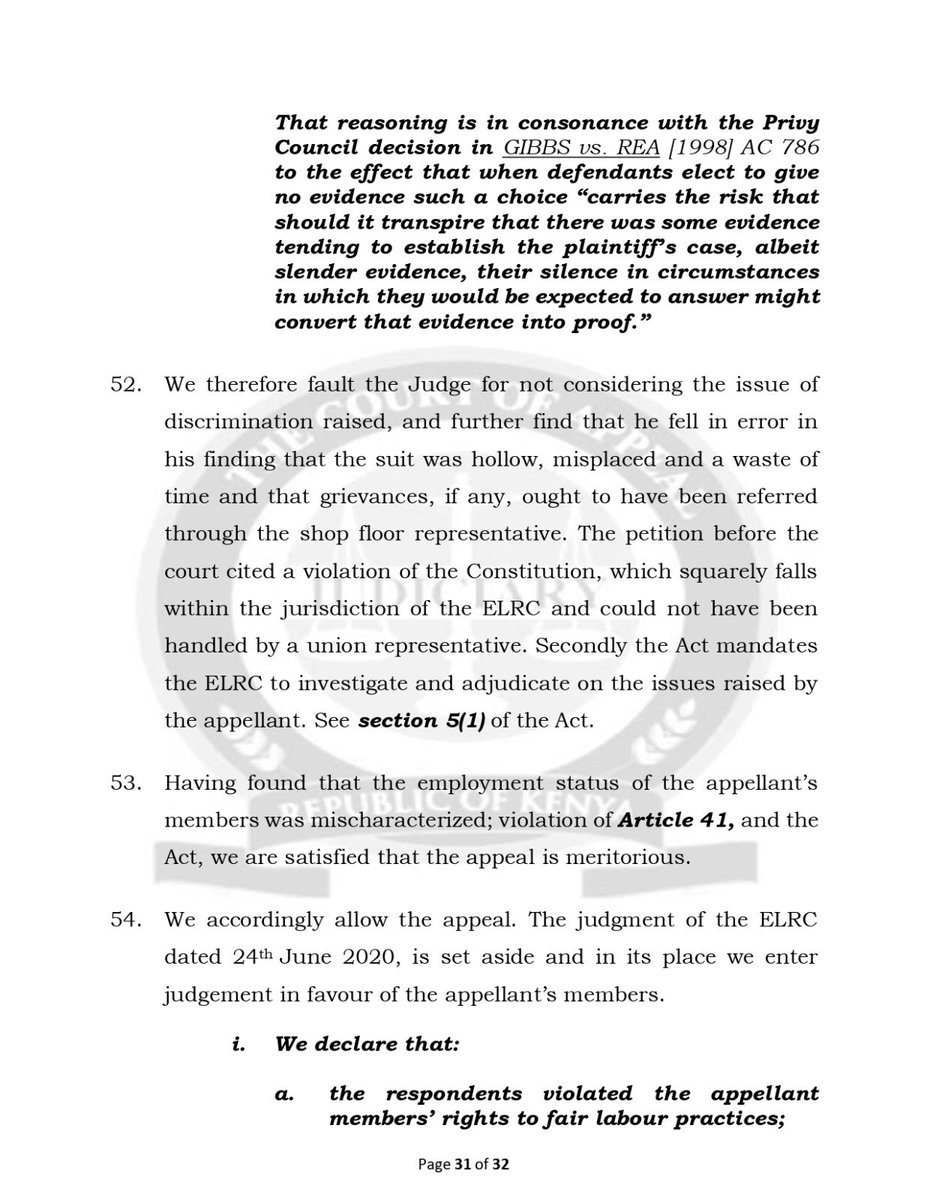
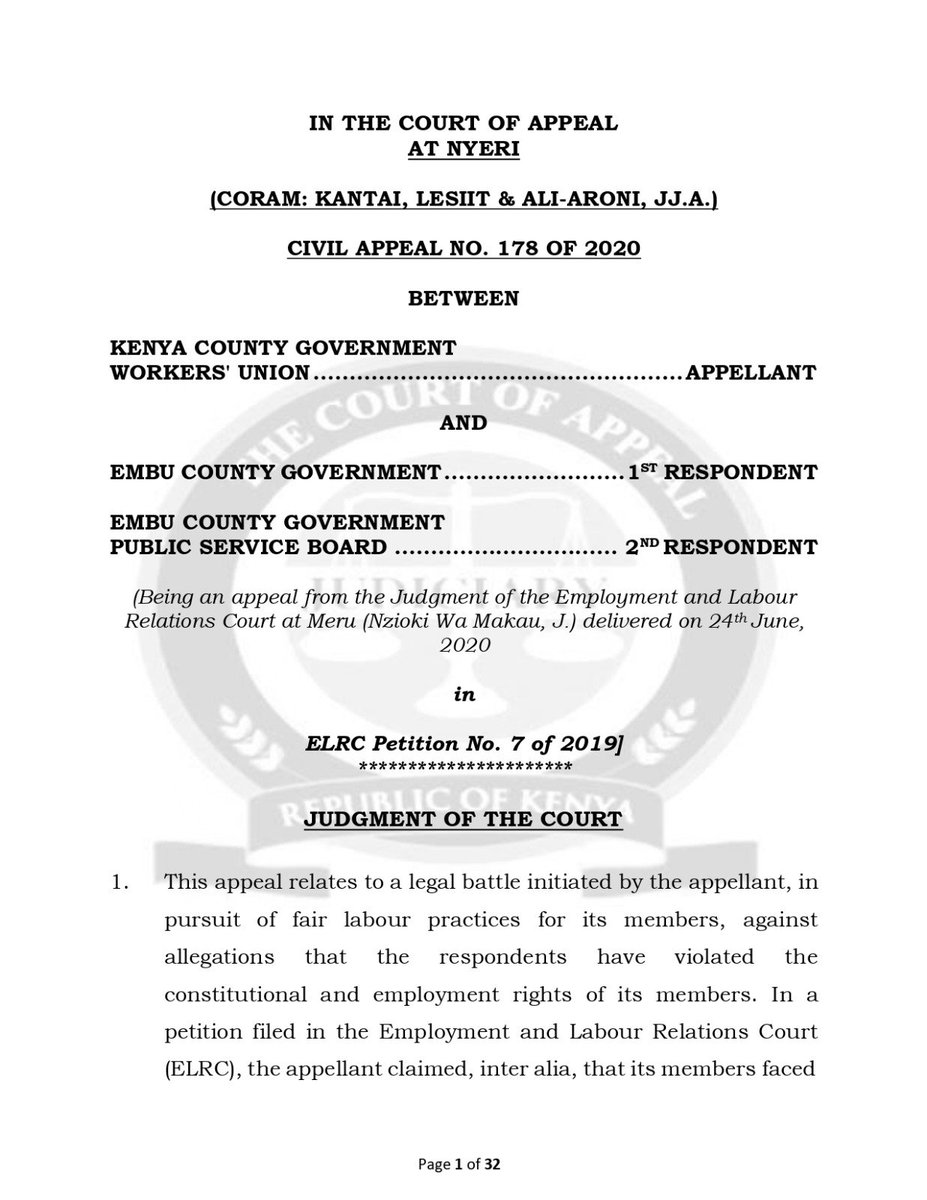
The Court of Appeal had held thay You can't keep someone working for years, call them a casual and then deny them permanent employment rights.
The Court of Appeal has made it clear, the law looks at the reality of the job, not the label on the contract.
If you're doing permanent work on endless short-term or "casual" contracts, you may already be entitled to the rights of a permanent employee.
The era of exploiting workers through fake casual contracts has come to an end.
🔴 ELC REAFFIRMS: YOU CAN BUY LAND, NEVER RECEIVE A TITLE DEED, YET STILL BECOME ITS LAWFUL OWNER DECADES LATER.
That is the powerful principle emerging from the Environment and Land Court's decision in Veronica Wairimu Mburu (Suing as the Personal Representative of the Estate of James Edward Mburu) v David Gatehi Thuo & Another (2024). In 1986, James Edward Mburu purchased a parcel of land in Ruiru, took possession immediately and began cultivating it. The seller vanished before completing the transfer, leaving the title unprocessed. Years later, another company mysteriously found its way onto the register as the proprietor despite never setting foot on the land. For nearly thirty-nine years, the Mburu family remained in open, peaceful and exclusive occupation, farming maize and beans season after season while the registered owners did absolutely nothing to assert their rights. After Mburu's death, his widow moved to court, not to enforce the forgotten sale agreement, but to claim the land through the doctrine of adverse possession.
The Court did far more than simply repeat the settled principles of adverse possession. It made a significant jurisprudential clarification on when possession under a sale agreement transforms into adverse possession. Traditionally, entry pursuant to a sale agreement is permissive because the purchaser enters with the vendor's consent. However, the Court held that such permission is not eternal. Once the vendor fails to complete the transaction and abandons the obligation to transfer title, the purchaser's occupation ceases to be permissive and becomes adverse. Drawing from Chandrakant Devraj Shah v Alibhai Haji, the English House of Lords decision in J.A. Pye (Oxford) Ltd v Graham, and the Supreme Court's landmark decision in Willy Kimutai Kitilit v Michael Kibet, the Court harmonised the law of contract, limitation and land registration, holding that an incomplete sale can ultimately mature into ownership by prescription where the purchaser continues occupying the land as owner for the statutory period. In other words, the law will not allow a vendor who has slept on his obligations for decades to hide behind an untransferred title deed.
The judgment also delivers a timely constitutional reminder to registered landowners. The Court emphatically rejected the notion that Article 40 of the Constitution offers perpetual protection to an owner who abandons land for decades. While title remains the strongest evidence of ownership, it is not immune from the Limitation of Actions Act. A proprietor who neglects to recover possession within twelve years risks losing not merely the right to sue, but the title itself. Consequently, the Court declared that Denko Properties Ltd's registered title had been extinguished by operation of law, ordered the Land Registrar to cancel its registration, and directed that the property be registered in the name of the Estate of James Edward Mburu. The decision serves as a stark reminder that Kenyan land law protects those who vigilantly assert their rights - not those who abandon them and later expect a title deed alone to resurrect ownership.
Please repost widely🙏
One parent cannot set a higher financial burden on another parent, without consulting them. Parents should make decisions together and be fair to each other.
https://t.co/rWGwPftgBu
Dear Law Students,
I hope you are not at the Summertides Festival in Malindi. 😂
The Supreme Court has delivered judgments and rulings today. See media summaries for an easier read.
https://t.co/HGgFnbiTRM
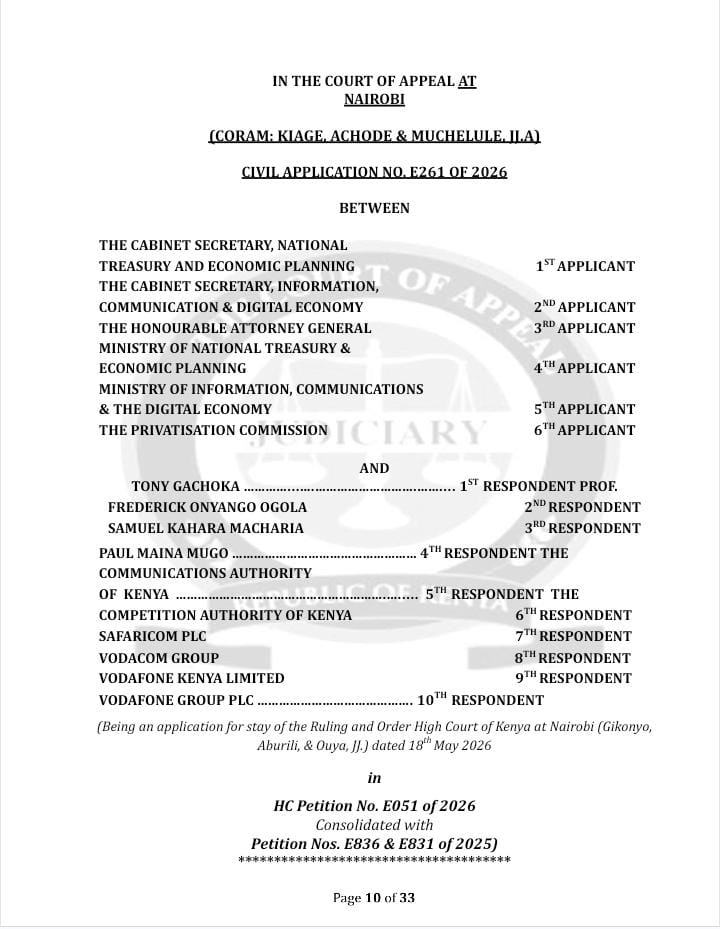
In Cabinet Secretary, National Treasury & 5 Others v Tony Gachoka & 9 Others**, **Civil Application No. E261 of 2026, the Court of Appeal held that conservatory orders are not immune from appellate intervention.
Where an interlocutory conservatory order occasions demonstrable prejudice to the public interest, including substantial fiscal and economic consequences, the Court may stay it under Rule 5(2)(b).
Kenya's Nairobi International Financial Centre has certified 15 companies expected to bring in over Sh26 billion in investment and create more than 1,000 jobs.
The certified companies are:
— Bupa Global Insurance
— Etica Capital
— Giraffe Bioenergy
— Valr Capital
— ReportsAI
— Afrex Technologies
— Onfon Mobile
— JPH Investments
— Nairobi Pesa City
— Mzizi Court
— Uhuru Heights
— Zurit Consulting
— Assnture Afrique
— BoC Technologies
— Africa First Exchange (A1X)
Japan has confirmed that construction of the Sh85 billion Mombasa Gate Bridge will begin under its Official Development Assistance programme.
The 1.4km bridge will replace the Likoni Ferry with a permanent four-lane road link connecting Mombasa Island and the South Coast
Yesterday on behalf of a client we filed the first Marex tort claim in Kenya. We filed a suit for Kshs 5.7 billion (about US$ 45 million) against a leading commercial bank in the East African region. The Marex tort was developed by the English Supreme Court and states that where a third party gatecrashes into a suit between the parties at the stage of executing a decree and tries to help the judgment debtor delay or escape execution, the decree holder has a claim for damages againt the said gatecrasher. The Marex tort insulates the court decree againt "sponsored, mercenaries and robbers barons" hired by the judgment debtor to defeat the decree issued by court.
Imagine buying property worth 110Million in public Auction,getting the property transferred in your name but then Court declares the Auction was Illegal and your title is cancelled! This is the Case of KUDHEIHA V TEA HOTELS LIMITED
⚖️ The Bench Speaks 📜
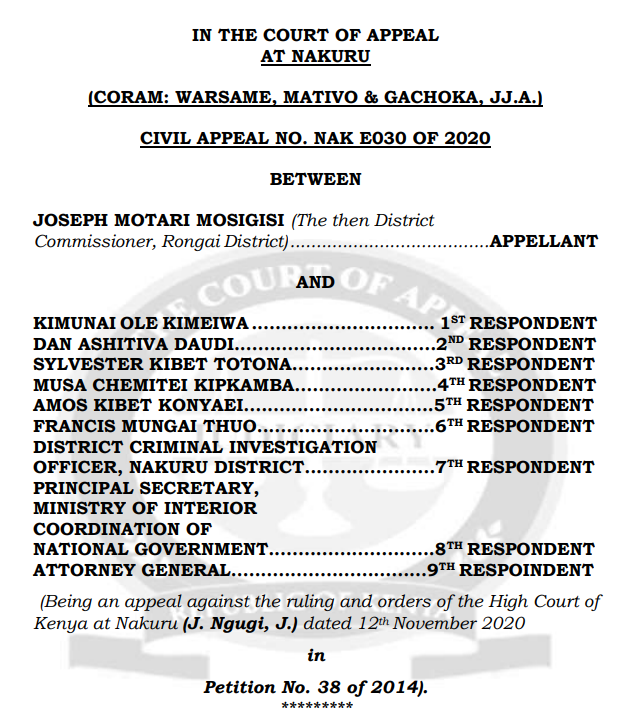
The Court of Appeal affirms High Court decision that Public officers on a "frolic of their own" cannot hide behind Govt immunity. A former District Commissioner just lost his bid to escape personal liability for malicious prosecution. The message? State power is not a weapon for political scores. Impunity loses. Accountability wins.
CIVIL APPEAL NO. NAK E030 OF 2020 JOSEPH MOTARI MOSIGISI (The then District Commissioner, Rongai District) Vs KIMUNAI OLE KIMEIWA and 8 others
https://t.co/vuwSVL3Sk4
@Kenyajudiciary@jsckenya@KMJA_KENYA@lawsocietykenya
“As lawyers, we have been taught that every case must produce a winner, a loser, and a fee note. But that’s not always the case. Sometimes it’s about being heard, it’s about healing, or dignity” Justice (Prof.) Joel Ngugi, JA.







![OduorACaroline's tweet photo. Can a litigant simply blame their advocate for filing an appeal out of time?
The Court of Appeal's answer in Chemben & 92 Others v Kenya Revenue Authority (Civil Appeal E267 of 2020) [2026] KECA 1535 (KLR) is a firm no.
The Court held that while mistakes by counsel may occur, a litigant has a corresponding duty to remain vigilant and actively follow up on the progress of their case.
Simply alleging that an advocate failed to communicate the outcome of proceedings, without demonstrating any effort to monitor the matter, is not a satisfactory explanation for delay.](https://pbs.twimg.com/media/HOzCvRoXEAEbnlN.jpg)
![OduorACaroline's tweet photo. Can a litigant simply blame their advocate for filing an appeal out of time?
The Court of Appeal's answer in Chemben & 92 Others v Kenya Revenue Authority (Civil Appeal E267 of 2020) [2026] KECA 1535 (KLR) is a firm no.
The Court held that while mistakes by counsel may occur, a litigant has a corresponding duty to remain vigilant and actively follow up on the progress of their case.
Simply alleging that an advocate failed to communicate the outcome of proceedings, without demonstrating any effort to monitor the matter, is not a satisfactory explanation for delay.](https://pbs.twimg.com/media/HOzCtpSXsAAj6sy.jpg)
![OduorACaroline's tweet photo. Can a litigant simply blame their advocate for filing an appeal out of time?
The Court of Appeal's answer in Chemben & 92 Others v Kenya Revenue Authority (Civil Appeal E267 of 2020) [2026] KECA 1535 (KLR) is a firm no.
The Court held that while mistakes by counsel may occur, a litigant has a corresponding duty to remain vigilant and actively follow up on the progress of their case.
Simply alleging that an advocate failed to communicate the outcome of proceedings, without demonstrating any effort to monitor the matter, is not a satisfactory explanation for delay.](https://pbs.twimg.com/media/HOzCrgRWsAAzXuK.jpg)






![OduorACaroline's tweet photo. Can a litigant simply blame their advocate for filing an appeal out of time?
The Court of Appeal's answer in Chemben & 92 Others v Kenya Revenue Authority (Civil Appeal E267 of 2020) [2026] KECA 1535 (KLR) is a firm no.
The Court held that while mistakes by counsel may occur, a litigant has a corresponding duty to remain vigilant and actively follow up on the progress of their case.
Simply alleging that an advocate failed to communicate the outcome of proceedings, without demonstrating any effort to monitor the matter, is not a satisfactory explanation for delay.](https://pbs.twimg.com/media/HOzCwhgXMAAw4Fb.jpg)