Son tiempos duros y peligrosos. De lucha e incertidumbre...
PERO LA VIDA ES BELLA Y SAGRADA
Abogo por un mundo multipolar, que se desarrolle en armonía y paz.
ODESSA AYER... ODESSA HOY
-Dos de mayo de 2014: los neonazis ucranianos incendian la casa de los sindicatos para quemar vivos a los prorusos que se refugiaban allí
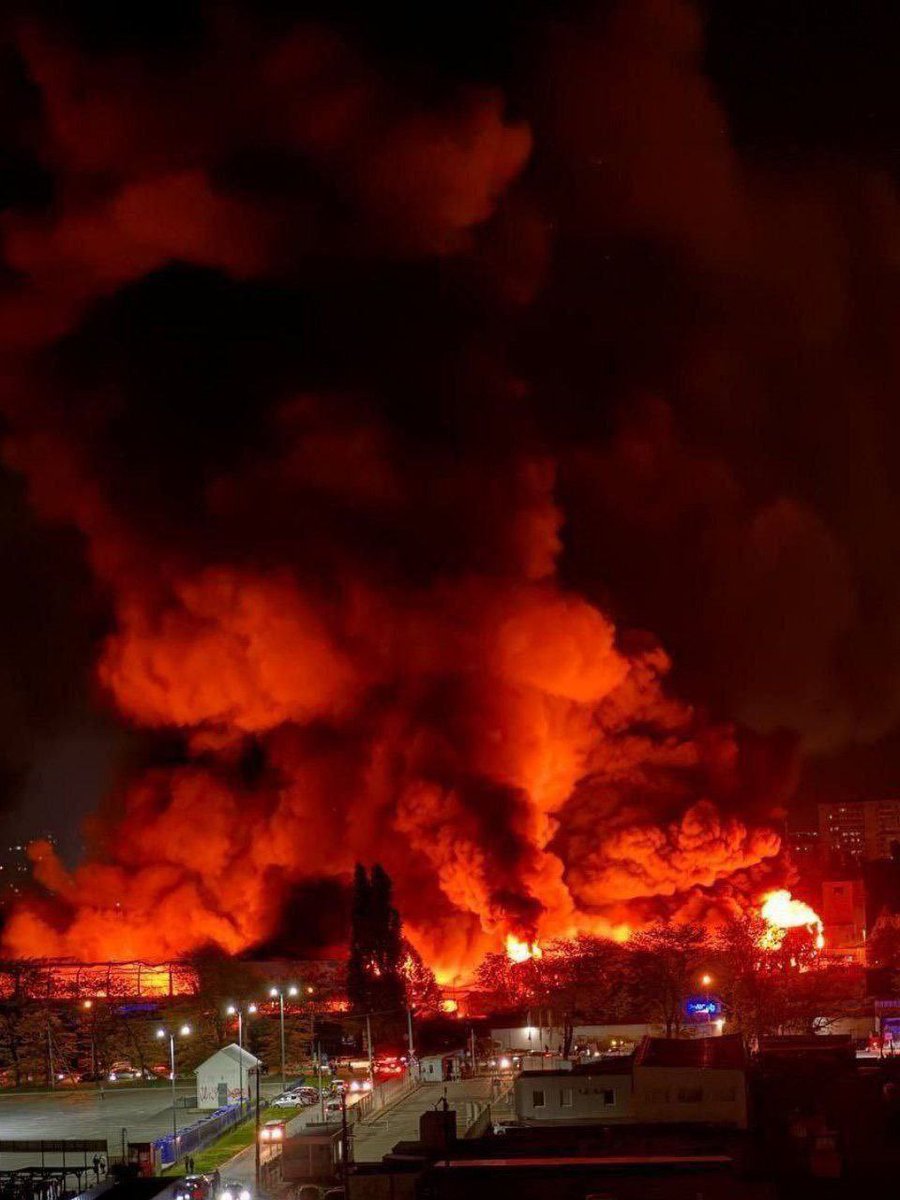
-Dos de mayo de 2024: Los rusos bombardean a los neonazis ucranianos en Odessa
Acción y reacción...
Tony Pabon - La Mentira / Yellow Days 🎵
Se te olvida
Que me quieres a pesar de lo que dices
Pues llevamos, en el alma, cicatrices
Imposibles de borrar
Se te olvida
Que hasta puedo hacerte mal si me decido
Pues tu amor lo tengo muy comprometido
Pero, a fuerzas, no será
Rolando Laserie – Sabor a Mí🎵
Tanto tiempo disfrutamos de este amor
Nuestras almas se acercaron
tanto así
Que yo guardo tu sabor
Pero tú llevas también
Sabor a mí
Si negara mi presencia en tu vivir
Bastaría con abrazarte y conversar
Tanta vida yo te di
Que por fuerza tienes ya
Concerto in C major for Mandolin, RV 425 is among the most distinctive works that Antonio Vivaldi composed for the mandolin. Written in the early years of the eighteenth century, the piece follows the familiar three-movement structure of the Baroque concerto: fast – slow – fast (Allegro – Largo – Allegro). The performance featured in the recording is given by mandolinist Avi Avital with the Venice Baroque Orchestra, an ensemble renowned for its use of period instruments and historically informed approach. This manner of interpretation brings out the bright, clear tone of the mandolin and the refined balance between solo instrument and string ensemble. Though modest in scale and without ostentatious display, the concerto reveals Vivaldi’s gift for transforming an instrument of delicate voice into the living centre of a vibrant musical whole. To understand why the work has retained its appeal after more than three centuries, one must begin with its most concrete musical details.
What strikes the listener from the opening bars of the first movement is not virtuosic passagework. Rather, it is the way the mandolin enters. Unlike the violin, which can sustain a note with the bow, the mandolin produces sound by plucking the strings; each note sounds and quickly fades into silence. Vivaldi does not seek to conceal this characteristic or to make the mandolin imitate the violin. Instead, he writes short, bright and supple phrases that allow the very nature of the instrument to become the source of its beauty.
The string ensemble, for its part, does not overwhelm the mandolin. It provides a transparent harmonic foundation upon which the solo voice emerges with clarity and lightness. Brief motifs follow one another in continuous succession. As one phrase closes, another opens. The music moves constantly, yet never with any sense of haste.
In the central Largo, the character of the work changes. The tempo broadens. The strings sustain long, stable chords while the mandolin unfolds simple, lyrical phrases that approach the quality of the human voice. What is particularly noteworthy is that Vivaldi makes no attempt to enlarge the mandolin’s natural sound beyond its proper limits. He allows the very fragility of each note to become the means of expression. Each tone appears and quietly dissolves. Precisely because there is no striving to prolong or display, the listener attends more closely to the refined beauty of every moment.
In the final Allegro, the concerto’s vitality returns. Short motifs pass continually between mandolin and strings. The tempo is brisk, yet the texture remains lucid. The music is full of energy, but preserves its equilibrium. There is no impression of a soloist striving to dominate the ensemble. The mandolin and strings engage rather in a lively dialogue, each voice contributing to the forward momentum of the whole.
At a deeper level, the concerto rests upon a consistent principle. Vivaldi does not create beauty by making all elements alike. He allows each part to retain its own character. The mandolin remains the mandolin; the strings remain the strings. Neither abandons its nature in order to merge with the other. It is precisely this difference that makes dialogue possible. Whenever a motif passes from strings to mandolin, or from mandolin back to strings, the listener senses the natural continuation of a single musical idea. What binds the parts together is not uniformity, but the shared service of every voice to one unified current of motion.
The listener’s experience therefore shifts gradually. At first, attention may rest upon the mandolin as the central figure. Yet the longer one listens, the less the ear focuses on any single instrument. What becomes apparent is the constant interplay: each part listening, responding, and supporting the others. The music thus creates a thoroughly natural impression: no voice is superfluous, and no voice exists merely for itself. The entire concerto resembles a living stream in which every element finds its proper place.
At a still broader level, the work reflects a principle familiar in human life. In any family, community or society, each person possesses particular gifts and responsibilities. The teacher imparts knowledge, the farmer produces sustenance, the builder raises dwellings, the physician tends the sick. The strength of a community lies not in all performing the same task, but in each fulfilling his or her own role and contributing to the common life. It is difference placed within a shared purpose that creates a lasting whole.
Concerto RV 425 evokes precisely this principle. The mandolin does not seek to become the string ensemble, nor do the strings overshadow the mandolin. Each part realises its own capacities while listening to and supporting the rest. In this way the work achieves richness without sacrificing unity.
At its deepest level, the concerto points to a universal law of natural order. In those enduring structures of nature, unity is not achieved by erasing difference. It arises when each element performs its proper function within a common order. Thanks to this law, variety does not lead to chaos, nor does unity descend into monotony.
Concerto RV 425 is built upon precisely this principle. The mandolin does not lose its identity in the orchestra, nor does the orchestra impose its power upon the solo voice. Each part remains true to its place, while all are directed towards the unity of the complete work. It is perhaps because it reflects so fundamental a law that the concerto retains its vitality more than three centuries after its creation.
From December:
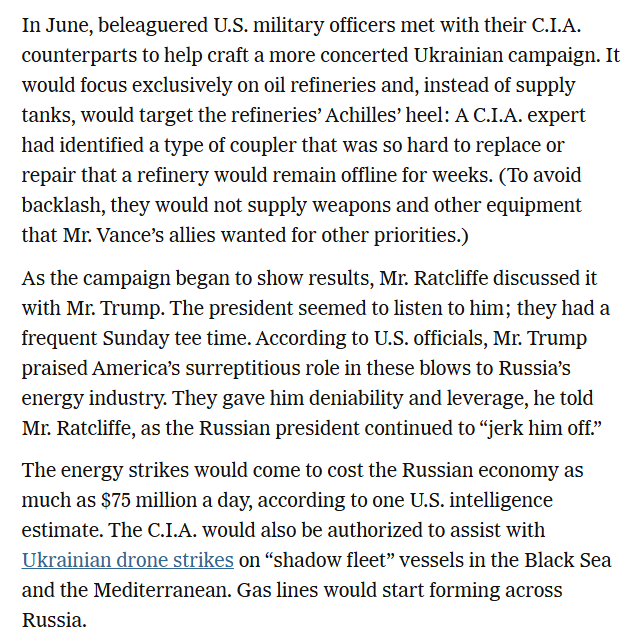
"But in secret, the Central Intelligence Agency and the U.S. military, with his blessing, supercharged a Ukrainian campaign of drone strikes on Russian oil facilities and tankers to hobble Mr. Putin’s war machine...
As the campaign began to show results, Mr. Ratcliffe discussed it with Mr. Trump. The president seemed to listen to him; they had a frequent Sunday tee time. According to U.S. officials, Mr. Trump praised America’s surreptitious role in these blows to Russia’s energy industry. They gave him deniability and leverage, he told Mr. Ratcliffe, as the Russian president continued to “jerk him off.”
The energy strikes would come to cost the Russian economy as much as $75 million a day, according to one U.S. intelligence estimate. The C.I.A. would also be authorized to assist with Ukrainian drone strikes on “shadow fleet” vessels in the Black Sea and the Mediterranean. Gas lines would start forming across Russia."
https://t.co/zdxtFzrg3d
CUMBRE OTAN
"🇪🇺consiguió lo que quería: la diplomacia está muerta y ahora esta es la guerra de Trump. ¿Cómo luchar y derrotar a la mayor potencia nuclear del mundo en una lucha por su supervivencia? Ahora veremos una escalada masiva mientras nos dirigimos hacia una guerra total"
The NATO Summit reads like a declaration of war. The Europeans got what they wanted: diplomacy is dead & this is now Trump's war. How to fight and defeat the world's largest nuclear power in a fight for its survival? We will now see massive escalation as we move toward total war
🇨🇳 Sobre la estrategia asiática de acumular oro físico real como base de un nuevo sistema de colateral fuera del dólar 👇
Gregor Gregersen, miembro de comités de bancos centrales en Singapur y Hong Kong, explica que mientras China importa masivamente oro por canales OTC, hasta 4 veces las cifras oficiales reportadas y lo retiene dentro del país creando un “agujero negro” de metal físico, Singapur y Hong Kong construyen hubs regulados que permiten usar ese oro como garantía directa para préstamos, manteniendo la titularidad clara del dueño y ofreciendo tasas de interés significativamente más bajas.
El contraste clave es con el sistema occidental de oro papel, con el COMEX y la LBMA, donde el mismo metal se rehipoteca hasta 30-60 veces.
Gregersen dice que cuando se rompa la confianza en el dólar, solo el oro físico con propiedad real y colateral funcional en jurisdicciones asiáticas seguirá operando como respaldo efectivo.
Al final, Asia está preparando silenciosamente el “sistema de respaldo” para el mundo post-dólar, mientras Occidente sigue multiplicando promesas de papel.
🇷🇺 Vladimir Putin:
Bir keresinde Jacques Chirac'a, "Amerikan liderliği neden böyle davranıyor; neden bu kadar saldırgan ve bazı durumlarda bu kadar dar görüşlü?" diye sordum.
Bana Rusça şu cevabı verdi:
"Çünkü onlar kültürsüz insanlar."
⚡️🇪🇺🇷🇺"Deja de afirmar que Ucrania está escalando esta guerra. Ucrania no está llevando la guerra a Moscú. Europa lo está haciendo.
Europa está llevando la guerra a Moscú, y muy pronto, Moscú se verá obligada a responder. Una vez que se agote nuestra paciencia angelical..."⌛️😎
Stop claiming Ukraine is escalating this war. Ukraine isn't bringing the war to Moscow. Europe is.
Europe is bringing the war to Moscow, and very soon, Moscow will be forced to respond.
Once our angelic patience runs out, and we are left with no choice, we will be at war with you too — just as you have been at war with us for at least five years.
Watch full here: https://t.co/wxkCX3neHE
"¿Quién mi*rda eres tú para darme lecciones?"
La directora del grupo RT, Margarita Simonián, cita las palabras del canciller ruso, Serguéi Lavrov, al responder a las críticas occidentales hacia RT.
‼️🇨🇴El pastor cristiano, jaime andres beltrán, destituido por corrupto como alcalde de Bucaramanga, por robarse partes del alumbrado público por un valor de 40 mil millones, junto con su cuñado, es hoy el flamante nuevo ministro de vivienda de la "patria milagro". Siguen apareciendo los "nunca". 🙏
Temas para investigar cuando te aburres:
-La teoría de cuerdas
-La materia oscura
-Las Analectas de Confucio
-La paradoja de Fermi
-El entrelazamiento cuántico
-La dilatación del tiempo y la relatividad
-El transhumanismo
-Civilizaciones perdidas y mitos
-El sesgo político en la cartografía
-La bioluminiscencia
-Los movimientos de arte urbano
-Las leyendas de los hombres lobo en Europa
-El Manuscrito de Voynich
-Los niños verdes de Woolpit
-Los 3 principios básicos de https://t.co/ufRXdkADPg
@mariamulatas@MariaAlejaVM No te dejes limitar por la ideología feminista, que explica todos los problemas del mundo con el "patriarcado".
La política/actores políticos, la lucha por el poder y/o las transformaciones sociales, la defensa del statu quo imperial (🇺🇸) o la utopía no es solo testosterona...
Obviamente, @MariaAlejaVM no es "Petrista"; talvez tampoco Uribista; mucho menos "clase popular".
Pero es una persona que vive, lucha, trabaja y trata de salir adelante en este país; como la mayoría de los petristas, uribistas y sufragantes abelardistas.
¿Caminaremos juntos?