Professional Historian | Specialist in the British Empire and the legacy of Christianity within it. Exploring power, belief, and the stories we inherit.
At first light on 6 June 1944, thousands of young men stepped from landing craft into the surf of Normandy and into the defining moment of the war. Under fire on Utah, Omaha, Gold, Juno and Sword, they pushed forward through chaos, fear and unimaginable resistance. Many fell; others kept moving, driven by duty and by one another.
Their courage cracked open the door to Europe’s liberation. Today we honour them not as distant figures but as men who walked into danger so others could live in freedom. Their sacrifice still shapes the world we inherit.
Lest we forget.
@Keir_Starmer In your spare time you hounded British soldiers. You have absolutely no right to speak about our armed forces or our history. You are a traitorous piece of shit.
D‑Day: The Beginning of the End, Not the End Itself. On 6 June 1944, Allied forces stormed ashore in Normandy in the largest amphibious assault ever attempted. It was a day of immense courage and consequence, but it was not the moment Nazi Germany was defeated. It was the moment the Allies finally secured a foothold from which they could begin the real work: destroying the German armies in France. The fighting that followed was far harder and far longer than the landings themselves. For seven brutal weeks, British, Canadian, and American troops battled through the bocage, a maze of hedgerows and sunken lanes that favoured the defenders. The decisive shift came only in late July, when the American breakout at Saint‑Lô triggered a rapid, cascading German collapse.
In the space of roughly 100 days, the Allies advanced from five fragile beachheads to the borders of the Reich. The Falaise Pocket shattered the German Seventh Army. Paris was liberated on 25 August. Brussels and Antwerp fell in early September. By 11 September, just 97 days after D‑Day, U.S. troops were across the German frontier. This was the true strategic victory of 1944: not the landings themselves, but the destruction of Germany’s western field armies and the liberation of France and Belgium.
D‑Day opened the door. The hundred days that followed forced it off its hinges.
They shall grow not old, as we that are left grow old:
Age shall not weary them, nor the years condemn.
At the going down of the sun and in the morning
We will remember them.
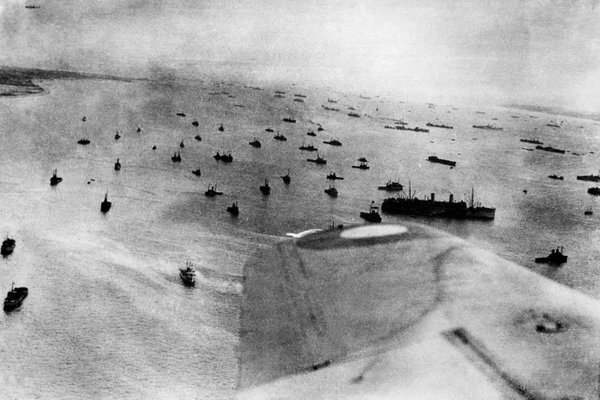
At sea, long before the first soldiers stepped onto the beaches of Normandy, the Royal Navy was already fighting the opening battle of D‑Day. Its role was vast, complex and indispensable: without the Navy, there would have been no landings, no foothold in France, and no Operation Overlord at all.
The Royal Navy assembled and commanded the largest invasion fleet in history, more than 6,000 vessels ranging from battleships and cruisers to minesweepers, landing craft and merchant ships. In the hours before dawn, British minesweepers cleared safe channels across the Channel, silently carving paths through waters seeded with explosives. Behind them came the assault convoys, shepherded by destroyers and escorts that guarded against U‑boats and fast German E‑boats.
As the first landing craft approached Gold Beach and Sword Beach, the Navy opened fire. Battleships like HMS Warspite and cruisers such as HMS Belfast unleashed bombardments that smashed coastal batteries and strongpoints, giving the assault troops a fighting chance. Naval gunfire support continued throughout the day, responding to urgent calls from units pinned down on the beaches or struggling to advance inland.
The Navy’s work did not end with the landings. Sailors hauled wounded men aboard under fire, towed damaged craft to safety, and kept the supply lines flowing as the beachhead expanded. They also protected the construction of the Mulberry Harbours, the artificial ports that allowed the Allies to pour men and equipment into France at unprecedented speed.
D‑Day was a joint endeavour, but the Royal Navy was its backbone. It carried the armies across the sea, shielded them from attack, and delivered the firepower that broke open Hitler’s Atlantic Wall.
Today, as we honour those who fought, we remember the sailors who faced the Channel’s dangers so that the liberation of Europe could begin.
On 6 June 1944, the Allied powers launched Operation Overlord, the largest amphibious invasion in military history and a decisive turning point in the Second World War. Its objective was clear: establish a secure foothold in Nazi‑occupied France, open a Western front, and accelerate the collapse of the Third Reich. The operation represented the culmination of years of planning, inter‑Allied negotiation, and technological innovation, from specialised landing craft to the development of artificial Mulberry harbours.
The landings took place across five designated sectors, Utah, Omaha, Gold, Juno and Sword, supported by extensive airborne operations designed to disrupt German communications and secure key terrain. Despite formidable coastal defences, adverse weather, and significant casualties, particularly at Omaha Beach, the Allies succeeded in establishing a continuous beachhead by nightfall. The landings took place across five designated sectors, Utah, Omaha, Gold, Juno and Sword, supported by extensive airborne operations designed to disrupt German communications and secure key terrain. Despite formidable coastal defences, adverse weather, and significant casualties, particularly at Omaha Beach, the Allies succeeded in establishing a continuous beachhead by nightfall. This achievement enabled the rapid build‑up of men and materiel that would ultimately liberate France and shift the strategic balance irreversibly in the Allies’ favour.
Last weekend I had the privilege of attending the Major General's review of Trooping the Colour. It was an absolute honour to watch the Household Division rehearsing. 💂🏼♂️ 🇬🇧
Churchill greeted Eisenhower’s quiet, decisive words, “Alright, let’s go”, with a mixture of resignation, dread, and admiration. He had long understood that the liberation of Europe required a cross‑Channel assault, yet no British statesman carried a heavier memory of amphibious disaster. Gallipoli had marked him for life, and the bloody failure at Dieppe only deepened his fear that the Channel might become another graveyard for Allied soldiers. As the moment of decision approached in June 1944, Churchill’s anxiety became almost physical; he paced, fretted, and even attempted to join the invasion fleet himself, as if proximity to danger might ease the burden of sending others into it.Eisenhower’s authority to launch Overlord was absolute, and Churchill respected that chain of command. But respect did not soften his private apprehension. He knew that the weather was marginal, the risks immense, and the cost, whatever the outcome, certain to be measured in thousands of young lives.
When Eisenhower finally made the call, Churchill accepted it without protest, yet those around him sensed the weight of his silence. He feared a repetition of earlier calamities, but he also recognised that history rarely offers victory to the cautious. The invasion had to proceed, and he trusted Eisenhower’s judgement even as his own instincts recoiled.
@EricStrattonMD I asked Grok to give him an American accent and they gave him a British one. I couldn't be bothered to change it at 5am.
AI isn't replacing anyone any time soon.
This Day in History: 5 June 1944 – “Alright, let’s go.”
In the early hours of 5 June 1944, inside a dimly lit room at Southwick House near Portsmouth, the fate of Europe hung on a weather forecast. For days, storms had battered the Channel, threatening to derail the most ambitious military operation ever attempted. The Allied invasion of Nazi‑occupied France, Operation Overlord, was poised on a knife‑edge.
At 04:15, the key figures gathered: General Dwight D. Eisenhower, Admiral Bertram Ramsay, Air Chief Marshal Arthur Tedder, Field Marshal Bernard Montgomery, and the man whose judgement mattered most that morning, meteorologist James Stagg.
Stagg delivered the news with quiet urgency: the storm would ease, briefly, on 6 June. A narrow, fragile window, but a window nonetheless.
Debate flickered around the table. Some feared catastrophic losses, especially among the airborne divisions. Others argued that delay would hand the Germans precious time. Eisenhower listened, pacing, weighing the lives of thousands against the chance to liberate a continent.
Then he stopped, turned back to his commanders, and spoke the words that set history in motion:
“Alright… let’s go.”
Within hours, Admiral Ramsay’s vast armada, nearly 7,000 vessels, began slipping out of English ports. By nightfall, paratroopers were boarding their aircraft. And before dawn on 6 June, the first Allied troops were crossing the Channel toward Normandy.
Lest We Forget.
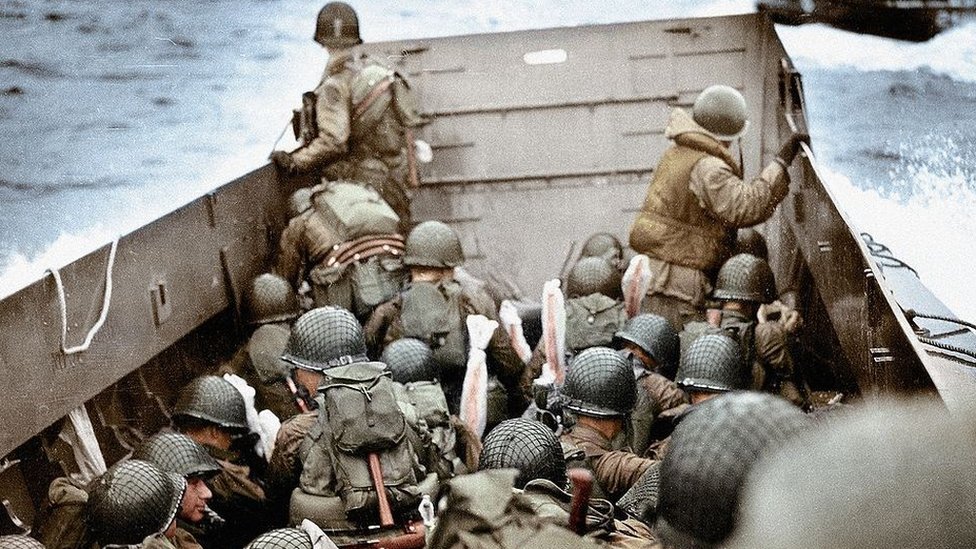
D-Day in Color: The Hours Before the Invasion (1944) 🇺🇸🇬🇧
Allied troops board landing craft and transport ships in Southern England before the launch of the D-Day invasion.
American soldiers carrying full combat gear pack tightly into LCVPs as convoys of landing craft head out toward the English Channel for one of the largest military operations in history.
The tense final moments before the Normandy landings began.
@PolitlcsUK@RupertLowe10 needs to concede this and let Reform challenge. But he won't because the true victory for Restore is to prevent Reform winning.
Patriots...
It is profoundly moving to reflect on the quiet, agonising anticipation of June 5, 1944. There is a unique, heavy solemnity to the eve of battle, perhaps even more so than the day of action itself.
To imagine thousands of young men, suspended between the safety of England and the lethal uncertainty of the Normandy coast, is staggering. Packed into Higgins boats and transport ships, tossed by the rough waters of the English Channel, they knew precisely what awaited them on the other side: the fortified, unforgiving teeth of the Nazi war machine. The sheer psychological weight of that crossing, enduring hours of tense silence and vulnerable vulnerability, is enough to give anyone chills.
They were ordinary citizens thrust into an extraordinary crucible. The depth of their courage is measured not just in their final actions on the beaches, but in the terrifying resolve it took to cross the water toward them. We are forever indebted to that brave generation who willingly bartered their youth, their futures, and their lives so that we might inherit a free world.
Lest we forget.