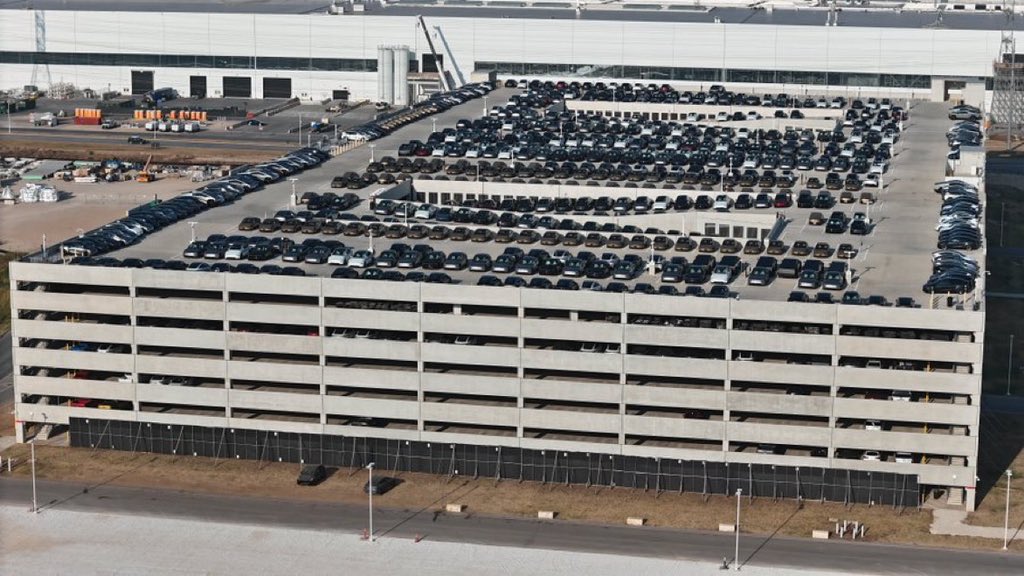
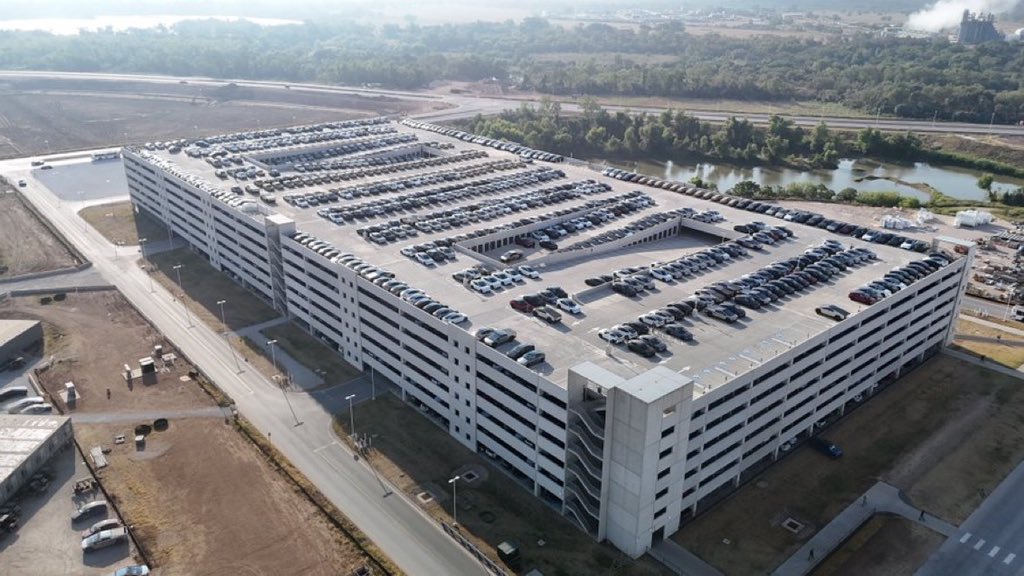
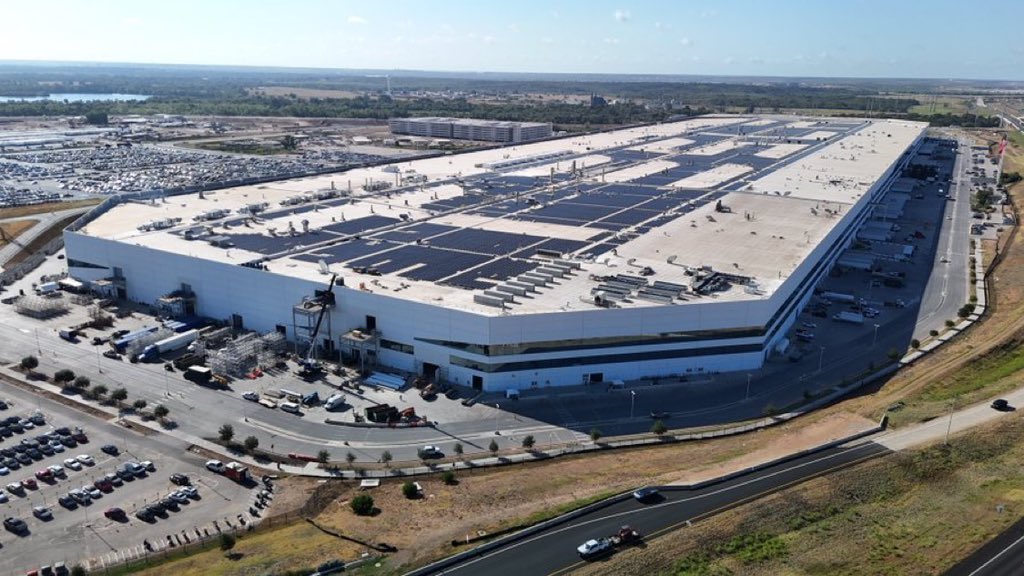
This is something new, at least at this SCALE, at Giga Texas … hundreds of vehicles, Model Y’s, @cybertruck & Cybercabs being move from the W outbound lot to the E parking garage, filing up inside and on the roof!
We are just about 2 weeks out from the HUGE 𝕏 Takeover event!
First time this event is at the Giga Texas factory near Austin!
Keynotes include @MayeMusk, @woodhaus2
(Franz von Holzhausen), @NICKIMINAJ, and newly announced, the Cybercab Lead Engineer @EricETesla (Eric Earley)
On the day before the big @tesla_semi Rollout event at Giga Nevada, one is on prominent display at the @Tesla World Headquarters here at Giga Texas today!
Looks really good & this is going to change freight transportation in more ways than most understand, starting tomorrow!
Changes at Giga Texas never stop & this one is a big efficiency boost that will improve Model Y & Cybercab production.
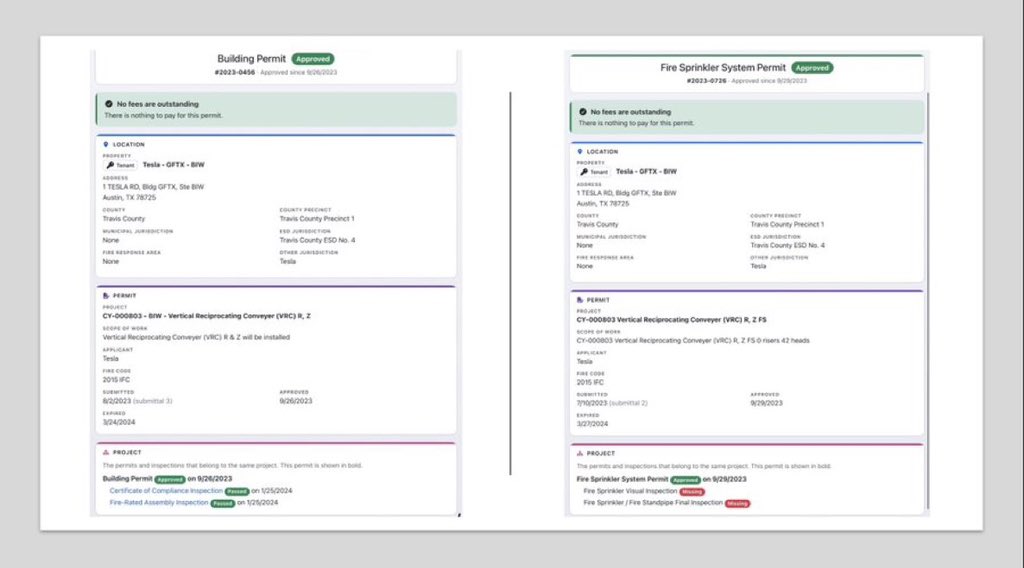
There is a new External Vertical Reciprocating Conveyor (VRC) going up on the east side of Giga Texas Body-in-White ()BIW.
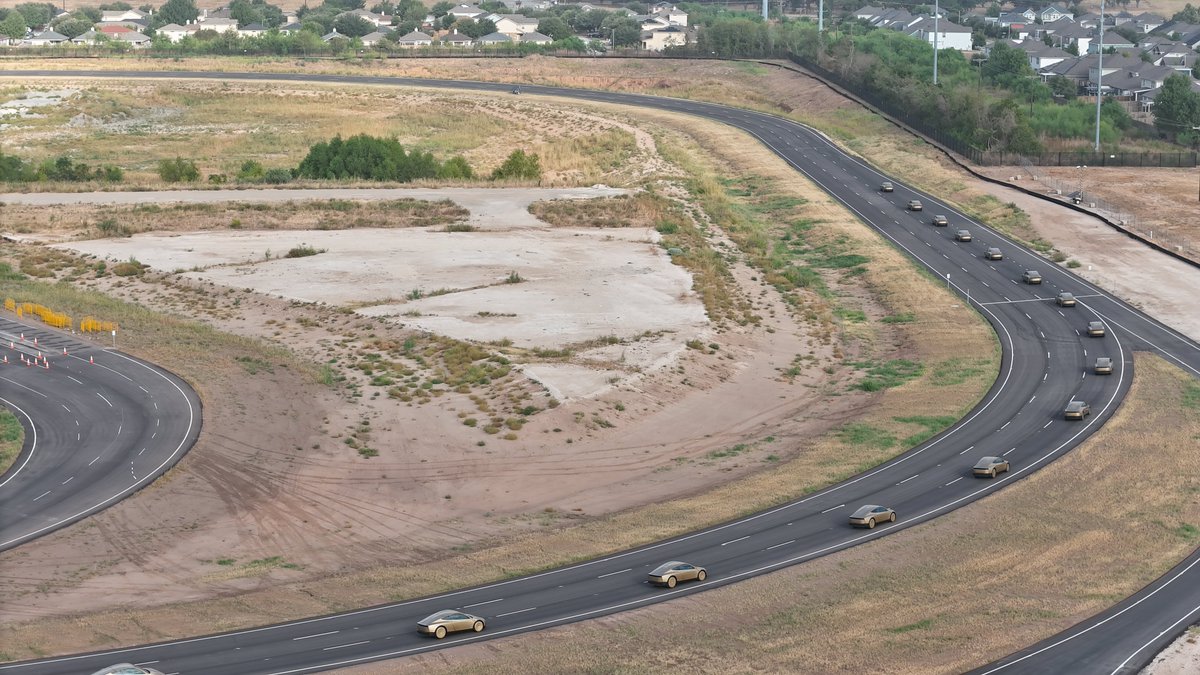
Cybercab testing underway again today at the Giga Texas track, along with Model YL rough road testing too.
The Cybercabs were in one massive group, racing around the outer oval and stopping together at stoplights placed ont eh W side of the oval.
The Model YL’s were repeatedly driving over the linear parts f the inner oval where various road surfaces have been created. I cannot say for sure, but it appears to be NVH testing if I had to guess. We have seen CYbercabs also testing on this section of the track previously.
Check out the track activity from today!
16 September 2026 Giga Texas VIDEO … Beautiful day to fly and to see the very active End-of-Line (EOL and outbound lots today.
Many Cybertruck, Cybercabs, Model Y/YLs and test track activity with a long single group of Cybercabs racing around the large oval while Model YL’s test out on the inner oval.
The W side near Tesla Rd, the large clearing has more Geotextile membranes installed and addition prep work ahead of construction start. Nearby, in the new staging lot, transformers were being set up.
N Campus Optimus Factory steel assembly continues to progress rapidly, including more concrete work on the upper 3 floors. The Advanced Tech Chip Fab is getting a large section of the ground slap poured with concrete.
Cortex 2 is getting work on the N extension while the W side Megapack installation seems to be paused, Much more to see today!
https://t.co/42YgjgjjBa
The Giga Texas Optimus Factory latest update … construction keeps moving fast!
Steel assembly is now only about 5 column grids from the north perimeter beam. Concrete is going in on the three upper floors, rebar is still being laid for more pours, and footing / grade-beam work continues on the south end.
The east side still looks more open w/ long roof trusses likely going to span ~3 grids. Possible atrium or taller bays. Stairwell with roof access showing on the west side.
This is Tesla’s dedicated high-volume Optimus plant, which is planned as a ~7 million sq ft building for the 10 million robots/year line.
In California, the Fremont Optimus Pilot line is nearing the start of production with a potential run rate of ~ 1M/yr pilot, probably beginning initial production in the 4th Qtr of this year.
The much larger Giga Texas Optimus Factory shown here is progressing towards the target of 1st limited production sometime in late 2027.
Remarkable pace for a building this size. 🤖
@Tesla
Advanced Technology Chip Fab (ATFC) update from this week’s flight.
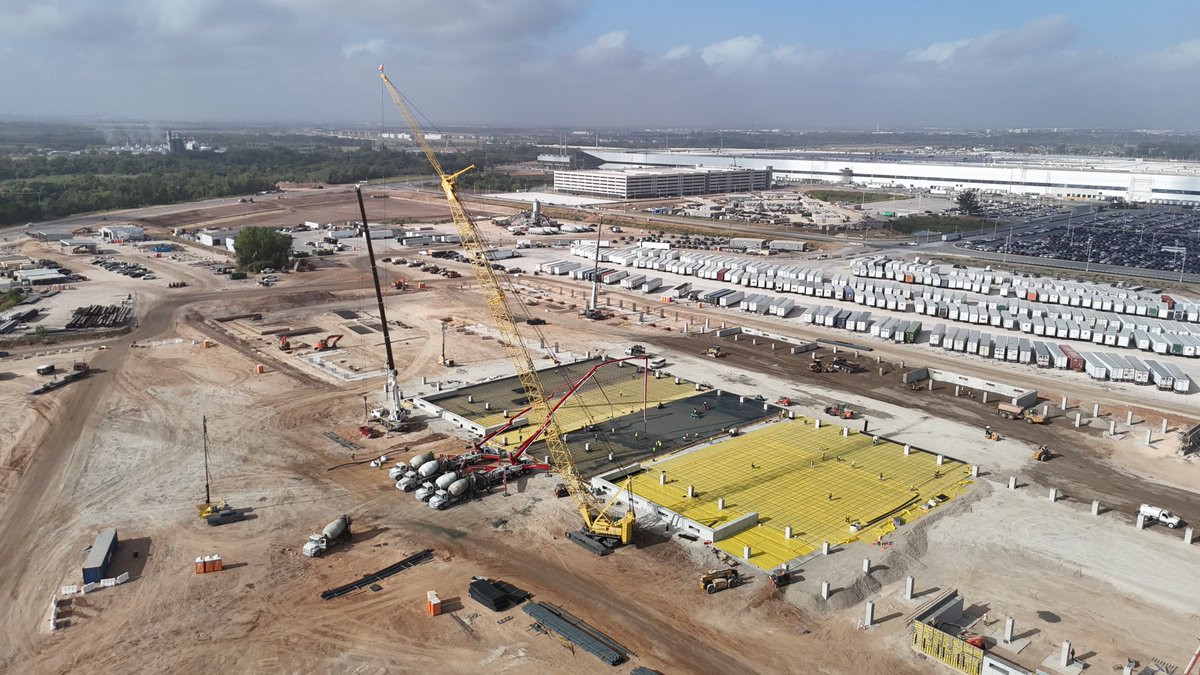
A large section of the ground slab is being poured today over the yellow moisture barrier. Rebar is in place for more pours, the new tall crane is assembled and working the slab, and the last reinforced footings on the south end are still going in.
This is the joint @Tesla / @SpaceX ATCF on the east side of Giga Texas and it is a ~490,000 sq ft research fab. Heavily vibration-isolated foundation (GeoPiers, pedestal piers, massive footings) because chip lithography can’t tolerate movement.
It’s the prototype: logic, memory, packaging, and test under one roof so they can make a chip, test it, revise the mask, and repeat without shipping wafers.
This is also the precursor to the much larger Terafab in Grimes County. Chips here are meant for Optimus, Cybercab, future Tesla vehicles, and SpaceX Starmind / orbital compute.
Foundation work is moving fast.
Oh the irony:
NASA once treated Crew Dragon as the risky understudy. A decade later it is the only US system that actually flies astronauts to the ISS on a reliable cadence ... & the agency is now scrambling because SpaceX has said it wants to wind the capsule down.
A bit of history:
In 2014 NASA split Commercial Crew awards: Boeing got about $4.2 billion for Starliner; SpaceX got $2.6 billion for Crew Dragon. Internal preference & congressional comfort favored the incumbent.
SpaceX had cargo Dragons flying, but no human-spaceflight record. The plan assumed two certified U.S. vehicles by 2017 so the country would never again depend on a single ride.
Shuttle last flew in July 2011. After that, US crews bought seats on Soyuz.
Demo-2 launched May 30, 2020. Bob Behnken and Doug Hurley on Falcon 9 from Pad 39A, ending a gap of nearly nine years (often rounded to “almost eight”). Splashdown off Pensacola on August 2 closed the test.
NASA certified Crew Dragon that November. Crew-1 flew weeks later. Regular rotations followed.
Boeing did not keep pace. Starliner’s first orbital test failed in 2019; a second flew in 2022. The 2024 Crew Flight Test suffered helium leaks and thruster failures. NASA would not bring the two astronauts home on Starliner; they returned on Dragon in 2025.
As of mid-2026 Starliner still lacks human-rating certification. NASA even redesignated the 1st “operational” Starliner flight as an uncrewed cargo run.
SpaceX, flying on the cheaper contract, became the default US crew taxi with dozens of successful cargo flights plus more than a dozen crewed ISS missions with a clean operational record.
That is the irony.
The company many insiders doubted delivered on time, reused capsules, and kept the station staffed. The favored partner did not produce a 2nd certified system.
NASA’s own inspector general has flagged the resulting single-string risk through the ISS’s planned end of life around 2030.
Now, SpaceX is telling NASA it intends to retire Crew Dragon by 2030, if not sooner, & shift scarce engineering and production onto Starship.
SpaceX President Gwynne Shotwell has said Dragon is not retiring today, & that Boeing should finally fly the vehicle the government already paid for.
NASA’s response has been to try to revive Starliner, order more of it, pay EVEN MORE to get it to even work properly & look at new launch options ... all because there is still no other certified US companion system.
The underdog that was not supposed to be trusted is the one NASA now is highly reliant on and simply cannot afford to lose.
Oh, the irony indeed!
@esherifftv@FelixSchlang@MarcusHouse
So much for trying to get to Giga Texas early for a sunrise video. Been parked on SH-130 about 3 miles South of the factory for about 45 minutes already due to a big accident just ahead. Oh well, daytime flight is good too 😕😎
18 September 2026 Giga Texas Snapshots! Busy and hot morning at the factory, with plenty of new Model YLs and Model Ys along with many @Cybertruck & some Cybercabs.
The Test Track was again busy with long groups of Cybercabs along with several Model Ys & YLs (& some Cybercabs)
18 September 2026 Giga Texas VIDEO … Another busy and hot morning at the factory, with plenty of new Model YLs and Model Ys along with many Cybertruck & some Cybercabs!
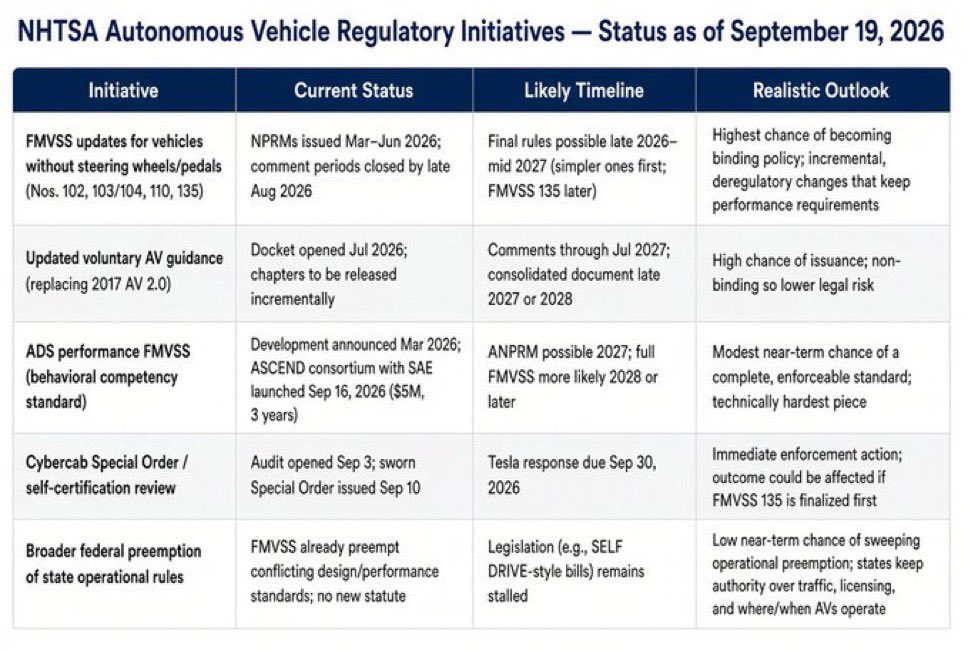
I asked Grok to help me summarize and visualize the current path NHTSA is on regarding Autonomous Vehicle (AV) Regulatory Initiatives that are and will be vital for @Tesla Cybercab and @Robotaxi along with other similar approaches like @Waymo
Painting a vehicle not only is expensive and time consuming, eating margins and the speed production can proceed, but it also eats up vast amounts of space in factories that could be used for other purposes if painting could be eliminated, using examples like the @cybertruck
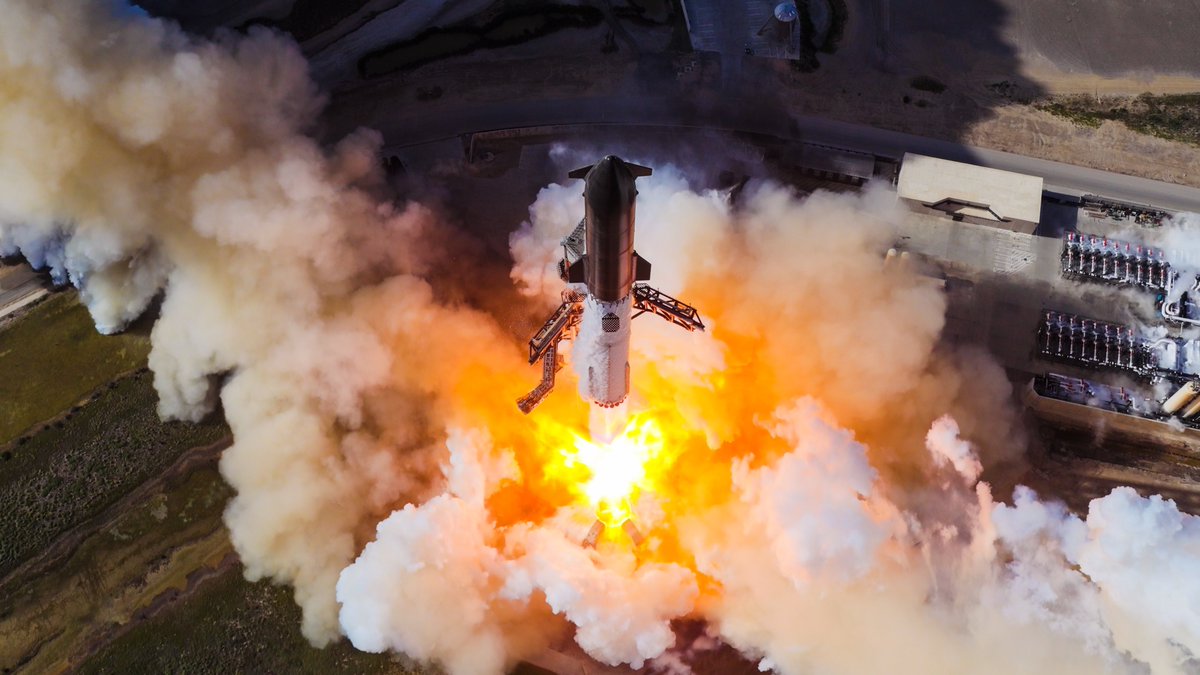
Flight 14 of Starship is coming up soon, with a NET of Friday, 18 September launch target just after sunrise at 7:15 AM local time. So, what *might* we expect for the mission timing and profile? Let’s discuss!
Well, we know @SpaceX wants to achieve full orbit this time & deploy the 1st operational V3 Starlinks. This means Starship will need to go around the earth at least a few times before performing a de-orbit burn to return.
Assuming the ship will return for a water landing off the Starbase coast in the Gulf, & assuming the goal is for this to happen in daylight for observation & imaging reasons, what might be the minimum & the ideal number of orbits required to meet these constraints?
The minimum would be about 3 orbits (~4–4.5 hours), relying a lot on Starship’s hypersonic banking plus the terminal “Swoosh” maneuver over South Padre Island (SPI) to line up the terminal flight profile for the flip, burn & splashdown off the coast.
3 orbits is the smallest number that consistently lines a ~26° Starbase ground track up with a daylight Gulf landing, which means ~ a 11:30 AM to 12:00 PM splashdown.
The “ideal” case would probably be 5 orbits or roughly 7.5–8 hours liftoff, putting splashdown around 3:00 PM local.
I think this may be the best balance of ground-track geometry, payload time, lighting, & recovery, without stretching Starship’s atmospheric reach or running into dusk.
Why five, not three?
3 orbits (~4.5 hours, ~11:45 AM) is the minimum that can put a ~26° track near the Gulf with the “Swoosh”. It is tight on everything else:
• Starlink V3s need time after insertion for a perigee-raise (if used), dispenser sequence, & confirmation of a usable orbit.
• Deorbit targeting is more precise with extra revolutions to refine the state vector.
• Late-morning sun is still relatively low & more in-line with an east-to-west approach; cameras & optical tracking of the Swoosh/flip are better when the sun is high & a bit west.
• Recovery boats & drones get a short afternoon instead of a long one.
5 orbits buys all of that while still landing well before sunset (~7:30 PM on 18 Sep in Brownsville).
4 is almost as good if the track on that pass is already clean. 6 still works, while 7 & 8 push into low sun & a compressed recovery window.
As you can surmise, Flight 14 timing & how we will watch the launch & then return of the booster & ship will be very different from what we have seen on all previous Starship launches to date.
The booster will still return & (for this flight) splash down (hopefully softly & in full control) about 7 minutes after launch, but the ship timing will be much different.
Instead of a Indian Ocean splashdown about 1 hour after launch, now we will have to wait at least ~ 4 1/2 hours, probably more like ~8 hours before the ship splashes down & this time, almost back where it started from (assuming the plan is to return to the Gulf).
A few other “side benefits for a mission profile like this for viewers:
• Sunrise launch lighting
• Potential for orbital daylight for Starlink deployments & daylight ship orbital views & daylight reentry
• Daylight splashdown views with the sun high enough for good views of the terminal “Swoosh” maneuver overhead SPI, & flip/burn/splashdown footage next to Starbase
• Much more time on orbit for V3 deployment
In my view, 5 orbits is the most likely option, 4 orbits is the runner-up for a shorter mission & 6 orbits if they want extra checkout time.
3 orbits remains the minimum number, but IMHO, places too much emphasis on ship cross range & down range reentry aerodynamic performance to be acceptable for the 1st ever orbital return to the Gulf (if that is confirmed as the objective)
But … what do you think?
@esherifftv
Wow! 100K followers on X! I am truly amazed and humbled at hitting this milestone and thanks to everyone who has made this possible along with my 390 Supporters! 😎
Thank you!
The joint @SpaceX and @Tesla Advanced Technology Chip Fab foundation is making fast progress here a t Giga Texas with a large section getting yellow moisture barriers and then rebar ahead of concrete pours on the main slab and in between the heavily reinforced footings, concrete supporting structures and pedestal piers.
On the S end, the final foundation footings and perimeter beam excavations are underway for what may be the full length of the structure.
As a reminder, this is the precursor facility for the much larger Terafab plant currently also under initial construction about 100 miles east in Grimes County.
What is one “Mod” I recommend to the Cybercab team that can make cleaning it much easier and with no added cost?
Drain holes in the rear tub! Just spray it out and it’ll drain on its own. Easy clean, minimal time and good to go!
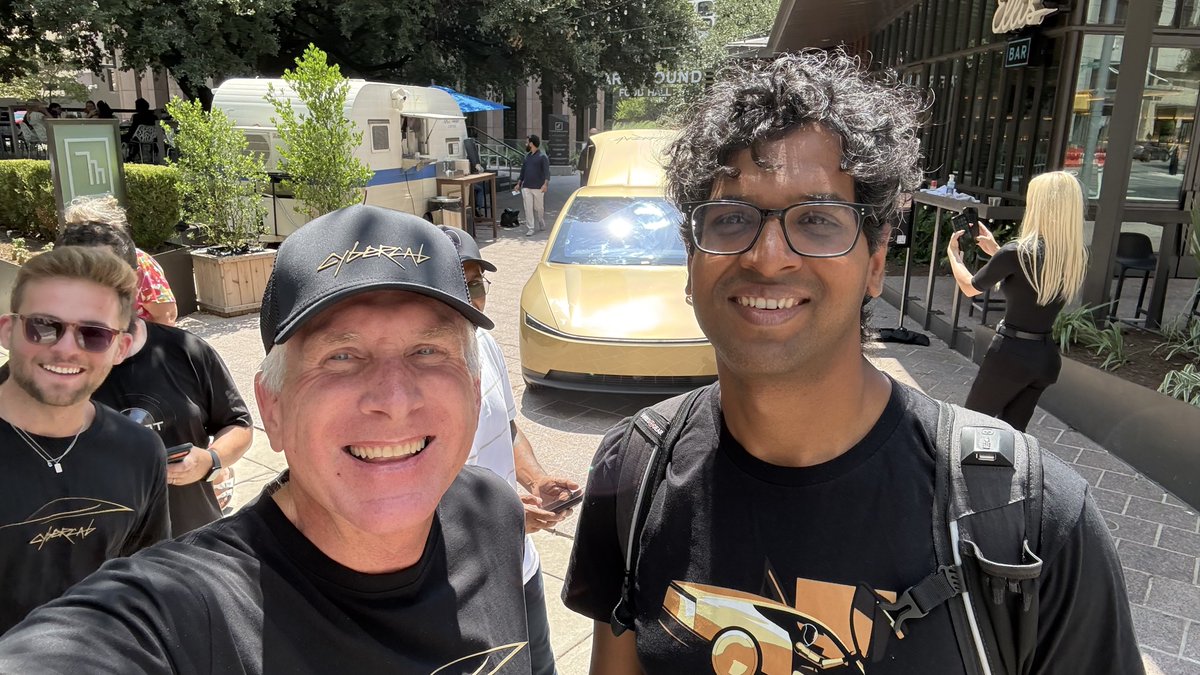
Oh, I got to meet @aelluswamy too!