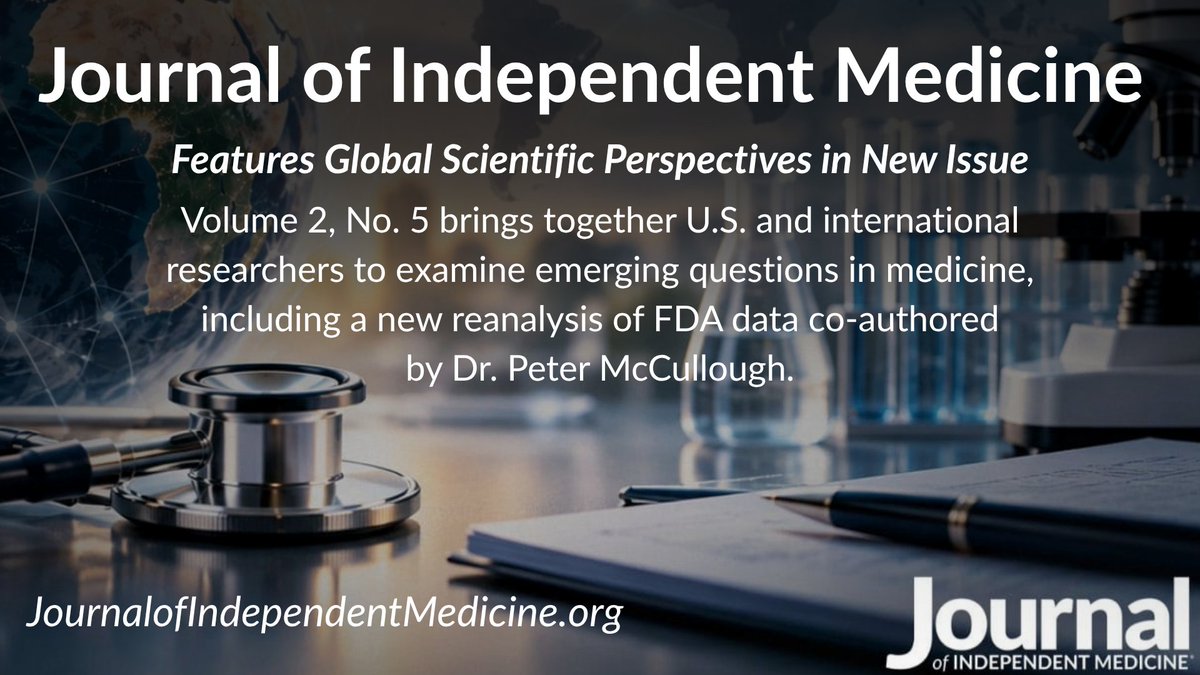
How to Write a Medical Manuscript That Gets Published: A Practical Guide from the Editors’ Desk
Writing strong research is only part of getting published. In a new 𝘑𝘰𝘶𝘳𝘯𝘢𝘭 𝘰𝘧 𝘐𝘯𝘥𝘦𝘱𝘦𝘯𝘥𝘦𝘯𝘵 𝘔𝘦𝘥𝘪𝘤𝘪𝘯𝘦 (@JIndepMed) article, Editor-in-Chief Dr. Joseph Varon (@joevaron) and Assistant Editor Dr. Adylle Varon break down the process of writing and submitting a medical manuscript—from choosing the right journal and formatting your paper to references, peer review, and more.
Whether you’re an experienced researcher, considering publishing for the first time, or simply a curious reader who enjoys digging into scientific papers, this practical guide offers a behind-the-scenes look at how medical research makes its way from manuscript to publication. Read the full article—link below. 🔽
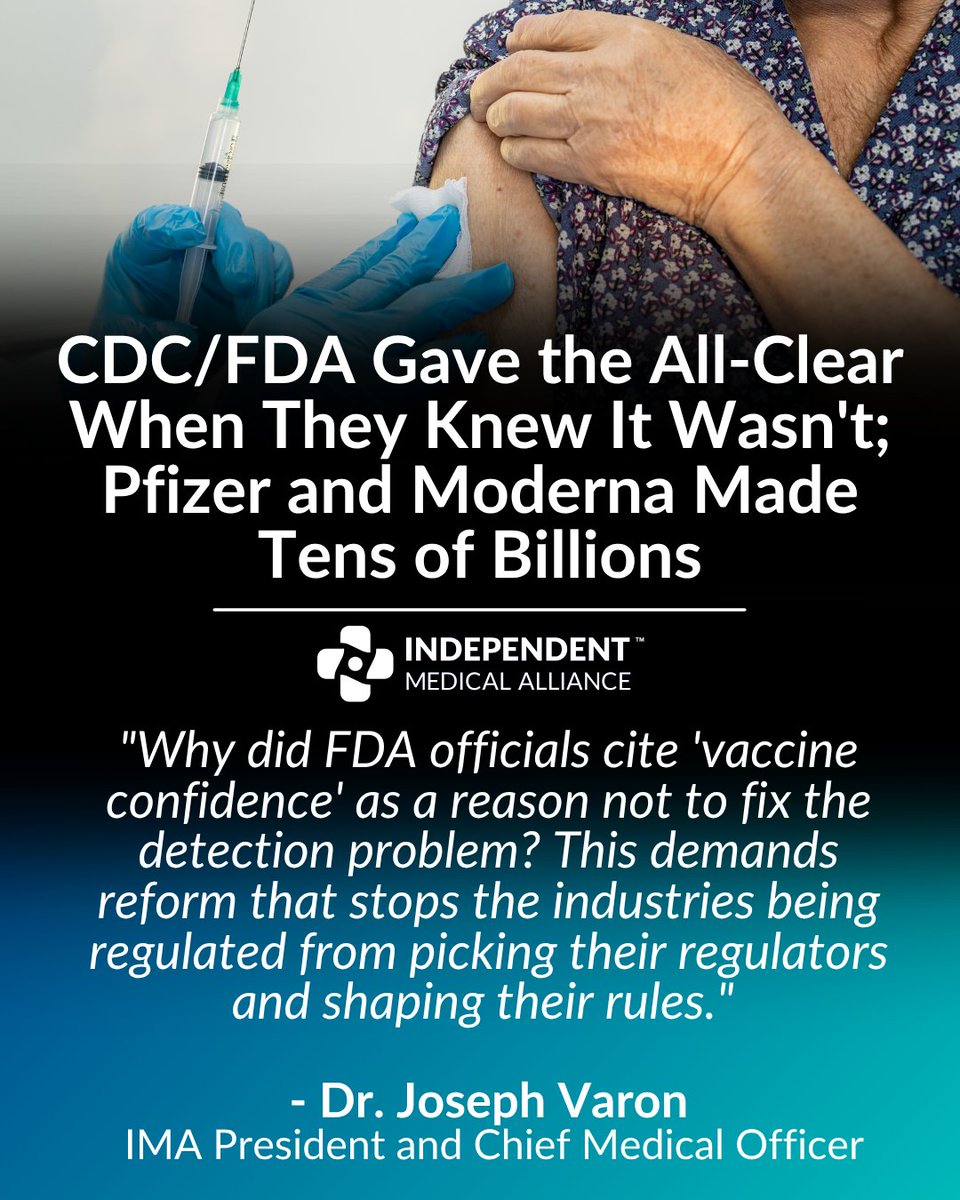
CDC/FDA Gave the All-Clear When They Knew It Wasn't; Pfizer and Moderna Made Tens of Billions
Federal health agencies leaned on a safety tool they had been warned was missing signals. Over the same stretch, the two mRNA makers posted the most lucrative years in their history.
FULL STATEMENT: WASHINGTON, D.C. – Days after calling for congressional and Justice Department investigations into CDC (@CDCgov) and @FDA vaccine safety surveillance, the Independent Medical Alliance (IMA), a national coalition of independent physicians, researchers and clinicians, today turned to the money.
The BMJ (formerly British Medical Journal) investigation published last week documented that CDC and FDA officials relied on a data mining method they had been told could not flag myocarditis and other serious events from the two mRNA shots. Officials then pointed to the lack of alerts as evidence the products were safe. That "no signal" message went out during the two most lucrative years Pfizer and Moderna have ever had.
"They told the country the safety alarm hadn't gone off, so there was nothing to worry about," said Dr. Joseph Varon (@joevaron), President and Chief Medical Officer of the Independent Medical Alliance. "The FDA had been warned the alarm was missing signals. Meanwhile, Pfizer (@pfizer) and Moderna (@moderna_tx) were booking tens of billions of dollars in COVID shot revenue. I'll let the public decide whether that's a coincidence."
What The BMJ found
The CDC promoted VAERS as the nation's early warning system and promised two methods of analysis. It did not run one of them, PRR, until 2022. In the weekly FDA reports The BMJ (@bmj_latest) reviewed, the method both agencies "chose to rely" on never signaled for myocarditis, pericarditis, or tinnitus.
In February 2021, FDA medical officer Ana Szarfman, working with statistician William DuMouchel, warned FDA leadership about the flaw and brought an updated method to fix it. Peter Marks, then head of the FDA's biologics center, kept the existing tool.
On April 27, 2021, after Israel and the Pentagon had already raised myocarditis concerns with a CDC safety committee, CDC Director Rochelle Walensky (@RWalensky) told reporters, "We have not seen a signal," and said the agency had looked for one across more than 200 million doses.
On May 7, 2021, FDA official Craig Zinderman asked Szarfman to stop sending analyses. He argued the surveillance method should stay "standard, predictable, and road tested" and warned that changing it could have "unintended consequences (eg, regarding vaccine confidence)."
In a September 2022 letter, Walensky acknowledged the CDC had not run its promised PRR analyses until 2022. When it finally did, myocarditis, pericarditis, Bell's palsy and tinnitus met the agency's own signal criteria in 13 straight weekly reports. Walensky still described the results as showing "no additional unexpected safety signals."
What the ‘all-clear’ was worth
Pfizer's COVID vaccine, Comirnaty, brought in about $37 billion in 2021 and nearly $38 billion in 2022. Pfizer's COVID pill, Paxlovid, added almost $19 billion in 2022. That year Pfizer's total revenue topped $100 billion, a first for any drug company.
Moderna went from $803 million in revenue in 2020 to more than $18 billion in 2021 and about $19 billion in 2022, almost all of it from its COVID shot, Spikevax.
The federal government was at the center of both windfalls. It regulated the shots, bought the most, and granted manufacturers immunity from liability. With Moderna, it was also a development partner: the National Institutes of Health (@NIH) co-developed the mRNA shot.
Had the government's own tool flagged a safety signal in early 2021, the resulting questions would have slowed the pace of pediatric authorizations, boosters, and seasonal shots that followed.
The revolving door
Peter Marks met with Szarfman, kept the flawed method in place, and later wrote that her work could "feed into anti-vaccination rhetoric." After leaving the FDA in 2025, he joined Eli Lilly (@EliLillyandCo) as a senior vice president.
Doran Fink, a senior FDA vaccines official who took part in the decision to license the Pfizer and Moderna shots, left the agency in December 2022 and was working at Moderna two months later.
Patrizia Cavazzoni, who led the FDA's drug center, the division that authorized and approved Paxlovid, left the agency in January 2025 and became Pfizer's chief medical officer weeks later.
Former FDA Commissioner Scott Gottlieb joined Pfizer's board in 2019, three months after leaving the agency, and served on it throughout the pandemic.
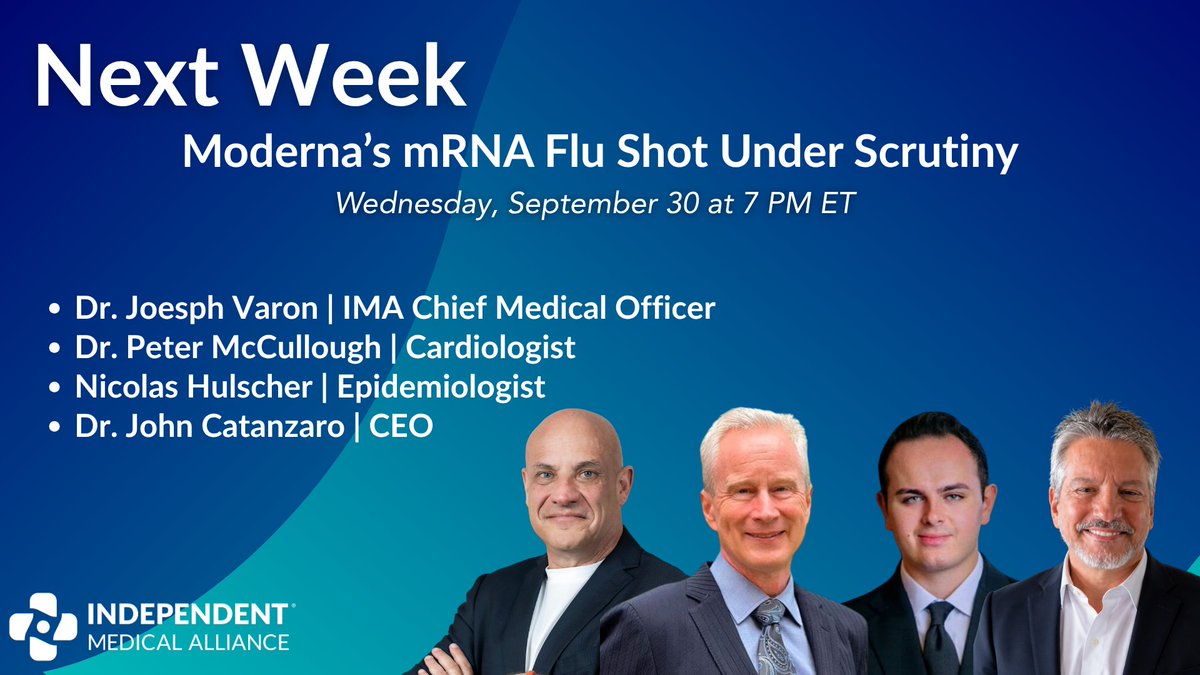
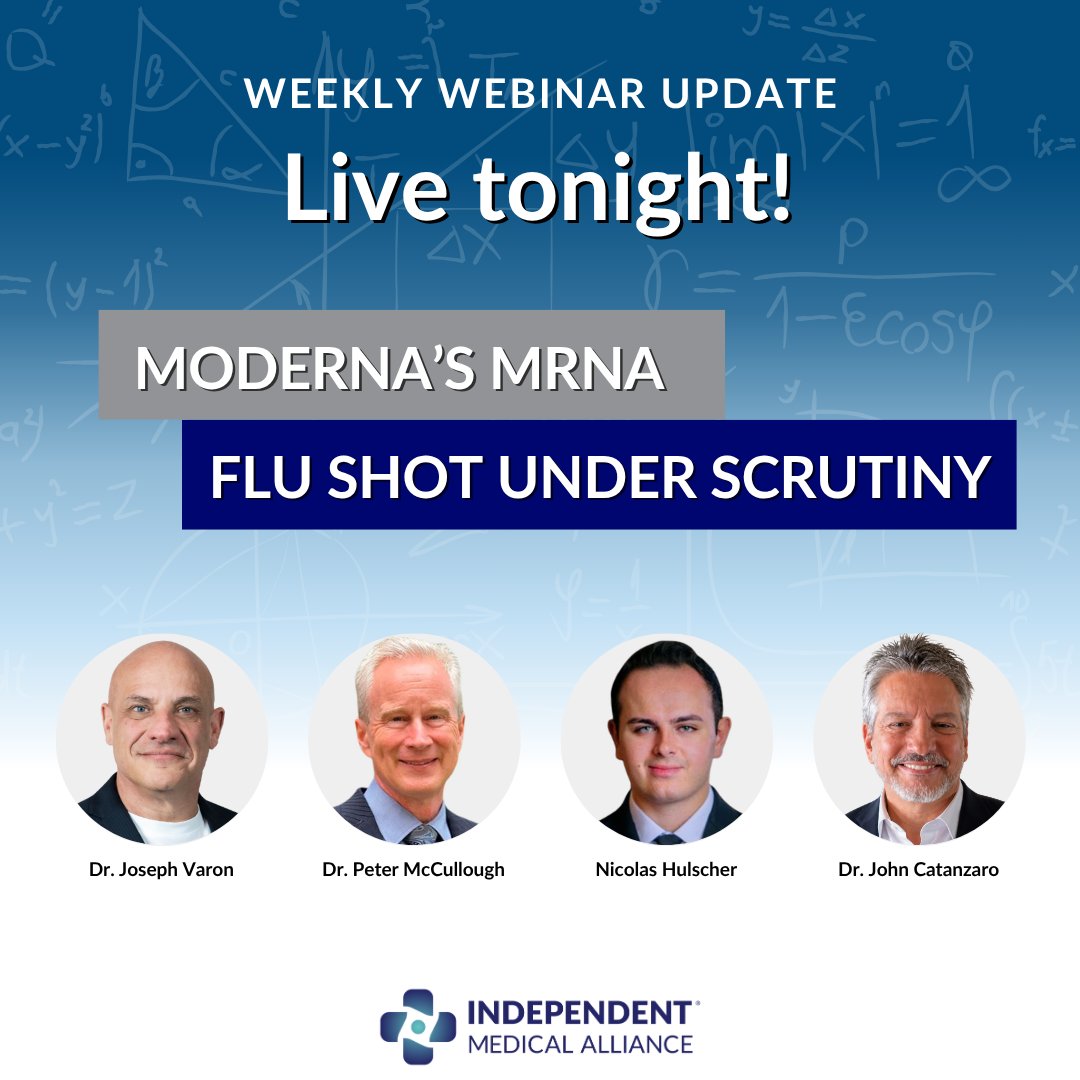
LIVE TONIGHT: Moderna’s mRNA Flu Shot Under Scrutiny
On tonight's IMA show, host Dr. Joseph Varon (@joevaron) will be joined by Dr. Peter McCullough (@P_McCulloughMD), Nicolas Hulscher (@NicHulscher), and Dr. John Catanzaro (@Docjohnc)—co-authors of a new paper published in the 𝘑𝘰𝘶𝘳𝘯𝘢𝘭 𝘰𝘧 𝘐𝘯𝘥𝘦𝘱𝘦𝘯𝘥𝘦𝘯𝘵 𝘔𝘦𝘥𝘪𝘤𝘪𝘯𝘦 (@jindepmed)—for a discussion on their findings about Moderna’s new mRNA influenza vaccine and the questions they raise. Don't miss it! Wednesday, September 30th at 7pm ET. Livestream here on X!
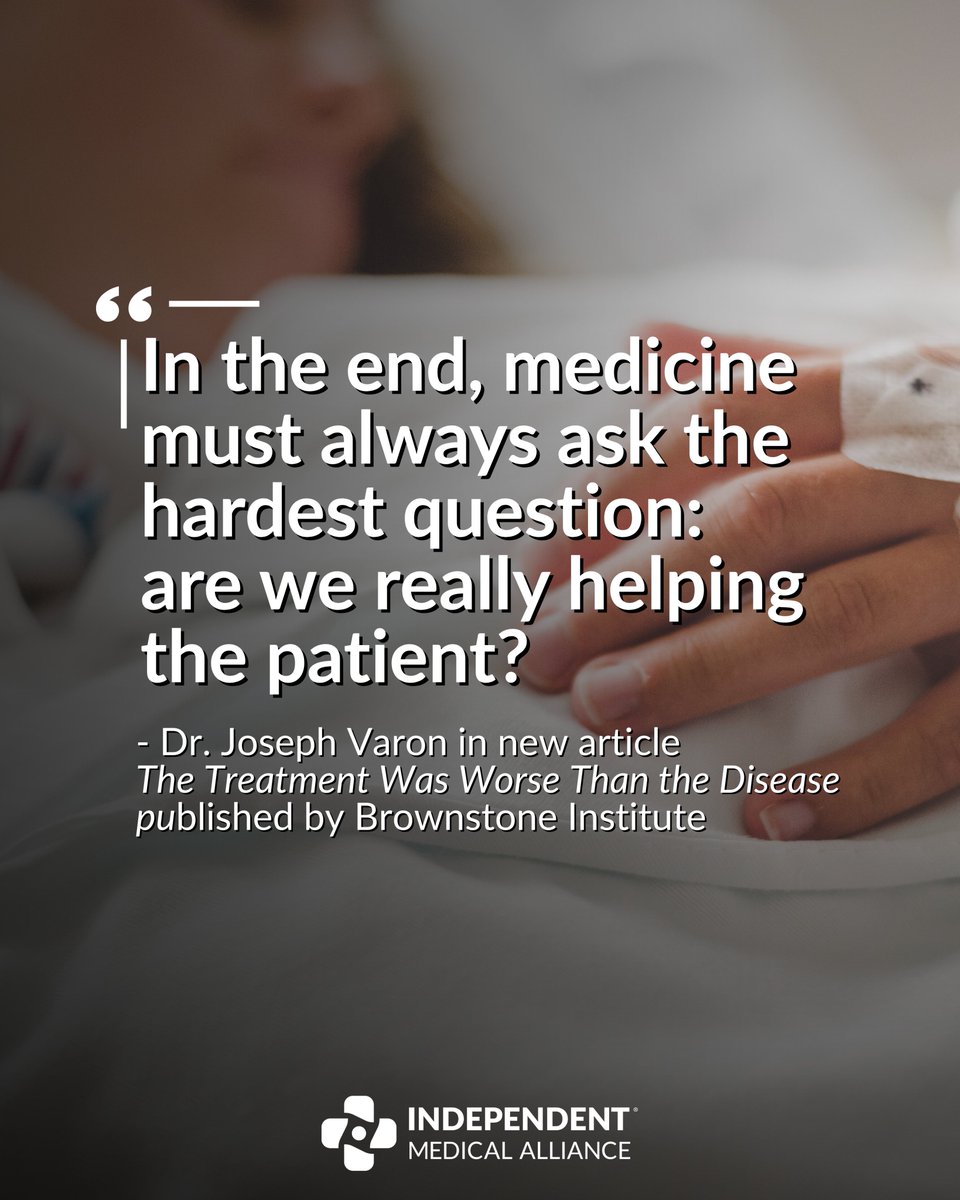
The Treatment Was Worse Than the Disease
In his latest @brownstoneins article, IMA President and Chief Medical Officer Dr. Joseph Varon (@joevaron) looks back at some of medicine’s most consequential reversals and asks what they can teach us today.
From bloodletting and aggressive surgeries to modern protocols and clinical guidelines, Dr. Varon examines why good intentions and accepted standards are not always enough, and why medicine must remain willing to question, reconsider, and change course when the evidence demands it.
Read the full article at the link below.
Washington’s doctors truly wanted to save him. They were trained, experienced, and sure that doing something was better than doing nothing. Now we know that good intentions are not enough.
~@joevaron
The Treatment Was Worse Than the Disease
https://t.co/B4jKhaJffA
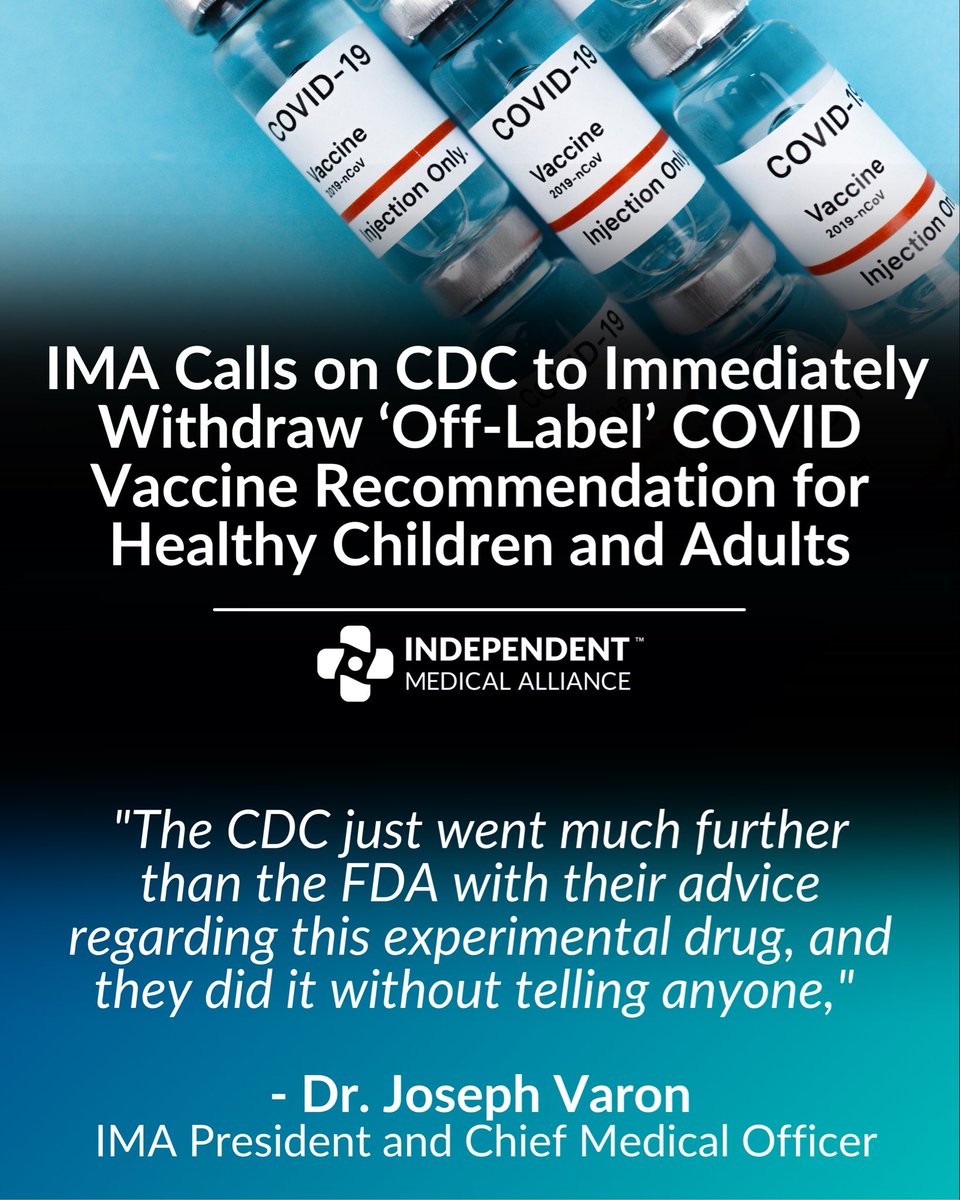
IMA Calls on CDC to Immediately Withdraw ‘Off-Label’ COVID Vaccine Recommendation for Healthy Children and Adults
A week after The BMJ exposed a broken vaccine safety alarm, the CDC (@CDCgov) quietly recommended mRNA shots for healthy infants, children and adults beyond what the FDA has approved.
WASHINGTON, D.C. – The Independent Medical Alliance (IMA), a national coalition of independent physicians, researchers and clinicians, today called on the CDC to immediately withdraw its new COVID-19 vaccine guidance for healthy Americans.
On September 23, with no public announcement, the CDC updated its guidance to recommend a 2026–2027 COVID vaccine for all adults and, through "shared clinical decision-making," for healthy children as young as 6 months. The agency's own page labels some of these uses off-label, which is significant because it opens the door for a wider use with the weight of government institution backing.
Doctors reserve the use of drugs off-label very cautiously and one patient at a time. When the CDC recommends an off-label use, it becomes the standard for everyone: insurers typically have to cover it, pharmacists in many states can give it without a prescription, and pediatric offices, schools and daycares follow the CDC's lead.
The FDA approved this season's COVID vaccines only for adults 65 and older and for younger people with at least one condition that raises their risk of severe illness. The CDC's guidance goes far beyond that, to healthy infants, healthy children and young men ages 12 to 24, the group most at risk of vaccine-related myocarditis.
"The CDC just went much further than the FDA with their advice regarding this experimental drug, and they did it without telling anyone," said Dr. Joseph Varon, President (@joevaron) and Chief Medical Officer of the Independent Medical Alliance. "There is zero evidence to support giving a healthy baby the mRNA shot, and there’s plenty of evidence to avoid it. This administration promised Americans informed consent and gold-standard science. This recommendation delivers neither, and it should be withdrawn today."
Unanswered safety questions
Late last year, FDA vaccine chief Dr. Vinay Prasad wrote in a memo to agency staff that an internal review found at least 10 children had died "after and because of receiving" the COVID vaccine. He called for randomized studies in every group before vaccines are recommended for them. No randomized trial has shown that COVID vaccination prevents severe illness or death in healthy children.
Adverse event reports after COVID vaccination continue to come into VAERS, the federal reporting system. Last week, The BMJ reported that federal officials relied for more than a year on a VAERS analysis they had been warned could not detect myocarditis and other harms from the mRNA shots.
Other countries are far more cautious. Britain's vaccine advisers say current COVID vaccines offer limited protection against mild infection and no evident protection against transmission. Denmark says only a small number of children need seasonal COVID vaccination.
"Our healthcare must be founded on transparency and informed consent, and that means parents need honest numbers," continued Dr. Varon. "What's the benefit to a healthy one-year-old? What are the risks? The CDC doesn't say. Until it can answer with real trial data, it has no business recommending these shots for healthy children."
IMA Calls for Probe After CDC and FDA Relied on a Safety Alarm They Knew Was Broken
Internal emails show FDA leaders were warned in early 2021 that the algorithm scanning COVID vaccine injury reports could not detect myocarditis and other harms from mRNA shots. Officials kept using it anyway and pointed to its silence as proof of safety.
FULL STATEMENT: WASHINGTON, D.C. – The Independent Medical Alliance (IMA), a national coalition of independent physicians, researchers and clinicians, today called on Congress and the Justice Department (@TheJusticeDept) to investigate how the @CDCgov and @FDA handled COVID vaccine safety surveillance.
The call follows an investigation published in The BMJ @bmj_latest (formerly British Medical Journal) by reporter David Willman. Willman reconstructed the first year of the mRNA rollout using internal government emails released under the Freedom of Information Act and to U.S. Senate investigators.
The CDC promoted its Vaccine Adverse Event Reporting System (VAERS) as "the nation's frontline system" and "the early warning system for detecting possible vaccine safety problems." Behind the scenes, federal officials had been told that the method used to analyze those reports could not reliably detect harm from the two dominant mRNA products. They did not fix the method. They told the FDA scientist who offered a fix to stand down. Then they cited the absence of alerts as public reassurance. One reason given in writing for leaving the method alone: a change could have "unintended consequences" for "vaccine confidence."
"Frontline doctors like me were seeing these injuries in growing numbers. When we raised the alarm, we were dismissed because the 'official data' said otherwise," said Dr. Joseph Varon (@joevaron), President and Chief Medical Officer of the Independent Medical Alliance. "Now we know that data came from a tool the FDA had been warned was blind. This is a failure of our public health system that may well rise to criminal negligence, and patients paid the price."
What The BMJ found
Two methods were supposed to run side by side: the CDC's proportional reporting ratios (PRR) and the FDA's empirical Bayesian data mining, with the agencies sharing results. In a little-noticed September 2022 letter, CDC Director Rochelle Walensky said her agency did not run PRR analyses until 2022, more than a year into the vaccination campaign. Both agencies, she wrote, "chose to rely" on the FDA's Bayesian method, which she called "a more robust technique."
In the weekly FDA reports The BMJ reviewed, that Bayesian method never signaled for myocarditis, pericarditis or tinnitus. The problem was a statistical effect called masking. In the first year, more than 90 percent of VAERS reports involved the two mRNA shots, so the algorithm was in effect comparing Pfizer against Moderna. If both raised the risk of the same injury, the elevated rate looked normal, and no alert fired.
Timeline
February 2021: FDA medical officer Dr. Ana Szarfman emailed Dr. Peter Marks, director of the FDA's Center for Biologics Evaluation and Research and the government's top COVID vaccine regulator. She urged the agency to fix its monitoring and offered an updated algorithm developed by statistician William DuMouchel, who had designed the original Bayesian method the FDA was using.
Late February 2021: The CDC and FDA received notice from Israel's Ministry of Health of a large number of myocarditis reports in young people after vaccination.
Two weeks after Szarfman's email: Marks's office held a video conference with Szarfman. Her slides showed the PRR method lighting up with signals and the FDA's Bayesian method showing almost none: "You are not getting useful information with such low counts." DuMouchel's updated method, first published in 2012, caught signals without burying investigators in false alarms. Marks and his staff declined to change the FDA's approach.
Spring 2021: Israeli officials told a CDC-convened safety committee that two of 77 vaccinated patients with myocarditis or pericarditis had died. The following week, the Pentagon's Defense Health Agency told the same committee about a cluster of myocarditis cases among male service members.
April 27, 2021: Walensky told reporters, "We have not seen a signal [for myocarditis], and we've actually looked intentionally for the signal in the over 200 million doses we've given."
May 7, 2021: Craig Zinderman, an FDA medical policy official, asked Szarfman to "please hold off on creating and sending data mining reports and analyses using COVID-19 vaccine AE [adverse event] data." Adjusting the method mid-campaign, he wrote, "could lead to confusion and have unintended consequences (eg, regarding vaccine confidence)."
June 2021: A CDC presentation showed VAERS myocarditis and pericarditis reports in males ages 12 to 24 running 29 to 347 times higher than expected. The day before, Dr. Tom Shimabukuro, deputy director of the CDC's Immunization Safety Office, received the FDA's latest data-mining report, which still showed no alert. He emailed a colleague: "I'm perplexed that myocarditis isn't alerting for either of the mRNA vaccines."
September 15, 2021: After Szarfman kept pressing, Marks wrote to his counterpart at the FDA's drug center that she had been asked to "cease and desist, because the strategy that she is using could create erroneous conflicts that feed into anti-vaccination rhetoric."
2022: When the CDC finally ran its PRR analyses, myocarditis, pericarditis, Bell's palsy and tinnitus met the agency's own signal criteria in all 13 consecutive weekly reports from May 6 to July 29. Hundreds of other event types also crossed the threshold. Walensky nonetheless wrote that the results were "generally consistent" with the Bayesian findings and revealed "no additional unexpected safety signals." The worksheets The BMJ examined do not support that description.
October 2023: Dr. Narayan Nair, head of the FDA's vaccine pharmacovigilance division, wrote to CDC and FDA colleagues: "We were aware of this [data mining] limitation before and during the pandemic."
"Officials protected the safety narrative instead of protecting patients," continued Varon. "They served the industry, not the individual. Groups like the American Medical Association and the American Academy of Pediatrics joined the chorus to drown out frontline doctors. It is long past time for Congress and the Justice Department to find out how this happened and why. It must never happen again."
Cancer Care Deserves More Than One Perspective
Behind the scenes, IMA Academy’s new 𝘐𝘯𝘵𝘦𝘨𝘳𝘢𝘵𝘪𝘷𝘦 𝘊𝘢𝘯𝘤𝘦𝘳 𝘊𝘢𝘳𝘦 𝘚𝘦𝘳𝘪𝘦𝘴 is taking shape, bringing independent physicians and researchers together to explore metabolic health, nutrition, and a broader approach to cancer care.
Help us expand independent medical education—with accredited courses for clinicians and free public viewing for patients, caregivers, and families. Right now, every gift is matched dollar for dollar, up to $250,000, thanks to Nick and Dee Adams! Learn more or make a gift today - link below. 🔽
'How Genomics Can Guide Clinical Care for Long COVID/Long Vax'
On this week's show, IMA President and Chief Medical Officer Dr. Joseph Varon (@joevaron) was joined by special guest Dr. Sharon Hausman-Cohen for an important discussion on how genomic testing may help clinicians identify biological pathways contributing to symptoms of Long COVID and Long Vax—and how those insights may help inform more personalized approaches to care. Watch now.
Read IMA's statement on the new issue of the Journal of Independent Medicine (@JIndepMed): https://t.co/P8MsDZCfGr
Find all issues of the Journal: https://t.co/gO8psX0wqN
Don't miss next week's IMA show, 'Moderna's mRNA Flu Shot Under Scrutiny,' with host Dr. @joevaron and special guests Dr. Peter McCullough (@P_McCulloughMD), @NicHulscher, and Dr. John Catanzaro (@Docjohnc)—co-authors of a new paper published in the Journal of Independent Medicine (@JIndepMed), 'Reanalysis of FDA Clinical Data for mFLUSIVA (mRNA-1010).' Don't miss it! Wednesday, September 30 at 7pm ET.
Ryan, Canada’s MAID experiment should concern every physician.
Medicine was built around a simple principle: when a patient is suffering, we care for them. We do not make death the treatment!.
Yet assisted death in Canada has moved from an exceptional measure to more than 15,000 deaths annually.
The danger is not merely the number. It is the normalization. Once a healthcare system accepts that intentionally ending a patient’s life is a legitimate medical intervention, the boundaries inevitably become easier to move.
We need better palliative care. Better pain control. Better mental-health care. More human presence.
Our answer to suffering must be better medicine, not death.





![Honest_Medicine's tweet photo. IMA Calls for Probe After CDC and FDA Relied on a Safety Alarm They Knew Was Broken
Internal emails show FDA leaders were warned in early 2021 that the algorithm scanning COVID vaccine injury reports could not detect myocarditis and other harms from mRNA shots. Officials kept using it anyway and pointed to its silence as proof of safety.
FULL STATEMENT: WASHINGTON, D.C. – The Independent Medical Alliance (IMA), a national coalition of independent physicians, researchers and clinicians, today called on Congress and the Justice Department (@TheJusticeDept) to investigate how the @CDCgov and @FDA handled COVID vaccine safety surveillance.
The call follows an investigation published in The BMJ @bmj_latest (formerly British Medical Journal) by reporter David Willman. Willman reconstructed the first year of the mRNA rollout using internal government emails released under the Freedom of Information Act and to U.S. Senate investigators.
The CDC promoted its Vaccine Adverse Event Reporting System (VAERS) as "the nation's frontline system" and "the early warning system for detecting possible vaccine safety problems." Behind the scenes, federal officials had been told that the method used to analyze those reports could not reliably detect harm from the two dominant mRNA products. They did not fix the method. They told the FDA scientist who offered a fix to stand down. Then they cited the absence of alerts as public reassurance. One reason given in writing for leaving the method alone: a change could have "unintended consequences" for "vaccine confidence."
"Frontline doctors like me were seeing these injuries in growing numbers. When we raised the alarm, we were dismissed because the 'official data' said otherwise," said Dr. Joseph Varon (@joevaron), President and Chief Medical Officer of the Independent Medical Alliance. "Now we know that data came from a tool the FDA had been warned was blind. This is a failure of our public health system that may well rise to criminal negligence, and patients paid the price."
What The BMJ found
Two methods were supposed to run side by side: the CDC's proportional reporting ratios (PRR) and the FDA's empirical Bayesian data mining, with the agencies sharing results. In a little-noticed September 2022 letter, CDC Director Rochelle Walensky said her agency did not run PRR analyses until 2022, more than a year into the vaccination campaign. Both agencies, she wrote, "chose to rely" on the FDA's Bayesian method, which she called "a more robust technique."
In the weekly FDA reports The BMJ reviewed, that Bayesian method never signaled for myocarditis, pericarditis or tinnitus. The problem was a statistical effect called masking. In the first year, more than 90 percent of VAERS reports involved the two mRNA shots, so the algorithm was in effect comparing Pfizer against Moderna. If both raised the risk of the same injury, the elevated rate looked normal, and no alert fired.
Timeline
February 2021: FDA medical officer Dr. Ana Szarfman emailed Dr. Peter Marks, director of the FDA's Center for Biologics Evaluation and Research and the government's top COVID vaccine regulator. She urged the agency to fix its monitoring and offered an updated algorithm developed by statistician William DuMouchel, who had designed the original Bayesian method the FDA was using.
Late February 2021: The CDC and FDA received notice from Israel's Ministry of Health of a large number of myocarditis reports in young people after vaccination.
Two weeks after Szarfman's email: Marks's office held a video conference with Szarfman. Her slides showed the PRR method lighting up with signals and the FDA's Bayesian method showing almost none: "You are not getting useful information with such low counts." DuMouchel's updated method, first published in 2012, caught signals without burying investigators in false alarms. Marks and his staff declined to change the FDA's approach.
Spring 2021: Israeli officials told a CDC-convened safety committee that two of 77 vaccinated patients with myocarditis or pericarditis had died. The following week, the Pentagon's Defense Health Agency told the same committee about a cluster of myocarditis cases among male service members.
April 27, 2021: Walensky told reporters, "We have not seen a signal [for myocarditis], and we've actually looked intentionally for the signal in the over 200 million doses we've given."
May 7, 2021: Craig Zinderman, an FDA medical policy official, asked Szarfman to "please hold off on creating and sending data mining reports and analyses using COVID-19 vaccine AE [adverse event] data." Adjusting the method mid-campaign, he wrote, "could lead to confusion and have unintended consequences (eg, regarding vaccine confidence)."
June 2021: A CDC presentation showed VAERS myocarditis and pericarditis reports in males ages 12 to 24 running 29 to 347 times higher than expected. The day before, Dr. Tom Shimabukuro, deputy director of the CDC's Immunization Safety Office, received the FDA's latest data-mining report, which still showed no alert. He emailed a colleague: "I'm perplexed that myocarditis isn't alerting for either of the mRNA vaccines."
September 15, 2021: After Szarfman kept pressing, Marks wrote to his counterpart at the FDA's drug center that she had been asked to "cease and desist, because the strategy that she is using could create erroneous conflicts that feed into anti-vaccination rhetoric."
2022: When the CDC finally ran its PRR analyses, myocarditis, pericarditis, Bell's palsy and tinnitus met the agency's own signal criteria in all 13 consecutive weekly reports from May 6 to July 29. Hundreds of other event types also crossed the threshold. Walensky nonetheless wrote that the results were "generally consistent" with the Bayesian findings and revealed "no additional unexpected safety signals." The worksheets The BMJ examined do not support that description.
October 2023: Dr. Narayan Nair, head of the FDA's vaccine pharmacovigilance division, wrote to CDC and FDA colleagues: "We were aware of this [data mining] limitation before and during the pandemic."
"Officials protected the safety narrative instead of protecting patients," continued Varon. "They served the industry, not the individual. Groups like the American Medical Association and the American Academy of Pediatrics joined the chorus to drown out frontline doctors. It is long past time for Congress and the Justice Department to find out how this happened and why. It must never happen again."](https://pbs.twimg.com/media/HTFQ6ETbUAA1ubs.jpg)