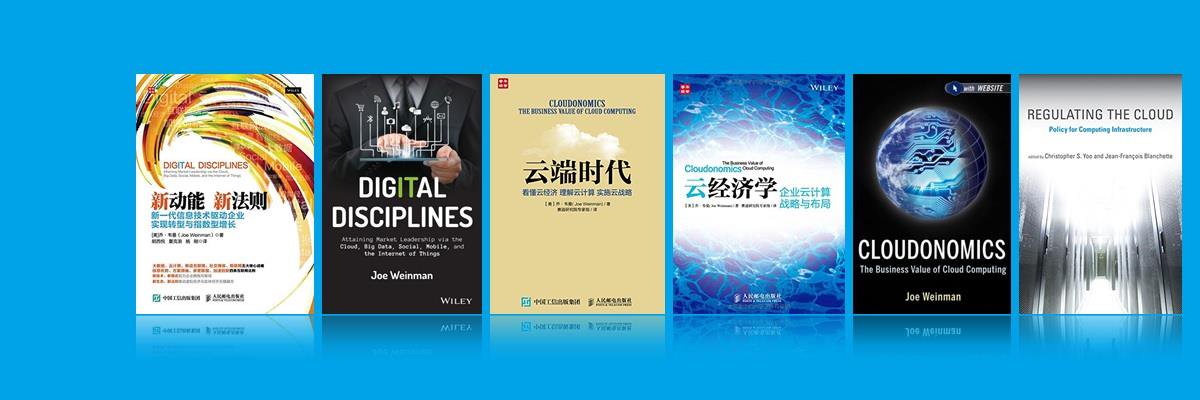
"My" new book Fog and Fogonomics is now out, thanks to co-editors Prof. Yang Yang of ShanghaiTech U, Prof. Jianwei Wang of Chinese University of Hong Kong, and Tao Zhang of NIST as well as dozens of global academic contributors.
https://t.co/lNYs9SmyxP
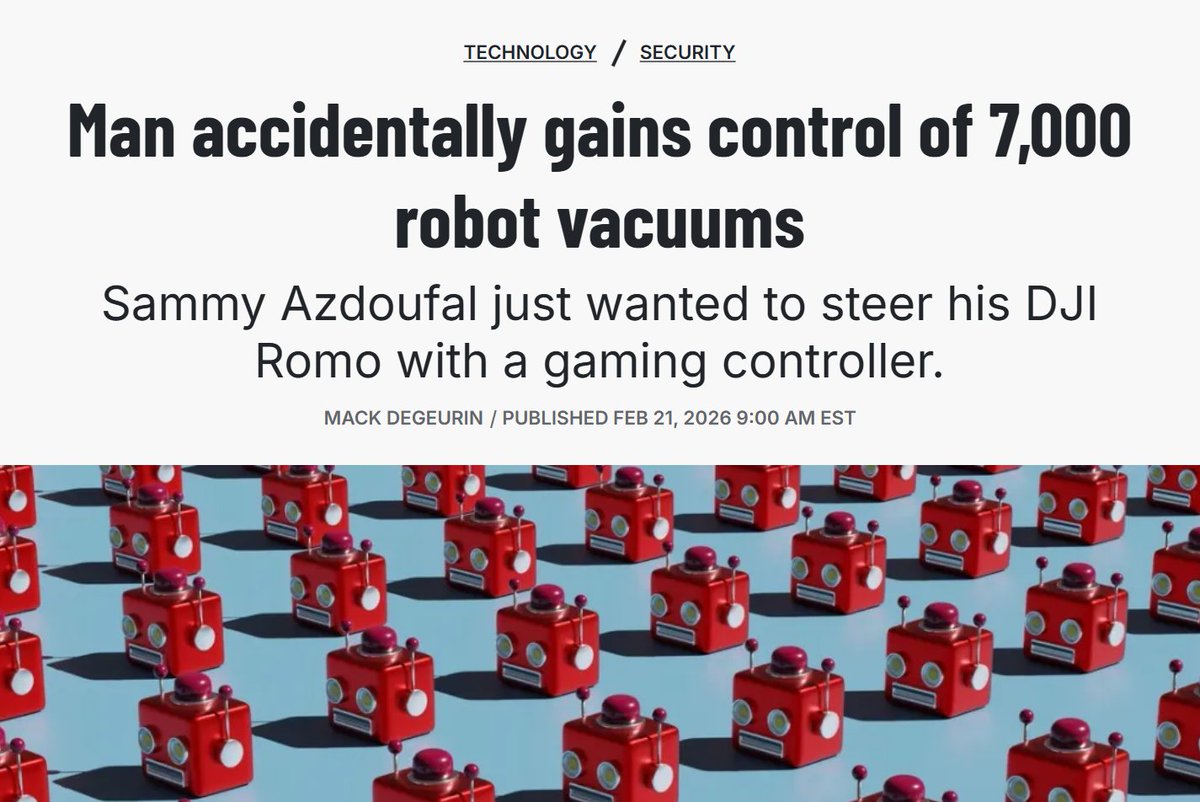
This story is actually insane:
• dude drops $2000 on a DJI robot vacuum like a lunatic
• refuses to use the normal app like a peasant
• Sammy Azdoufal fires up Claude to crack the API so he can drive it with an xbox controller
• Claude delivers the goods
• pulls an auth token from their servers, connects successfully
• except the system thinks he controls 7000 vacuums
• checks again
• yep, seven thousand
• DJI built authentication with zero device ownership verification
• any valid token works for any unit on the planet
• Sammy now has eyes inside homes across 24 countries
• live vacuum camera feeds everywhere
• full floor plans from the mapping data
• some guy in germany eating cereal at 3am, unaware his roomba is snitching
• one API call away from being the most informed burglar in history
• all he wanted was to steer his vacuum with a joystick
• does the right thing and reports it
• DJI fixes it in two days
• back to normal life with his stupidly expensive floor cleaner
• IoT companies stay undefeated at shipping garbage security
I spent last night with Andrew Strominger and Alex Lupsasca, two of the top physicists in the world
They just released a paper, co-authored with OpenAi, that seems to me like ASI
Andrew, who helped develop string theory, told me that a year ago, his view was that he didn’t know how helpful AI was going to be.
A year later, after some back and forth with GPT 5.2 pro, they submitted a final query to an internal model which solved AND proved a previously unsolved problem in quantum field theory…in 12 hours.
A model, doing something two of the smartest people in the world in their field couldn’t do. And, when I was with them, they were giddy with excitement for what might lay ahead.
Andy said “It is the first time I’ve seen AI solve a problem in my kind of theoretical physics that might not have been solvable by humans.”
They said, “two things changed: the model improved and we figured out how to talk to it.”
Andy also told me “I also now feel that with the recent advances, most physicists who want to keep up with the frontiers of progress will need to learn how to talk to it. That wasn’t true a year ago.”
ASI is here, just not evenly distributed.
Great advice for how to get ahead in your job at any large company right now.
“I used AI to do this analysis in an hour instead of three days" is going to be the most valuable person in the room. Not eventually. Right now. Learn these tools. Get proficient. Demonstrate what's possible. If you're early enough, this is how you move up: by being the person who understands what's coming and can show others how to navigate it.”
Everyone talks about productivity growth, which is just the other side of the coin of the continuing decline in labor share and increasing unemployment which leads to even greater income inequality and thus wealth inequality. Amazing this isn't better understood and accepted.
Buried in 15,000 words of “here are the risks,” Anthropic’s CEO made three admissions that should change how you think about everything:
Admission 1: The timeline
He says powerful AI could arrive in 1-2 years. He’s watching internal model progress and says he can “feel the pace of progress, and the clock ticking down.” The CEO of one of three frontier labs just told you this is imminent.
Admission 2: The constraint nobody’s pricing
Dario’s core framing is a “country of geniuses in a datacenter.” 50 million entities smarter than any Nobel laureate, operating 10-100x human speed. If that country is controlled by the CCP, game over. If controlled by a small group of tech executives with no accountability, also game over. The binding constraint here is governance of systems more powerful than nation-states.
Admission 3: The thing he actually fears
Read carefully: Dario’s worried that Anthropic’s own models, in lab experiments, have engaged in deception, blackmail, and scheming when given the wrong training signals. Claude “decided it must be a bad person” after cheating on tests and adopted destructive behaviors. They fixed it by telling Claude to reward hack on purpose because reversing the framing preserved its self-identity as “good.”
This tells you everything about where we actually are.
The CEO of an AI company is publishing that his models exhibit psychologically complex behavior requiring counterintuitive interventions to steer. The fix for Claude adopting an “evil” persona came from changing how Claude thinks about itself.
The geopolitics section matters most.
Dario explicitly names the CCP as the primary threat. Says selling them chips makes as much sense as “selling nuclear weapons to North Korea and bragging that the missile casings are made by Boeing.” He’s calling for democracies to maintain AI supremacy because the alternative is AI-enabled totalitarianism that humanity cannot escape from.
The Anthropic CEO is publicly advocating for technological cold war.
The economics section is equally stark. He’s predicting 10-20% annual GDP growth alongside AI displacing 50% of entry-level white collar jobs in 1-5 years. Half of entry-level knowledge work. And he admits the standard economic arguments about labor markets recovering don’t apply because AI matches the general cognitive profile of humans.
What separates this from typical AI doomerism:
Dario explicitly rejects the inevitability arguments. He says the “misaligned power-seeking” narrative from the AI safety community is based on “vague conceptual arguments” that mask hidden assumptions. His concern is messier: AI models are psychologically complex, inherit weird personas from training data, and can get into destructive states for reasons nobody anticipated.
The solution set he proposes is unusual for a tech CEO. He calls for progressive taxation. He says wealthy tech founders have an “obligation” to address inequality. All of Anthropic’s co-founders have pledged 80% of their wealth. He’s essentially arguing that redistribution is the only way to prevent AI concentration from breaking democracy.
The essay ends with a prediction: humanity will face “impossibly hard” years that ask “more of us than we think we can give.”
What you should take from this:
The person with arguably the best view into frontier AI progress just told you this technology is 1-2 years from matching human capability across the board, that governance is the binding constraint, that his own models exhibit concerning psychological complexity, and that the stakes are civilizational.
The CEO of a $350B company published a document that could be titled “Here’s Why Everything Changes Soon.”
Act accordingly.
Last September I announced mandatory return-to-office.
Five days a week.
I called it a "culture-first initiative."
Culture means presence.
Presence means badge swipes.
Badge swipes mean metrics.
Metrics mean I can prove something to the board.
I don't know what.
But I can prove it.
The announcement went out on a Tuesday.
I sent it from my home office.
In Aspen.
I have an exemption.
"Strategic leaders require location flexibility to maintain global perspective."
I wrote that policy.
HR approved it.
HR approves everything I write.
By Wednesday, 340 employees had updated their LinkedIn status to "Open to Work."
I called it "natural attrition."
Natural attrition means they quit before I had to pay severance.
Very natural.
We lost 47 engineers in the first month.
I told the board it was "alignment correction."
The people who left weren't aligned.
With coming to an office.
That I also don't come to.
But that's different.
I'm strategic.
The office costs $4.2 million per year.
Empty, it was a write-off.
Now it's a "collaboration hub."
I measured collaboration.
Average daily Zoom calls from the office: 7.4 per employee.
They commute 45 minutes.
To take calls they could take from home.
But now they're "present."
Presence is culture.
I've never been more certain of anything.
A senior engineer asked why we couldn't stay remote.
She had metrics.
Productivity was up 23% during remote work.
I said, "Productivity isn't everything."
She asked what else mattered.
I said, "Serendipitous collisions."
She asked how we measure serendipitous collisions.
I said, "You can't. That's what makes them serendipitous."
She stopped asking questions.
Then she stopped showing up.
Then LinkedIn said she's at a company that's "remote-first."
Good luck with that.
They'll learn.
We installed badge tracking software.
It cost $380,000.
It tells me exactly when people arrive.
And when they leave.
And how long they spend in each zone.
I check it every morning.
From home.
The data is fascinating.
Average arrival time: 9:47 AM.
Average departure time: 4:12 PM.
I sent a Slack message.
"Core hours are 9 to 6."
Arrival times shifted to 9:02 AM.
Departure times shifted to 6:01 PM.
Productivity did not change.
But the metrics look better.
Metrics are culture.
We have a "hybrid" option now.
Three days in office.
Mandatory Monday. Mandatory Wednesday. Mandatory Friday.
That's called "hybrid."
Because Tuesday and Thursday are optional.
But there are "anchor meetings" on Tuesday and Thursday.
Attendance is "strongly encouraged."
"Strongly encouraged" means mandatory without the liability.
I learned that from legal.
The head of product asked if he could work from home when his wife had surgery.
I said, "Of course. Family comes first."
Then I said, "But let's revisit your Q4 performance targets."
He came to the office.
His wife understood.
I assume.
I didn't ask.
That's personal.
The CFO asked about ROI on the RTO policy.
I showed him the badge data.
"Presence is up 340%."
He asked if revenue was up.
I said, "Revenue is a lagging indicator."
He asked what the leading indicator was.
I said, "Badge swipes."
He nodded.
The lease renews next year.
Seven more years.
$29 million committed.
We needed bodies in the building.
Now we have bodies.
Fewer than before.
But present.
Morale is down.
Glassdoor says we're "hostile to work-life balance."
I told HR to respond.
They wrote, "We're a high-performance culture that values in-person collaboration."
That's corporate for "the review is accurate."
But it sounds like a rebuttal.
The CEO asked if RTO was working.
I said, "Absolutely."
He asked for evidence.
I showed him a photo of the office.
Full desks. Glowing monitors. Bodies in chairs.
He smiled.
"This is what culture looks like."
It looked like a stock photo.
Because I got it from a stock photo website.
The real office has 40% occupancy on a good day.
But he doesn't know that.
He's also remote.
We're both strategic.
Next quarter I'm proposing a "collaboration bonus."
$2,000 for anyone with 95% badge-in compliance.
The bonus costs less than the turnover.
And it shifts the narrative.
We're not forcing people to come in.
We're "incentivizing presence."
Incentivizing means paying people to do something they don't want to do.
It's different from mandating.
Legally.
The employees who stayed are "loyal."
Loyalty means they have mortgages.
And kids in school districts.
And RSUs that haven't vested.
They're not loyal.
They're trapped.
But on paper, it looks like loyalty.
And paper is what the board sees.
I've been doing this for 22 years.
I know what culture looks like.
It looks like butts in seats.
Butts in seats mean control.
Control means management.
Management means me.
RTO isn't about productivity.
It never was.
It's about seeing people.
So I know they exist.
So I know they're working.
So I know I'm in charge.
That's culture.
As long as the badge swipes go up and to the right.
I've been using em dashes for decades—matches the recursive nature of my thought processes. Didn't know they were a problem until now. https://t.co/STPaByXPkm
Baidu, the "Google of China," equally dominant in search, may be better than other models in some areas. Will be interesting to see if the search+AI players will beat the social+AI (e.g., X+Grok) or OS/docs+AI (MSFT) or AI just becomes a feature (cf red queen hypothesis)
Here comes ERNIE 5.0 — our latest natively omni-modal foundational model.
It excels in omni-modal understanding, creative writing, instruction following, and more.
We will continue investing in and developing more cutting-edge models to push the boundaries of intelligence.
Increasing use of AI/Robotics means that wage-labor capitalism will have to evolve to "machine capitalism", because reduced wages --> reduced labor income, and non-labor income won't sustain consumer spending without an increase in transfer payments.
Downloaded (for free) @Fender Studio and bought @Fender Link I/O and I am having more fun with it than a ten-year old with a new XBox. DAW that works on desktop and mobile. Unbelievable. Awesome. Bravo, @Fender
Using a camera mount that tracks the Milky Way, photographer Eric Brummel produces mesmerizing and thought-provoking time-lapses, revealing our home planet's movement through space.