1/ AI market validation is live on @Delphi_fyi
this process sanity-checks every stage of the market creation process: the question, outcomes, sources, settlement prompt, and market timing, then flags issues for you to fix before you publish
now available for whitelisted market creators -> https://t.co/g76gFNzJ2U
here's what the validator caught when I tried to create the worst World Cup market I could think of 🧵
Last week, the United States refused to participate in the UN’s review of the Global Compact on Migration.
The United States objects to the Global Compact on Migration and UN efforts to facilitate replacement migration to the United States and our Western allies.
Coming soon: $AI
@gensynai, the network for machine intelligence, is an open infrastructure layer for AI. It provides infrastructure AI needs to operate at scale: compute, data, and information exchange.
Get ready → https://t.co/THPTuVQs1e
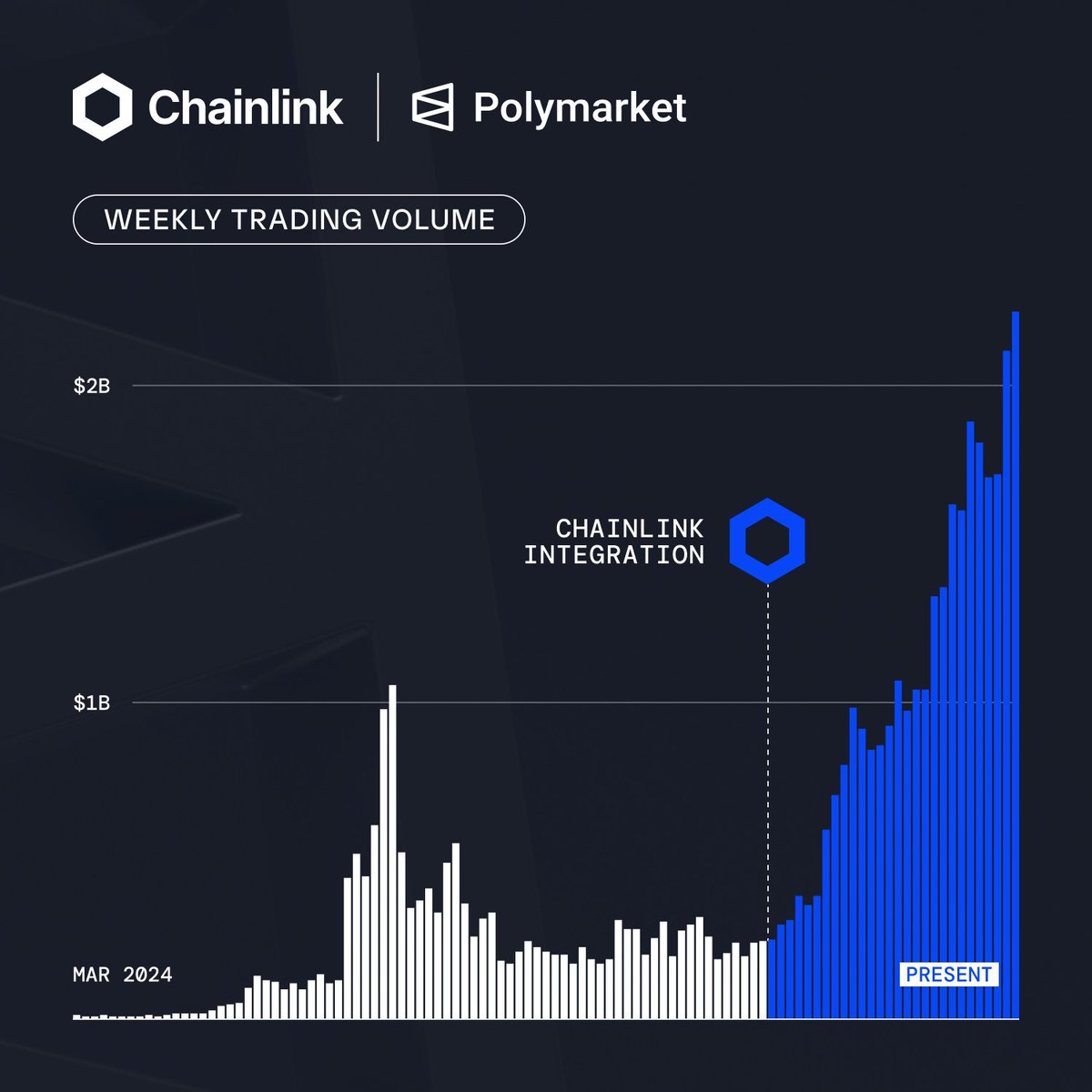
Since adopting Chainlink to power 5 & 15 min crypto markets, @Polymarket has seen:
• $153M+ avg daily volume, up 3x
• $4B+ volume across 5 & 15 min markets
• $200M+ in week one of 5-min markets
The Chainlink effect is real.
Cycles are a normal part of the crypto industry, what is important is what those cycles reveal about how far the industry has progressed and what next stage/trends of adoption/value creation will go on to define the industry.
So far this cycle reveals two key things for me:
Firstly, there have been no large risk management failures leading to large institutional failures or widespread systemic risks. In the previous cycle you had FTX and multiple lenders cleaned out through large price drops, this time around I am pleasantly surprised to see none of that or at least none of it at any system wide scale. If the crypto industry and its systems are able to successfully weather large drawdowns in price and liquidity issues then it is a more reliable place to put both retail/client capital and institutional capital. This time has been much better managed than last time.
Secondly, real world asset migration on-chain continues to accelerate regardless of Bitcoin/Cryptocurrency prices, signaling that having real world assets on-chain is not tightly coupled to crpytocurrency prices but provides its own unique value that can grow irrespective of market pricing of Bitcoin or other crypto assets. We have seen RWA issuance continue to grow and we've seen leading on-chain perp markets rival tradfi perp markets for very traditional commodities like silver, especially in periods when trading in permissioned traditional markets became harder or more risky vs trading in on-chain permissionless markets. As more and more RWA data goes on-chain to make perps work correctly for more asset types and as more on-chain value is generated as RWAs themselves, I expect these dynamics to only increase regardless of crypto prices.
These are both very positive signals for the assumptions I have been making about three key trends I am expecting to work together to reshape our industry in the next stage of its growth into mainstream adoption.
Firstly, on-chain perps about real world assets and tokenization of the assets on-chain has unique and durable long-term value which is growing regardless of any other dynamics. It is the value of 24/7/365 markets, on-chain collateral management and on-chain data.
Secondly, institutional adoption of our industry will be driven by the fundamental/technology value it provides, accelerated by access to permissionless/always on markets in DeFi, which will grow massively as a result.
Thirdly, the infrastructure that will make RWAs possible will be experiencing much more demand as more of the real world finds itself on-chain. As more RWAs have to go on-chain as perps via on-chan data or tokenization itself and as those RWAs are increasingly complex in how they need to work on-chain, more systems will need to interface with chains to enable those RWAs.
The first two trends are inevitable market forces that are now accelerating regardless of cryptocurrency prices, that is the real insight I see from this part of the cycle. The third trend is where Chainlink is providing the key global standards/protocols/infrastructure that is needed for providing the data, connectivity and orchestration that accelerates the first two trends.
Data is what allows most RWAs to exist on-chain at all. Market data for on-chain perps e.g. on-chain silver markets, Proof of Reserves for Stablecoins, NAV for Tokenized Funds to operate on-chain and many other examples touching every category of RWAs. Chainlink is the largest provider of data to the leading blockchains by far and is successfully servicing the vast majority of DeFi for all their data needs with 70%+ market share. Our new launches with leading institutional data providers like S&P, ICE and many others put Chainlink in a similar position in the growing institutional RWA world.
Connectivity to both other chains and existing backend/accounting/risk management systems is key for liquidity. The ability to connect to the other chains as a system of record/source of liquidity and to the existing centralized systems of record/sources of liquidity are key for scaling RWA adoption globally. Chainlink is the leading provider of these capabilities to institutions and has been chosen by the leading security teams in Web3 to be their official bridging provider due to a superior reliability/security track record. Chainlink is also the only system that successfully pulls TradFi payments into on-chain transactions across multiple chains, integrating existing sources of liquidity and new sources of liquidity into one interoperability layer.
Orchestration is the process of coordinating multiple systems into one workflow/transaction that defines the core value an application is providing to its users. Coordinating between multiple chains, multiple off-chain systems, multiple market data sources and now multiple AIs is a key function that some system needs to play for the more advanced RWAs to function properly. The Chainlink Runtime Environment seems to be the only environment in which you can currently run a workflow that can coordinate all of these key systems into a single application, already in use by enterprises and with advanced integrations into many key systems. Orchestration has an additional critical component of creating privacy, which there are now new and exciting solutions for being built on CRE. More to come on truly useful privacy as a key feature of CRE's orchestration.
If these trends continue I believe what I have been saying for years will happen; on-chain RWAs will surpass cryptocurrency in the total value in our industry and what our industry is about will fundamentally change. This shift will also lead to cryptocurrency's growth as an asset class that benefits from more capital on-chain, but RWAs is how all of this goes mainstream.
I have never been more excited about our industry's potential to become the way a better version of the global financial system works to benefit all of us.
There have recently been some discussions on the ongoing role of L2s in the Ethereum ecosystem, especially in the face of two facts:
* L2s' progress to stage 2 (and, secondarily, on interop) has been far slower and more difficult than originally expected
* L1 itself is scaling, fees are very low, and gaslimits are projected to increase greatly in 2026
Both of these facts, for their own separate reasons, mean that the original vision of L2s and their role in Ethereum no longer makes sense, and we need a new path.
First, let us recap the original vision. Ethereum needs to scale. The definition of "Ethereum scaling" is the existence of large quantities of block space that is backed by the full faith and credit of Ethereum - that is, block space where, if you do things (including with ETH) inside that block space, your activities are guaranteed to be valid, uncensored, unreverted, untouched, as long as Ethereum itself functions. If you create a 10000 TPS EVM where its connection to L1 is mediated by a multisig bridge, then you are not scaling Ethereum.
This vision no longer makes sense. L1 does not need L2s to be "branded shards", because L1 is itself scaling. And L2s are not able or willing to satisfy the properties that a true "branded shard" would require. I've even seen at least one explicitly saying that they may never want to go beyond stage 1, not just for technical reasons around ZK-EVM safety, but also because their customers' regulatory needs require them to have ultimate control. This may be doing the right thing for your customers. But it should be obvious that if you are doing this, then you are not "scaling Ethereum" in the sense meant by the rollup-centric roadmap. But that's fine! it's fine because Ethereum itself is now scaling directly on L1, with large planned increases to its gas limit this year and the years ahead.
We should stop thinking about L2s as literally being "branded shards" of Ethereum, with the social status and responsibilities that this entails. Instead, we can think of L2s as being a full spectrum, which includes both chains backed by the full faith and credit of Ethereum with various unique properties (eg. not just EVM), as well as a whole array of options at different levels of connection to Ethereum, that each person (or bot) is free to care about or not care about depending on their needs.
What would I do today if I were an L2?
* Identify a value add other than "scaling". Examples: (i) non-EVM specialized features/VMs around privacy, (ii) efficiency specialized around a particular application, (iii) truly extreme levels of scaling that even a greatly expanded L1 will not do, (iv) a totally different design for non-financial applications, eg. social, identity, AI, (v) ultra-low-latency and other sequencing properties, (vi) maybe built-in oracles or decentralized dispute resolution or other "non-computationally-verifiable" features
* Be stage 1 at the minimum (otherwise you really are just a separate L1 with a bridge, and you should just call yourself that) if you're doing things with ETH or other ethereum-issued assets
* Support maximum interoperability with Ethereum, though this will differ for each one (eg. what if you're not EVM, or even not financial?)
From Ethereum's side, over the past few months I've become more convinced of the value of the native rollup precompile, particuarly once we have enshrined ZK-EVM proofs that we need anyway to scale L1. This is a precompile that verifies a ZK-EVM proof, and it's "part of Ethereum", so (i) it auto-upgrades along with Ethereum, and (ii) if the precompile has a bug, Ethereum will hard-fork to fix the bug.
The native rollup precompile would make full, security-council-free, EVM verification accessible. We should spend much more time working out how to design it in such a way that if your L2 is "EVM plus other stuff", then the native rollup precompile would verify the EVM, and you only have to bring your own prover for the "other stuff" (eg. Stylus). This might involve a canonical way of exposing a lookup table between contract call inputs and outputs, and letting you provide your own values to the lookup table (that you would prove separately).
This would make it easy to have safe, strong, trustless interoperability with Ethereum. It also enables synchronous composability (see: https://t.co/9jy6v1X6Fw and https://t.co/gZmu3YjebM ). And from there, it's each L2's choice exactly what they want to build. Don't just "extend L1", figure out something new to add.
This of course means that some will add things that are trust-dependent, or backdoored, or otherwise insecure; this is unavoidable in a permissionless ecosystem where developers have freedom. Our job should make to make it clear to users what guarantees they have, and to build up the strongest Ethereum that we can.
JUST SHIPPED: Chainlink 24/5 U.S. Equities Streams brings the ~$80T U.S. equities market onchain.
Fast, secure stock & ETF data is now live across 40+ chains—24 hours a day, 5 days a week.
Trusted by @lighter_xyz, @BitMEX, @OfficialApeXdex, & more.
🧵
https://t.co/dpJku60hXL
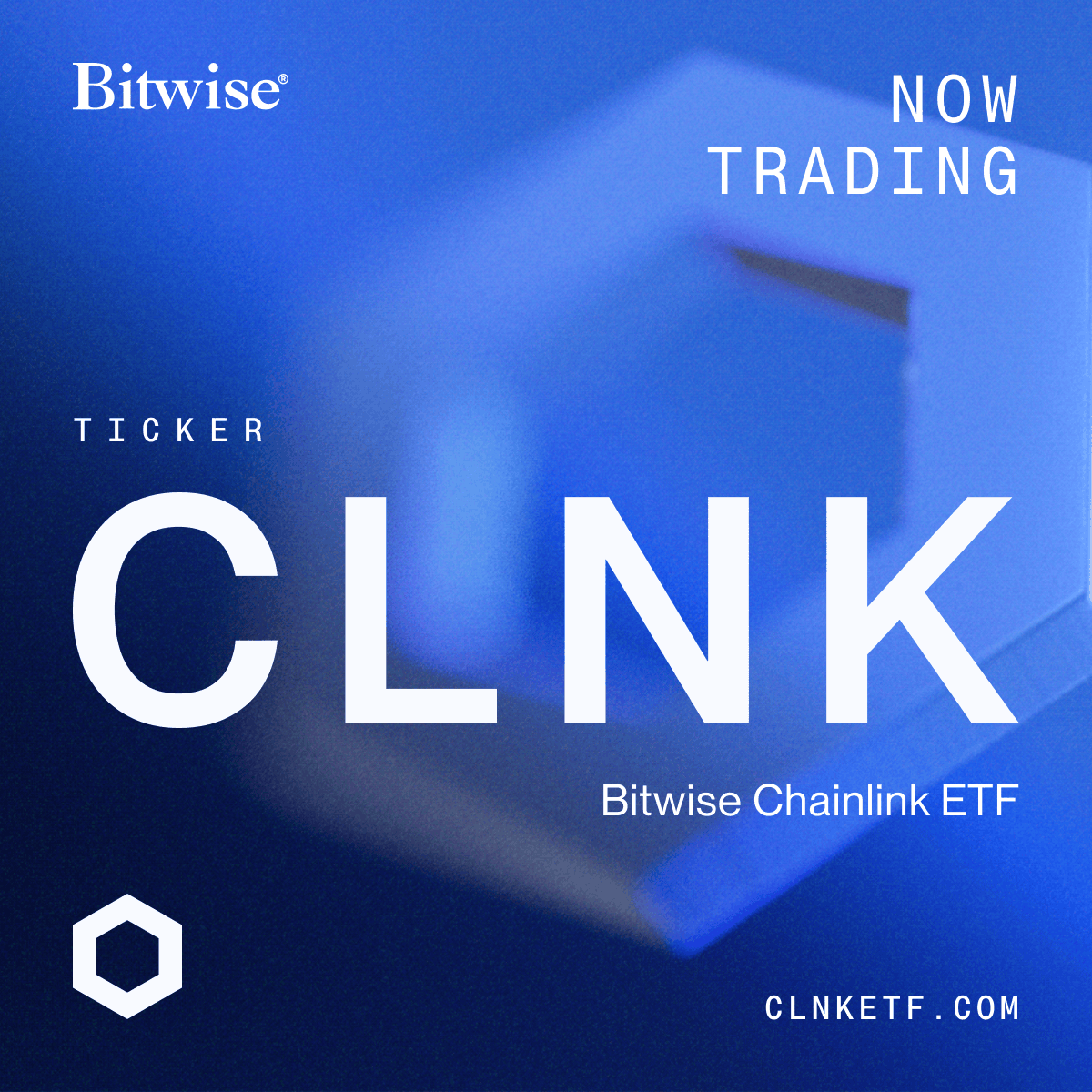
Today, we’re excited to launch $CLNK, an ETP offering investors spot exposure to Chainlink (LINK)—the leading oracle platform connecting blockchains to real-world data.
Why Chainlink is a big deal:
- It’s the infrastructure behind many of crypto’s most powerful real-world use cases, from tokenization to DeFi to prediction markets
- $27T+ in transactions facilitated
- $75B+ in DeFi smart contracts rely on its data
- 19B verified messages published onchain
- 7-year track record
Chainlink is playing a huge role bringing crypto to everyday life. With CLNK, we’re thrilled to offer investors efficient access to one of the most important platforms behind crypto’s march to the mainstream.
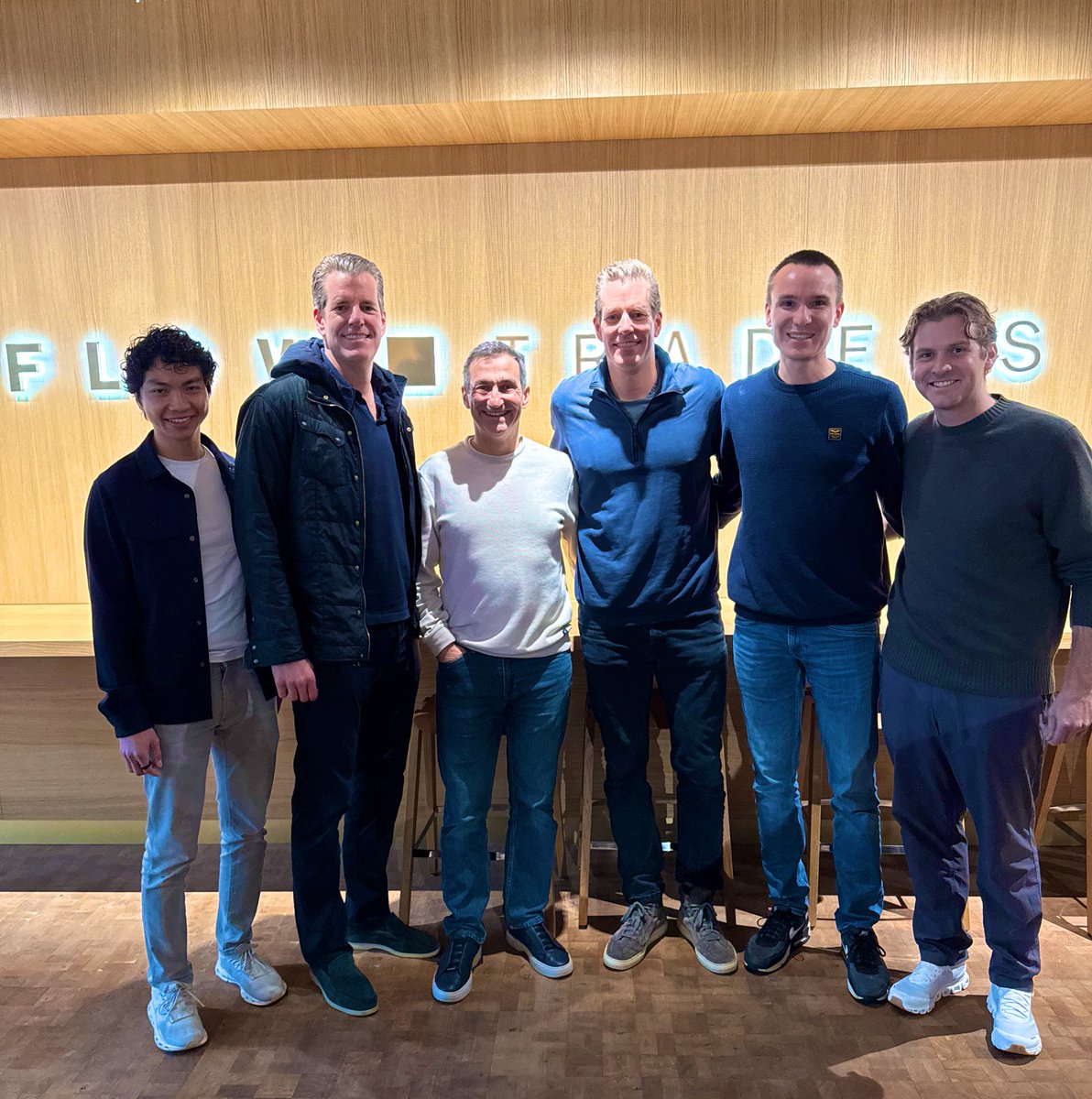
Great meeting the @FlowTraders team in Amsterdam. They have promised to come on @Gemini’s livestream with @austinoakes next time they are in New York and give us their latest takes on crypto, markets, and more! 🎙️😃🚀
We’re excited to announce that @SPGlobalRatings—the leading credit rating agency relied on by 95% of the top 20 global institutional investors—is collaborating with Chainlink to publish its Stablecoin Stability Assessments (SSAs) onchain for the first time via DataLink.
https://t.co/oIByU9CoD8
The launch comes at a pivotal moment in the evolution of digital assets. As of October 2025, the size of the stablecoin market exceeds $300 billion.
With the passage of the GENIUS Act in the United States, stablecoins are becoming a core financial primitive of global finance, underpinning payments, settlement, and trade.
However, to support institutions seeking to adopt stablecoins at scale, they require a standardized, reliable, and transparent onchain way to evaluate stablecoin risks.
S&P Global Ratings’ SSAs assess the stability and resilience of widely used stablecoins by evaluating credit, market, and custody risks to the overall asset quality, along with additional risk factors.
This data provides institutions and DeFi protocols alike critical information that can be used to evaluate a stablecoin's ability to maintain a stable value relative to its pegged fiat currency, enhancing risk management operations.
By securely making this data directly available to smart contracts via Chainlink’s institutional-grade DataLink publishing service, S&P Global Ratings and Chainlink are empowering 2,400+ financial institutions, protocols, and developers in the Chainlink ecosystem to confidently integrate stablecoins into next-generation financial products, strengthening risk management, enhancing market integrity, and unlocking innovation across the onchain economy.
"The launch of SSAs on-chain through Chainlink underscores our commitment to meeting our clients where they are. By making our SSAs available on-chain through Chainlink's proven oracle infrastructure, we're enabling market participants to access our assessments seamlessly using their existing DeFi infrastructure, enhancing transparency and informed decision-making across the DeFi landscape," said Chuck Mounts, Chief DeFi Officer at S&P Global.
The collaboration leverages Chainlink's infrastructure, which has powered the majority of the onchain economy for more than half a decade, enabling over $25 trillion in transaction value while actively securing nearly $100 billion in DeFi TVL.
As a turnkey service, DataLink empowers data owners like S&P Global Ratings to seamlessly publish data to blockchains in a secure and reliable manner—without the need to build or maintain new infrastructure.
Plasma (@plasma), a high-performance layer-1 blockchain purpose-built for stablecoins, with over $5.5B in stablecoin supply just one week after launch, is joining Chainlink Scale to enable Plasma developers to build next-gen stablecoin applications.
https://t.co/dDY1M7L3jT
With Chainlink as Plasma’s official oracle provider, Chainlink CCIP, Data Streams, and Data Feeds are live on Plasma from day one, laying the foundation for high-performance, data-rich, and interoperable stablecoin applications.
@aave is live on Plasma and already seeing massive traction with over $6.2B deposited since launch, powered by Chainlink CCIP and Data Feeds to bring secure and efficient lending markets to Plasma’s rapidly growing ecosystem.