This extended thread by @PhilWMagness is important in at least a couple of contexts. First, it shows how academic malpractice, this time from Quinn Slobodian, gets done (and one way to confront and debunk it). Second, it shares deep truths about the actual work of Ludwig von Mises, one of the great cosmopolitan liberals of the past century. Mises was so far ahead of his time in terms of race and gender it's still staggering--and particularly offensive to see him slandered as a racialist.
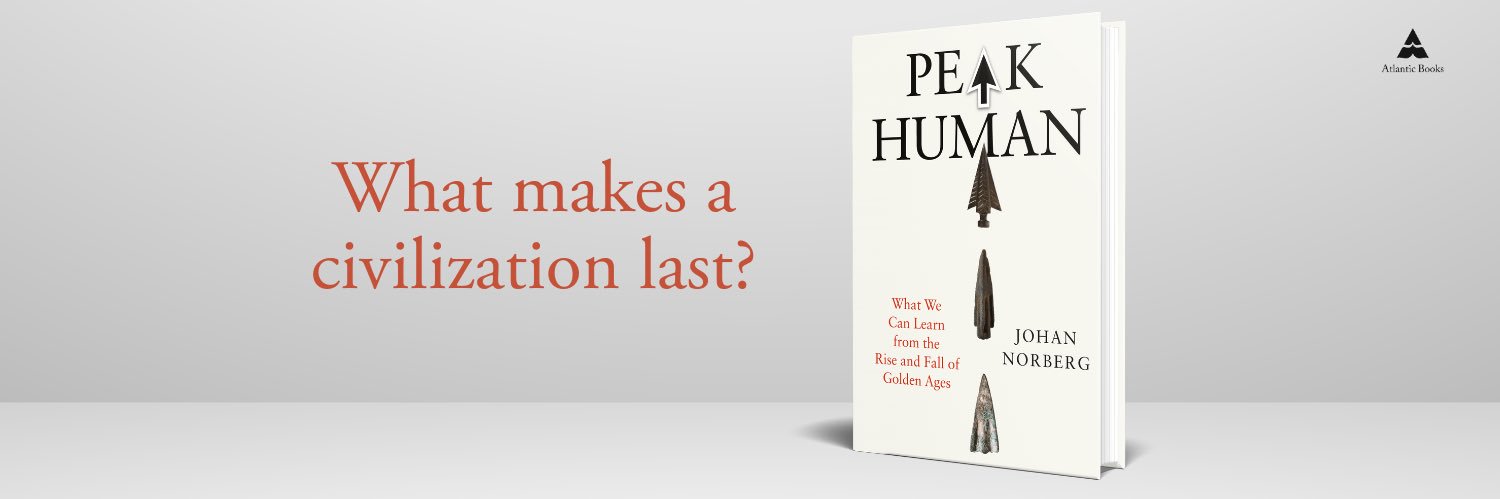
I enjoyed @johanknorberg’s Peak Human about seven golden ages throughout history (Athens, Renaissance Italy, 17th c Netherlands, etc).
The last one is our current golden age, and it’s imo different both quantitatively and qualitatively. It’ll take far more for it to disappear.
Polska premiera już w październiku tego roku.
Wstęp do polskiego wydania: @MikolajPisarski - podobno już go pisze. ;)
Więcej o książce:
https://t.co/bjlTu8UgNo @johanknorberg
„Apogeum ludzkości” Johana Norberga to fascynująca analiza siedmiu wielkich cywilizacji w historii, takich jak starożytne Ateny, renesansowe Włochy czy kalifat Abbasydów. Autor bada czynniki, które doprowadziły je do rozkwitu i zrodziły ich „złote ery” nauki, kultury oraz gospodarki. Jednocześnie szuka odpowiedzi na kluczowe pytanie: dlaczego te potęgi ostatecznie upadły?
Ta błyskotliwa i aktualna lekcja dziejów pozwala lepiej zrozumieć wyzwania, przed którymi stoi nasza współczesna cywilizacja.
Interesting take from @johanknorberg on the diverging path of China and Europe towards the end of the Middle Age.
<<A few generations later, the influential writer Wang Yangming (1472–1529) even overturned the neo-Confucian emphasis on the natural world and its patterns. To him, only the mind was real, and knowledge of the good came from intuition, not instruction. Reality did not exist independent of the
mind, and therefore empirical study lost the significant position it had during the Song. Since no sensory experience could challenge such a complex metaphysics, nothing was really puzzling or challenging, and therefore all the empirical anomalies that troubled European scientists at that time, forcing them to investigate and develop better instruments, could safely be ignored.
[…]
The whole traditionalist counter-revolution was a cataclysm for China, bringing an astonishing era of progress to a dreary end. Eventually, the Ming court could not even adjust its calendar since the occupants of the now hereditary posts at the directorate of astronomy didn’t know how to do it.>>
<<In 1323, Thomas Aquinas, the controversial protagonist of a Christian Aristotelianism, was canonized by the pope, and from then on, Christendom increasingly saw the world as a beautiful place that could be understood through reason, logic and the evidence of the senses, and not just a vale of tears where we suffer and die, preparing for afterlife. The European barbarians would, as it were, become Greek.>>
“Openness” is commonly cited as a necessary feature of democracy. But why is it actually important?
At the #FreeSpeechSummit2026, @johanknorberg will discuss how openness to new ideas and dissent doesn’t just ensure accountability — it’s the key to flourishing societies.
We’re calling it: The war in Ukraine has entered a new phase.
@KatStepanenko and I have authored a new special report studying how Ukraine is actively challenging the positional character of the war that has dominated the battlefield since 2023.
Data on Russia’s battlefield performance indicates that the character of the war is shifting in favor of Ukrainian forces – at least for now. Russian forces rates of advances are stagnating while Ukrainian forces are employing novel tactics and operational concepts in efforts to break out of positional warfare. Neither Russia nor Ukraine can conduct operational maneuvers yet, however.
The bottom line is that the war in Ukraine is competitive and far from stalemated. Ukrainian forces are out-innovating Russian forces in both military technologies and in applying these new technologies in effective operational concepts that can help Ukrainian forces break out of positional warfare. Ukraine is employing mechanized equipment in tactical maneuvers in ways that were impossible 12 months ago. Russia’s ability to conduct infiltration missions will likely continue to degrade as Ukraine’s intermediate-range strike campaign pushes Russia’s logistics and forward operating bases further away from the frontlines, reducing resourcing to sustain infantry tasked with infiltration missions. Ukraine may be able to scale these effects if they resourced properly by international partners.
Ukraine’s advantage in intermediate range strikes is notably not permanent, and Russia will very likely eventually develop countermeasures to mitigate Ukraine’s advantages. Ukraine’s international partners thus have a rare and temporary opportunity to help Ukraine exploit favorable battlefield dynamics while Ukraine has the upper hand.
Key Points of the report:
• Russia’s rate of advance is plummeting during the Russian Spring-Summer 2026 offensive.
• Russia is losing more soldiers to make fewer gains, with monthly Russian casualty rates reportedly outpacing monthly recruitment since December 2025.
• Ukraine is starting to regain more ground than it is losing for the first time since 2023.
• Ukraine’ recent counterattacks feature unique characteristics and deviate from key trends that defined the positional character of the war since 2023.
• Ukraine is conducting a pattern of more frequent mechanized counterattacks at the tactical level for the first time since 2023.
• The Ukrainian command’s operational planning is maturing.
• Ukraine’s early 2026 counterattacks in the south were successful likely due to better planning and preparation of the battlefield.
• Ukraine has been conducting a coherent campaign to suppress and destroy Russian air defenses since late 2025, in order to shape the battlefield as part of more sophisticated campaign planning.
• Ukraine significantly intensified its intermediate-range strike campaign against dynamic targets in Spring 2026 in order to degrade Russian logistics at operational depths ahead of planned Ukrainian maneuver.
• Ukrainian forces started actively disrupting Russian railway logistics in occupied Ukraine and Russian western regions in Spring 2026.
• Ukrainian intermediate-range strikes are already achieving notable operational effects, including degrading Russia's ability to use the key Russian highway connecting Russia to occupied Crimea and GLOCs around Donetsk City.
• Ukrainian forces decisively seized the initiative in intermediate-range strikes by fielding new technologies such as the US-made Hornet strike UAV, among other systems.
• Ukrainian forces are achieving temporary tactical drone overmatch in some frontline sectors, which is slowing Russian offensive operations by degrading the effectiveness of Russian shaping operations.
• Ukrainian forces likely achieved tactical drone overmatch in certain frontline sectors after degrading Russia’s drone capabilities in late 2025 to early 2026 - primarily by suppressing drone launch positions and increasingly intercepting Russian tactical UAVs.
• Ukraine’s degradation of Russian forces at operational depth combined with tactical-level drone overmatch likely is creating vulnerabilities in the Russian lines.
• Ukraine’s intermediate-range strike campaign is likely far from its zenith, assuming continued support from Ukraine’s partners, and will likely intensify over 2026 as Ukraine fields new weapons capable of striking Russian’s operational rear.
Link to full report: https://t.co/rCeWbYJNiB
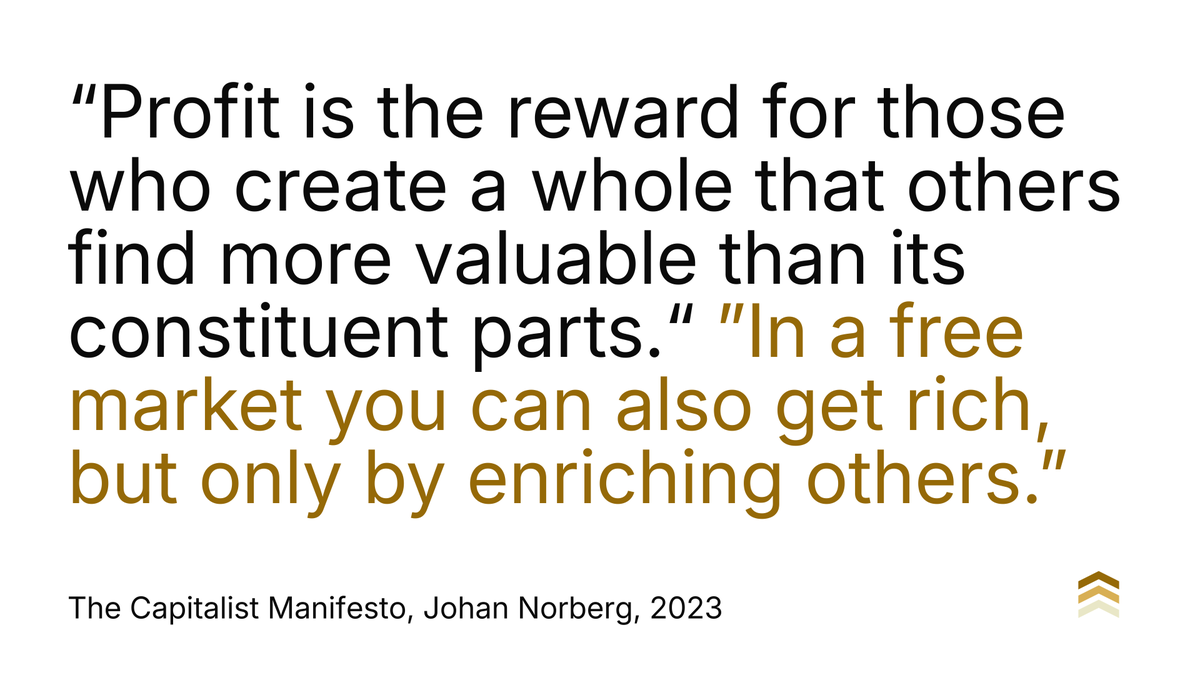
“Profit is the reward for those who create a whole that others find more valuable than its constituent parts.” “In a free market you can also get rich, but only by enriching others.” — The Capitalist Manifesto, @johanknorberg
Every year the economic gap between the US and Europe grows wider.
Progress studies is the field that asks why: why civilizations flourish or stall, and what we can do about it. It has gained real traction in the US, but the conversation is just starting in Europe. Last Monday in Stockholm, we hosted the first in a new salon series to help change that.
@johanknorberg talked about why golden ages end and how we can keep Europe’s alive; @StefanFSchubert about why we underestimate progress; and @beatrice_erk about what progress studies is and why Europe needs it.
Big thanks to everyone who joined us.
Zucman manipulated the stats you show below to make them fit his political story.
In 2018 he published a dataset that inadvertently revealed the real tax rate paid by the top 0.001%. It hovered around 40% in recent years - nearly twice what his 2019 chart claims to show.
WATCH: @johanknorberg and @nickgillespie discuss what makes societies prosperous, why protectionism and nostalgia keep returning, and how populism feeds cultural decline.
https://t.co/eZOsW8lMoB
Churchill disait que le capitalisme, c’est « le partage inégal des richesses », tandis que le socialisme, c’est « le partage équitable de la misère ».
S’il était un livre que tout candidat à la présidentielle devrait avoir sur sa table de chevet, ce pourrait être The Capitalist Manifesto, du Suédois @johanknorberg.
Dans une France oscilant entre souverainisme de droite et étatisme de gauche, cet essai passionnant publié il y a deux ans mais pas encore traduit en français (un bon test en langue anglaise pour qui prétend à la fonction suprême !) offre une alternative très documentée à quarante ans de socialisme de tous les partis.
@LesEchos
Excited to see this go live! My @reason Interview with @CatoInstitute fellow and Peak Human: What We Can Learn from the Rise and Fall of Golden Ages author @johanknorberg: "Why populism leads to decline" https://t.co/s6zIZ7PPan
.@johanknorberg warns America, “Don’t get cocky.”
Look at his country, Sweden - politicians passed socialist policies.
“It almost killed the Swedish economy.”





![aa_gilli's tweet photo. Interesting take from @johanknorberg on the diverging path of China and Europe towards the end of the Middle Age.
<<A few generations later, the influential writer Wang Yangming (1472–1529) even overturned the neo-Confucian emphasis on the natural world and its patterns. To him, only the mind was real, and knowledge of the good came from intuition, not instruction. Reality did not exist independent of the
mind, and therefore empirical study lost the significant position it had during the Song. Since no sensory experience could challenge such a complex metaphysics, nothing was really puzzling or challenging, and therefore all the empirical anomalies that troubled European scientists at that time, forcing them to investigate and develop better instruments, could safely be ignored.
[…]
The whole traditionalist counter-revolution was a cataclysm for China, bringing an astonishing era of progress to a dreary end. Eventually, the Ming court could not even adjust its calendar since the occupants of the now hereditary posts at the directorate of astronomy didn’t know how to do it.>>
<<In 1323, Thomas Aquinas, the controversial protagonist of a Christian Aristotelianism, was canonized by the pope, and from then on, Christendom increasingly saw the world as a beautiful place that could be understood through reason, logic and the evidence of the senses, and not just a vale of tears where we suffer and die, preparing for afterlife. The European barbarians would, as it were, become Greek.>>](https://pbs.twimg.com/media/HJp-asZW0AMRQ6u.jpg)