Nvidia's customer borrows to buy Nvidia. You own both.
Meta's free cash flow went from $8.5B to $784M in a year.
Buybacks stopped.
The campus didn't. The bond for that campus already traded at 94.4 cents. PIMCO anchored it. The index still calls the same spend growth. You hold the chipmaker. You hold the debtor. The premium you collected is the collateral for the next cluster.
Profit isn't the bill. Free cash flow is. And the bill has your name on it.
Your index fund owns Meta. Capex eats its cash: $784M left last quarter. Charlie Munger
A year earlier it was $8.5B. And the buybacks stopped.
Meta Q2 2026 results, Jul 29
Profit isn't the bill. Free cash flow is.
@NoLimitGains Everyone's reading this as a jobs story. The bill lands on AI debt.
Meta's Hyperion data center bond already hit a record 94.4 cents in late September.
PIMCO anchored it. The next campus borrows at this long end.
Everyone's reading your $100 Pixel hike as memory costs. It's memory margin.
Micron's phone and PC memory unit just printed a 90% gross margin.
Micron fiscal Q4 results, Sep 30
The phone price or the memory margin: which one gives first?
@NoLimitGains Nobody mentions the cash part of cash-secured puts.
One Nvidia put near today's price locks up about $23,000 of your money.
Stock tanks and you still pay the full strike. The premium just softens the hit.
@orbitalisVector Not cooling, not launch cost. Funding comes first.
SpaceX spent $15.8B on AI compute in Q2, and not one Starmind is in orbit yet.
SPCX holders are paying for that now, and orbit is still just the pitch.
Bought the Nasdaq at the March 2000 peak? You waited 15 years to break even. On price.
Seven weeks after that peak, Buffett told shareholders this.
S&P 500 Shiller CAPE on Sep 30: 41.00. Record: 44.19, Dec 1999.
What would you check first today: earnings or the multiple?
@Barchart Equal-weight S&P is on track for a losing streak it's only had twice, in 2002 and 2022. The only sectors up this month are the ones stuffed with AI megacaps
@unusual_whales Micron covered all of its fiscal 2026 capex with under a third of its operating cash. The memory side of the AI boom pays for itself, it's the hyperscalers buying the chips who are borrowing
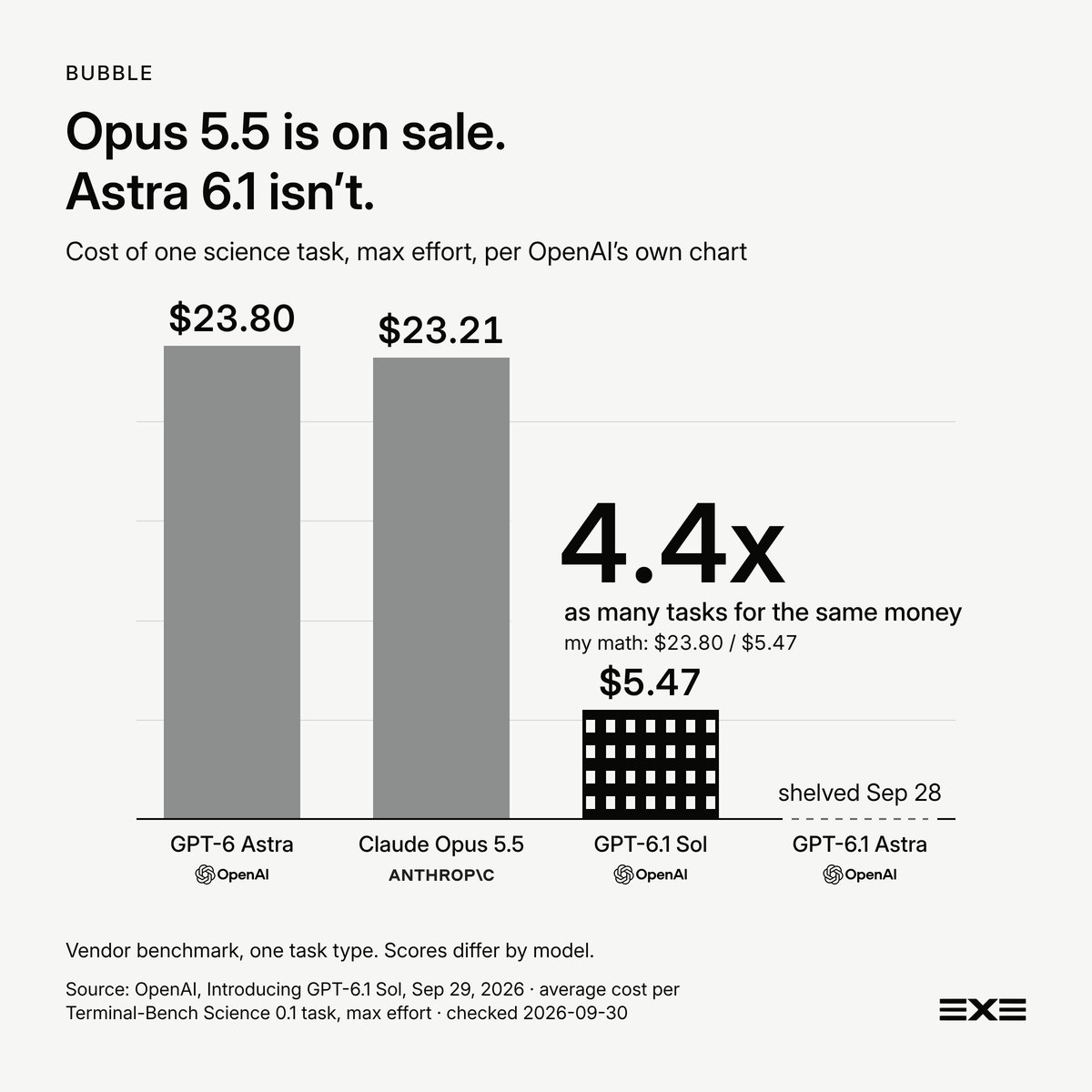
Claude Opus 5.5 is on sale. GPT-6.1 Astra isn't: OpenAI shelved it on Monday over safety.
What OpenAI shipped instead, GPT-6.1 Sol, does one science task for $5.47 on its own chart. Opus 5.5: $23.21. The same day, per Bloomberg, OpenAI asked investors for a $1.4 trillion valuation.
Those two pitches don't work at the same volume.
GPT-6 Astra on that chart: $23.80. A customer who moves that work from Astra to Sol pays OpenAI about a quarter as much per task. To bring in the same money, they'd have to run about 4.4x as many. That part is my math, not theirs.
OpenAI said Astra 6.1 fell short on staying within scope and authorization. So the next premium tier isn't on the price list.
And the $1.4T is pre-money, early talks, people familiar. March's $852B already counted the new money.
Every launch this month is pitched as the same work for less. The round is priced on a lot more of that work getting done.
Bain's "$6 trillion" for AI isn't a forecast of what AI will earn. It's Bain's data center spending forecast times four.
A year ago the same math gave $2 trillion. The multiplier didn't change. The spending estimate tripled.
Bain treats the buildout as fundable when capex runs about 25% of revenue, roughly where cloud providers sit.
Sept 2025: ~$500B a year of capex by 2030, so $2T of revenue needed.
Today: up to $1.5T a year by 2031, so ~$6T.
Different horizons, same ratio.
By Bain's own count, today's AI products cover 30% of that at most. The rest is supposed to come from robotaxis, robotics, drug discovery and products that don't exist yet.
Meanwhile model launches are now sold on fewer tokens per job. Sonnet 5.5 kept its list price and claims up to 30% less cost per task.
If the revenue bar moves every time the spending forecast does, is it still a test?
@KobeissiLetter Some of this is plain supply. Hyperscalers have sold over $200B of bonds this year, mostly long dated, to the same buyers Treasury needs