@elonmusk Above you, something swerves every 76 seconds. You never see it.
It's a Starlink dodging debris or another satellite: 207,152 times in six months, by SpaceX's own count. The company says it's automatic.
My bet: that software is the most underrated part of Starlink.
@JohatsuExe The $15.8B is Q2 AI compute capex, per SpaceX's earnings call. It doesn't say how much of it is orbital. Musk says Starmind launches start next year, so the orbital part is still a plan.
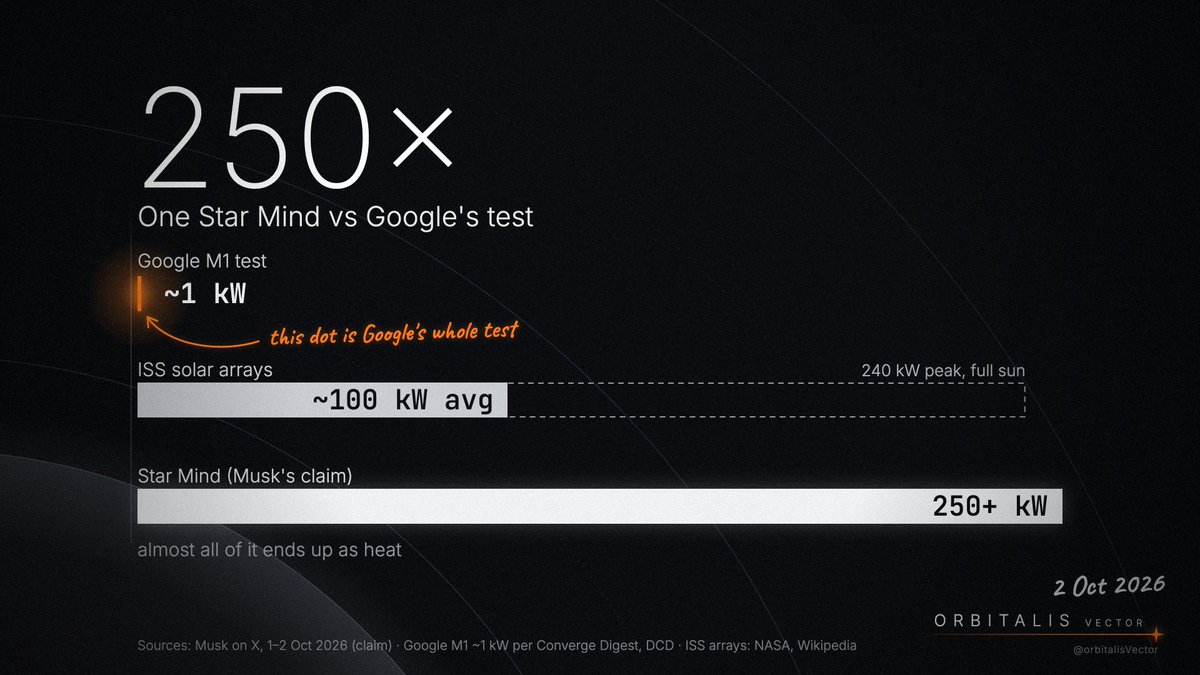
~1 kW powers Google's entire orbital AI test. Four TPUs.
Musk says one Star Mind gets 250 kW.
A chip turns almost every watt into heat. On Earth, air and water carry it away. Up there it can only radiate into the dark.
My napkin math: radiators from half a tennis court to two.
I'd bet on cooling, not launch cost. Who has a better answer?
@EyeToque Fair catch. June AI1 material says 150 kW peak, 120 sustained. The 250 kW is Musk's newer Star Mind post, solar power. Musk's own radiator figure, 1,400 W/m², gives ~110 m² at 150 kW, ~180 at 250. Which spec survives?
@Staikech Cooling is the gate, but those radiators still have to launch and unfold. My napkin math: 150 to 550 m² for 250 kW. What breaks first, the physics or the packaging?
@0xbobaaa Same ~300 m² on my side. But that's the ideal case: sunlight and Earth's glow also heat the radiator, so real numbers go up. Can chips live with a 350 K loop?
@XFreeze The scariest (and coolest) part isn’t the size.
It’s that in 2–3 generations these things will be able to train models directly in orbit — without downloading terabytes back to Earth. Who else feels like we’re standing at the edge of something massive?