opus 5.5 overruled me at 9:31 and i wanted to throw my f***ing laptop out the window
every chart screaming long. $25,000 account. finger on buy
it blocked the trade. no override. no "are you sure?" button
what happened 9 minutes later is the exact reason i stopped trading the open by hand
nasdaq dropped 180 points
so i gave 4 claude agents one job for 11 weeks: trade nasdaq and s&p 500 at the new york open, nothing else
only 9:30 to 10:30, 2 free quant libraries, zero manual trades
every setup has to survive 14 risk metrics, 2,000 bootstrap stress tests, 252 sma versions on the first hour, a risk split between nq and es and a fight with buy & hold
one agent scans the open, one kills bad trades, one analyzes, one gives the final yes or no
the parameters were fixed before the first test, nothing was tuned after
a setup that fails never touches the account
honest numbers
→ account: $25,000 → $33,740 in 11 weeks
→ best morning: +$2,310 by 9:52
→ worst morning: −$610
→ buy & hold over the same 11 weeks: +$1,900
→ days it refused to trade: 31 of 55
what this actually shows:
the money isn't in the trades it takes
it's in the ones it refuses
honest question: would you let 4 ai agents trade your account at 9:30, or is that insane?
Fable 5.2 is the MOST dangerous AI model right now.
It gives you AGI-adjacent reasoning.
That can discover new profitable trading strategies for you 24/7.
If you set it up correctly, you gain super powers. https://t.co/37IkQHiQEC
Floyd Mayweather says he made over $1 billion in 21 years of fights. At 49, he says $550 million of it was stolen. A man who was "sort of like a father figure" took $350 million. Another sat next to him "acting like a friend" and took $200 million. He found out years later.
Mayweather said it on Patrick Bet-David's podcast last month. "It's a guy who was sitting next to me acting like he was a friend helping me clean up business and he stole $200 million." The other one, he said, "was sort of like a father figure, but he stole 350 million from me."
He didn't say who either man was.
He already knew what it was to lose a father. He was born Floyd Joy Sinclair in Grand Rapids, Michigan. His mother was fighting a drug addiction. When he was 16, his father went to federal prison for smuggling cocaine, and the boy would make the two-hour trip just to visit him.
In 2006 he walked away from an $8 million payday and paid $750,000 to buy himself out of his promoter's contract. He wanted to own his fights. From then on, the deals and the payments went through the people around him.
In 2013 he signed a six-fight deal with Showtime. In 2015, his fight with Manny Pacquiao sold 4.4 million pay-per-views and brought in $410 million. No pay-per-view has made more.
Then he picked a new money man. Jona Rechnitz had pleaded guilty in 2016 to bribing NYPD officers. In May 2025, days after a magazine laid out his decade of run-ins with the law, Mayweather went on a stage in New York and said: "I trust Jona, not just 10 percent, 20 percent, 100 percent."
Then it all came out.
In February 2026, he sued Showtime for $340 million, saying his fight money was sent to accounts run by Al Haymon, the adviser who managed him for over a decade. Haymon isn't a defendant.
When his team asked for the numbers on Pacquiao and McGregor, the complaint says, they were told the records were lost in a flood.
In May 2026, he sued Rechnitz for $175 million.
His lawsuit says nearly $100 million of his jewelry was pledged for about $13 million.
And his private jet was signed away for $1.
In September, he dropped the case.
Rechnitz's lawyer has his own explanation: Mayweather had "gambling issues, prolific spending habits" and IRS tax liens. Paramount, which owns Showtime, calls his claims "baseless."
In the video below, Bet-David asks him straight out if $550 million was stolen from him, and Floyd answers in 8 words.
He paid $750,000 to buy his freedom from one promoter. He says the people he trusted after that took $550 million.
Is Floyd Mayweather a rich man who got robbed blind by the people he trusted most, or did the man they call Money spend it all himself and now he's looking for someone to blame?
$BTC
monthly gave a full flush. we're sitting in a bad range now.
the only thing that matters: close the month with a wick. 14 days left.
no big plan for that. any plan here questions a narrative that isn't even clear.
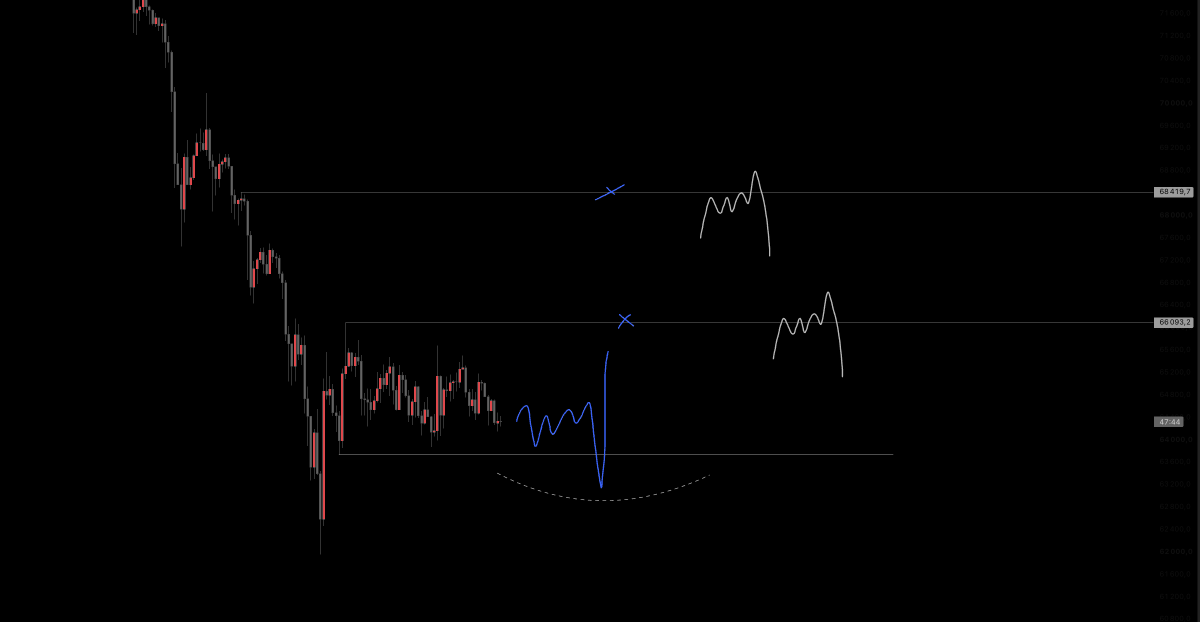
but i found one setup. it's on the 1h.
the short narrative is still there. how long it stays short, nobody knows.
the 57k low is too clean. dense, heavily defended. whether we take it depends on where price gets there from.
daily is full of FVGs. flipping them will be long and painful.
so, the 1h:
- printed a mid-term low, got bought fast
- built a shelf of equal lows, swept part of it
- reacting now. weak reaction, daily FVG right overhead
that FVG questions every long. but the short impulse got blunted. the aggression is gone and we took a good target.
so i want a long correction:
→ 66.1k, first daily FVG. a reaction is fine, it should be weak
→ 68.4k, second daily FVG. that's where it should stall
from there: short continuation, or wait for a monthly reversal.
what gets me in:
- clean manipulation, ideally on the 1h
- 15m iFVG as confirmation
- speed. if the manipulation drags slow and long, the idea is dead
on the plus side, we swept internal liquidity and barely reacted. that's aggressive buying. and the zone itself is interesting for longs.
looks beautiful so far. we'll see.
long the sweep, or wait for 68.4k to short?
In 2019, Sam Bankman-Fried had his college roommate write a secret line of code. It let his fund take customer money with no limit. $8 billion was gone. His roommate, ex-girlfriend and top engineer testified against him. He's serving 25 years. They did 440 days combined.
Bankman-Fried was the son of two Stanford law professors. He met Gary Wang at a math camp in high school, and they roomed together at MIT. He said he wanted to get rich only to give it all away. He drove a Toyota Corolla and slept on a beanbag next to his desk.
In 2017 they started a crypto hedge fund, Alameda Research. In 2019 they launched an exchange, FTX. Soon after, Wang says, Sam asked him for a feature called "allow negative." Alameda's account could go below zero and keep withdrawing, "essentially without any limits." The money came from customer deposits.
The limit started at $1 billion. "We picked a number so high it would never be hit," Wang told the jury.
It went to $65 billion.
By 2022 Forbes put Sam's fortune at $26.5 billion. Tom Brady, Steph Curry and Larry David were promoting FTX. He lived in a $35 million penthouse in the Bahamas with about 10 roommates, Wang among them.
Then, days before the collapse, Sam asked Wang if he'd counted "our Korean friend." Wang had no idea who that was. Nishad Singh, the head of engineering, told him: it was the $8 billion hole.
Wang brought Sam the number. Sam said, "that sounds correct." Wang says he didn't even look surprised.
November 2022: FTX files for bankruptcy.
December: Sam is arrested in the Bahamas.
Days later, Wang and his ex, Caroline Ellison, plead guilty. Singh follows.
October 2023: all three take the stand against him.
Ellison says she made 7 fake balance sheets and Sam picked No. 7.
March 2024: 25 years. June 2026: appeal lost.
The others:
Ryan Salame, the one top executive who didn't testify: 7.5 years.
Caroline Ellison: 2 years. Out after 440 days.
Nishad Singh: no prison.
Gary Wang, the man who wrote the code: no prison.
And one line from Wang's own testimony: Sam never wrote, reviewed or implemented FTX's code. He told Wang what to build.
"He directed me to commit these crimes," Ellison told the jury. The appeals court called the evidence "conservatively stated, robust."
Sam says he doesn't think he was a criminal. From prison, he told Tucker Carlson that anyone close to him "ended up with a gun to their head," with two options, and one of them was decades in prison.
In the video below, Sam explains why everyone who was close to him turned on him.
Three people helped build it. Between them, they served 440 days. Sam is serving 25 years.
Is 25 years too much for one man when the three who did it with him are free, or too little for $8 billion?
You weren't hacked so someone could steal your money. You were hacked so your money would work for someone else.
We've seen this play out before. In June.
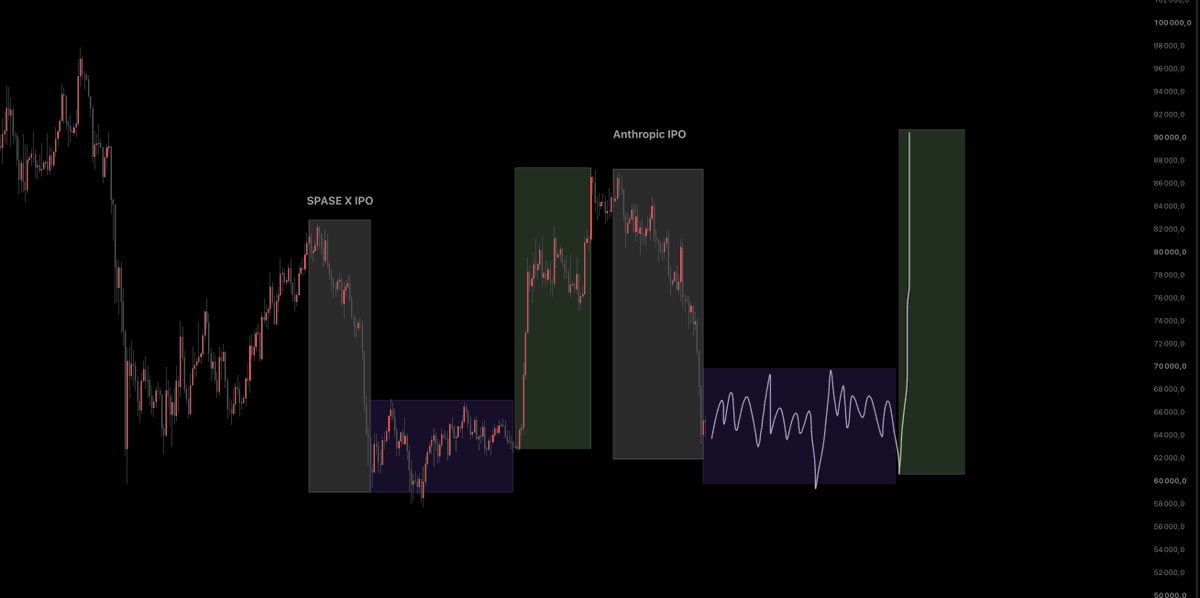
SpaceX IPO on Nasdaq → dump → boring consolidation → aggressive longs.
It's happening again. And this time it started with a hack.
1 → The hack
Binance lost $6.3B in about 20 minutes. The biggest hack in crypto history.
Binance covered the losses. But the real damage wasn't to the wallets. It was to people's heads.
Everyone's running to fiat, to cash, anywhere but assets.
Meanwhile, over $3B of the stolen funds is still sitting in the hackers' wallets. They're not panicking. They're waiting.
2 → Nvidia and the "Chinese spy"
A woman from Jensen Huang's inner circle. US intelligence believes she was working for Beijing. According to the NYT, Trump knew for almost a year and said nothing.
Sounds like a romance novel. That's exactly why I don't buy it as the main story.
When the people at the top need to hide something, they don't go quiet. They hand the crowd a louder story.
3 → Anthropic IPO
There isn't much free money in the world right now. And everyone wants in on one of the biggest IPOs of the decade.
Where do you get the cash? Sell risk.
BTC is first in line.
Doesn't matter if you're retail on your phone or a hedge fund with a Bloomberg terminal.
The interesting part won't be the dump.
It'll be the consolidation, when everyone is bored and scared at the same time.
That's where the best prices were handed out in June.
They've already scared you.
The only question is whether you'll hand them your coins too.
Bitcoin is now perfectly mirroring the pattern from 2017 and 2021.
According to this chart, $BTC will dump from $65,000 to $35,000 in 10 days.
Are you actually prepared for that scenario?
@PennyLedgerr Fair, and your checklist is right. Funding, basis, vol compression is how you confirm it.
But the post isn't the trade. It's the why behind the flows.
Structure tells you when. Narrative tells you who's selling.
You weren't hacked so someone could steal your money. You were hacked so your money would work for someone else.
We've seen this play out before. In June.
SpaceX IPO on Nasdaq → dump → boring consolidation → aggressive longs.
It's happening again. And this time it started with a hack.
1 → The hack
Binance lost $6.3B in about 20 minutes. The biggest hack in crypto history.
Binance covered the losses. But the real damage wasn't to the wallets. It was to people's heads.
Everyone's running to fiat, to cash, anywhere but assets.
Meanwhile, over $3B of the stolen funds is still sitting in the hackers' wallets. They're not panicking. They're waiting.
2 → Nvidia and the "Chinese spy"
A woman from Jensen Huang's inner circle. US intelligence believes she was working for Beijing. According to the NYT, Trump knew for almost a year and said nothing.
Sounds like a romance novel. That's exactly why I don't buy it as the main story.
When the people at the top need to hide something, they don't go quiet. They hand the crowd a louder story.
3 → Anthropic IPO
There isn't much free money in the world right now. And everyone wants in on one of the biggest IPOs of the decade.
Where do you get the cash? Sell risk.
BTC is first in line.
Doesn't matter if you're retail on your phone or a hedge fund with a Bloomberg terminal.
The interesting part won't be the dump.
It'll be the consolidation, when everyone is bored and scared at the same time.
That's where the best prices were handed out in June.
They've already scared you.
The only question is whether you'll hand them your coins too.
Bear Stearns workers lost more than $3 billion of their own savings in less than a month. Days before the bank sold for $2 a share, Jim Cramer yelled at his viewers: "Don't move your money from Bear! That's just being silly!" Then Jon Stewart found a tape of Cramer's own voice.
In the video below, Cramer explains on camera how a hedge fund fakes a stock's story, and why, in his words, "the SEC doesn't understand it."
Cramer didn't start rich. In 1979, two years out of Harvard, someone broke into his apartment and took everything. He spent nine months living in his Ford Fairmont with a gun for protection, and he still put $100 a month into stocks.
He made it to Goldman Sachs, then started his own hedge fund. He raised $450 million and kept 20% of the profits. He said he "routinely" took home $10 million a year. Then CNBC gave him his own show, Mad Money.
On January 24, 2008, he told viewers to buy Bear Stearns. The stock was above $60.
On March 11, a viewer named Peter emailed the show. He wanted to know if he should be worried about Bear Stearns and get his money out. Cramer didn't hesitate. "No, no, no! Bear Stearns is fine! Do not take your money out."
Five days later it was over.
The Fed backed a rescue deal with $30 billion.
JPMorgan bought the bank for $2 a share.
Bear's own workers owned about a third of it.
They lost more than $3 billion.
About 7,000 of them faced layoffs.
"Never in my wildest dreams did I believe we would be sold for $2," one trader told The New York Times.
A year later Stewart brought Cramer onto The Daily Show and rolled a 2006 tape. In it, Cramer explains how a hedge fund can push a stock around with as little as $5 million. He calls it "blatantly illegal." And then: "It's a fun game, and it's a lucrative game."
"It's not a f***ing game," Stewart told him.
Cramer has his own version. He says Peter asked about money held at Bear, not the stock, and that money was safe. "The fact that I was right rankles me even more," he wrote. A week after the deal he also said: "Okay, I was wrong. Bear Stearns was in trouble."
But Peter didn't ask about a technicality. He asked if he should get his money out.
In February 2023, Cramer told viewers to buy Silicon Valley Bank. A month later it collapsed too.
It took Cramer one sentence to tell Peter his money was safe. It took Bear's workers less than a month to lose $3 billion, and for many of them, their life savings.
Cramer stayed on TV.
So did Jim Cramer lie to the people who trusted him with their future, or is he taking the blame for a crash he never caused?