Same 700 million shares. Ten times the paycheck.
Buffett's warrants covered 700M shares at $7.14, which is exactly what $5B of plain stock buys at that price. Plain stock paid a penny a quarter, roughly $28M a year on 700M shares. His $5B ranked ahead of it and paid 6%, $300M a year, whatever the stock did.
Call it courage if you want. It also came with a coupon and a 10-year option, and regular holders footed the bill.
Yesterday I said Iran gave Texas a raise. Here's the payslip.
Gas costs about $2.90 in Texas right now and over $26 in Europe. Same gas, roughly nine times the price. Cool it into a liquid, put it on a ship, and you get paid for that gap.
Qatar used to fill a lot of those ships. Much of its gas is stuck behind Hormuz, so buyers go looking for whoever else has a terminal, and that's mostly America. Nobody's cheering, but that's how it works: the war is a tax on everyone who can't get gas, and the money goes to the people who can. Every story about Qatar's losses is also a story about somebody's income, and I keep waiting for someone to write that one.
@UnfleshedO@thsottiaux Ha, they don't even need the split. Pro is a flat fee, so OpenAI gets paid the same whether the dot wins or loses, and the chip owner gets paid by the hour either way. The only one actually exposed to the trade is you.
@Rubos_Rex@thsottiaux Could be, and nobody outside OpenAI can check that. The meter runs the same either way, and whoever owns the chips gets paid by the hour.
On paper, 60 million kids just became one giant buyer of US stocks. Every account goes into one master trust and then into index funds. But money only arrives when a parent sends it, and I'd bet those are the families already owning stocks. So this moves who holds the shares less than the headline says.
@StockSavvyShay The biggest mistake is thinking the move is the opportunity.
By the time $BE is up 11.79%, the opportunity everyone is talking about has already changed. The real edge is understanding what caused the move before the crowd had a reason for it.
Highest since 2004, and America's biggest foreign lender is burning cash at a record pace.
Japan holds about $1.1T of Treasuries. Its reserves fell $79.6B in August alone, defending the yen, the biggest monthly drop it has ever had. I'd bet some of that came out of the same drawer. Who's buying 30 years at 5.587% if Tokyo keeps reaching in?
Trillions will flow. Through one gate, until 2051.
What got signed today is a license, not a blockchain. Cboe stays the only exchange for S&P 500 index options for another 25 years, tokenized or not. And CME owns about a quarter of the index owner, so even the rival skims it. I'd watch the pipe, not the chain.
The people who get paid first just got scared. The people who get paid last bought a record.
When a company breaks, lenders get their money back before shareholders. So when lenders start buying insurance, I pay attention. In September they did it in four places at once.
Treasuries. MOVE, the bond market's fear gauge, is near its highest in a year. The VIX, the stock version, sits near its lowest. Those two usually move together. Right now they point in opposite directions.
Blue chip credit. Insurance on investment grade corporate debt (CDX IG) went from the middle of its 1-year range to the top in about two weeks. That's the safest corporate paper in America getting repriced.
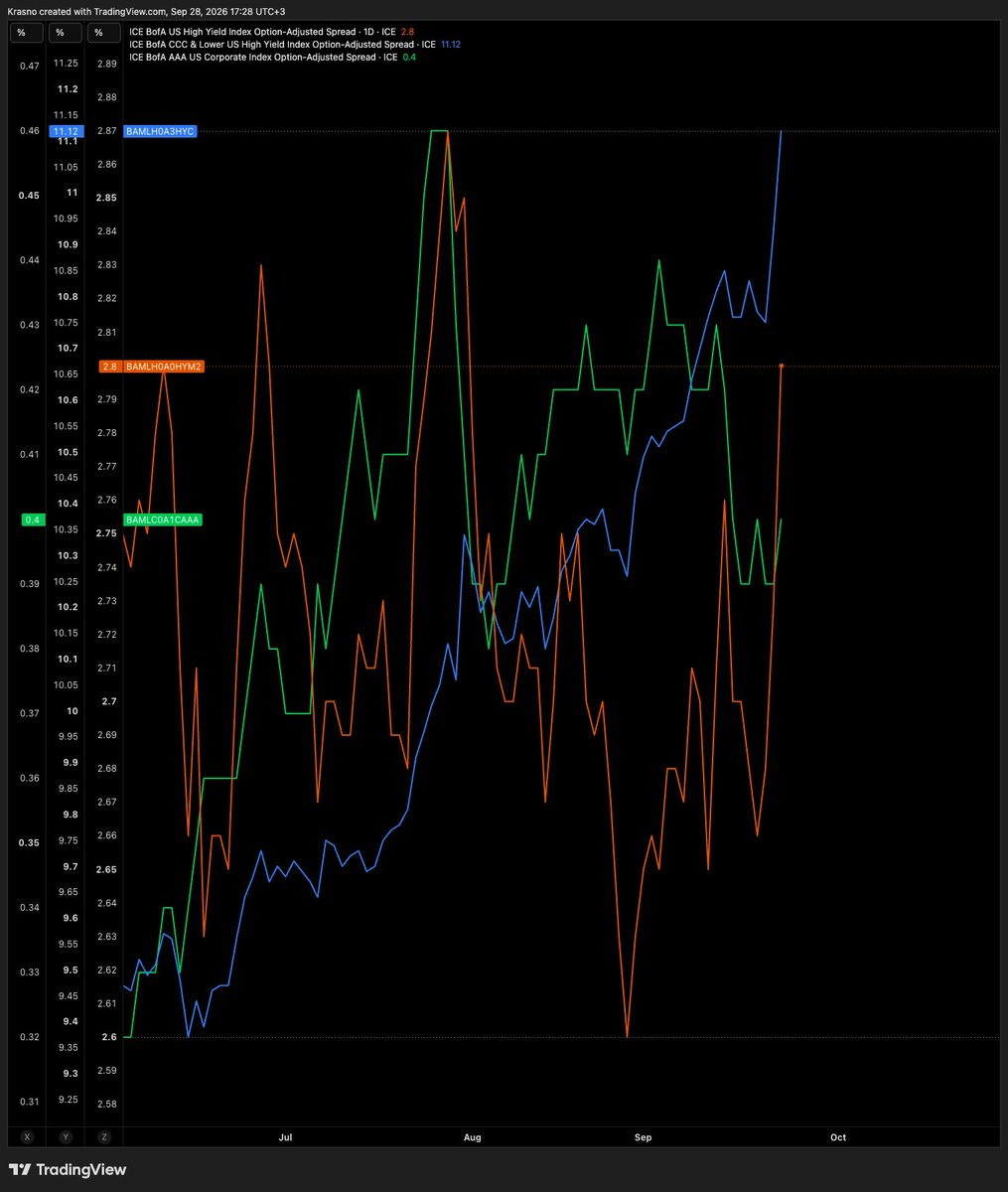
The weakest borrowers. CCC bonds now pay 11.1% over Treasuries, up from 9.4% in June. The broad junk index barely moved. Stress starts at the bottom of the ladder and climbs.
The stock market itself. Goldman's breadth gauge just hit its worst reading since 2000. The S&P is near its highs, the median stock is nowhere close. A few giants are carrying the whole thing.
Options are leaning the wrong way too. Calls betting on more upside are expensive. Puts that protect against a drop are cheap. Everyone's paying to own the rally, almost nobody's paying to insure it.
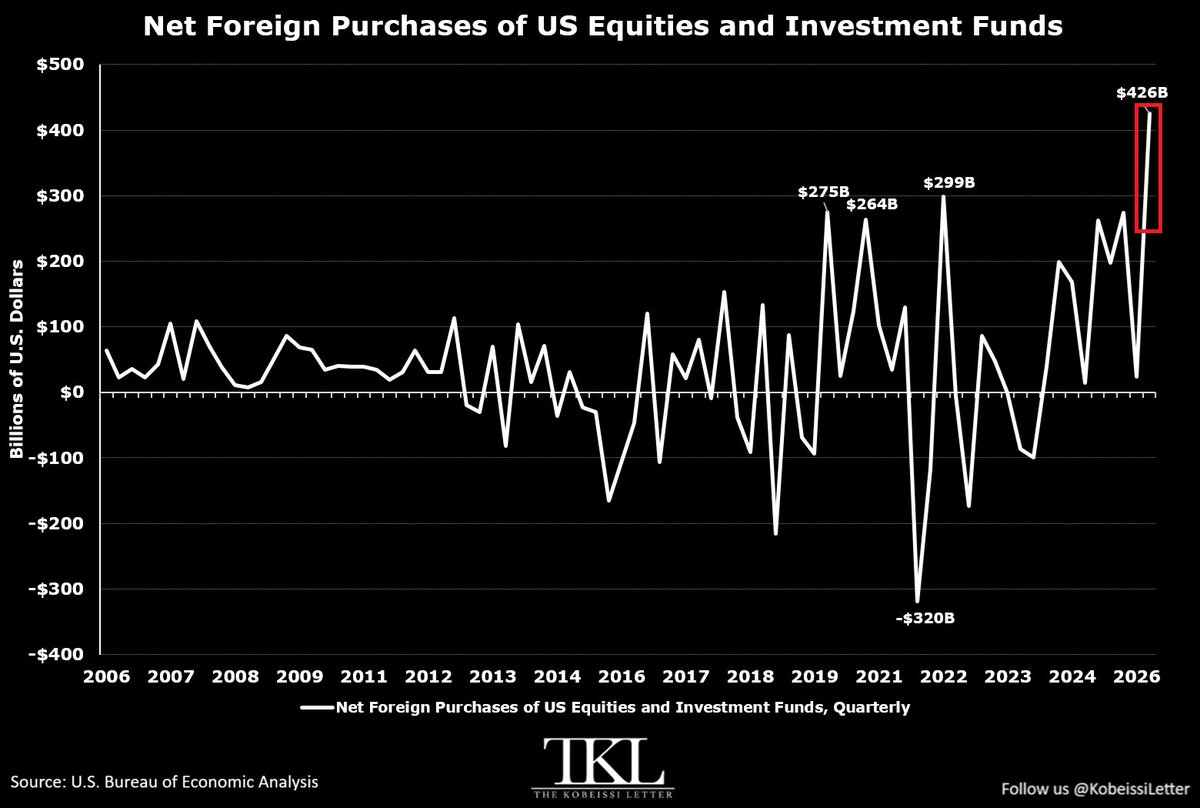
Now look at who's buying. Foreigners put a record $426B into US stocks in Q2. Their bond buying fell 40% in the same quarter. They walked away from the market that's nervous and piled into the one that isn't.
Here's what bugs me. Lenders have the better seat. They get paid first, they see the balance sheets up close, and they're the ones hedging. Shareholders have the worst seat, and they're the calm ones.
That's backwards. October earnings will tell us which side read it wrong, and I know which side I'd rather be standing on.
BREAKING: Foreign investors bought a net +$426 billion of US equities and investment fund shares in Q2 2026, the largest quarterly purchase on record.
This marks the 9th consecutive quarterly net purchase, totaling +$1.6 trillion.
By comparison, the previous record of +$299 billion was set in Q2 2022.
Furthermore, foreign investor purchases of US equities and investment fund shares rose to +$942 billion in the 12 months ending in July, their largest rolling 12-month total in Treasury data going back to 1985.
Meanwhile, foreign investors bought a net +$188 billion in US debt securities in Q2 2026, down from +$314 billion in Q1 2026.
Foreign investors are piling into US equities.
@NexasHub@KobeissiLetter Differentials are the tell, agreed. They've already moved once.
In August Iranian Light went from $3 under Brent to $2 over in a single week (Reuters), because nothing was getting out. If it slips back under Brent, that's the real signal, not a headline. I'll be watching it.
@YConscience77@oguzerkan Half right. Refiners fatten margins in every crisis. But crude is still the biggest chunk of your pump price, and that's the part the war moved.
@BullTheoryio Oil's getting cheaper already. Just not for you.
Saudi is running a sale right now, biggest discount for Asia since 2020.
Americans are still paying $4.48 a gallon, over a dollar more than last year.
Crude drops in an hour. Pump prices never get the memo.
Every $100 you put in an S&P 500 fund sends about $40 to just 10 companies. That's Peter's bear market.
Ten years ago it was $19.
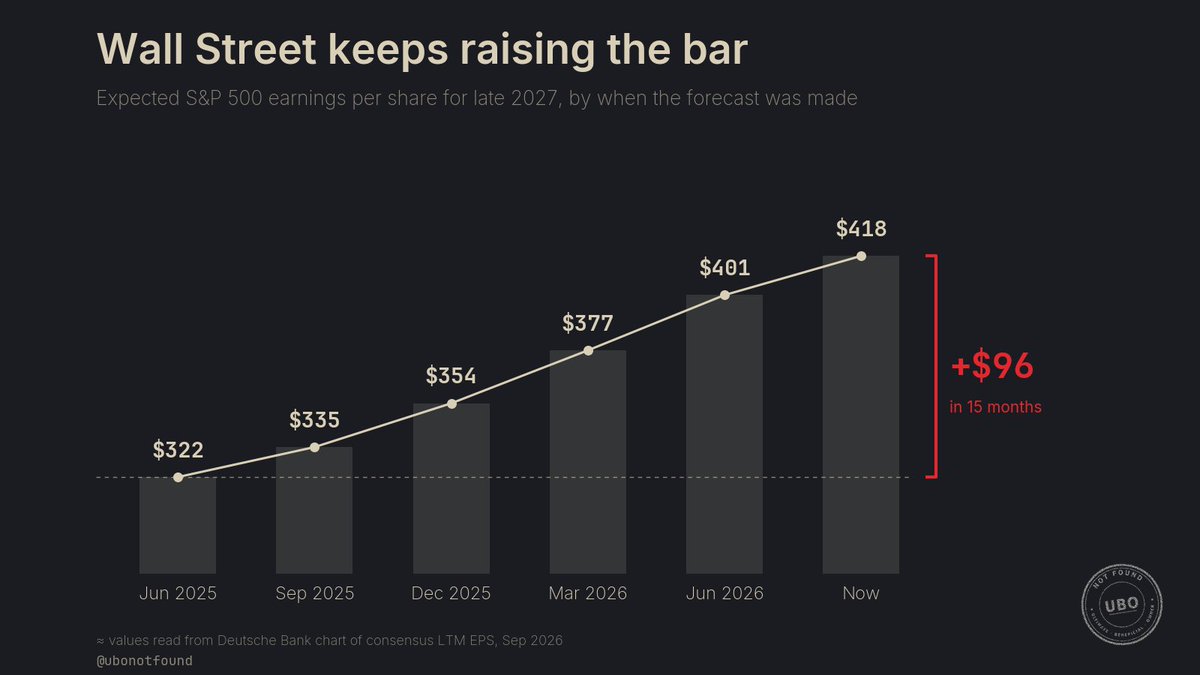
The other 490 aren't broke. Profits grew in all 11 sectors in Q2, up 33% overall per Deutsche Bank. The money just stops at the top.
So I wouldn't call 1973 yet. Either those 430 are cheap, or their earnings are about to roll over. October reports settle it.
The S&P 500 is 0.7% below a record high, yet 430 of those stocks are 21.7% below their highs. That means on average 86% of the stocks are in a bear market. Breadth has only been this bad twice, in January 1973 and in 1999/2000. On both occasions, the S&P then crashed nearly 50%
@unusual_whales Every Fed hike sends Bessent a bill of about $18B a year. Treasury's short-term debt reprices within months. So yes, he'd love the Fed to believe AI fixes inflation.
@MarioNawfal Iran just gave Texas a raise.
With Hormuz closed, someone has to replace the Gulf barrels, and Texas is first in line. US crude sells about $13 under Brent. Exporters buy at home, sell at the world price and keep most of that gap. Every week without a deal pays them again.
@Barchart This chart just sent you a bill. US debt is $40T, so every 1% on this line adds roughly $400B a year in interest once old bonds roll over. Bondholders cash it. The check comes out of your taxes.