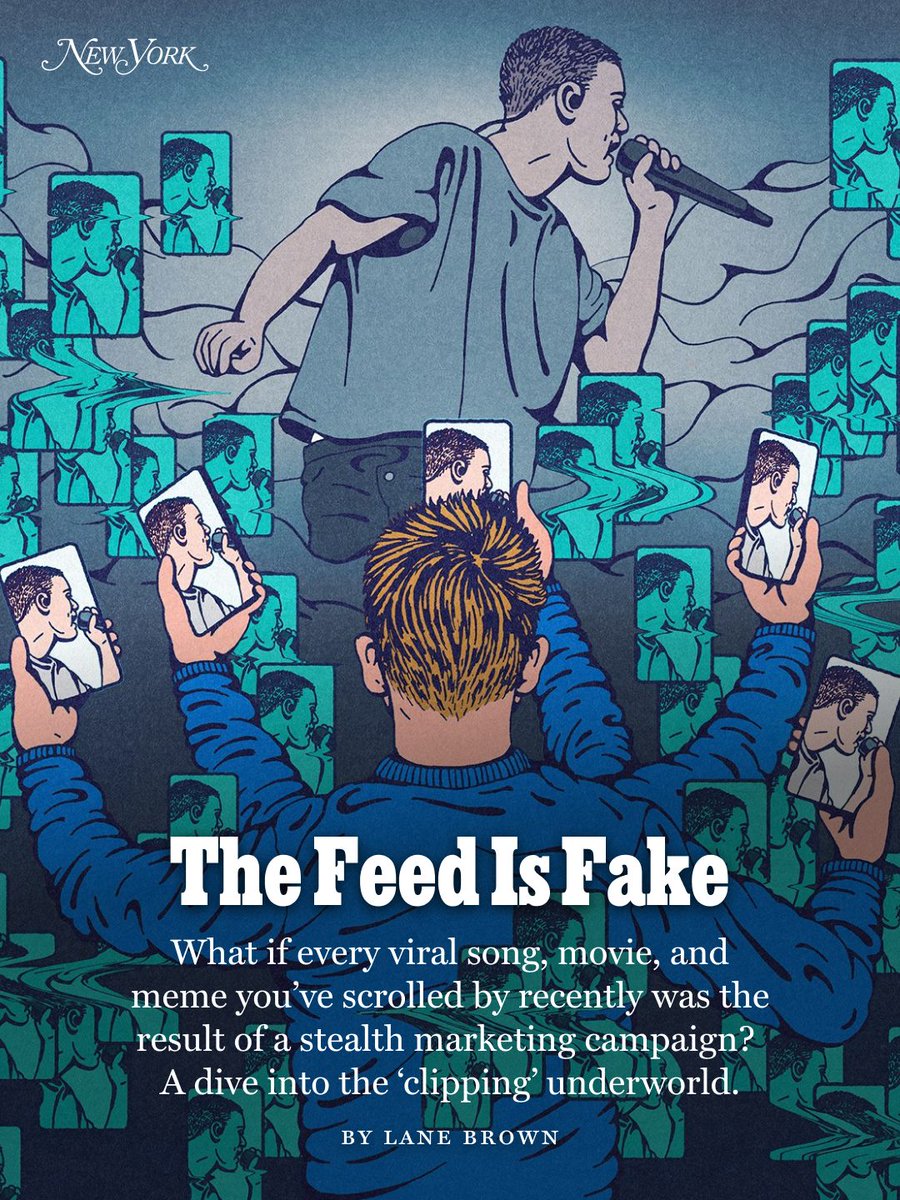
Joe Lim estimates that 90 percent of what you see on the internet is advertising in disguise, and he should know. For three years, Lim ran a company called Floodify, which at its peak operated 65,000 dummy social-media accounts used to drum up attention on behalf of paying clients.
The point of this kind of marketing is that nobody is supposed to notice it. But lately, the machinery has started to show.
In April, Justin Bieber headlined two consecutive weekends at Coachella. Coachella is the biggest stage in pop music save only for the Super Bowl, the kind of event that in theory generates its own attention. And yet on both weekends, a Discord server writer Lane Brown had been monitoring hosted paid campaigns for Bieber’s Coachella performances, offering clippers — people who are hired to turn a song, trailer, interview, stump speech, or whatever into short, social-media-friendly fragments — as much as a dollar per thousand views.
“On social media, popular opinion is being formed, measured, and manipulated all at once, and every signal the platforms produce — a trending song, a backlash, a talking point, the feeling that ‘everybody’ is suddenly talking about the same thing — can now be fabricated by unseen actors with hidden agendas,” writes Brown.
“Everybody is doing this now,” Lim says. “And if you’re not, you’re behind.”
Brown reports on how the same techniques are now being used to fool people on every app they go to in order to find out what other people think, not just in music but across entertainment, politics, consumer products, and celebrity gossip: https://t.co/hlcdfSmzPc
🇨🇦 Know anyone at Meta in Canada who can help Emily Howard (and possibly the hundreds or thousands more entrepreneurs building their businesses on Instagram and Facebook who get their accounts / livelihoods hacked or deleted with no way to get them back)? Or any journalists who can further share / report on stories like this? Pls share!
Emily, a visual artist based in PEI, spent 8 years building her community on IG to almost 40,000 followers. She woke up a few days ago and her account was gone.
Meta's shift to AI customer support means the company essentially offers NO customer support (I've been a victim of this as well, conversing for hours with a dumb bot). It is nearly impossible to reach a human. The company takes ad money from all kinds of scammers, but neglects the actual people legitimately trying to use their products.
Full conversation with Emily on this week's The AmberMac Show podcast: https://t.co/rAJC44hWlT
cc @jeffmacarthur
Imagine back in the heyday of online essay mills, if the push had been to teach students to use essay mills ethically and to develop essay mill strategies. Or if we had accepted that essay mills were okay for grammar and organization but taught Ss to make the essays their own.
Yet another example of what I call the "K-Shaped Life Experience." Those at the top get in-person experiences, while those below get to interact with a machine.
The divide is not just wealth; it is what wealth now affords to those who have it versus those who don't.
I'm not excited about summer 2027 when children are running around the playground wearing (hopefully kid-proof and safe) AI pins with Life360 apps. But I do think that's partly where all this goes, and you'll be told that this is safer for the kids than smartphones/tablets.
This finding is fairly compelling evidence of what AI is doing to the job market for recent college grads. Certain fields like computer science and information science are more exposed to displacement by AI. Amazing that just a few years ago some were telling the underemployed to “learn to code.”
“We found that graduates in fields more exposed to AI have suffered markedly worse outcomes. Between 2022 and 2024 graduates in the least-exposed quintile—studying subjects such as education, philosophy and civil engineering—saw their average full-time employment rate fall by just 1.5 percentage points. Those in the most exposed quintile—including computer science, computer engineering and information science—suffered a 6.6 percentage-point drop.”
While it's true that professors are most highly rewarded for research, I think that it is good service to industry to occasionally dump some ivory tower spillover. Yes, much of it will be useless, but but more capable/active hands may make use of it.
Going to try to blog more about tech and observations. I was interested in what I saw as the creep towards wearable AI in summer 2025, and then said/did nothing with it except email with a co-author. Huge mistake. No points for good thoughts.
AI is a reverse printing press. It's the exact inversion of what the printing press did. AI now creates the incentive NOT to write, NOT to communicate in ANY form that will be disseminated. AI means that if you discover something, you should keep it a secret and sell the secret
You may have heard that Jeffrey Epstein was bad at investing.
You probably have not heard exactly why.
I looked through his brokerage statements (which has not been reported on).
He was trying to swing-trade broken turnaround stories, including AOL, BlackBerry, and Sears.
More on it on the latest episode of "This Time is Different".
Memorization, Phonics, Sentence Diagramming, Rote Learning, Penmanship, Shop Class/Home Economics...I get why we de-emphasized many of these skills and classes, but they are needed fundamentals in K-12 for good college prep.
One of my more right wing positions is that a classical education on traditional subjects with high expectations for students was very much a good thing and that we should find ways to get our educational system back to it.
I find myself musing about this as I teach basic operations to business students. When should I fuss about details and when is it ok to tell students something can be done imprecisely?
Understand the concept of "by-and-large" and use approximations. Because our educational system is hung up on precision, the art of being good at approximations is insufficiently valued. This impedes conceptual thinking. For example, when asked to multiply 38 by 12, most people do it the slow and hard way rather than simply rounding 38 up to 40, rounding 12 down to 10, and quickly determining that the answer is about 400. Look at the ice cream shop example and imagine the value of quickly seeing the approximate relationships between the dots versus taking the time to see all the edges precisely. It would be silly to spend time doing that, yet that's exactly what most people do. "By-and-large" is the level at which you need to understand most things in order to make effective decisions. Whenever a big-picture "by-and-large" statement is made and someone replies "Not always," my instinctual reaction is that we are probably about to dive into the weeds--i.e., into a discussion of the exceptions rather than the rule, and in the process we will lose sight of the rule. #principleoftheday
1575. Des loups ont tué deux bergers.
Un scribe écrit : "c'étaient des sorciers déguisés en loups".
Un 2e scribe ajoute : "moi je pense que c'étaient des harengs déguisés en hommes".
Le 3e scribe : "vous n'êtes pas drôles" 🤣
Une pépite partagée par @JDDelle_Luche !