⚡️Finance is about to become software.
Not metaphorically. Literally.
For centuries, ownership has been trapped inside slow institutional databases that cannot communicate.
Every intermediary exists because those databases do not naturally synchronize.
Clearing houses, custodians, transfer agents, reconciliation teams, settlement cycles, correspondent banks - all compensate for fragmented ledgers.
A globally shared settlement layer removes an enormous amount of that coordination cost.
That changes the architecture of capitalism.
The biggest misconception is believing tokenization is about creating new assets. It is about making capital programmable.
Once capital becomes programmable, assets stop behaving like static certificates and start behaving like software objects.
Software compounds.
Static paperwork does not.
The next twenty years are less about crypto than about the operating system underneath finance replacing the operating system above it.
Most people are staring at coins.
The money is in the rails.
The market will eventually stop saying “crypto” and simply call it finance.
The winners will not necessarily be the loudest blockchain projects. The winners will own the interfaces between governments, institutions, identity, custody, liquidity, and programmable settlement.
Every previous financial revolution reduced friction.
Electronic exchanges replaced trading pits.
Internet banking replaced branches.
Digital payments replaced cash.
Programmable ownership replaces paperwork.
That progression feels structurally inevitable.
The largest underappreciated implication has almost nothing to do with speculation.
Collateral becomes mobile.
Capital becomes continuously usable.
Idle balance sheets become productive.
Settlement risk collapses.
Velocity increases.
Once capital can move instantly, entirely new financial products become possible that simply could not exist under multi-day settlement.
That is where the explosion comes from.
The deepest insight in Chesky’s thread is the comparison with the internet.
The internet did not make information more valuable.
It made information frictionless.
The value explosion came afterward because friction disappeared.
The same pattern is likely to occur with capital.
The hidden variable almost nobody appreciates is artificial intelligence.
Human-scale financial infrastructure becomes the bottleneck once AI agents begin transacting economically. Software negotiating with software cannot wait for paper signatures, manual reconciliation, business hours, or settlement cycles measured in days.
Machine-speed economies require machine-speed ownership.
Programmable capital is the financial operating layer for autonomous economic agents.
That convergence between AI and tokenized financial infrastructure is much bigger than tokenizing real estate.
That is the real destination.
This took 2.5 months, but have completed a full, agentic ERP for a company
Rethought every system and approach, built a custom ERP fully agentic backed.
This manages everything for them, runs agents with locally hosted small models (so no token burn) and helps run a large part of the business just by talking/typing to it
Because its agentic backed, we can tune how it works by adjusting system prompts, skills, and tools.
Built a backend system of record, agentic middleware, and UI.
Heavily used
- Our own Agentic Harness specifically for enterprise (tracking, security, audit, observability focused - with quick deployment and tuning of agents for any purpose)
- Langgraph for dialed in workflows
- Litellm/vllm inferencing
- react front
hosted as microservices and full API so they can build anything they want off of it (fastapi)
This thing is next level
You are going to be able to run Fable 5 locally on your desk
In 2 years Apple will be coming out with Mac Studios with 1.5TB of memory
With just 300gb of memory you can run Opus 4.8 level intelligence
Think of what you can do with 5x that
You need to be preparing for this now
Start getting familiar with local AI technology
Go to your Hermes/OpenClaw and use this prompt:
“I am brand new to local AI and want to get familiar. Look at the computer you are currently on. Understand the specs. Then go on Huggingface and find the best models I can run on it. Then, walk me through how these models work, how they will run locally, and use cases I can do with them. After walking me through all of that so I’m educated, you can then load it onto this computer and build an interface so I can use them”
In 2 years EVERYONE on Earth will have a local model running on their desk
The people who start preparing now will be WAY ahead of everyone else
On the island of Roatán, off the coast of Honduras, a company called Próspera runs something the textbooks say cannot exist: a functioning jurisdiction where governance is a service you purchase rather than a burden you inherit at birth.
The mechanism is elegant. You sign an agreement with the platform, pay a flat annual fee (around $260 for Hondurans, $1,300 for foreigners), and in exchange you get a legal system, dispute resolution, and a regulatory menu you actually choose from. Businesses select which country's regulations they want to operate under. A clinic can opt into Arizona medical rules. A builder can pick from a set of international codes rather than wait for a bureaucrat in Tegucigalpa to stamp a form. The contract binds Próspera too, which is the part statists never understand. When the ruler signs the same document as the ruled, arbitrary power gets expensive.
This is Paul Romer's charter city idea stripped of its World Bank chaperone and handed to private capital. Honduras passed the ZEDE law in 2013 under President Juan Orlando Hernández. Próspera opened in 2020. The residents came. The capital came. Then the politics arrived.
President Xiomara Castro's government repealed the ZEDE framework in April 2022, and Honduras now faces Próspera in international arbitration with a claim that reached $10.775 billion, roughly a third of the country's GDP. Consider what that tells you. A nation of nine million people torched a project that promised jobs and foreign investment, then discovered that breaking contracts with people who read contracts carries a price.
The lesson here is old: property rights and legal predictability produce development. They are not luxuries you enjoy after development. Hong Kong under British common law went from fishing rocks to financial capital on exactly this insight, no natural resources required.
Próspera's enemies call it a colonial enclave for the rich. Odd, then, that the cheaper residency tier is reserved for the locals, and that the whole point is letting a poor Honduran opt out of the sclerotic system that kept his grandfather poor.
Governments hate exit. Próspera is exit made legal, priced, and voluntary. Watch which side blinks.
Satya Nadella just warned every company using AI: you are paying twice. Once with money. Again with something far more valuable.
He published an article introducing something called the Reverse Information Paradox.
And it changes how you think about every AI tool your company uses.
Nobel laureate Kenneth Arrow described the original paradox: a seller risks giving away knowledge just to sell it. Nadella says AI flips this completely.
In the AI age, the buyer gives away knowledge just to use what they bought.
Every time your team uses Claude or GPT at work, every prompt reveals what you are building. Every correction teaches the model what good looks like inside your company. Every eval shows what you value. Every trace exposes your workflow.
The model provider learns more about you with every interaction. You learn almost nothing about what they are learning in return. Your corrections are distilled institutional know-how. The kind a competitor could never buy.
And it leaks trace by trace, correction by correction, without you noticing.
His line: "You can offload a task. You can offload a job. But you can never offload your learning."
If the model provider disappears tomorrow, do you still own the intelligence your team built on top of it? Your evals. Your memory. Your traces. Your workflows. Or did all of that compound inside someone else's infrastructure?
In the cloud era, companies accumulated data. In the AI era, they accumulate learning. Right now, most of that learning is compounding inside the model provider. Not inside the company paying for it.
The CEO pushing AI harder than anyone just told you to protect your knowledge from the very tools he is selling you. That should tell you everything.
TRUMP ACCOUNTS AREN'T WHAT YOU THINK. 5 THINGS ALMOST NO ONE KNOWS.
Over 6 million are open and most people have no idea how they actually work. 🧵👇
1. Your kid or grandkid can now obtain a Roth IRA with no job
I think robotics is the next 10x asymmetric trade.
I spent the last week writing a deep-dive research report on my thesis and breaking down exactly how I'm building exposure to this sector.
This is the most important financial research I've published all year:
In 1945 Hayek published four pages in the American Economic Review that dismantled the entire socialist calculation project. "The Use of Knowledge in Society." Read it. He showed that the central planner faces a problem no supercomputer solves: the knowledge required to run an economy does not exist in any single place. It lives scattered across millions of minds, in the particular circumstances of time and place. The tin dealer in Kuala Lumpur who knows a mine flooded. The baker in Vienna who knows his regulars want more rye this week. That knowledge is fleeting, local, often unspoken.
Prices carry it. When tin gets scarce, the price rises, and a thousand people who have never heard of the flooded mine start economizing on tin. Nobody ordered them to. They saw a number and acted. Hayek called this a marvel, and he meant it literally: the price system communicates dispersed information faster and more honestly than any planning bureau ever could.
Now watch what happens when you destroy the signal. Gosplan in Moscow set 24 million prices by decree and produced shortages of bread alongside warehouses of unsold shoes nobody wanted. Venezuela froze the price of gasoline and got empty pumps in a country floating on oil. You cannot plan what you cannot know, and you cannot know what only the market reveals through free prices.
The economy is not an engineering problem with a solution waiting to be computed. It is a discovery process. Competition is a procedure for finding out things that would otherwise stay hidden. Kill competition and you kill the finding-out. The planners in 1920 thought Ludwig von Mises was being difficult when he told them socialism could not calculate. Hayek spent the next fifty years explaining why, and in 1974 the Nobel committee agreed.
Here is what should keep you up at night. Every central bank on earth sets the price of money by committee, twelve people around a table in Washington pretending they know the correct interest rate for 330 million strangers. Hayek showed you exactly why they cannot.
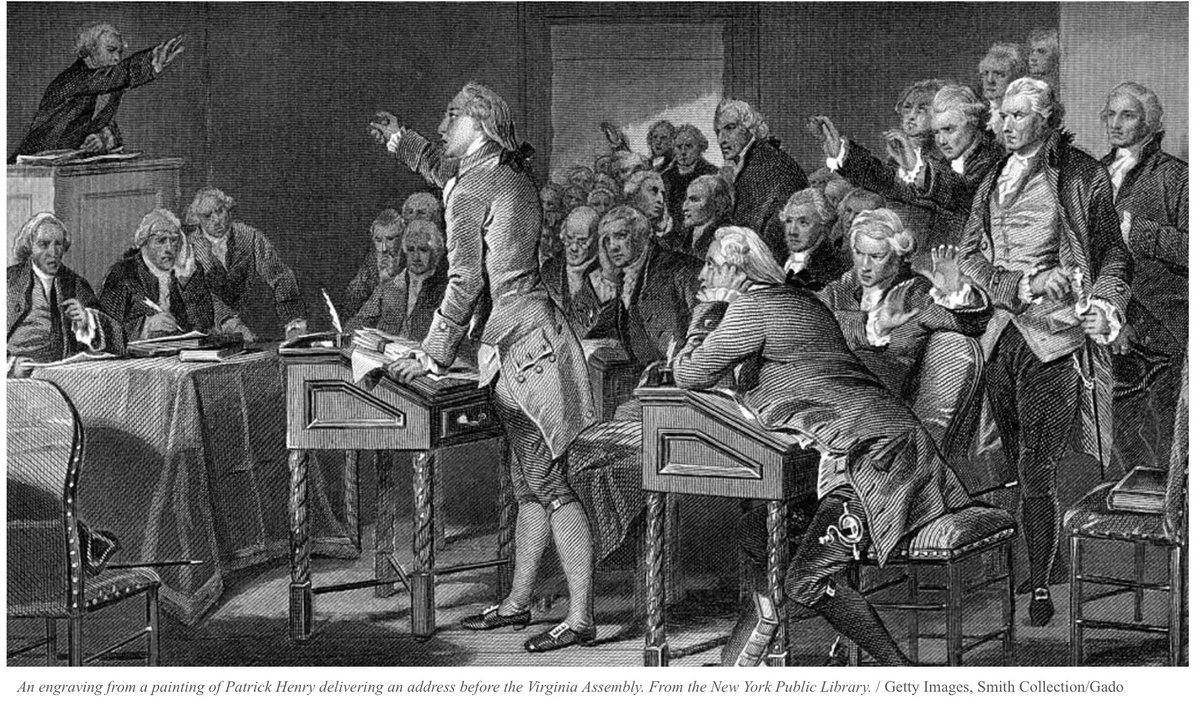
Patrick Henry Ignites the American Revolution:
On March 23, 1775 a 38-yr old self-taught lawyer named Patrick Henry rose to speak in St. Johns Church in Richmond VA, where 122 of the colony's delegates were meeting to discuss a resolution to "immediately put into a posture of defense." against the Crown.
Henry spoke without notes.
A Baptist clergyman who was present wrote:
"His voice rose louder and louder until the walls of the building and all within them seemed to shake....his face became terrible to look upon. Men leaned forward in their seats with their heads strained forward, their faces pale.
When he sat down, I felt sick with excitement."
Henry concluded with these famous words:
"We shall not fight our battles alone. There is a just God who presides over the destinies of nations and who will raise up friends to fight our battle for us.
The war is inevitable, and let it come. I repeat sir, let it come!"
And then this -- among the most famous quotes in American history.
Gentlemen may cry "'Peace! Peace!'" but there is no peace. The war is actually begun.....
What is it that gentlemen wish? What would they have?
Is life so dear, or peace so sweet, as to be purchased at the hands of chains and slavery? Forbid it, Almighty God.
I know not what course others may take; but as for me, give me liberty or give me death!
The vote was called for and taken, it passed by a narrow margin of five and the American Revolution in Britain's largest colony was underway.
they did it. the mad lads actually did it.
i never talked about my time at DOGE last year because it was so controversial and contentious (remember that?)
early last year, @jgebbia recruited a handful of his most trusted early Airbnb engineers to embed at the Office of Personnel Management to solve the "retirement paper" problem.
processing a federal retirement took months, and in the extreme retirees could wait up to 6 months for their full pension to arrive. what was the holdup? paper. remember hearing Elon talk about "the mine" in Pennsylvania? we got to visit it. in deep underground caverns blasted out of limestone, there were literally acres of file cabinets, as far as the eye could see, storing files detailing federal employees' employment and paystub history. a simple "case" might be only a quarter or half inch thick, but really complex cases filled up whole filing cabinets. one famously took up a whole pallet.
each case was hand processed by case workers in cubicles deep underground. they checked calculations, made sure forms were filled out properly (many weren't), and handled a long tail of complex issues. we'd watch as they keyed data into a black and white terminal, transmitting to the COBOL mainframe built many decades ago.
since cases were processed by hand, there were multiple rounds of human review, and additional rounds for complex cases. case files were walked around between one worker's outbox and another's inbox. sometimes it would sit in one place for days, waiting to be picked up.
to OPM's credit, they'd done multiple rounds of "digital transformation" spanning decades, so some systems were newer than others. there was a big effort in the mid-90s. but the systems were disparate, and it was a total maze getting them to talk to each other. there was a big effort to build a web app where employees applying for retirement could digitally fill out the necessary forms — just to be mailed to the mine and stuffed into the paper file. and few federal agencies were even using it.
when we arrived, OPM was midway through a fresh attempt at digital transformation, delivered by a software contractor.
the blackpill was seeing the terrible quality of the software and interacting with the contractors. coming from silicon valley, i couldn't believe how low the talent and quality bar was for selling software to the government. it's clear, as the OG USDS people explained to me a decade ago, the primary skill these vendors have is securing government contracts. it's a huge moat. delivery of quality product be damned.
we fired the vendor and took over the project. they'd been working on it for more than a year, and there was another year before they were going to deliver it. at first we tried to bend it to our will, to actually connect all the various data sources and get to a decent UX for case workers in the mine to use, but we soon realized we were going to have to rebuild the whole stack from scratch.
it was around this time I had to go back to new york — i had a new job waiting for me, a four month old, and a wife whose patience was running out. but i got to watch from afar as the team cranked day and night, hitting early milestones. and now they've fully done it.
huge congrats to Joe and the team. @yatshitcray was the hero in the trenches. indefatigable, unrelentingly optimistic, and determined to see this project through. when i recruited him for "ok i can do two, maybe three months", he stuck it out over a year making this project a reality.
while the retirement project was under the DOGE banner, it operated different from what you heard from the breathless, negative media — we came in with the attitude of partnering with career OPM employees. we were team members determined to bring our software talents to bear on the problem they've been trying to fix for years, which they hadn't had the resources to solve before. they were wary at first, not sure about us, but they quickly saw how authentic and determined we were to work together toward the same goal. props to Joe for developing those relationships, setting the example of how to collaborate together.
what's the end result? lifelong federal employees, veterans, postal carriers get their full pension installments almost immediately. days instead of months. peace of mind for these people to devoted their careers to serving our country. massively streamlined operations inside of OPM. and NO MORE PAPER 🫡🇺🇸
You don't understand how BIG this is.
Until now, agents could search the web but X was basically a wall. Real-time posts, trending topics, what people are actually saying right now, none of that was easy to pull into an agent workflow without a complicated API setup.
X just shipped a hosted MCP that changes that. Connect Grok, Cursor, or any MCP-compatible tool to the X API with no setup at all.
What this actually means if you run agents:
→ Your content agent can watch what's trending in your niche and surface it before you open your feed
→ Your research agent can pull real-time reactions to a product launch, not just news articles
→ Your morning brief now includes live X signal, not just web search
I run a content operation across 5 businesses. The bottleneck was always "my agent doesn't know what's happening right now." That just got solved.
If you're running agents and not wiring this in this week, you're leaving real-time context on the table.
I would like to see you make a voluntary contribution of 5% of your family’s $200M net worth to the government for important healthcare, childcare, and jobs. Don’t worry, it’s just one-time. Your $10M contribution will provide free childcare for over 1,000 California kids for a year! Once you’ve made your personal contribution to a more just and equitable society, I’ll support all your other asset seizure ideas. But you gotta go first…
A British physiologist named Brett Gooden published a paper in 1994 that quietly proved every human walking around on this planet has an emergency reset button hidden in the skin of their face, and almost nobody knows how to use it.
His name is mostly forgotten outside diving medicine. The paper is called "Mechanism of the Human Diving Response," and the body of research it kicked off has been replicated by neuroscientists, cardiologists, and physiologists in labs across the world for the last thirty years.
The mechanism it described is the single fastest way to lower a human heart rate that has ever been documented.
The discovery actually began long before Gooden formalized it. Physiologists had noticed for decades that seals, whales, dolphins, and otters could slow their heart rates dramatically the moment their faces touched water, allowing them to dive for long periods without running out of oxygen.
The question Gooden helped answer was whether the same reflex existed in humans, and what exactly triggered it.
The answer turned out to be a network of nerves almost nobody outside neurology had paid attention to.
The trigeminal nerve is one of the largest nerves in your head, and it covers the entire surface of your face, especially the area around your eyes, nose, forehead, and mouth. When cold water touches that skin, the trigeminal nerve fires a signal straight into the brainstem, which then routes a command through the vagus nerve directly to the heart.
The vagus nerve is the master switch of your parasympathetic nervous system, which is the part of the body responsible for calm, recovery, and the slowing of the heart.
The entire signal chain takes about a second to complete. Cold water hits the face. Trigeminal nerve fires. Vagus nerve responds. The heart slows.
Human heart rate has been documented to drop anywhere from 5 to over 50 percent during this response, depending on the temperature of the water, how much of the face is covered, and how strongly the person is holding their breath.
In infants the response is so powerful that it has been implicated in cases of Sudden Infant Death Syndrome, because the same reflex that protects a baby underwater can be triggered accidentally by bedding pressed against the face during sleep.
The reflex is called the mammalian dive reflex, and the broader nerve circuit it sits inside is called the trigeminocardiac reflex.
Researchers who study it now consider it the single most powerful autonomic reflex in the human body, which means it is faster and stronger than almost any other automatic response your nervous system is capable of producing.
The detail Gooden zeroed in on is the part that should matter most to anyone who has ever had a panic attack, a racing heart at 3am, or a moment of overwhelming anxiety they could not breathe their way out of.
Two ingredients trigger the response. The water has to be cold, ideally under about 15 degrees Celsius, and it has to touch the area around the forehead, eyes, and nose. The skin of the cheeks and chin alone is not enough.
The receptors that fire the reflex are concentrated in the upper face, which is exactly the part of a seal that hits the water first when it dives. Evolution kept that wiring intact in humans even though we stopped diving for our food a long time ago.
This is why splashing cold water on your face during a moment of panic actually works. It is not psychological. It is not a placebo. You are activating a neurological circuit that has been sitting in your body since before your species walked upright, and the circuit does exactly what it was built to do.
A psychiatrist at Harvard named Marsha Linehan eventually wrote this exact protocol into a dialectical behavior therapy technique she called the cold water dive, which she taught to patients in acute emotional crisis. The instruction was simple.
Fill a bowl with cold water and ice. Hold your breath. Submerge your face from the forehead down to the chin for thirty seconds. Within the first ten seconds, the heart begins to slow. By the time the face comes out of the water, the body has shifted out of fight-or-flight and into the parasympathetic state that makes thinking clearly possible again.
Emergency room physicians have used the same trick to reset abnormal heart rhythms in patients with certain types of tachycardia for decades. They call it the diving reflex maneuver.
A bag of ice water held against the face for fifteen to thirty seconds can convert a runaway heart rhythm back to normal without a single drug being administered.
Same nerve. Same reflex. Same biology your ancestors used to hunt for fish underwater two hundred thousand years ago.
The strangest part of all of this is how few people know it exists. The cold plunge industry has built itself into a billion-dollar movement based on full-body cold exposure, ice baths, and dramatic protocols that require expensive equipment and serious commitment.
But the fastest, most underrated nervous system reset available to a human being requires a sink, a few seconds, and the upper half of your face.
Your nervous system has an emergency brake. You were born holding the handle.
ANTHROPIC CEO DROPPED A 47-MINUTE INTERVIEW.
This is the deepest look inside Anthropic ever filmed.
Save this before you forget.
47 minutes about Claude
Anthropic → Mythos → Fable 5 Banned → Pentagon → What's Next
Malcolm Gladwell revealed why you shouldn't go to Harvard:
1. America does not have a shortage of students who want science and math degrees. It has a shortage of students who finish them. Half of all high school seniors who intend to study STEM drop out by the end of their second year. The problem is not interest. It is persistence.
2. The obvious assumption is that smarter students persist longer. So Gladwell tested it. At Hartwick College, a small liberal arts school in New York, the top third of math SAT scorers took the majority of STEM degrees. The bottom third dropped out in large numbers. The data seemed to confirm it. Smarter kids stick around longer.
3. Then he looked at Harvard. The bottom third of Harvard's math SAT scores are equal to the top third at Hartwick. By the logic above, everyone at Harvard should graduate with a STEM degree. They are all brilliant. Nobody should be dropping out.
4. Harvard showed the exact same pattern as Hartwick. Top students graduated. Bottom students dropped out like flies. Even though the bottom Harvard students were objectively brilliant by any global standard. Something else entirely was driving the dropout rate.
5. That something is called relative deprivation theory. Human beings do not measure themselves against the world. They measure themselves against the people immediately around them. A Harvard student in the bottom third does not think I am in the top one percent of all students globally. They think that kid next to me keeps getting everything right and I keep getting it wrong. So they quit.
6. The research from UCLA puts a specific number on it. Your odds of graduating with a STEM degree fall by two percentage points for every ten point increase in the average SAT score of your peers. Choose Harvard over the University of Maryland and your chance of finishing a STEM degree drops by thirty percent. Thirty percent. Just to put a brand name on your resume.
7. Relative position matters more than absolute position when it comes to confidence, motivation, and self belief. The eightieth percentile student at Harvard looks up at the people above them and feels like they cannot compete. The number one student at a state school feels like they can conquer the world. That feeling drives everything.
8. The practical hiring implication is radical. Class rank matters more than institution name. Gladwell argues companies should have a don't ask don't tell policy for where someone went to college. Hiring only from top schools means missing the top students from every other school. That is not smart hiring. That is brand worship.
9. When choosing a college, never go to the best school you get into. Go to the school where you are guaranteed to be near the top of your class. Being a big fish in a smaller pond does not just feel better. It statistically produces better outcomes than being a small fish in the most prestigious pond available.
10. So why do we keep choosing Harvard over Maryland? Because we are flattered. Because the acceptance letter feels like validation. Because we make an irrational decision in a moment of enormous flattery and call it ambition. Gladwell's conclusion is simple and brutal. When we have the chance to join an elite institution we do things that are genuinely against our own interest and we feel great about it the whole time.