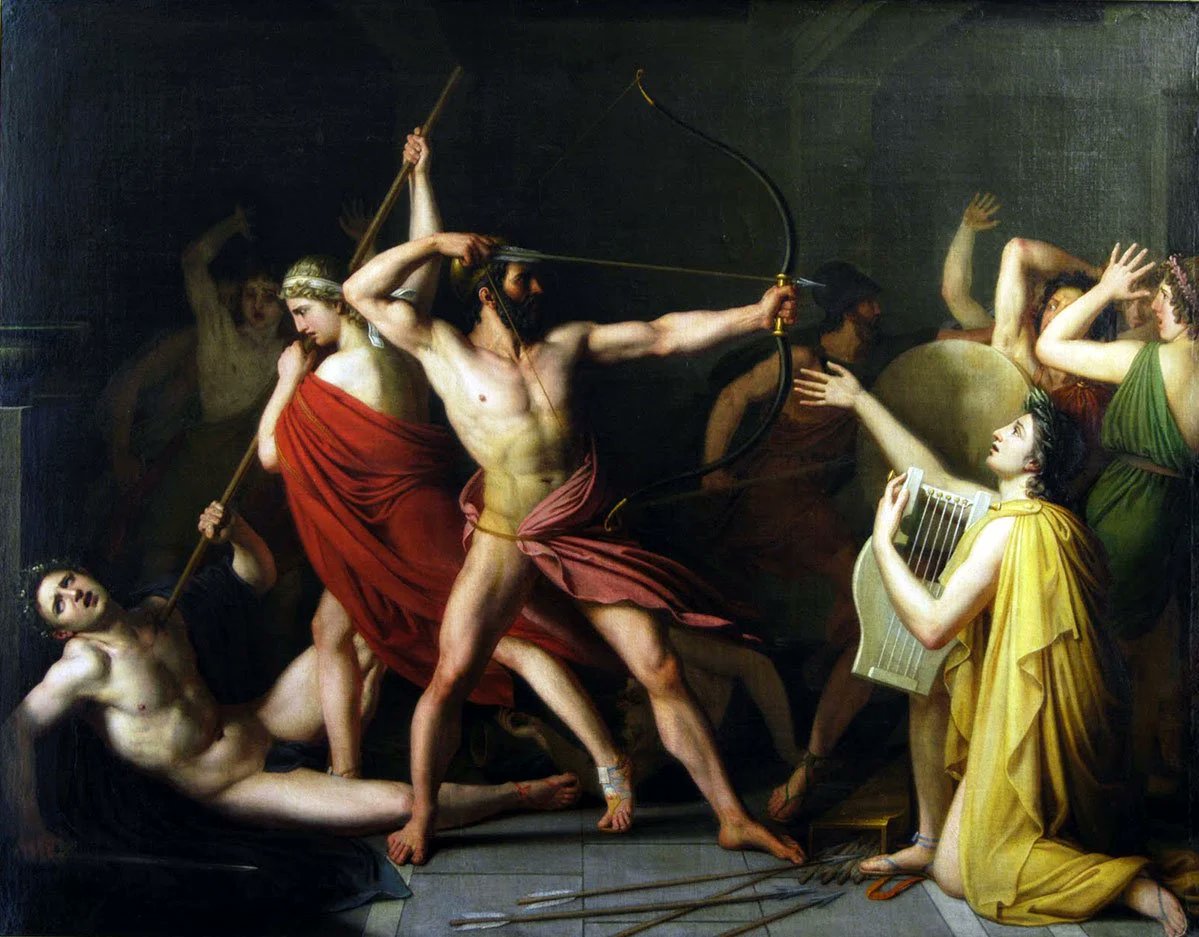
There are some powerful secrets and symbols in the Odyssey that you can only understand if you speak Greek. The Odyssey, apart from being a literary work, also conceals a profound philosophy that most people are unaware of, not intentionally, but because this philosophy cannot be fully understood in the English language; it can only be grasped in Greek, thanks to the richness of its philology and the etymology of its words. The three most important suitors who die are Antinous, Eurymachus, and Amphinomus. In English, these names mean nothing, but in the Greek language, they carry great significance due to Homer's deliberate choice of them.
The name Antinous means the one who opposes rational arguments, the irrational one ('anti' + 'nous' = mind/intellect). Antinous is the first to speak, the most irreverent of all, and the first to be killed. Odysseus reveals his true self, he has changed after ten years fighting at Troy and another ten struggling against the seas. The first trial he faces upon his return is a war within his own mind, his reason. That is why Homer creates Antinous as his first enemy: the one who fights against logic, according to his name. Odysseus triumphs over him.
Next comes Eurymachus. He is warlike but also two-faced. His name means the broad, great fighter ('eurys' = wide/broad + 'machites' = fighter). Eurymachus puts Odysseus in a dilemma and tries to shift the blame onto Antinous. He personifies discord and duplicity, a man without morals, capable of anything to avoid punishment. Yet Odysseus overcomes this obstacle as well, which symbolizes moral superiority. He does not yield, and his mind is not poisoned.
Third is Amphinomus. His name means the one who distorts the law ('amphi' = around/both sides + 'nomos' = law). He is the most compassionate of the suitors. Amphinomus tries twice to discourage the other suitors from murdering Telemachus. Odysseus even tries to warn Amphinomus to leave the house before the final battle. Nevertheless, Amphinomus stays and dies along with the others.
Through this, Odysseus, and by extension Homer, teaches us that in life, sacrifices are required, even when they demand that we show no compassion when the goal is more important and serves a greater purpose that will improve things overall. These are sacrifices that most people, even brave and heroic ones, cannot make.
That is why there are many people, but few are truly heroes.
Homer Pavlos
@r0ck3t23 Great story until you conclude universal high income will motivate or free 90% of the people to become their best.
Human nature has other plans.
The same 10% of humanity will thrive, the rest, not so much.
"They cannot simultaneously believe democracy requires shared commitments and rule that citizenship requires none—unless they believe someone else will do the forming.
And someone else already is."
Read my latest piece for the American Mind on birthright citizenship:
https://t.co/Jzycnloajo
She was awake because of the noise.
Above the Palo Duro Canyon, 1878, the Texas Panhandle, and Mary Ann Goodnight was probably the only settler woman for a day's ride in any direction. Molly, to her husband. Aunt Mary to the cowboys. She had no children. She had three chickens a ranch hand had given her because he could see she had nothing to look after, and a small string of cattle under her own brand, the Flying T, and a reputation among hard men as the person you went to when you came off a horse badly or needed somebody to sit with you. They called her the Mother of the Panhandle and they were not being decorative about it.
At night she lay in the dark and listened to the canyon.
The sound was bleating. It went on and on.
The hide hunters had worked the canyon floor. They took the skins and left everything else where it fell, and what they also left were the calves, because a calf could not climb out. Their mothers were on the ground with their hides off. The calves stayed down there in the dark next to them and cried.
She asked Charles to go and get her some.
He rode down and roped a heifer calf. Then a bull calf, which ran under his horse and butted him repeatedly on the way back up, as they do. A handful of orphans came up out of that canyon on the end of a rope, and Molly put them under milk cows as foster mothers and raised them by hand. Whenever anybody found a straggler after that, it came to her. Thirteen head by 1887. Over two hundred by the 1920s.
Charles did what Charles did. He crossed them with Angus and Galloway to make cattalo. He fenced the Goodnight American Buffalo Park and sold picnics on Sundays and shipped bison meat around the world and sold mounted heads to Europe. Three of the animals went to Yellowstone. Some went to the New York Zoological Park. A few went out on the road with Buffalo Bill.
Here is the part nobody puts on the plaque.
In late 1877, roughly fifteen thousand bison were exterminated inside Palo Duro Canyon to clear the grass for longhorns, and the man who gave that order was Charles Goodnight. The crying she could not sleep through was her husband's business plan arriving. She spent the next fifty years pulling the survivors back out one at a time.
In J. Evetts Haley's biography, the standard life of Goodnight, the founding of the most important bison herd in the American South is credited to Molly in exactly four words. She had been "distressed by the slaughter." That is her whole appearance. And they are his words, not hers.
She died in 1926, eighty-six years old, wandering the property with dementia, still trying to get the canyon made into a national park. It opened as a state park on 4 July 1934, eight years too late to tell her.
In 1994 a German conservationist rang Texas about fifty-odd forgotten bison still standing on the JA Ranch. The DNA came back: last of the southern plains bison. Nothing else like them left. They moved to Caprock Canyons in 1997 and the legislature made them the official State Bison Herd of Texas in 2011.
He got a town, a trail, a highway and a Lonesome Dove character.
She got four words, in his telling, and the animals.
Just change her girl boss blazer into drab olive overalls and she immediately becomes the Soviet People's Commissar for Education. There's no substantive difference.
Groundhog Day is one of the most beloved films ever made. And yes, Andie MacDowell is cute and charming. But that is not why it hits a chord thirty years later with people who can’t quite explain why they keep rewatching it.
The reason is Aristotle. And almost nobody knows it.
1. Phil Connors wakes up on February 2nd. Again. And again. Infinitely. No consequences, no memory from others, no tomorrow. He has been given what every hedonist, every utopian, every system that promises liberation through freedom from constraint has always promised: complete freedom from accountability. The result is not paradise. It is the most precise laboratory experiment in the history of cinema – what does a human being actually become when freed from all consequences?
2. He tries pleasure first. Eats everything, seduces women, steals money. It works, briefly, the way soma works. Then it stops working, the way soma always stops working. He tries knowledge — learns piano, French poetry, ice sculpture — not yet for virtue, but for manipulation. Still instrumental. Still empty. Then he tries suicide. Repeatedly. The groundhog always wakes him. The void cannot be escaped. It can only be filled.
3. This is Aristotle’s laboratory. Not theoretical – experimental. Eudaimonia (read below) cannot be purchased, stolen, or stumbled into. It is not a feeling. It is not a peak experience. It is the condition that results from becoming, through practice, the kind of person capable of it. Phil has infinite time and zero character at the start. The loop is not his prison. It is his curriculum.
4. The turn is the most important moment in the film and the easiest to miss. Phil stops trying to escape the loop and starts trying to improve within it. He learns piano not to impress anyone – nobody will remember tomorrow. He helps people not for reward – there is none. He becomes good with no audience, no record, no consequence. This is virtue in its purest Aristotelian form: the action done for its own sake, repeated until it becomes character.
5. Rousseau would say Phil is naturally good and the loop is oppressing him. The film says the opposite: left completely free, with no social pressure, no consequences, no system to blame, Phil reveals everything that needs work before anything worth keeping emerges. The loop doesn’t corrupt him. It shows him to himself. That is the most anti-Rousseau statement in popular cinema – and nobody noticed, because Bill Murray is just very funny.
6. He falls in love with Rita not by manipulating her — he tried that, it failed spectacularly — but by becoming someone worth loving. You cannot love your way to virtue. You can only become virtuous and discover that love becomes possible. The film gets the causality exactly right – which almost no film does.
Virtue gets you true love.
7. The loop ends when Phil has become genuinely good – not performing goodness, not strategically good, but actually virtuous through ten thousand repetitions of the right choice with no reward attached. Aristotle said virtue is a habit formed through practice. Groundhog Day is the proof of concept. The film hits a chord because everyone senses, somewhere beneath the comedy, that this is how it actually works – that there is no shortcut, no hack, no liberation through freedom from consequence. Only the truth of it. Only the practice. Only becoming, slowly and without an audience, the person you were supposed to be.
Orwell's most brilliant observation in "Nineteen Eighty-Four" was that reducing a person's vocabulary also reduces his capacity to think.
Reading old or difficult literature will unleash the full potential of your mind.
Great video 👇
Apple is quietly hoping you never open the Camera app settings.
I did.
There are 9 camera features hidden behind menus that turn the iPhone into a professional-grade camera ProRAW, Action Mode, 48MP full resolution, exposure lock, the 2x telephoto crop, portrait lighting, long exposure via Live Photos, the grid, and a Camera Control button most owners have never pressed properly.
A wedding photographer who shoots on an iPhone 16 Pro alongside her $4,000 Sony told me: "Half my Instagram portfolio is iPhone shots.
Nobody can tell which camera took which photo. The difference isn't the hardware it's the 9 settings that are turned off by default."
Most iPhone owners point, tap the shutter, and accept whatever the phone gives them. The phone can give them dramatically more. They've just never asked.
Here's every setting and why professional photographers turn them on first 🧵
This is a statue of the only man in Troy who saw the trap. He tried to warn everyone, and this is what the gods did to him because of it...
His name was Laocoön, a Trojan priest. When the Greek army vanished and left a giant wooden horse outside the city gates, all of Troy celebrated. Only Laocoön refused to believe it. He warned his people the horse was a trick and, to prove it was hollow, hurled his spear into its side.
In Virgil's telling, he spoke a line that has outlasted almost everything else about Troy: "I fear the Greeks, even when they bring gifts."
He was right. The horse was packed with soldiers, and Troy was hours from destruction.
This sculpture shows what he got for it. Two enormous sea serpents rise out of the sea and coil around him and his young sons, dragging all three down together. The father's whole body is knotted in the struggle, every muscle straining, his face locked in a scream. The gods wanted Troy to fall, and Laocoön was in the way.
The Trojans watched him die in agony and drew exactly the wrong conclusion: they decided the gods were punishing him for attacking a holy gift. So they pulled the horse inside their own walls, and that night, Troy burned...
The statue is called Laocoön and His Sons. It is the work of three Greek sculptors from the island of Rhodes, Agesander, Athenodoros, and Polydorus, and dates to the Hellenistic period, making it well over two thousand years old.
Buried for more than a thousand years, it was dug out of a Roman vineyard in 1506, and Michelangelo rushed across Rome to see it the day it was found.
It has been called the single greatest depiction of human suffering in the history of art, but it endures because of what it is really about: the man who sees the truth, says it out loud, and is destroyed for being right while the crowd watches...
It is one of the oldest patterns there is, and it has never stopped repeating.
There is nothing new under the sun.
She was forty years old, divorced, and already famous. He was twenty-six, a young archaeologist digging in the Iraqi desert. When he asked her to marry him, she said no. They argued for two whole hours in the rain before she finally changed her mind and decided to take a leap of faith.
This decision did not just change her personal life; it challenged how the entire world viewed age and love in the 1930s.
Four years earlier, Agatha Christie’s life had seemingly fallen apart. Her first husband had demanded a divorce, sparking a massive public scandal.
Devastated, she famously disappeared for eleven days, eventually turning up at a hotel under a fake name, claiming she had amnesia. The newspapers turned her real-life pain into a mystery for the public to solve.
Seeking peace, sunshine, and a way to escape her past, she decided to travel alone to Baghdad in March 1930.
It was among the ancient ruins of Ur, in modern-day Iraq, that she met Max Mallowan.
He was working as an assistant at the excavation site and was tasked with showing Agatha around. Max was young, warm, and deeply passionate about his work. He showed her ancient pottery and thousands-of-years-old ruins with so much enthusiasm that the ancient world came alive for her.
The fourteen-year age gap between them quickly became a meaningless detail.
When the digging season ended, Max visited Agatha at her home in Devon, England. On their second evening together, while walking under the English rain, he asked her to marry him.
Agatha immediately said no.
For two hours, they stood there and debated. Agatha was terrified of the age difference. In the 1930s, a forty-year-old divorced mother was considered an older woman, while Max was a twenty-six-year-old at the very beginning of his career.
"It will not work," Agatha insisted during their debate. "People will talk. I will care too much about you. I am simply too old."
But Max refused to back down. He did not care about societal expectations or gossip. He looked at her and said,
"I do not care about the age difference or what people say. I see your brilliance, and that is all that matters."
Agatha decided to choose happiness over fear. The couple married in September 1930, ignoring the whispers of a judgmental society that claimed the marriage would never last.
They proved everyone wrong for forty-six years.
Their relationship became a beautiful, lifelong partnership. Every autumn and spring, Agatha joined Max on his archaeological digs in the Middle East.
She became the official photographer for his digs, mixing chemicals to develop photos in improvised darkrooms. She even cleaned ancient ivory relics using her own expensive face cream.
"There is almost none left for my poor old face!" she joked to Max.
Max deeply appreciated her help, later writing, "Agatha's controlled imagination was a massive help in preserving the most delicate artifacts."
During World War II, when they were separated by the war effort, they wrote to each other every single day. Agatha wrote to him saying she missed him with a "corkscrew-like feeling," and Max replied that he felt a constant "emptiness, like hunger." They were intellectual equals, creative partners, and best friends.
Agatha once described their marriage beautifully: "We are like two parallel railway tracks—each needs the other close, without ever merging."
While traveling with Max, Agatha wrote some of her most famous novels, including Murder on the Orient Express and Death on the Nile. Both of them achieved great heights; Max was eventually knighted for his contributions to archaeology, and Agatha was made a Dame.
When Agatha died in 1976 at the age of eighty-five, she left behind an incredible legacy of literature.
Max passed away two years later, and today they rest side-by-side in a quiet churchyard in Oxfordshire, their initials intertwined on a single headstone.
Sweden got rich under laissez-faire and nearly wrecked itself trying to forget it. Between 1870 and 1970, Sweden ran one of the freest economies in Europe: low taxes, open trade, sound money, and entrepreneurs like the Wallenbergs and Ingvar Kamprad building world-class firms. By 1970 Sweden ranked fourth in OECD per capita income. Then the social democrats decided prosperity was automatic and started spending it.
You know what happened next if you understand incentives. Government spending blew past 60 percent of GDP by the late 1980s. Marginal tax rates crossed 85 percent. In 1976 Astrid Lindgren, the children's author, calculated her effective marginal rate at 102 percent and wrote a satirical fairy tale about it in Expressen. She paid the state more than she earned. Not a single new net private-sector job appeared between 1950 and 1990. Every job added came from the public payroll. Capital fled, IKEA's ownership moved offshore, and by 1993 Sweden had slid to roughly 14th in the OECD income rankings.
The 1991-93 crisis forced honesty. The krona collapsed, interest rates briefly hit 500 percent, and the political class ran out of other people's money in real time. What followed was one of the sharpest market-oriented turnarounds in modern history. Carl Bildt's government introduced universal school vouchers in 1992, letting for-profit schools compete for every student. Sweden partially privatized pensions in 1998 with individual investment accounts. It deregulated taxis, rail, telecom, postal services, and electricity. It abolished the inheritance tax in 2004 and the wealth tax in 2007. Corporate tax fell from 52 percent to 20.6 percent. Spending dropped nearly 20 points of GDP.
Notice what you never hear from the "democratic socialism" crowd: Sweden's welfare state produced stagnation. Its recovery came from cutting, privatizing, and deregulating. Bernie Sanders praises a country that killed its estate tax while he campaigns to raise yours. The lesson free market economists have taught for a century holds here perfectly. Wealth comes from capital accumulation and voluntary exchange. Redistribution consumes it. Sweden ran the experiment twice, in both directions, on live television.
The Swedes learned. The question is whether you will before your own government runs the same experiment.
Your grandparents spent all day outside.
Farmers. Builders. Beach holidays. Kids disappearing after breakfast and coming home at sunset.
Now people burn in 30 minutes.
The sun didn't change.
You did.
Your skin is built from the fats you eat.
Modern diets flooded it with unstable polyunsaturated fats from industrial seed oils.
UV light oxidises those fats, producing inflammatory by-products and oxidative damage.
Melanoma rates in America:
1950: around 1 in 500
2020: around 1 in 50
During that same period, seed oil consumption exploded.
The sun hasn't become more dangerous.
Maybe we've become less resilient to it.
After 6 to 12 months without seed oils, most of your skin cells have been replaced.
Those new cells contain far less stored linoleic acid.
Thousands of people report tanning more easily, burning less, and spending far longer in the sun than they could before.
Maybe the answer isn't just what you put on your skin.
Maybe it's what you built your skin from.
Elon Musk just told the world his plan to own the one thing every AI on Earth depends on.
The silicon.
The entire AI industry is fighting over the same layer. Models. Parameters. Data. Benchmarks.
All of it runs on chips none of them produce.
Every frontier lab on the planet is building intelligence on a foundation they do not control, in a country they cannot influence, on an island they could not defend.
Musk: “You design a chip, you fabricate the chip, you test the chip, you redesign the chip, and you fabricate it again. All under one roof.”
That’s the Terafab. One building in Austin, Texas.
No wafers shipped across the Pacific. No six-month tape-out cycles. No single point of geopolitical failure sitting in the Taiwan Strait.
Total vertical sovereignty over silicon.
But sovereignty is not the endgame. Sovereignty is what makes the endgame possible.
Speed.
Every fab on Earth optimizes for yield. For cost. For predictable output at massive scale.
The Terafab optimizes for one variable only.
Learning speed.
That distinction will define the next era of compute.
When your iteration cycle compresses from months to days, perfection on the first attempt becomes irrelevant. What matters is how fast you reach the fiftieth.
That is the exact principle that made SpaceX untouchable.
They did not build a superior rocket on the first try. They built a system where failure was cheap and iteration was relentless. And that system produced something no one else could match.
Now transplant that into semiconductors.
Musk: “New physics. Wild and crazy things.”
He is not trying to out-manufacture TSMC.
He is trying to make TSMC’s entire model a relic of a slower era.
TSMC cannot take radical bets on unproven architecture. Their customers demand predictability. Their margins demand stability.
Their entire empire is built on perfecting what already works.
Elon’s model is built on trying what has never worked. Repeatedly. At near-zero cost. Until it does.
When the cost of failure approaches zero, breakthroughs stop being accidents.
They become mathematically inevitable.
Now add the layer that makes this permanent.
xAI builds frontier AI. That AI assists in chip design. Better chips accelerate the AI. Faster AI designs better chips.
That is not a production line. That is a compounding feedback loop with no external dependency.
And nobody else on Earth can run it.
Intel has fabs but no frontier AI. NVIDIA designs but does not fabricate. TSMC fabricates but does not design. Google designs but outsources production.
Every one of them has a structural gap they cannot close.
Elon is closing his.
The AI that architects the chip. The fab that forges it. The vehicles and robots that run on it. The data they generate. The AI that trains on that data to design the next generation.
Full circle. No seams. No permission required from any government, company, or supply chain on Earth.
That is not a factory.
That is a self-improving system with a physical body.
A structure that manufactures upgrades to its own capacity to think.
That has never existed before. Not as a concept. Not as a metaphor.
As a building.
Every era of human civilization was defined by whoever mastered its most critical substrate. Land built empires. Iron built armies. Oil built superpowers.
The next substrate is compute.
And a single facility in Austin is being designed to produce it in a closed loop that no competitor can replicate, no government can embargo, and no market force can interrupt.
That is not a factory announcement.
That is the foundation of the first self-reinforcing intelligence monopoly in the history of this species.
And the loop only needs to start once.
In John chapter 5, Jesus heals a man who had been paralyzed for thirty-eight years at a place the Gospel calls the Pool of Bethesda. John gives an oddly specific detail: the pool, he writes, had five covered colonnades, five porches surrounding it.
For a long time this description was treated as evidence that John's Gospel was unreliable. No such pool had ever been found. And a pool with five sides, five porches, seemed architecturally strange, almost invented. Critics argued the writer had never seen Jerusalem, that the detail was symbolic fiction, perhaps standing for the five books of Moses. The Gospel, they concluded, was written late, by someone far removed from the real city.
Then archaeologists dug near the Church of Saint Anne in Jerusalem, and they found it. A pool, exactly where John located it, near the Sheep Gate. And its design solved the puzzle immediately. It was not one pool but two large basins side by side, with a colonnade on each of the four outer sides and a fifth colonnade running across the middle, dividing the two pools. Five porches, precisely as John wrote.
Consider the significance. This was no symbol invented by a distant author. It was a detailed, accurate description of a real structure, one that no longer existed in Jerusalem after the city was destroyed in AD 70. Whoever wrote this had walked past that pool. He knew the city as it stood before its destruction.
To the world, the Gospels are late, secondhand, disconnected from the events they describe. But the man who wrote of Bethesda knew its five porches because he had seen them, and the healing he recorded happened at a real pool where real suffering people waited.
Jesus went to the place of the broken and the hopeless, and He still does. He walks toward the ones the world has written off, and He heals. He sees you where you wait. Bring Him your thirty-eight years, whatever they are.
Jesus is the Healer, the one who makes the broken whole.
Thank You, Jesus.
Two quotes, twenty-one centuries apart, describing the same mechanism.
Aristotle first: “Another mark of a tyrant is that he likes foreigners better than citizens, and lives with them and invites them to his table; for the one are enemies, but the others enter into no rivalry with him.”
Jefferson second: “To admit foreigners indiscriminately to the rights of citizens would be nothing less than to admit the Trojan horse into the citadel of our liberty and sovereignty.”
Read them together and the argument assembles itself.
The tyrant’s problem is the citizen. The citizen has history, has roots, has pre-existing loyalties to the republic that predate the tyrant and do not depend on him. He has opinions. He remembers what things were like before. He has standing to compare. The foreigner — admitted suddenly, dependent on the system that admitted him, owing his position to the current arrangement — enters with none of that. He is grateful rather than demanding. Dependent rather than sovereign. The tyrant does not prefer foreigners because he is cosmopolitan. He prefers them because they cannot yet rival him. Loyalty purchased through admission is more reliable than loyalty inherited through citizenship.
Jefferson names the mechanism from the other end: indiscriminate admission is not generosity. It is the Trojan Horse – the gift that enters through the open gate precisely because the gate is open, bypassing every defense the citadel was built to maintain. The horse is welcomed in. The soldiers emerge at night. The citadel falls not to siege but to hospitality weaponized.
Neither man was against foreigners. Both were against the political use of admission – the deliberate flooding of the civic space with people whose loyalties are unformed, whose dependencies are fresh, and whose gratitude can be directed. Aristotle observed it as a tyrant’s tool. Jefferson warned against it as a republic’s vulnerability. Both understood that a self-governing people requires a demos with shared history, shared stakes, and shared accountability – and that a ruler who bypasses the formation of that demos is not building a nation. He is building a tyranny.
And the Trojan Horse didn’t need to breach the walls. The citizens opened the gates. And then it was just administration.