This is no time to nominate GOP candidates who are repellant to independent / swing voters or are unproven rookies.
The GOP needs its strong general election candidates on the field in November.
#txsen
Texans for Excellence in Education, the right wing alternative to the Texas Association of School Boards that my reporting linked to school voucher advocate and Dallas Express publisher Monty Bennett, has shuttered as of today, per this email to a Conroe ISD board member.
When Ronald Reagan took office in January 1981, Americans were facing high inflation, unemployment, and a deepening economic crisis. His answer was a program of policy changes: reduce taxes and government spending, ease regulatory burdens, and encourage saving, investment, and work.
Reagan understood that people also needed a reason to believe the country could recover.
He didn’t promise an instant fix. In his inaugural address, he said, “They will not go away in days, weeks, or months, but they will go away.”
That was an acknowledgment of how hard the moment was, paired with confidence that it would not last forever.
That combination matters. Hope, in Reagan’s telling, wasn’t pretending the pain wasn’t real. It was refusing to treat hardship as the final word.
Reagan used the presidential pulpit to make a case for people’s capacity to act: to work, build, create, take risks, and shape their own lives.
In a 1981 address on the economy, he said, “We will restore the freedom of all men and women to excel and to create.”
His economic vision was that policy could open room for people to do more with their own effort and ideas. But they needed to walk through the doors.
That message was not simply, “Wait for Washington to rescue you.” In his 1984 election-eve address, Reagan put it this way: “The greatness of America doesn’t begin in Washington; it begins with each of you.”
He was asking people to see themselves as participants in the country’s future, not spectators watching it happen to them.
That is the deeper meaning behind his familiar image of a “shining city upon a hill.” In his farewell address, Reagan described a city alive with commerce and creativity, whose doors were “open to anyone with the will and the heart to get here.”
The image wasn’t only about national pride.
It was about a country made stronger by people with the freedom and opportunity to contribute.
There’s a difference between telling people their struggles are their own fault and telling them they still have agency.
Reagan’s appeal was to the second idea: that people deserve a chance to build, and that a society should make room for their initiative.
But he also told them to take responsibility for that vision and for that day. Build now!
In his 1985 inaugural address, he called for an “American opportunity society” where people would “go forward together, arm in arm.”
That’s the part of Reagan’s message worth revisiting in difficult times. Policy matters because it changes the conditions people face. But leadership also speaks to what people believe is possible.
The strongest message is not that hardship is imaginary, or that everyone can overcome every obstacle alone. It is that a hard season does not erase a person’s dignity, potential, or right to take part in what comes next.
Reagan’s pitch was: here is a path forward. Here is room to build. Here is a country that still needs your work, your ideas, and your courage.
Hope is not sitting back and waiting for a better day. It is believing a better day can be built, and inviting people to help build it.
The last two large events I’ve run I’ve had billionaires @JTLonsdale and @LukeNosek speak. My limited time with them pointed that what they were looking for one thing: builders.
America needs builders and it needs people using the pulpit to point people towards America being that City on a Hill.
One big reason I’m very bearish on the GOP’s chances in 2028 is this kind of thing.
I think the next two years will be a nonstop flow of stories of this type of cartoonish (alleged) corruption, any one of which would’ve sunk any other presidency.
BREAKING: Trump came close to firing Commerce Secretary Howard Lutnick earlier this year, then dropped the idea after Lutnick gave $25 million to Trump’s presidential library, per WSJ
The near-firing came after Lutnick acknowledged visiting Jeffrey Epstein’s private island, according to people familiar with the matter. The New York Times’ Maggie Haberman has also confirmed the report.
Senator, your assertion about resources and polling is demonstrably false! Texas House members worked hard and outperformed statewide candidates in their districts. We look forward to working with you to rebuild Texas; however, with all due respect, the solution is not throwing money at DC consulting firms. . .
This is exactly what some of us have been saying over the last year. This problem is particularly acute in Texas with the combination of MAGA and Dunn dominating many of the primaries.
Their message appeals to an ever narrowing slice of the electorate- but that slice dominates the primary. That dynamic produces nominees like Paxton and French who are non-viable in general elections.
Yes, the GOP needs unity if we are going to win. We should be a big tent party, all conservatives welcome, 80% Friend, etc.
But it is critical that our message and our standard-bearers appeal to a broad majority of the electorate, not just the small minority that turns out in GOP primaries.
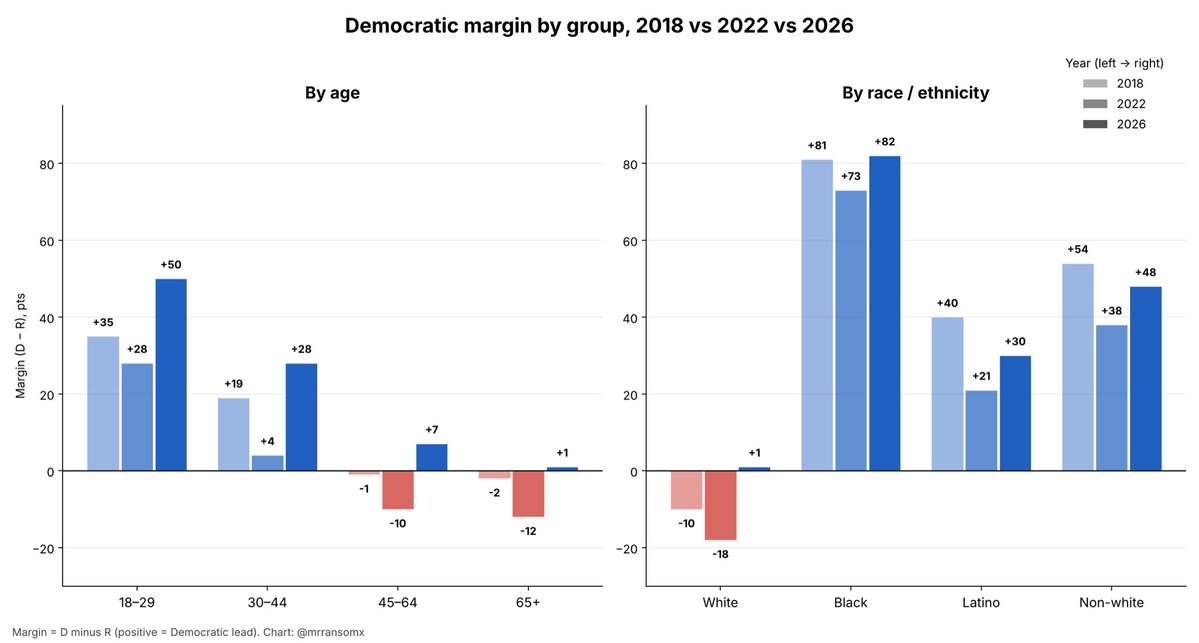
Republicans’ problem heading into 2028 isn’t turnout. It’s coalition erosion. They’ve built a party that can dominate MAGA voters but struggles to compete with independents, younger voters, college graduates, and non-MAGA conservatives.
The strategic trap is that doubling down may further alienate the voters they need, while broadening the party risks upsetting the base. Republicans need more than a new messenger. They need a governing agenda that can hold their coalition together and persuade voters outside it. Mobilization can’t compensate indefinitely for a failure to persuade.
Democrats, meanwhile, have an opportunity to build a broader coalition that combines college-educated voters, younger voters, independents, and a more competitive share of white men.