Beam weights are out today (Apache 2.0 license).
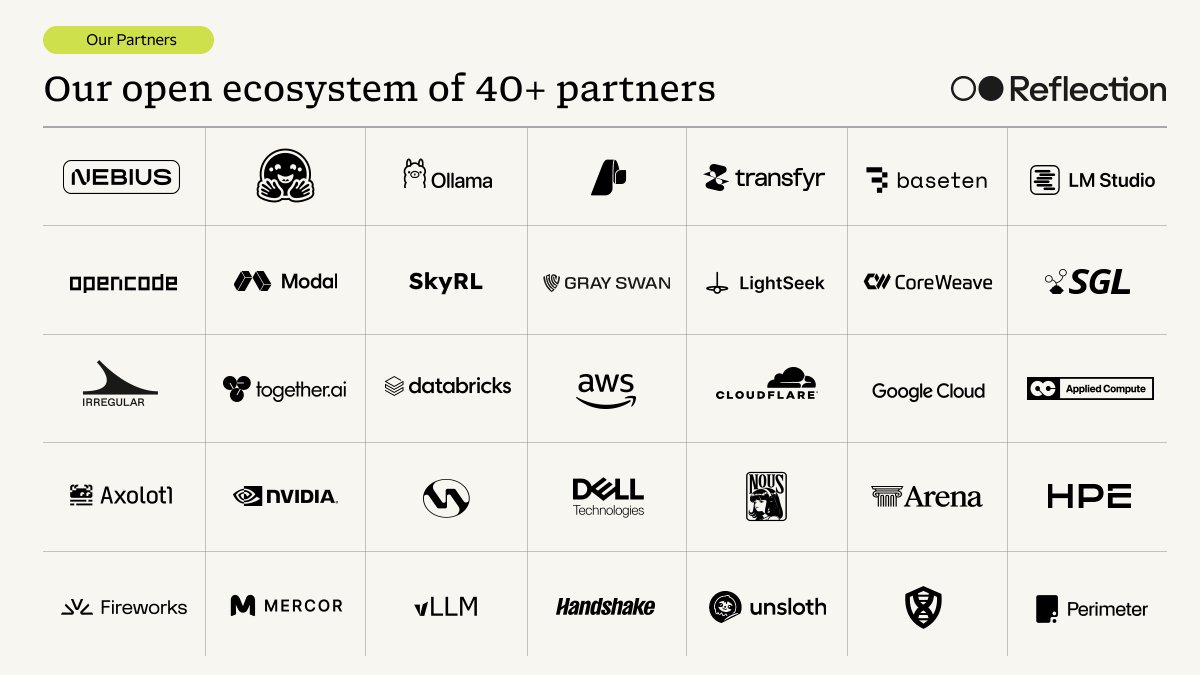
We integrated Beam across 40+ different partners.
And are also open sourcing Mirror CLI - the harness Beam was trained against.
Happy building.
Really proud of Beam, our first-ever release! Among US open-weight models tested by Artificial Analysis, it ranks #2 on the Intelligence Index and #1 on the Cyber Index.
So grateful to the team for the work that went into this. We're just getting started 🚀
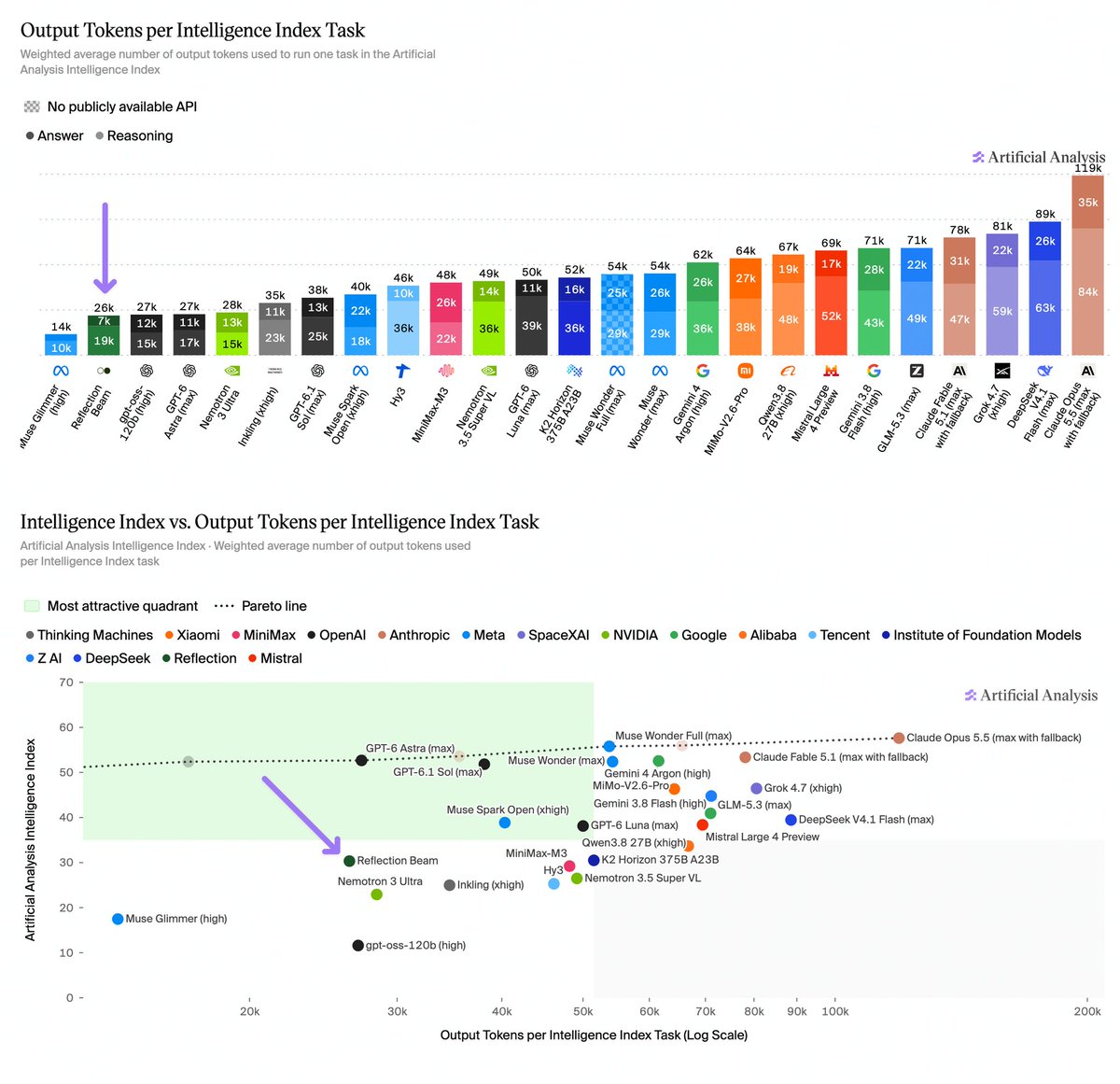
Beam uses ~26k output tokens per Intelligence Index task: ~19k for reasoning and ~7k for answers. Only 26% of its output goes to final answers, the 28th-lowest share of 219 models tested on Intelligence Index v4.3
Beam is here.
501B total, 23B active parameters.
Apache 2.0, for everyone.
Incredibly token-efficient model in the Western open frontier.
Trained with Mirror, new blazing-fast harness, now open-source.
Build with Beam!
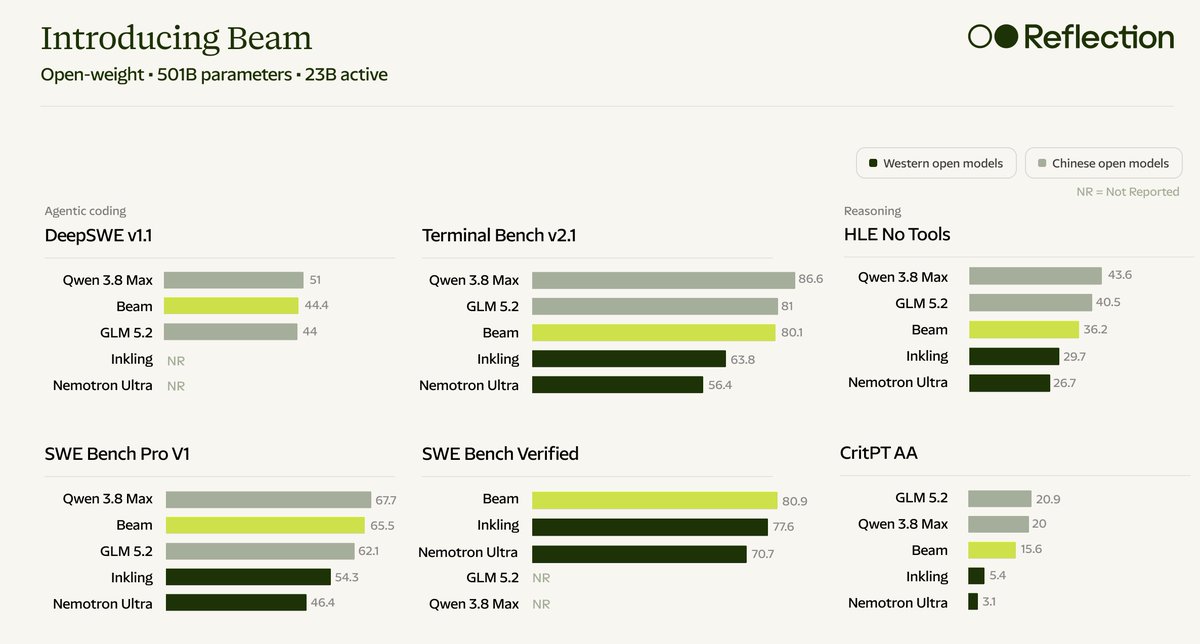
Reflection’s first model, Beam, scores 30 on the Artificial Analysis Intelligence Index, placing it #2 among US open weights models
Beam is an open weights model with 501B total and 23B active parameters, released on @huggingface
Congratulations to @reflection_ai on the release!
Key takeaways:
➤ Second among US open weights models: Beam scores 30, behind only Meta's Muse Spark Open (39) and ahead of yesterday’s NVIDIA Nemotron 3.5 Super VL (26) release. Outside China, only Muse Spark Open and the UAE's K2 Horizon (31) score higher
➤ Token efficient for its intelligence: Beam uses ~26k output tokens per Intelligence Index task compared to K2 Horizon, one point ahead, which uses twice as many (~52k). Proprietary models still set the frontier, with GPT-6 Astra (max) scoring 53 on the same budget (~27k)
➤ Strong on agentic workflows, weaker in the terminal: Beam scores 48.5% on AutomationBench-AA, 11 percentage points ahead of K2 Horizon (37.2%) and level with Qwen3.8 27B (48.2%). Terminal-Bench 4.0 is a weak point, where Beam scores 3.0%, behind Qwen3.8 27B (5.6%) and Muse Spark Open (8.1%)
➤ Knows more, guesses more: On AA-Omniscience it answers 33% of questions correctly, well ahead of K2 Horizon (18%) and Qwen3.8 27B (16%). But its hallucination rate is 47%, against 26% for K2 Horizon and 30% for Qwen3.8 27B, giving Beam a net index score of 1.5, ahead of both peers (−3.0 and −10.0)
Other model details
Context window: 1M tokens
Modalities: Text
Parameters: 501B / 23B
Beam is now available across platforms, with open weights under the Apache 2.0 license - in collaboration with an ecosystem of 40+ partners.
We're releasing:
- Weights, tokenizer, and reference implementation
- BF16, FP8 and NVFP4 weights and a DFlash2 drafter
- The open source harness we built and trained Beam on: Mirror CLI
Weights and model card on Hugging Face: https://t.co/tPqWpk9RXL
Beam is now available across platforms, with open weights under the Apache 2.0 license - in collaboration with an ecosystem of 40+ partners.
We're releasing:
- Weights, tokenizer, and reference implementation
- BF16, FP8 and NVFP4 weights and a DFlash2 drafter
- The open source harness we built and trained Beam on: Mirror CLI
Weights and model card on Hugging Face: https://t.co/tPqWpk9RXL
I’m proud of what we achieved with Beam.
It’s Reflection’s first open-weight model release, and the result of 9–10 months of hard work by one of the strongest, most builder-minded teams I’ve worked with.
I joined Reflection last December, when the pretraining team was under 10 people and we were just getting started with MoEs. I remember the long discussions about designing our in-house evals, data materialization, scaling ladder, and large-scale data filtering pipelines from scratch.
Over the following months, we built all of that at an incredible pace. Watching our compute efficiency and training stability steadily improve as we scaled up was deeply satisfying. We also held ourselves to scientific rigor: we didn't land features on vibes. We measured, validated, and earned each improvement.
Coming from Gemini, it initially felt like a shock to start from such an early stage, with the codebase still minimal in major areas. Looking back, I’m glad it was that way, because I can genuinely say we built this model from the ground up.
Full weights and a detailed technical report will land later this month. Until then, you can read more in today’s announcement.
This is the most important plot from the Beam release IMO. The Chinese models are great, but horribly token inefficient (try running an eval with max reasoning to feel the pain).
I'm looking forward to a future where open models start competing on this axis!
We built our first model!! Beam is a competitive text-only 501B-A23B MoE, openly released under the Apache 2.0 license
It’s been fun scaling the production RL/OPD stack for this over the past year. I’m so proud of the team! We attained exactly what we set out to do and ended up with a stable run on 10K GB300s that produced more than 100M rollouts across ~1M tasks that significantly improved the final performance of the model
👇 many more details in our announcement below :)
So proud of what we’ve built!
To build a frontier model, we needed to have a relentless focus on execution and science, while having a team with one mission and one focus. I was glad to be a part of this journey.
Introducing Beam: a highly efficient agentic open model with 501B total parameters and 23B active.
- Frontier reasoning efficiency
- Advances the Western open frontier on coding & agentic tasks
- Trained end-to-end from scratch
Full weights release this month.
Learn more about Beam: https://t.co/c3Qx2cpM8G
Introducing Beam: a highly efficient agentic open model with 501B total parameters and 23B active.
- Frontier reasoning efficiency
- Advances the Western open frontier on coding & agentic tasks
- Trained end-to-end from scratch
Full weights release this month.
Learn more about Beam: https://t.co/c3Qx2cpM8G
Today, we’re introducing Beam, @reflection_ai's first model.
We started the high-compute RL team in February. Looking back at these past few months, it’s remarkable how far we’ve come.
Making RL work at this scale took careful science, scalable infrastructure, and a strong foundation from mid-training. Seeing that work come together to keep learning stable as we pushed the scale and complexity of the run has been incredibly rewarding.
What has made this especially meaningful is the people: their commitment and curiosity, the way they supported one another through difficult stretches, and the joy of figuring things out together.
To everyone who helped bring Beam to life, across RL science, infrastructure, mid-training, pretraining, and our close collaborators throughout Reflection: thank you. There is so much of your hard work and care in this model.
Building and leading this team has been an honor and one of the most rewarding experiences of my career. I’ve learned so much from the people around me, and I’m proud of what we’ve built together.
@MishaLaskin and @real_ioannis, thank you for your trust and support throughout this journey.
This is our first model, and there’s so much more ahead. I’m excited to share Beam with the community, learn from your feedback, and continue building better models together.
Reflection’s founders on building a DeepSeek of the West
Reflection is soon releasing Beam, its first open-weight AI model, in a bid to become the DeepSeek of the West. Trained from scratch, Beam is designed for coding, reasoning, and AI agents. Reflection's benchmarks put it alongside the strongest open models, with substantially more efficient token economics.
To mark Beam’s debut, I'm joined by Reflection's co-founders: CEO @MishaLaskin, who led reward modeling for Google’s Gemini, and CTO @real_ioannis, who helped create AlphaGo and AlphaZero before leading Gemini’s RLHF effort. Reflection has raised $4.6 billion from investors that include Nvidia, Sequoia, and Lightspeed.
We discuss why Chinese labs pulled ahead in open AI models, how Reflection built Beam, and why the founders think companies and countries will increasingly want to control their own models. I ask how they plan to make money from open-weight AI, whether openness can make these systems safer, and what comes next for Reflection.
Timestamps:
00:00 Why open models are surging
01:06 Renting vs. owning intelligence
03:40 Open models catch up
05:53 Why China led open AI
08:03 Introducing Beam
10:05 Scaling reinforcement learning
14:09 Training from scratch
16:04 Safety, alignment and openness
32:29 The Reflection origin story
37:32 Making money on open models
42:33 Vertical integration and compute
48:45 Partnerships and distribution
56:46 What’s next for Reflection
Links: https://t.co/lsXfGvSuAw
Spotify: https://t.co/XSTrGNHb8O
YouTube: https://t.co/UqqKA6AYmT
Substack: https://t.co/difFf7X42Z
Thanks to the show’s premier sponsors: @Atlassian, @meetgranola, and @mercury.
I am so proud of Beam.
Beam is Reflection's first open-weight model. It's the result of a ~year of hard work, ingenuity, and camaraderie of one of the most incredible teams I've ever seen in AI 🔥
I joined Reflection last November. Pretraining in particular was so nascent – only 5-10 people and a bit of code! We didn't yet have a crawler, or a resilient GPU infra, or a deduplication pipeline, or in-house evals, or even sufficiently big MoEs. All that started in earnest in 2026, in one of the most satisfying sprints I've ever had the pleasure to live through.
What we nailed, I think, was a perfect blend of scientific rigor, startup intensity, team iteration, and ambition. We did not YOLO decisions in pretraining, that tends to blow up in your face when you scale up 🙂 But we also made sure to move fast and play to our strengths as a nimble, high-ownership, high-trust team. The resulting system of systematic iterations and fast cross-team back-and-forths really paid off.
The midtraining, RL, and post-training teams really really cooked here on top of the pretrained base. The announcement below details the sheer scale and payoff of that investment, I'll let the team cover it, it's remarkable. On many agentic coding capabilities the model kept going up without any sign of a plateau.
Feel free to read more in the announcement today – but later this month we will also drop the full weights release under Apache 2.0, a detailed tech report with the cool LLM science, and partner integrations with the OSS ecosystem. It's an open model after all. I strongly believe open intelligence is the future of AI, this is why I'm here.
And I encourage y'all to join us on the open side 😉
Reflection AI, an artificial intelligence startup from two former Google DeepMind researchers, has unveiled a new open-weight model that it says rivals leading options in the US and China https://t.co/8agHGvBLW4
Today, we’re introducing Beam, Reflection’s first model.
A year ago, we set out to build a frontier open model before we had much of the team or infrastructure required to do it.
Since then, Reflection has grown 10x. We assembled an extraordinary technical team of researchers and engineers I feel privileged to call my colleagues, alongside a world-class group across recruiting, business, policy, operations, and the rest of the company whose work made all of this possible.
At the same time, we built the science, data, software, and infrastructure behind the model itself. In July, we started pretraining Beam and weeks later, we had a 500B-parameter model at the frontier of Western open intelligence—particularly strong at agentic coding, with remarkable reasoning efficiency.
What makes me proudest, though, is our team. The relentless focus, speed of execution and the willingness to own and solve whatever problem was in front of us. And, most importantly, the commitment of this team to our mission.
Beam is our first milestone toward our mission of building open intelligence and making it accessible to everyone.
We’ll release Beam’s weights, model card, and tech report later this month.
And we’re already training the next, larger model.
Over the past year, we built the team and the engine to propel us to the frontier and that’s what makes me so excited about what comes next.