With Samsung Heavy Industries exploring India for additional shipbuilding capacity, Tamil Nadu should pitch Thoothukudi as a manufacturing base.
Samsung is reportedly exploring a greenfield investment in Odisha’s proposed Kendrapara cluster. Tamil Nadu should act quickly to make Thoothukudi a competitive alternative.
But the objective must go beyond attracting foreign investment. How long should we depend on foreign companies for our critical manufacturing requirements and exports? We should use these partnerships to build our own shipbuilding capabilities.
1. Financial participation
If feasible, Tamil Nadu should explore an equity stake in the shipyard under its Shipbuilding Policy 2026. This could enable technological learning and eventually help develop an indigenous shipbuilding company and also generate dividend returns on public investment,
Alternatively, the government could use the asset-leasing model, owning critical shipyard assets and leasing them to the operator.
2. Develop a multi-shipyard cluster
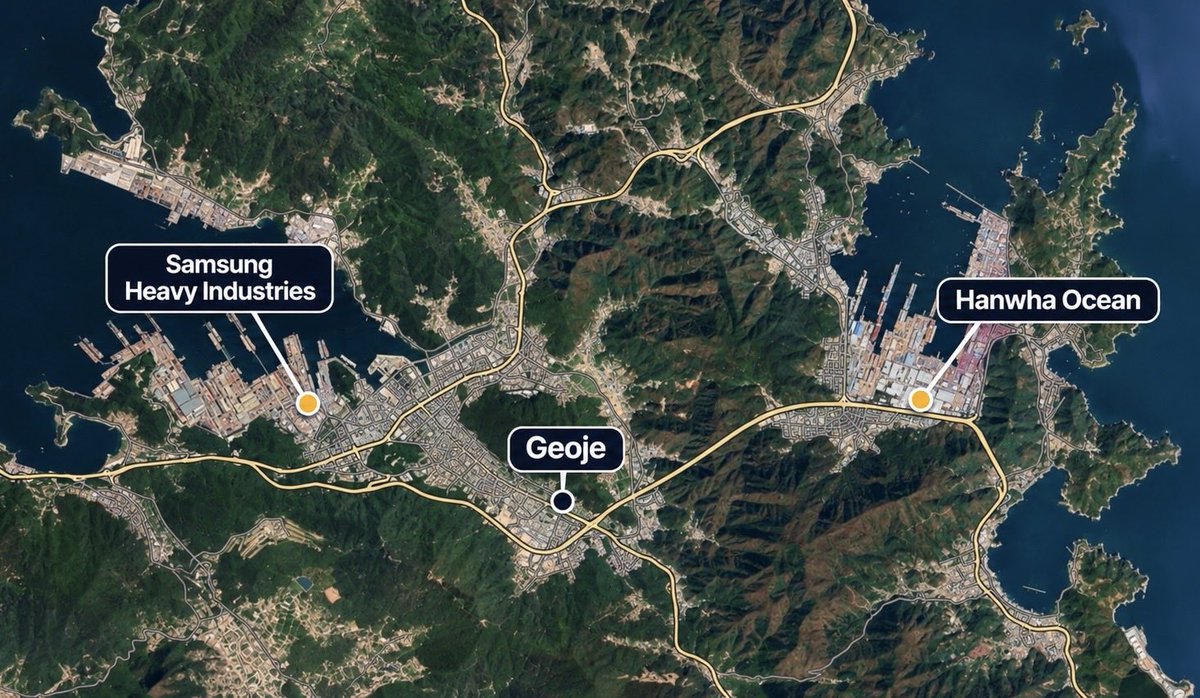
Take inspiration from South Korea’s Geoje Island, where competing Samsung Heavy Industries and Hanwha Ocean operate competing shipyards within the same industrial ecosystem.
HD Hyundai and Samsung could follow a similar model at Thoothukudi, sharing infrastructure such as port connectivity, roads, railways, utilities, logistics and warehousing.
3. Build a common supplier ecosystem
Attract marine equipment manufacturers, engineering companies and component suppliers to the cluster. Serving both Hyundai and Samsung would create economies of scale, reduce costs and attract more maritime manufacturers.
4. Address infrastructure constraints
Thoothukudi’s proposed cluster has a listed draft of 5 metres, compared with 12–15 m planned at Odisha’s Kendrapara and 13–15 m at Andhra’s Dugarajapatnam.
Tamil Nadu should prioritise a technically feasible deepwater basin and dredging plan while identifying additional waterfront land for another shipyard. The Centre’s Shipbuilding Development Scheme can support eligible common infrastructure.
The long-term objective should be to make Thoothukudi a global shipbuilding and maritime manufacturing hub, using foreign partnerships to progressively develop India’s own industrial and technological capabilities.
@TNIndMinOffice@CMOTamilnadu@Guidance_TN@AadhavArjuna@Keerthana4VNR
#InvestInTN #MaritimeTamilNadu
Mumbai: Navi Mumbai airport opened 25 Dec 2025. A feasibility study is under way for a third airport, offshore at Vadhavan with a capacity to handle 90 million passengers a year. Mumbai region traffic is expected to reach about 240 million a year by 2047–2050.
Chennai: "Full capacity by about 2032" is CAPA India's estimate. AAI expects 47–51 million passengers by 2031–33, but capacity will be 35 million after the new terminal opens in 2027.
Mumbai is planning for 2050's demand while Chennai hasn't even started working for 2035's demand.
Mumbai opened its second airport last December, 28 years after it was first planned. It is already studying a third, for 2050 traffic.
Chennai has searched for a second airport since 2007. Our only airport will be full by about 2032, and we still have no site.
https://t.co/DwXcTXbrEF
@mystic_varunn@india_plus_ True. And Bihar's average holding is about half the size of UP's. Bihar started chakbandi in 1956 but stopped in 1992, so many villages were left out.
On plots splitting again: that's why UP is now on a second round.
@ItsVishalVerma_@india_plus_ Obviously farmers won't like to move from the land they have been farming all their lives. In fact, Punjab tried this as a voluntary option for the farmers, but there weren't many takers, so they made it mandatory in 1948.
Some other states like MH and UP tried, but didn't finish the job. Maharashtra stopped in 1993, and UP is still at it after 70 years. Our states have to resume consolidation because:
1. Plots keep splitting. The average farm fell from 2.28 ha in 1970-71 to 1.08 ha in 2015-16. Every generation divides it again. The longer we wait, the harder it gets.
2. The hard work is done. Punjab did it in the 1950s with paper maps. Today most land records and village maps are digital, so it is easier than ever before.
@india_plus_ It's chakbandi. Under a 1948 law, every village was mapped. Each farmer's scattered plots were swapped for one block of the same value, laid out on a grid of 1-acre rectangles (killas). Punjab and Haryana did 2 crore acres. No other state did it.
@UpdatesChennai Chennai is like this because no single industry runs it. Cars, factories, hospitals and IT have shaped the city and family life still sets the rhythm more than networking does.
The hard part is keeping it that way as the city grows.
@UpdatesChennai This matters now. The Tamil Nadu government has sanctioned ₹45.5 crore for a new master plan for the expanded Chennai Metropolitan Area.
@CMDA_Official should plan it with these points in consideration.
Skyscrapers alone don’t stop sprawl. Houston has one of the biggest skylines in the US, yet only has about 1,400 people per sq km. Paris, mostly 6 to 8 storeys, has 14 times that.
What Chennai needs:
• Skyscrapers only for offices and monuments, spread across many job hubs, not one CBD.
• Homes in blocks of up to 10 storeys, with shops at street level. Tall residential towers cut people off from the street.
• Mixed-use areas: offices, small factories, schools and shops together, so people live near work.
Hong Kong’s metro made more profit from property than from everything else: HK$11.1 bn vs HK$5.7 bn in 2025.
Chennai Metro is now trying it: 4 towers at Thirumangalam, with the metro line through them.
It works where commercial demand is high. Which station should be next?
#ChennaiMetro #CMRL
@Indicfederr0d This map counts only listed companies' capex, not all capex.
For example, Foxconn and Samsung invest big in Tamil Nadu, but they are not listed in India.
HD Hyundai's planned $4 bn (₹38K cr) Thoothukudi shipyard is 2.5x TN's total here, and it wouldn't be counted either.
Which one looks better?
Left: Chennai Metro’s 27-storey tower, now rising at Central.
Right: the same tower, redesigned with Madras heritage and Dravidian elements (AI render).
Chennai has a unique architectural culture and history. Our future buildings should reflect it.
Let me be blunt and call a spade a spade. Chennai has largely avoided this kind of nightlife for the middle class. You can call Chennai a conservative city—yes, it is. Our relative lack of nightlife is one reason we attract fewer IT professionals from other parts of India who specifically want that lifestyle.
Honestly, this is something we can live without. I’m not talking about culture here—purely from an economics perspective, this kind of nightlife ruins people’s savings. We already have a TASMAC addiction problem; why add another one?
The IT crowd in Tamil Nadu values stability—that’s why you see a massive concentration of BFSI and enterprise captives here rather than a high-burn startup culture.
Let Chennai stay slightly conservative for as long as we can, and continue our growth slow and steady.
And if we don’t want to lose IT talent from other states to competing cities, build a greenfield coastal city along the ECR, connect it directly with the Chennai–Bengaluru Expressway, and let that have the nightlife.