November has been a big month in #endocrinology, and most of it flew by in headlines. So I put together a quick 10-question quiz from the month's real data: GLP-1 discontinuation and heart risk, retatrutide for knee OA and sleep apnea, the new once-weekly growth hormone for Turner syndrome, long-term phentermine, and the muscle-preservation trials.
One question at a time, with the numbers and the caveats after each answer. Takes about five minutes.
Drop your score in the comments, and tell me which question surprised you most. #MedTwitter #EndoTwitter #obesity #OA #GLP
https://t.co/jNHJyaELCV
Today, we release LingSante-3.1-flash, an open-weight MoE model with 560B total parameters and 25B activations per token. It unifies diverse medical capabilities while retaining general capabilities, including complex medical reasoning, long-horizon workflow execution, and professional behavior alignment.
LingSante-3.1-flash moves beyond medical QA toward real-world healthcare problem. The model leads on HealthBench Professional (65.72), HLE (text-only, with tools: 72.22) and BrowseComp (with context: 94.10), outperforming GPT-6 Astra, Claude Opus 5.5 and Gemini 4 Argon on all three. LingSante-3.1-flash also performs well on professional long-horizon medical workflows, such as PhysicianBench (57) and EHR-Complex (74.40).
Together, these results establish LingSante-3.1-flash as the leading open-weight models for healthcare.
The weights are available. Explore LingSante and build with it.
More below ↓
2/2 When endocrinologists biopsy a #thyroid nodule and order molecular marker testing, finding a classic TERT promoter mutation (C228T or C250T), especially alongside BRAF V600E, signals a higher risk of aggressive thyroid cancer, metastasis, and recurrence. Because modern sequencing panels read broader stretches of DNA, however, test reports increasingly list rare, unfamiliar changes in the TERT gene's "on-off switch" (its noncoding promoter) as variants of uncertain significance (VUS). Clinicians are then left wondering whether that patient carries a true high-risk mutation or a harmless background change. To test whether artificial intelligence models that read DNA sequences can help clarify these grey-zone results, we evaluated @GoogleDeepMind #AlphaGenome, which models whole thyroid gland tissue, alongside AlphaGenome 2, which models primary human thyroid follicular cells (the exact cells where papillary and follicular thyroid cancers develop). We scored five known or uncertain TERT variants and all 360 possible single-letter DNA changes across the TERT switch region, comparing predictions against ClinVar clinical records and published laboratory gene-activity assays.
Both models accurately identified the established high-risk TERT mutations (ranking C250T and C228T first and second of 360 changes) as strong activators of telomerase in thyroid follicular cells, while scoring benign variants and a rare papillary thyroid cancer variant (C216T) near zero. That computational result matches clinical reports showing that C216T tumors do not behave more aggressively than ordinary papillary cancers. AlphaGenome 2 also helped explain why coexisting BRAF V600E and TERT mutations worsen prognosis, showing that BRAF-activated cells recruit extra growth-signaling proteins onto the mutated TERT switch and trigger follicular-cell-specific DNA methylation changes, while matching laboratory measurements across all 360 variants (correlation above 0.80). Although these research models cannot directly guide surgical decisions in clinic today, commercial molecular laboratories and researchers can use them to flag which rare VUS need priority laboratory testing before clinical reclassification.
@DynamicWebPaige - thanks for posting about access to the models for science experiments.
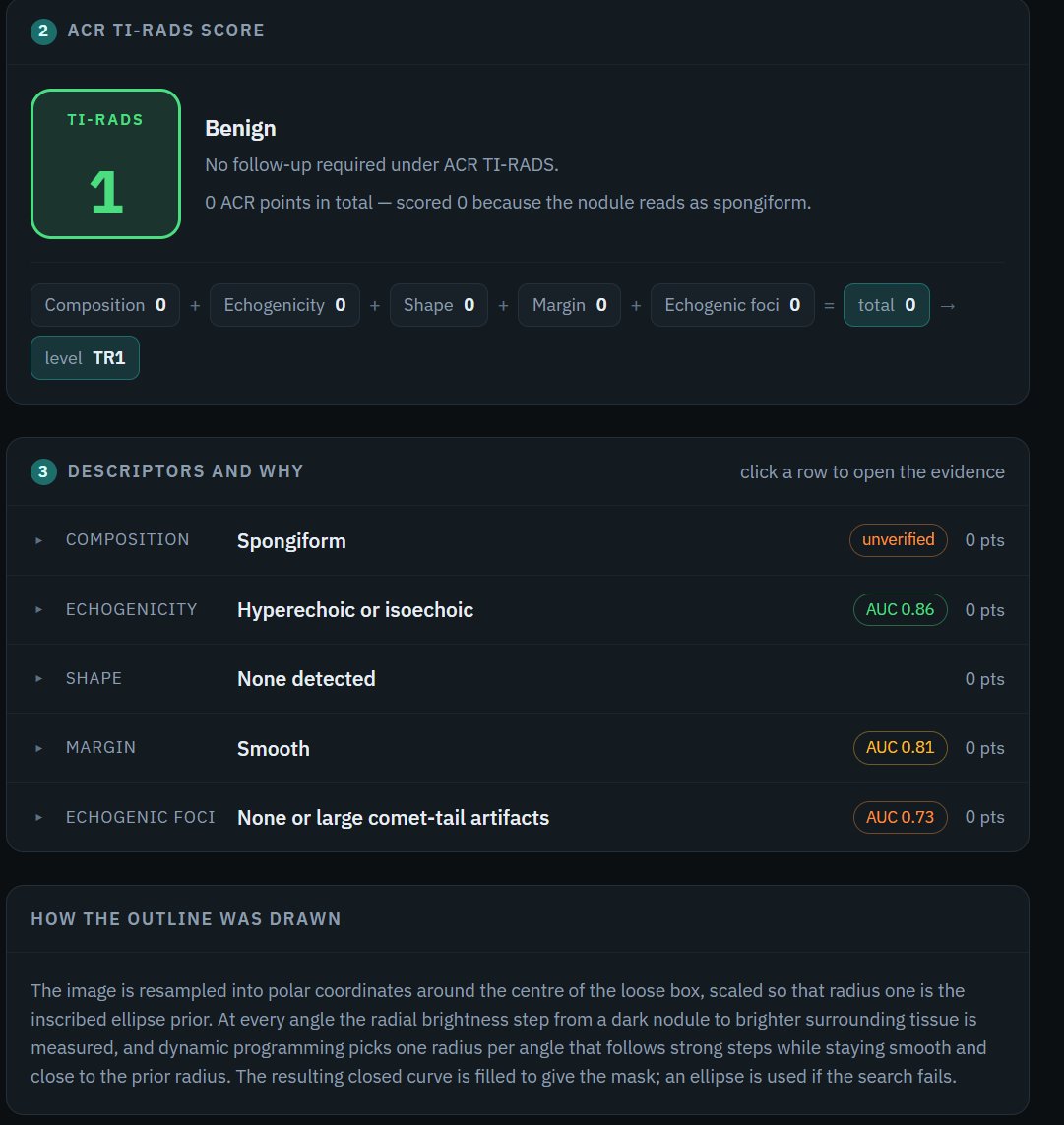
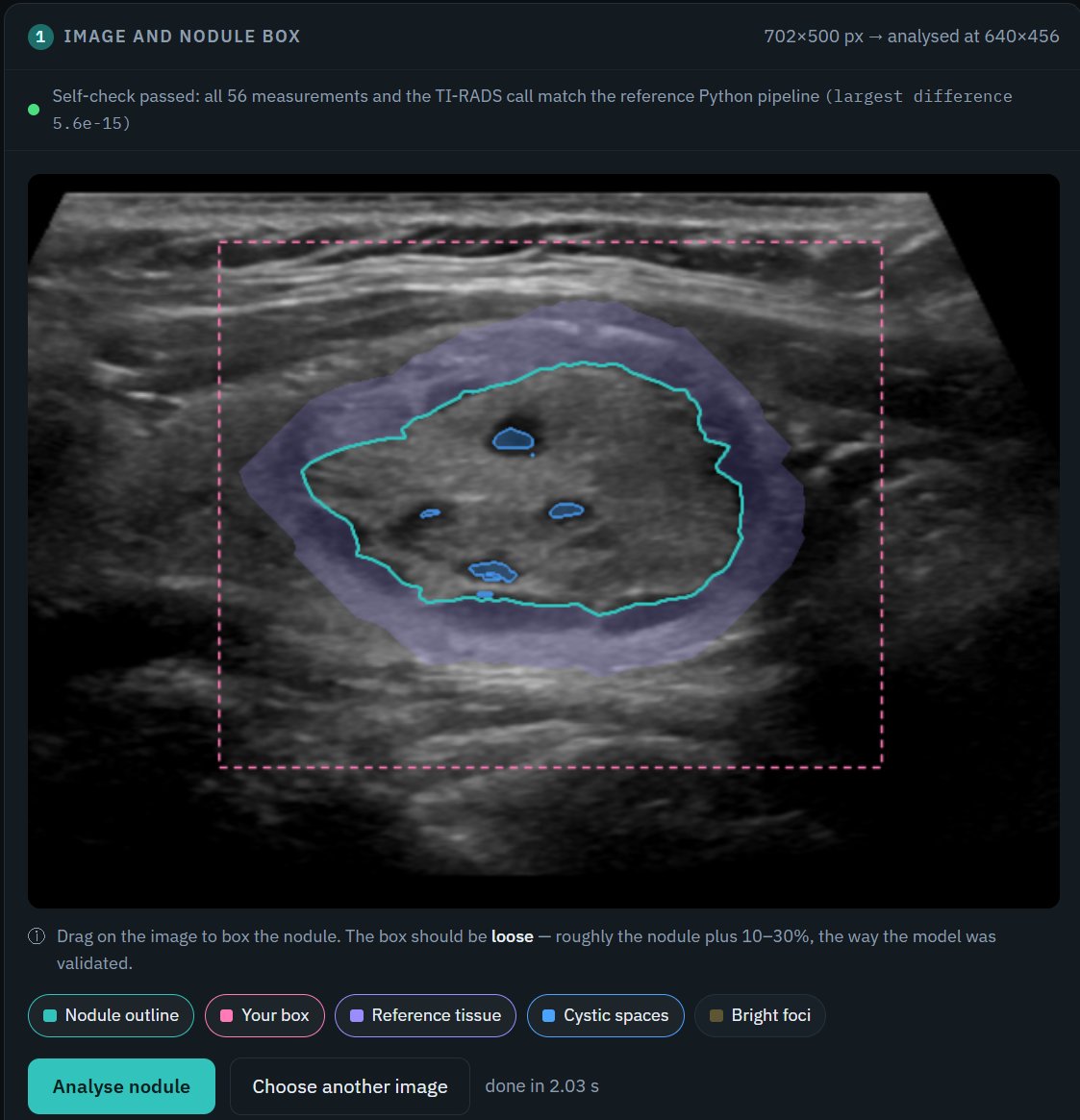
Can you build a thyroid ultrasound AI with no neural network at all — and still read every step of it?
That's what we're testing with iWSP TI-RADS.
The inspiration: a paper posted this week from @MSFTResearch@JohnsHopkins@NYUDataScience and @Columbia - "Interpretable Weight-Space Programming Builds Transparent Transformers and Brain Encoding Models" (@y_mehtu et al.). Instead of training a model with backpropagation, an AI agent writes the model directly as readable code, tests it, and revises it over many rounds.
AI is making many people miserable, but it doesn't have to. Decades of psychology research and empirical results show the importance of nurturing your own skills & development.
https://t.co/sqp0V29xrT
Can you build a thyroid ultrasound AI with no neural network at all — and still read every step of it?
That's what we're testing with iWSP TI-RADS.
The inspiration: a paper posted this week from @MSFTResearch@JohnsHopkins@NYUDataScience and @Columbia - "Interpretable Weight-Space Programming Builds Transparent Transformers and Brain Encoding Models" (@y_mehtu et al.). Instead of training a model with backpropagation, an AI agent writes the model directly as readable code, tests it, and revises it over many rounds.
A non-AI model, created using ideas behind weight space programming for #thyroid nodule risk stratification. Runs locally, no #AI, no CNN - just #HTML and JavaScript is all you need. @java Built using @claudeai
Can you build a thyroid ultrasound AI with no neural network at all — and still read every step of it?
That's what we're testing with iWSP TI-RADS.
The inspiration: a paper posted this week from @MSFTResearch@JohnsHopkins@NYUDataScience and @Columbia - "Interpretable Weight-Space Programming Builds Transparent Transformers and Brain Encoding Models" (@y_mehtu et al.). Instead of training a model with backpropagation, an AI agent writes the model directly as readable code, tests it, and revises it over many rounds.