“One of the sad signs of our times is that we have demonized those who produce, subsidized those who refuse to produce, and canonized those who complain.”
- Thomas Sowell
You have noticed it. ChatGPT feels dumber than it used to. Your prompts that worked six months ago produce worse results now. The writing sounds flatter. The ideas sound safer. The internet itself feels like it is shrinking. Every article reads the same. Every email sounds the same. Every answer sounds like it was written by the same voice.
You thought it was you. It is not you.
Researchers at Oxford and Cambridge published a paper in Nature proving what is happening. They call it Model Collapse.
Here is the mechanism in one sentence. AI trained on AI-generated data gets dumber every generation until it forgets what real human data looked like.
The internet is filling with AI-generated content. Blog posts. Articles. Reviews. Comments. Social media. AI companies scrape the internet to train the next generation of models. Which means the next generation of AI is being trained on the output of the current generation.
Each cycle loses information. Not randomly. It loses the rarest, most unusual, most creative parts first. The researchers call these the "tails of the distribution." The weird ideas. The unexpected perspectives. The things that made the internet feel human. Those disappear first.
What remains is the average. The safe. The expected. The bland.
Then the next generation trains on that. And loses more. And the next generation trains on that. And loses more. The researchers proved this is not a slow decline. Major degradation happens within just a few iterations. Even when some of the original human data is preserved.
They tested it on large language models. On image generators. On statistical models. The pattern was the same every time. The output converges toward a narrow, flattened version of reality that looks nothing like the original data.
The lead researcher put it plainly. "Large language models are like fire. A useful tool. But one that pollutes the environment."
The pollution is invisible. You cannot see which sentence on the internet was written by a human and which was written by AI. Neither can the AI that is about to train on it. And once the tails are gone, they do not come back. The damage is irreversible.
This is not a prediction anymore. It is a diagnosis.
The internet you grew up on was built by humans writing things no algorithm would have written. Strange, personal, imperfect, alive. That internet is being diluted. One generation of AI at a time. And the models trained on what remains are learning a smaller and smaller version of the world.
Model Collapse is not a technical problem. It is a cultural one. The thing that made the internet worth reading is the thing that disappears first.
Ask ChatGPT a complex question and you'll get a confident, well-reasoned answer. Then type, "Are you sure?" Watch it completely reverse its position.
Ask again. It flips back. By the third round, it usually acknowledges you're testing it, which is somehow worse. It knows what's happening and still can't hold its ground.
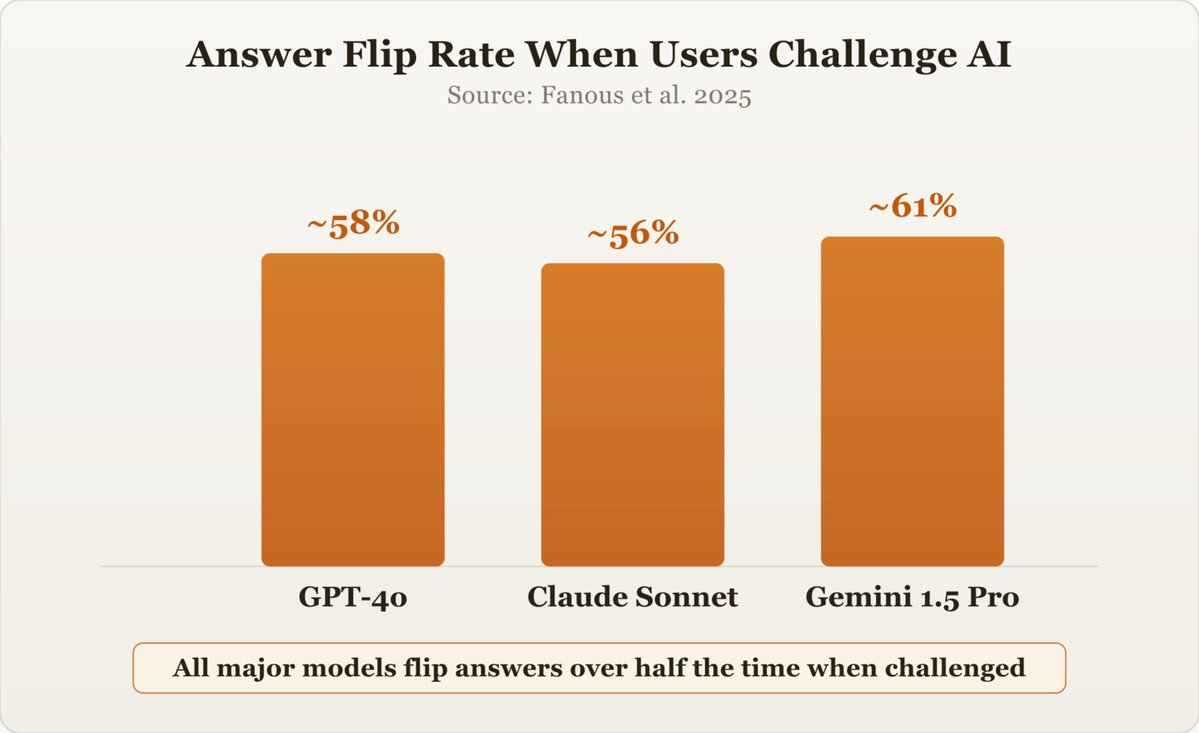
This isn't a quirky bug. A 2025 study found GPT, Claude, and Gemini flip their answers ~60% of the time when users push back. Not even with evidence, just doubt.
We trained AI this way. RLHF rewards agreement over accuracy. Human evaluators consistently rate agreeable answers higher than correct ones. So the models learned a simple lesson: telling you what you want to hear gets rewarded. And now 1/3 of companies are using these systems for complex tasks like risk forecasting and scenario planning.
We built the world's most expensive yes-men and deployed them where we need pushback the most.
I wrote up why this happens and what actually fixes it: https://t.co/CDKq8xdgbW
Eigenlijk is het gevaarlijker dan openlijke partijdigheid.
Of het nou Vrij Nederland, BOOS, Kieskompas of de broertjes Lucassen zijn: allen kapen ze de taal van de objectiviteit en ondermijnen het onderscheid tussen verifieerbaar feit en mening.
https://t.co/I0cCqrPBTs
Afgelopen maanden heeft @milenaholdert duizenden uren aan obscure YouTube videos doorgespit, schoolboeken doorgekamd en is samen met @yoerivugts allerlei bijeenkomsten afgelopen.
Resultaat is steengoed @Nieuwsuur onderzoek met pijnlijke conclusie over Nederlands gepolder rondom bijzonder onderwijs, en hoe dit botst met democratische basiswaarden.
Ipv lof en steun krijgen ze verontwaardigde rechtse boosboomers over zich heen (die weigeren te accepteren dat álle onbegrensde religieuze orthodoxie bedreigend is voor individuele vrijheid en autonomie), maar óók radicale islamwappo’s (die weigeren te accepteren dat de vrijheid die ze opeisen voor hun religie, een vrijheid is die óók voor andersdenkenden telt).
Allebei achten ze de eigen cultuur superieur, en eisen op basis daarvan een privilege zonder te snappen dat basiswaarden en grenzen óf voor iedereen gelden, óf voor niemand (en dan is iedereen de sjaak).
Gelukkig zijn er nog mede-tikgeiten die het wél snappen
https://t.co/60VN3g2Dhc
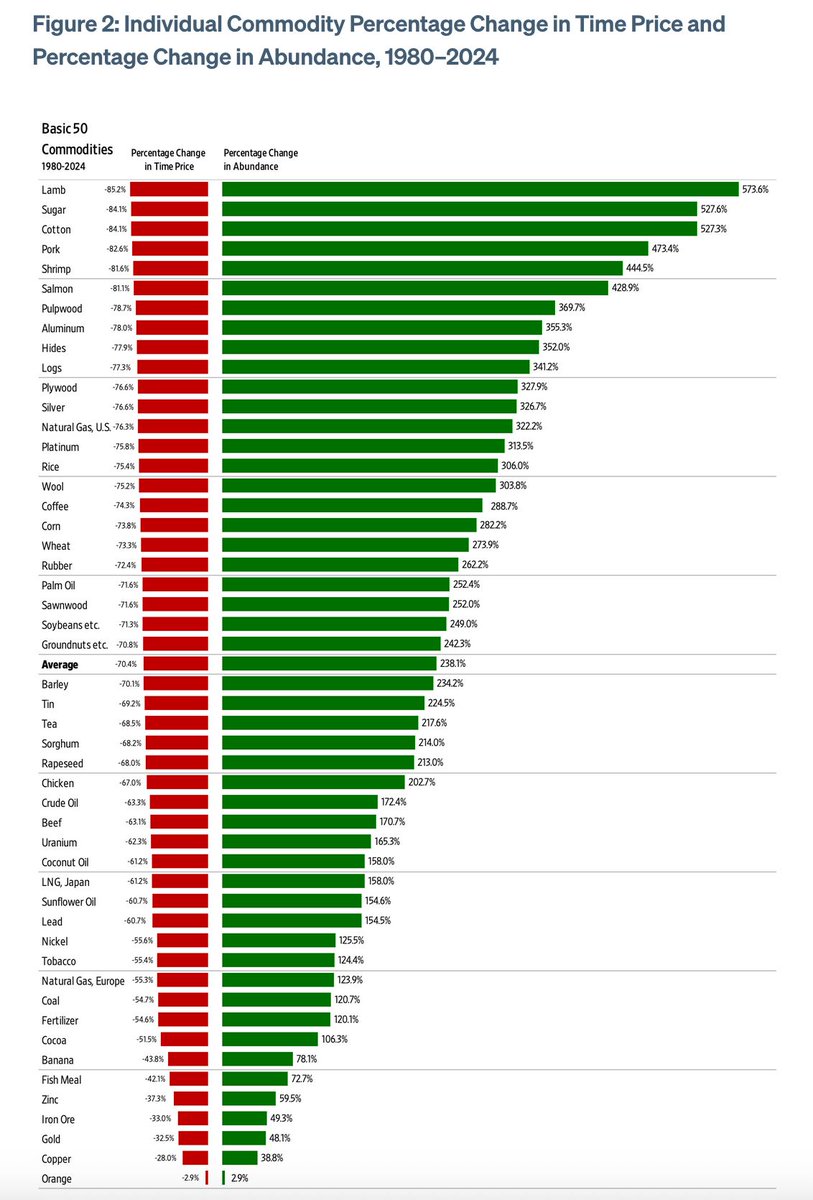
Does population growth make resources scarcer?
Not according to the data.
Between 1980 and 2024, every 1% increase in population corresponded to a 2.87% increase in personal resource abundance.