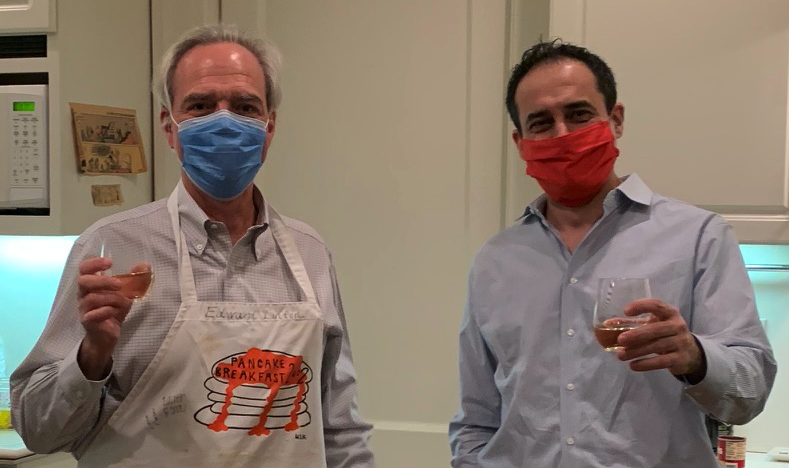
Happy Thanksgiving 🦃🍁🍽 from this rockstar @VUMCMedicineRes @VUMC_Medicine team! Grateful to get to work alongside these amazing doctors. #WomenInMedicine Thx to all #healthcareworkers serving today!
Our recent publication was reviewed in NEJM today! @davidrliu, @NIHDirector, @JonBrownLabVUMC, @Progeria, @mrrerdos The figure is absolutely killer!
Will definitely be sending this to my mom.
https://t.co/eRAr8RaR14
Read this study from Paul Cohen @RockefellerUniv about Brown Fat in humans and risk of cardiometabolic disease. Nice to see independent work from former @BrighamFellows. https://t.co/ATScpg7Zqx
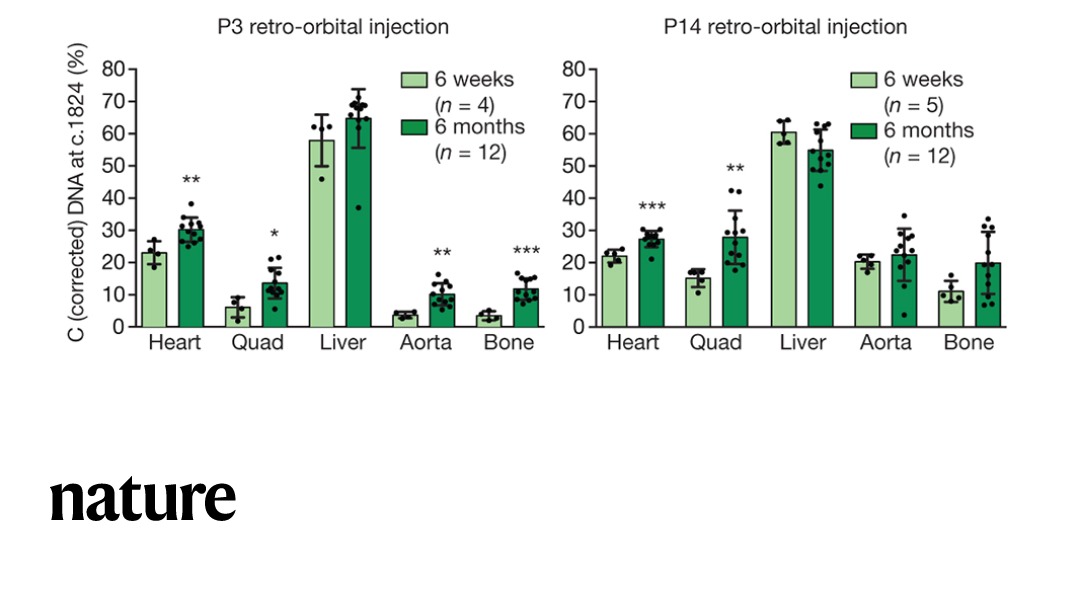
The findings of a study in Nature demonstrate the potential of in vivo base editing as a possible treatment for Hutchinson–Gilford progeria syndrome and other genetic diseases by directly correcting their root cause. https://t.co/9FMUuY3TzA
News & Views: No cure exists for the lethal premature-ageing condition Hutchinson–Gilford progeria. A gene-editing tool offers a way to treat the condition in mice, according to a Nature paper. Could this approach lead to an effective therapy? https://t.co/SKZhd7teEE
In vivo base editing shows promise in treating the genetic accelerated-aging disorder Hutchinson–Gilford progeria syndrome in mice - find out more in our latest highlight of research by @jonbrownlabVUMC
@davidrliu@LiuGroup et al. https://t.co/hvQBfHResT
Research from the @JonBrownLabVUMC and collaborators have rescued mice afflicted with progeria—accelerated aging—which could lead to a cure for Hutchinson-Gilford progeria syndrome in humans.
https://t.co/tkA2lh3tSw
Congratulations to @SarnoffCardio & @BrighamFellows alumnus/current @VUMChealth cardiologist Dr. John Brown. Really nice story & demonstrating power of teamwork. Can studying progeria provide insights into CV aging? @JonBrownLabVUMC @saptarsi_haldar @tmmichelangelo @Progeria
Great science marches on.
A rare incurable disease—progeria—tackled by #CRISPR genome editing with striking results in mouse model
https://t.co/y4RWpB3yRX
@nature@davidrliu @NIHDirector @LukeKoblan @JonBrownLabVUMC
David's ★🧵👇
https://t.co/9tLFsHoQze
So proud of this work demonstrating DNA base editing treatment for #progeria in human cells & mouse model. Amazing collaborative team @davidrliu @NIHDirector @LukeKoblan & Mike Erdos at NIH and my @VUMCResearch team @lindsaymdavison & Sean Doherty
https://t.co/6MN8Nq4gxt
Here is a really great article about our progeria work that mentions the early days where we only had DNA editing data from only a single LMNA c.1824 C>T mouse– @davidrliu, @JonBrownLabVUMC, and @NIHDirector may remember fondly! Check it out here: https://t.co/W1cEH6YyWJ
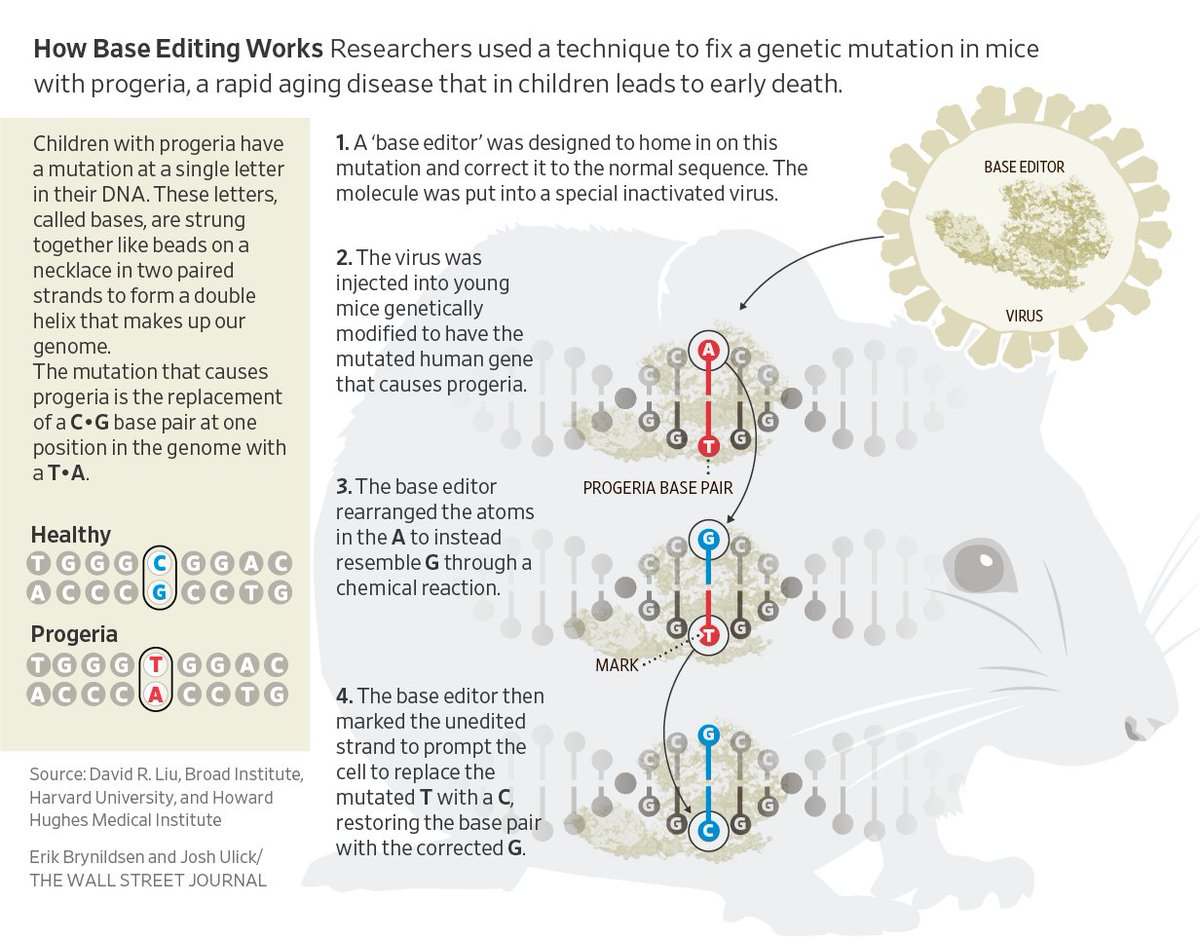
Today we report the use of base editing in patient-derived cells and in mice to correct the most common cause of progeria, the devastating rapid aging disease. Progeria is typically caused by a dominant negative C•G-to-T•A point mutation in LMNA. 1/11 https://t.co/O7dkEYpndg