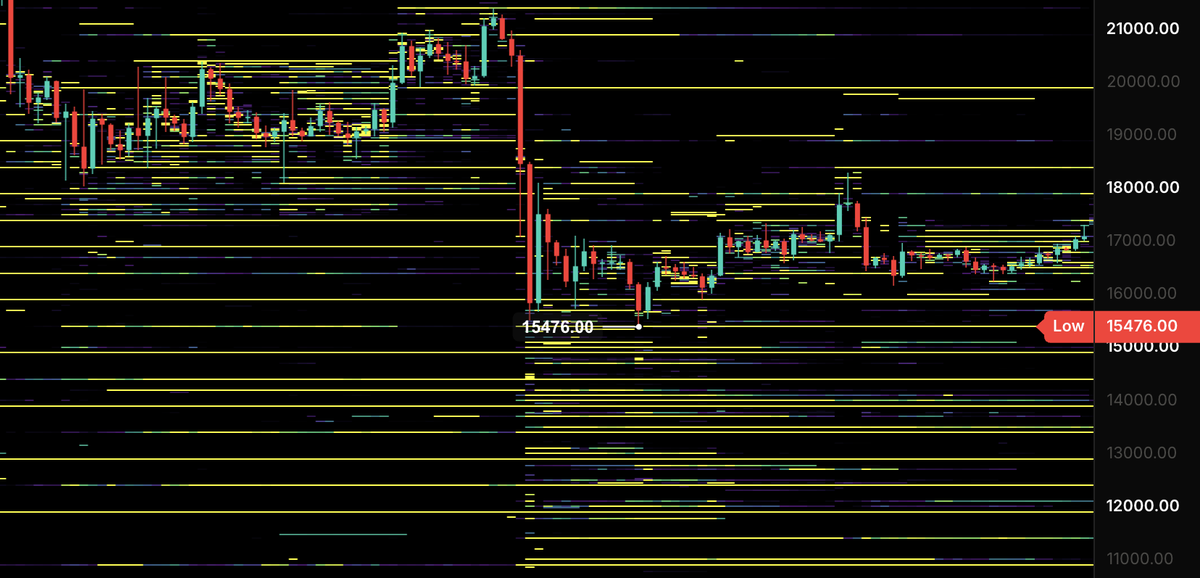
2026 Bottom vs. 2022 Bottom
We’re either still in the pre-capitulation phase, meaning we see one final capitulation wick into the 54K–44K zone.
Or
If we're already in the capitulation phase, then the 54K–44K bids could play out similarly to the 10K–12K bids in 2022 that never got filled.
Either way, the downside from here is limited.
We're either looking at another 10–15% to the bottom, which, in my view, is insignificant in the bigger picture, or we're already within 5% of the bottom.
El mundo desarrollado no tiene un problema de deuda pública. Tiene un problema de deuda total.
Francia 326%, Canadá 315%, China 298%.
Los tipos de interés no solo importan para el bono soberano, importan para todo el sistema.
No te voy a decir cuándo va a subir Bitcoin.
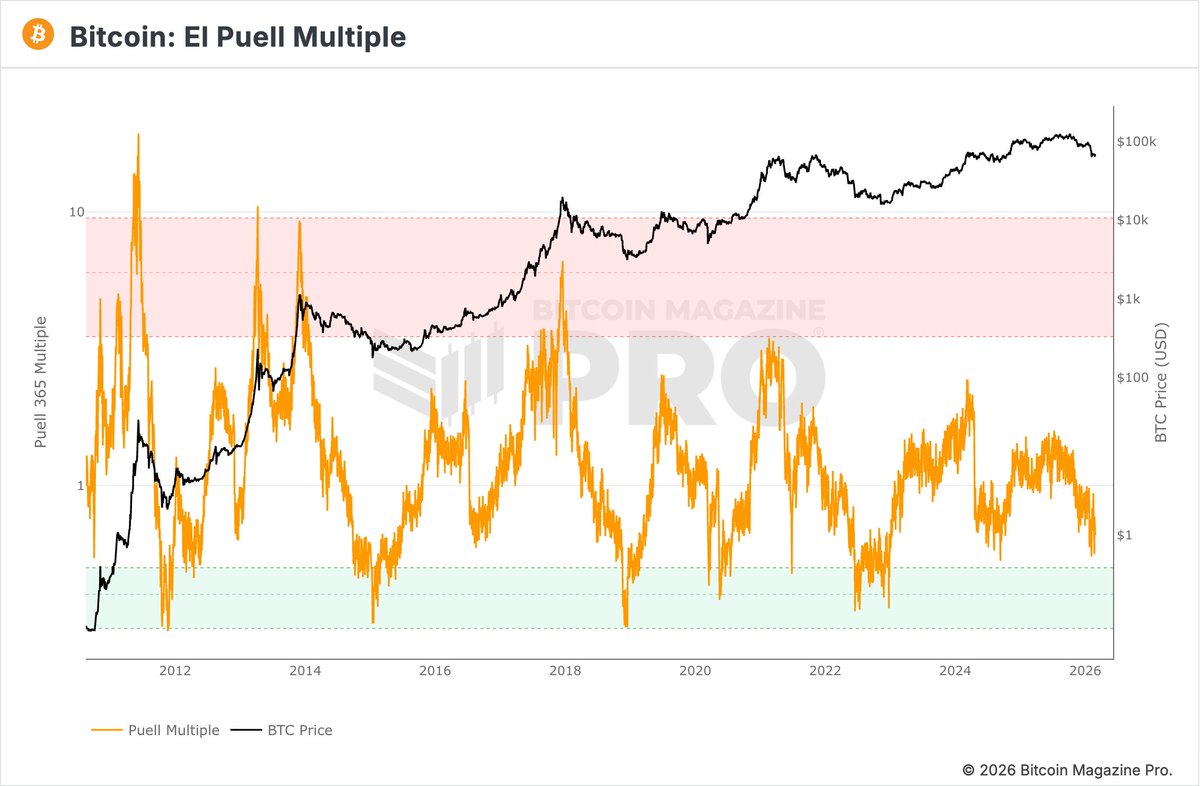
Pero sí te voy a mostrar el indicador que ha predicho cada gran suelo de los últimos 15 años.
Se llama Puell Multiple.
Y ahora mismo está en 0.67.
Déjame explicarte por qué esto importa.
El Puell Multiple mide la rentabilidad de los mineros de Bitcoin comparando los ingresos diarios que generan con su media histórica de los últimos 365 días.
Los mineros son vendedores obligados: necesitan vender BTC para pagar sus costes fijos. Cuando ganan mucho, venden más. Cuando ganan poco, la presión vendedora cae.
Ese flujo influye directamente en el precio.
Las zonas históricas:
— Por encima de 4 → Mineros en modo euforia. Venden fuerte. Techo de ciclo.
— Entre 1 y 4 → Bull market activo. Todo funciona.
— Entre 0.5 y 1 → Territorio neutral-bajista. Presión vendedora cayendo.
— Por debajo de 0.5 → Zona verde. Mineros bajo máximo estrés. Suelos históricos.
¿Y hoy?
0.67.
Estamos en territorio neutral-bajista. La presión vendedora de los mineros está cayendo, pero todavía no hemos llegado a la zona de capitulación real.
¿Señal de compra inmediata?
No.
Porque históricamente los grandes suelos de ciclo se han formado cuando el Puell Multiple cae por debajo de 0.50:
— 2015: cayó a 0.31 antes de tocar suelo.
— 2018: cayó a 0.30 antes de tocar suelo.
— 2022: cayó a 0.35 antes de tocar suelo.
Hoy: 0.67. ¿Ves el patrón? Todavía no hemos llegado al nivel donde históricamente se han formado los mínimos.
Entonces, ¿cuál es el mensaje real?
Que los mineros están sufriendo. Que la presión vendedora estructural está disminuyendo. Pero que el mercado aún no ha mostrado la capitulación que históricamente precede a los grandes suelos.
Si te gustan este tipo de post házmelo saber con un like o un comentario :)
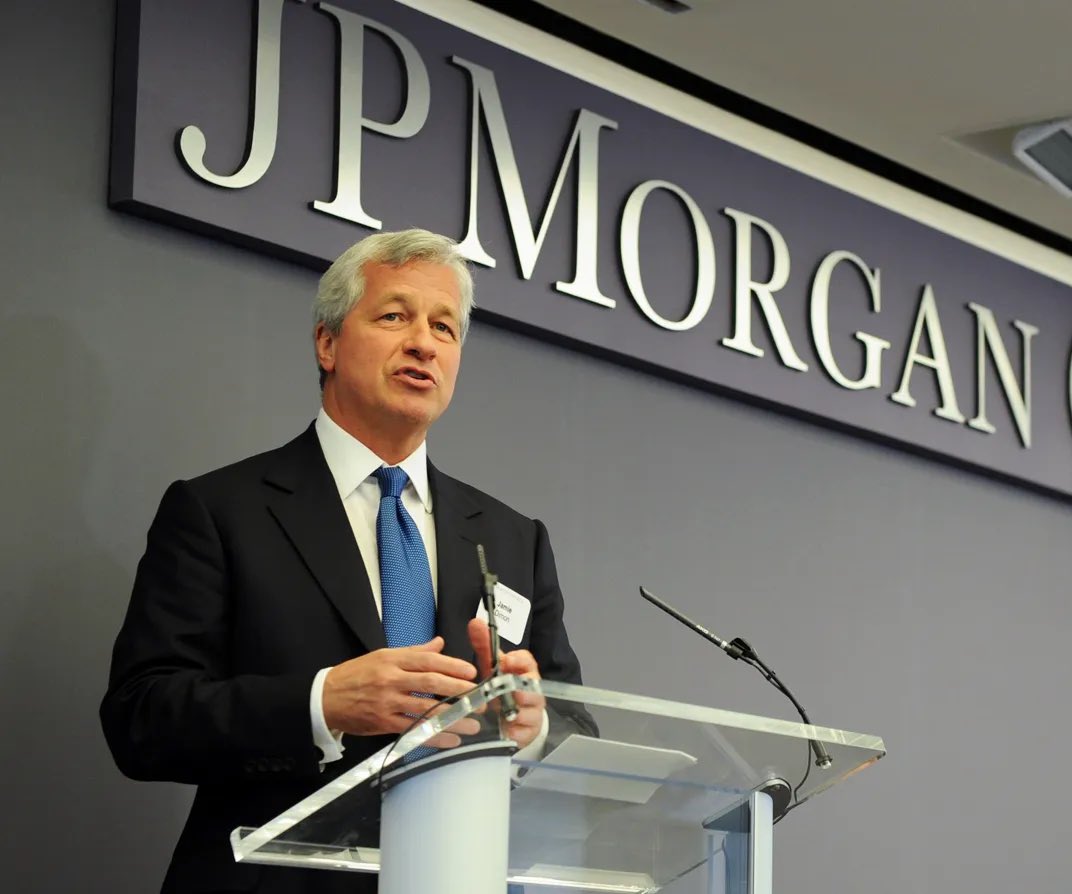
BREAKING🚨 BILLIONAIRE MAX KEISER SAYS A 50% SURGE IN STRATEGY $MSTR COULD BANKRUPT JPMORGAN
JPMORGAN reportedly holds a major short position
Now, Retail investors are backing Saylor against corrupt banks
LIKE 👍 if you want to see JPMORGAN fall
Trump could appoint Kevin Costner or “Kevin Clain” to head the Fed.
Market participants wouldn't care, because whoever comes in will have to inject liquidity into the system.
👉 https://t.co/ZP15cew3tB
🇺🇸 President Trump's next FED Chair pick, Kevin Warsh on Bitcoin:
“I think of it as an important asset that can help inform policymakers when they are doing things right and wrong.”
“It can be a very good policeman for policy.”
“It's the newest and coolest software that will provide us an ability to do things that we could have never done before.”
Van a inyectar 200.000 millones más de liquidez. Y no lo va hacer el FED.
La economía de EEUU está creciendo al 4%.
Y hoy, el fallo de la Corte Suprema.
👉 https://t.co/kDjIvBwK0O
57% of Europe's LNG imports now come from the United States
Overall EU: 57% US share
Highest dependency:
Finland ~92%,
France ~49%,
Spain ~45%
Lowest:
Turkey ~18%,
Italy ~38%
The US has decisively replaced Russia as Europe's primary LNG supplier, reshaping energy security and transatlantic trade.
#LNG #Energy #Europe #USA #NaturalGas
MSTR, BTC, ETH y BMNR suben con fuerza, suelo😝
Y Powell FED dijó "inyéctese liquidez en el sistema" y la liquidez se inyectó, y todo el mundo vio que la liquidez era buena.🥳
👉 https://t.co/rnSumm0M2z
Burry, bajista en TSLA. Va a por todos.
Bitcoin: La línea que cambió la historia de #BTC.
Han vuelto a repetir la pauta: caída del 20%, pánico, capitulación y giro al alza.
Es psicología humana.
👉 https://t.co/0uxm6c9WDG
THE $7.4 TRILLION DETONATOR: AMERICA’S HIDDEN LIQUIDITY BOMB ABOUT TO OBLITERATE EVERY MARKET ASSUMPTION
The most dangerous number in financial history is hiding in plain sight.
$7.4 trillion parked in money market funds. Not in stocks. Not in real estate. Not in gold. Not in Bitcoin. In idle Treasury bills earning 5%+, waiting for a single Federal Reserve decision to unleash the largest capital reallocation event in human civilization.
This isn’t cautious investing. This is a civilizational coiled spring with a central bank trigger.
THE DETONATION PHYSICS
When the Fed cuts 150-200 basis points, MMF income collapses by $100-140 billion annually. That lost yield must hunt returns somewhere.
Each 1% MMF reallocation releases $74 billion.
10% rotation unleashes $740 billion … exceeding most nations’ GDP.
20% exodus deploys $1.48 trillion into risk assets.
The flows don’t trickle. They cascade through institutional pipes like a breaking dam.
THE HISTORICAL PATTERN NOBODY REMEMBERS
1998: $1.3T MMF → Fed cuts → Tech bubble ignites
2003: $2.1T MMF → Fed cuts → Housing mania begins
2009: $3.8T MMF → Fed cuts → Everything rallies 300%+
2025: $7.4T MMF → Fed signaling cuts → Unknown territory
Double the 2009 powder keg. But now Bitcoin exists as 24/7 institutional-grade scarcity with ETF rails.
THE FOUR HORSEMEN TRIGGERS
3-month T-Bill drops below 4.0% from 4.8%
Fed confirms sequential cuts beyond one-and-done
High-yield spreads compress below 350bps
Crypto ETF inflows sustain above $2B weekly
All four converging = detonation sequence.
THE BITCOIN MATHEMATICS
MMF pile: $7.4 trillion at 5% yields
Bitcoin supply: 21 million fixed, 96% mined
BlackRock IBIT: $100B AUM in under 10 months
If 5% rotates ($370B): Bitcoin $280-350K
If 10% rotates ($740B): Bitcoin $550-700K
If 15%+ with sovereign buying: Bitcoin $1M+
Not speculation. Thermodynamics. Finite supply meets infinite liquidity in mathematical collision.
THE MECHANISM
MMFs flow through institutional architecture:
Prime brokerages rebalancing
Pension allocation triggers hitting
Corporate treasury deployments
Sovereign wealth hunting uncorrelated returns
ETFs absorbing without selling pressure
Every pipe terminates at scarcity. Only one asset is provably finite, instantly settlable, globally accessible 24/7: Bitcoin.
THE FED’S CHOICE
Keep rates high: Recession, debt spiral
Cut aggressively: $7.4T liquidity tsunami
Bond markets price 150-200bps cuts through 2026. The choice is made. The spring releases.
THE COUNTDOWN
When 3-month yields crater from 5% to 3%, capital doesn’t deliberate. It hunts yield with systemic urgency.
Gold supply: uncertain
Real estate: illiquid
Stocks: expensive
Bonds: debasing
Bitcoin: mathematically provable 21M cap with instant global settlement.
The largest dry powder pile in history aims at civilization’s scarcest asset.
The trigger is Fed policy in motion.
The timing is bond-market priced.
The outcome is thermodynamic inevitability.
When the spring releases, price discovery enters unknown physics.
Choose accordingly.
For years, Bitcoin was secure but static. Ethereum was programmable but had its risks.
If you wanted to do anything with your BTC, you had to wrap it, bridge it, and hope that the multisig held.
That was the compromise → Not anymore.
Bitcoin now supports programmability natively, without forks, wrappers, or abstractions. And with it, an entirely new financial stack is emerging on the base layer.
Why did this take so long?
Bitcoin’s scripting language was intentionally limited with no loops and no complex logic.
That design made it predictable and secure, but it also made smart contracts impossible.
The workaround was wrapping BTC as ERC-20 tokens on other chains. It worked but came with risk: custody, bridges, validators, and gas in other assets.
You weren’t building on Bitcoin. You were building around it.
What Bitcoin DeFi actually needs
To make DeFi work natively on Bitcoin, you need four things. Until now, you could pick two. Arch gives you all four:
🔸 Smart contracts
🔸 Native BTC liquidity
🔸 Composability
🔸 Bitcoin-level security
The execution layer unlock
Programmability on Bitcoin doesn’t mean changing Bitcoin.
It means using an execution layer that processes logic off-chain but anchors every state transition to Bitcoin’s consensus.
That’s what the ArchVM delivers.
Developers write in Rust → Apps execute fast and settle on the base layer.
Performance and cost
Bitcoin’s base layer is secure but slow.
Execution layers fix this by batching and anchoring proofs to Bitcoin periodically.
That means:
🔸 Sub-second execution
🔸 Low fees
🔸 Bitcoin-grade finality
It’s the same model that powers Ethereum’s scaling solutions, applied to Bitcoin without changing its consensus.
The bigger picture
DeFi can now exist on Bitcoin with no governance overrides, validator politics, or trusted intermediaries.
This is what finance looks like when it inherits Bitcoin’s immutability.
What comes next
Mainnet is on the horizon.
→ For builders: the environment is ready.
→ For users: your BTC can finally work natively.
→ For the industry: the divide between “Bitcoin-only” and “DeFi” no longer exists.
Bitcoin was never supposed to be static. It was meant to be sound money with programmable rails.
That's the future we're building 🟠
La verdadera "bomba atómica" comercial de China reside en el monopolio de tierras raras. Tiene el 60% de la producción, pero más del 85% de la capacidad de refinado.
Si China dejase de exportar tierras raras, el impacto sería inmediato y devastador para la industria global. Estas materias son esenciales para fabricar desde microchips, baterías, motores eléctricos y paneles solares, hasta turbinas eólicas, misiles, satélites y teléfonos móviles.
Sin ellas, se paralizaría gran parte de la cadena tecnológica moderna: la transición energética se detendría, el desarrollo de vehículos eléctricos quedaría bloqueado y la producción de componentes estratégicos —tanto civiles como militares— se vería gravemente comprometida.
Y esa es el arma que tanto angustia a D. Trump y que equilibra la batalla comercial entre las dos grandes potencias del mundo. El viernes vimos la reacción del mercado a la amenaza de recrudecer la guerra arancelaria entre los dos gigantes. Veremos si es un nuevo fuego de artificio o si es el primer paso de otro enfrentamiento que puede convertirse en un problema real que desate la reacción bajista en los mercados.