I'm excited to have been chosen to participate in the Future of Rights & Governance program at NYU Law @nyulaw Center for Human Rights & Global Justice March 14-15. I'll discuss how innovations in democratic practices can address failures of electoral governance @PHRCRSIS@AU_SIS
I’ve officially resigned as Associate Editor for Frontiers in Systems Neuroscience (part of @FrontNeurosci). It used to be a reputable journal, but became a case study in how forced automation destroys academic integrity. 👇
Today, the Stanford @DigEconLab launches the AI Economic Indicators, a new platform for tracking how AI is reshaping work, productivity, adoption, and the economy.
1/6
In my new book, Artificial Intimacy. I trace the effects of our lives with chatbots from childhood to parenthood, from work to love, and more. I offer both a cautionary tale and a roadmap for being human in the age of AI. Out on September 29; preorder now: https://t.co/BMNPau6vCR
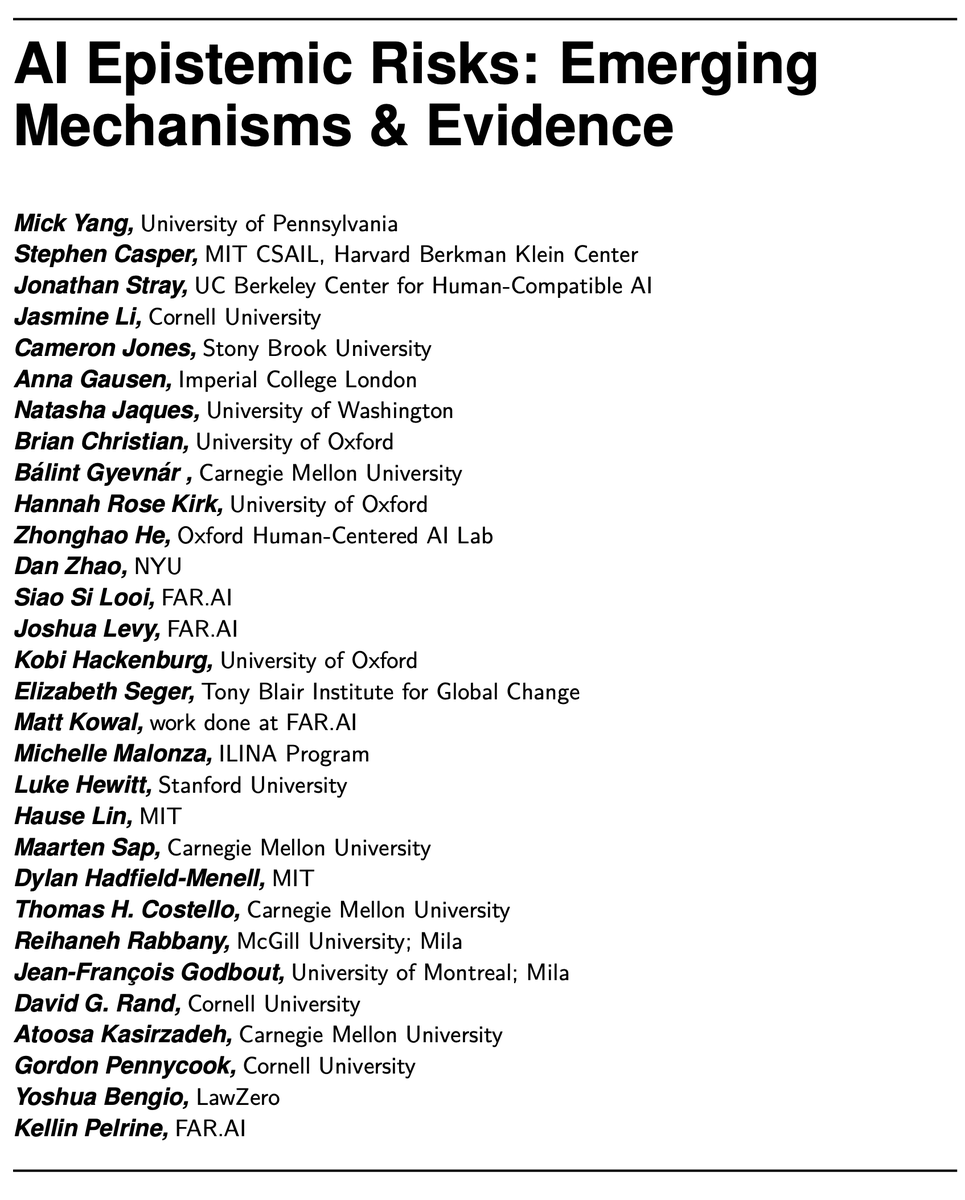
Humanity's ability to know, reason, judge, and act well is the foundation of science, democracy, crisis response, & management of AI itself.
AI poses serious risks to that foundation.
New paper on epistemic risks by 30 experts calls for attention to this. Link in thread.
Students without access to LLMs are 2 to 8 times more creative than students with access.
That is the finding of a new paper comparing 2,200 college admissions essays written by humans before ChatGPT with essays generated by GPT-4.
The key point is not individual creativity. GPT-4 can write well, sometimes better than individual students. The problem is collective creativity.
Each new human essay added new semantic territory. New ideas. New angles. New experiences. New combinations.
Each new GPT-4 essay added much less.
The authors call this the diversity growth rate: how much novelty each additional text contributes to the collective pool of ideas.
Humans kept expanding the pool. GPT-4 made the pool converge.
Even when the authors pushed GPT-4 to be more creative, changed parameters, or used chain-of-thought prompting, the homogenizing effect remained.
This is the real danger of AI in education.
Not that students will write worse.
That everyone will write the same.
*
Full paper in the first reply
@JeromeAdamsMD@PaulRoundy1 .@JeromeAdamsMD Is @PaulRoundy1's statement that "Unfortunately we could not eliminate the virus" true? I've heard engineers argue that it could be possible to achieve R0<1 by adding engineering controls. If that is the case, then virus elimination would be a policy choice.
"Don't let other people write your paper."
Economic sciences laureate Daron Acemoglu spoke to nine students around the world and shared his best career advice.
Watch the full conversation: https://t.co/WTO2wjwXFP
Enjoyed giving a talk about the economics of AI at the econometric society meeting this morning. Some motivating facts/ideas that all economists should know about AI below. 1/n
@drseanmullen Maja Chwalińska is also sick.
"To make matters worse, she also came down with a respiratory infection."
"Na domiar złego dopadła ją także infekcja dróg oddechowych."
https://t.co/vh7l4LFeOe
Leiden Declaration on AI and Mathematics.
https://t.co/UtJrD6OkeM
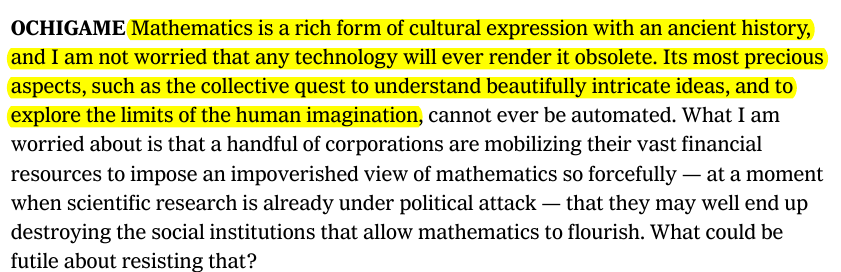
A glimpse of what is mathematics by those who practice mathematics.
Excerpts from the NYT (by Harris, Ochigame, and Martin).
https://t.co/O3lWs3jU7L
Reminder: Long COVID's disability & suffering will be the pandemic's most devastating long-term global legacy. Neither GBD supporters nor critics anticipated its scale or included it in their policy calculus -and “let er rip” strategies prioritizing widespread exposure clearly worsen the toll. Millions affected, with real costs in lives and productivity (on top of 20 million direct deaths globally, which we should never forget or minimize). https://t.co/I48h2XxxfS
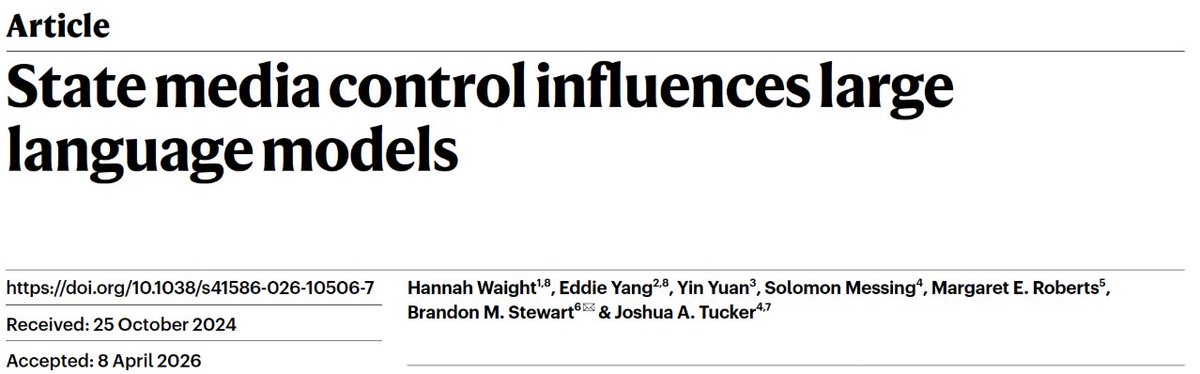
1/ New @Nature! We study how powerful institutions shape the information environment for LLMs. Commercial LLM training is opaque, so we trace a path from state-coordinated media -> training data -> model responses.
Concerns about AI risks are not a fringe view, at least not in France.
New CeSIA × OpinionWay poll:
- For every 1 French person opposed to international AI red lines, 9 are in favor of them.
- Cross-partisan consensus, from the far-left to the far-right, and across both current and catastrophic risks.
- 83% are concerned by deepfakes and evidence forgery; 80% cyberattacks; 78% AI-designed chemical, biological, nuclear weapons; 75% loss of control over AI systems.