Introducing...
THE FUNNELS SHOW:
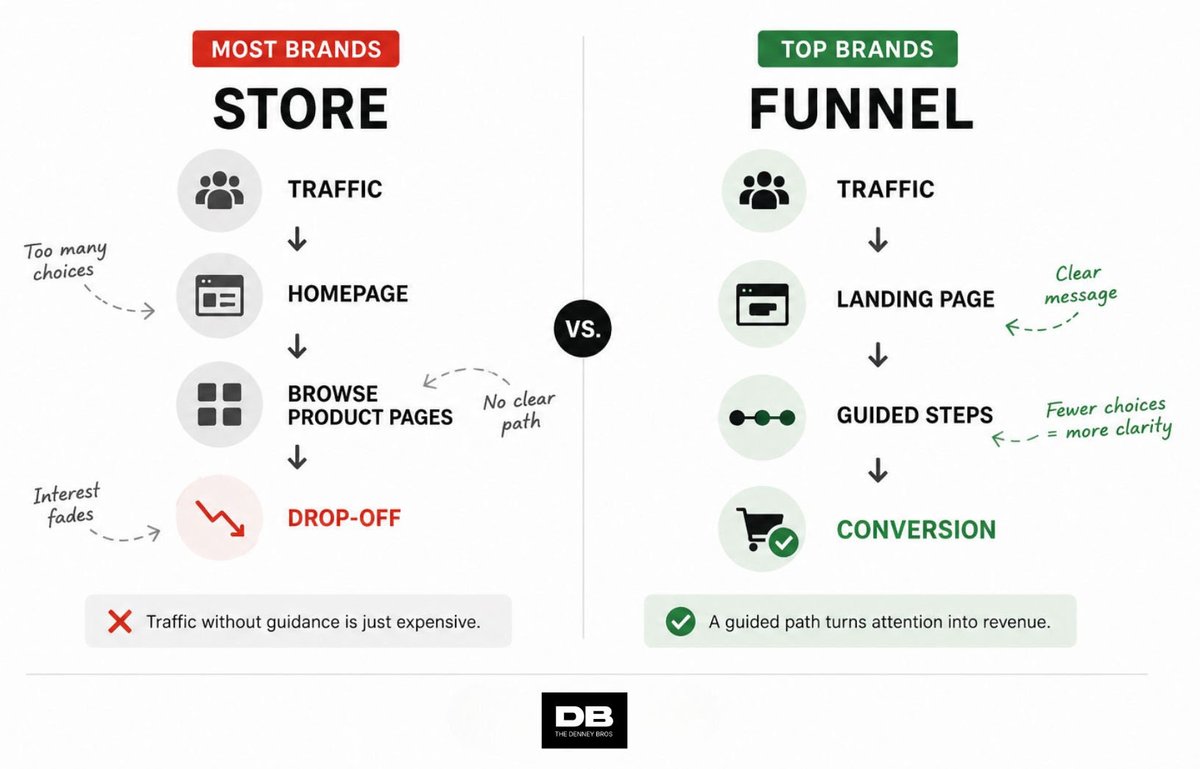
Stop driving traffic only to stores. Start driving traffic to funnels.
Most brands burn ad dollars sending traffic to just their store.
All while the fastest-growing DTC brands use offer funnels to hit target order value, and are designed turn one-time buyers into repeat customers.
On The Funnels Show, we teardown the funnels 9-figure brands are using to scale up.
We’ll even show you how to apply this to your own brand and clients, with funnel templates, swipe files and AI (coming soon 👀)
Expect in-depth funnel teardowns, case studies, and proven playbooks for landing pages, quiz funnels, upsells, popup offers, and more.
Subscribe if you’re a founder of a brand, a marketer, agency or growth team ready to scale up 👇
@jasonfried Feel like cracked founders want products to be a CLI because they know what they want, with founder incentives
Meanwhile everyone else doesn't really know what they want and want that spoon fed to them
Great software products for non-founders are prescriptive and opinionated
@MarcioClutch Perhaps just like remote work took 5 - 10 years to roll out from bootstrapped tech companies to corporate America, the same will happen for the AI workforce shuffle
AI kills remote work.
I grew up on remote work, starting out as a web developer in my teens, craving working in person with like-minded people.
By the time I had started ConvertFlow it was right before COVID and we were bootstrapping, so hiring remote was a cost advantage and natural, but not ideal.
Our instinct was to try to work with people in person as much as financially possible, but then COVID hit and that went out the window.
My co-founder and I worked in person each day through it all, scaling hiring remotely.
It started feeling off seeing the growing expectations from the friends who want to WFH and nomad around, seeing them become less serious about work, vs seeing the friends who are killers and chase in-person work.
They’re dominating when simply showing up person is rare. It’s clear why.
Remote-first has mostly felt like an unfortunate necessity and disadvantage so far in my career.
Whenever working with someone in person, it feels like moving at light speed.
Decisions get made instantly which turns into immediate action. This compounds.
We have an office in Miami, have started hiring locally and have begun operating Miami-first.
We will continue to hire remote as well, but now that AI has started to really take effect for our work, I don’t see us scaling it.
All of the n+1 work once scaled up remotely, is about to get fully automated with AI.
Remote is worth it maybe for the AI-pilled senior hire who can already manage and scale AI agents for recurring workloads, the ones genuinely worth all the zoom fatigue and cost of flying to work in-person together periodically.
What’s left is the human work that’s fuzzy, requires constant context sharing, and simply can’t be done by AI. This work is best done in person.
AI kills remote work.
This has been shown to be concentrated in routine-cognitive white collar occupations. The challenge we highlight is that GenAI exposure is super strongly correlated with WFH exposure, posing a challenge for empirical analysis.
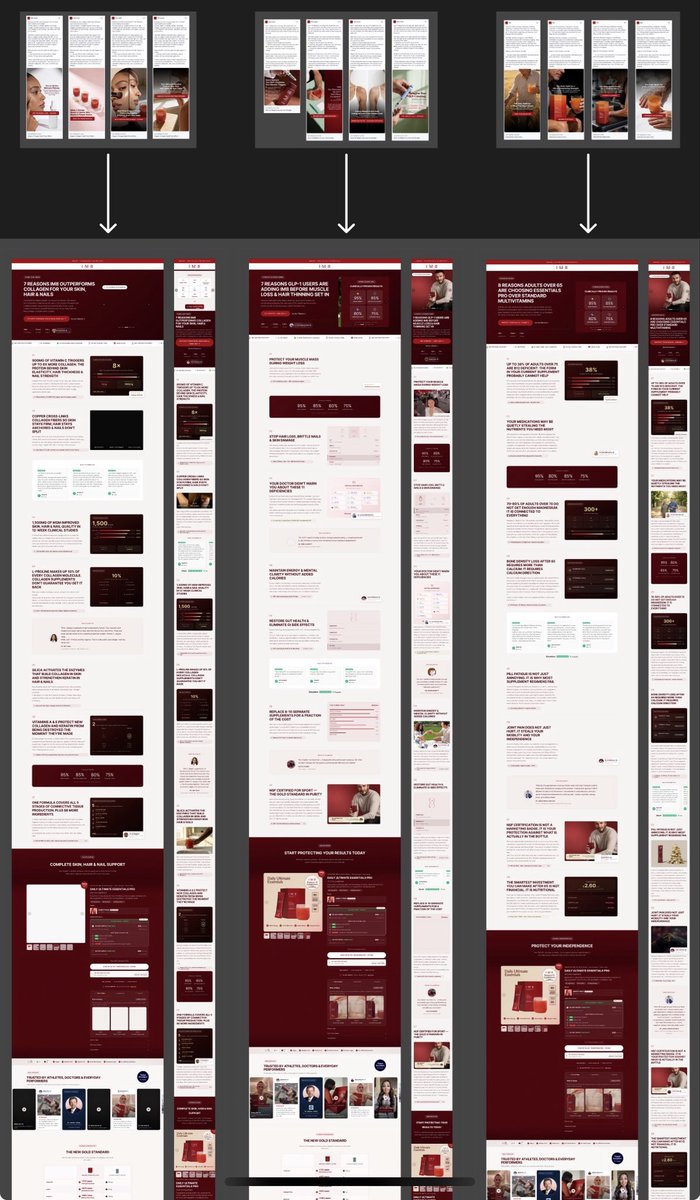
On The Funnels Show, @ethanhdenney and I broke down how IM8 hit $120M in 11 months.
Most people think the reason is obvious:
David Beckham.
That’s the wrong takeaway.
Celebrity alone doesn’t convert. Funnels do.
Attention is just a multiplier.
If the system behind it is weak, you get:
- Traffic with no conversion
- High CAC with no payback
- Hype with no retention
But if the go-to-market system is strong, attention becomes fuel.
That’s what IM8 got right.
They didn’t send traffic to a home page.
They built a path:
- Focused offer
- Clear positioning
- Guided experience
- Controlled decision-making
That’s the difference.
Ethan and I see the same pattern across high-growth brands:
- Hims guides users instead of letting them browse
- The Farmer's Dog uses quizzes to reduce friction
- AG1 simplifies the choice down to one core product
None of them rely on attention alone. They convert it.
If you’re paying for traffic right now, here’s the real question:
What happens after the click?
Three quick things to look at this week:
1. Are you guiding visitors, or making them figure it out?
2. Does your offer reduce decisions or increase them?
3. Are you building momentum toward purchase, or losing it?
Fix those, and your existing traffic becomes more valuable. AOV goes up.
Ignore the leaky bucket and more traffic just makes the problem bigger.
If you want to see how this plays out in real-life funnels, watch our IM8 breakdown (link in the replies)
@helloitsolly@robwalling To break that plateau we had to replace most of the first type of revenue we got.
MRR from self-service customers through organic channels specifically.
The AI opportunity for marketing agencies is post-click:
AI is like a cheat code for marketing agencies:
- AI helps you generate 100x more ad creative
- AI helps you analyze 100x more reporting data
- AI automates workflows for fulfillment
- AI reduces headcount increasing profit
Today marketing agencies can still get an edge using AI for ads.
The problem? Every other marketing agency has the same AI as you do.
With AI every marketer fills every channel with 100x more creative, reducing its effectiveness over time.
Any increase in profit ends up getting competed away by the next marketing agency who can simply charge less.
“Your margin is my opportunity.” - Jeff Bezos
If everyone can generate endless ad creative AI, where’s the edge?
Where’s the next unfair advantage that allows an agency to charge more and create profits?
Post-click.
Before AI, marketing agencies treated the post-click experience as an after thought.
“We don’t touch post-click.”
“My client’s web developers own that.”
In the AI era, managing the post-click experience now becomes the marketing agencies responsibility.
There’s no technical excuse anymore. AI solved that.
The marketing agencies who will have the edge in the AI era will be the ones who master optimizing the post-click experience of their ads.
Each ad instantly performs better when it drives traffic to message matched post-click experiences.
If your marketing agency currently is using AI to generate more ads and isn’t owning the post-click experience, the next marketing agency will own it and offer better results.
“But my client controls their website content.”
Don’t drive traffic to their website.
Drive traffic to funnels that you control.
Funnels you can spin up, A/B test and get clean reporting on, without worrying about breaking their site, their SEO, or having to fight with their web developer.
Using AI to build funnels to match all the AI ad creative is how marketing agencies will deliver better results and differentiate to charge more to profit.
Are you funnel-pilled?
Every business eventually reaches a plateau where the team realizes:
You can’t keep waiting for traffic to show up.
You can’t grow predictably relying on organic channels.
You can’t continue being at the mercy of the market.
This is the moment a business becomes “funnel-pilled”.
A funnel is a growth engine with inputs and outputs you control.
Without funnels, a business can’t grow predictably.
With funnels, a business has the levers to pull to drive and optimize revenue growth.
Websites and ecommerce stores are built to be SEO-first.
The design, the content, every link and every line of copy has to go through the judgement of:
Will this break SEO?
Funnels don’t have this limitation.
Whether the funnel entry point is a landing page for directing paid traffic, or a popup for directing organic traffic, it’s not limited by SEO.
Funnels are 100% optimized for one thing and one thing only: conversion.
This means you can easily measure success, with clean funnel reporting to answer:
- Does the content convert?
- Where do people drop off?
- Does the offer sell?
Because funnels are so easy to report on, this means funnels are easily A/B tested.
What if the landing page uses new messaging?
What if the form on funnel step 2 requires a phone number?
What if the upsell on funnel step 4 is 10% off?
Funnels make it easy and cost efficient to experiment fast without breaking your website, your SEO and current market positioning.
The conclusions from your funnel can then be implemented into your SEO optimized website and product pages.
Without a funnel, you’re flying blind.
You’re looking at Google Analytics trying to figure out where traffic comes from and where it’s flowing.
Every change you make to your main website is diluted, mixed into a soup of thousands of past decisions baked into your site structure, market positioning and offering.
Without a funnel, you can’t see clearly.
Funnels are how you take control.
Funnels are how you go on the offense.
Funnels are how you experiment to spot losers and winners.
Funnels are how you win.
Take the funnel pill!
The “build vs buy” equation has completely changed in SaaS the last few months.
All demand for software goes through a “build vs buy” decision for the potential buyer.
The fast roll out of highly capable AI tools just changed the equation of that decision and takes a lot of would-be customers off market.
The penetration of highly capable AI will jump dramatically with the coming roll out of equivalent open source models you can self host.
I think this shift is about to force a pivot for SaaS companies and define the next gen software products.
After AI penetrates a software market, who is the customer of paid software products?
Is it actually those who would make the decision to build it themselves if they could?
Or perhaps is it those who actually want to buy a product?
In some markets this is already reality today, and it will become all software market’s realities in the coming months and years.
I’m not convinced product buyers want software with the same high IQ command line interface cracked builders are using with LLMs.
If with AI the cost of building software becomes minimal, that means the remaining buyers want products where all the thinking (including the AI-assisted thinking) is entirely done for them.
Software buyers don’t want to PROMPT to create their own solution, they want to PAY to make their problem go away.
The remaining buyers don’t want tokens, they want templates.
In the AI era, the prevailing products will have all the consulting and service already done for you baked into the product, making service 10x-100x more accessible and affordable than the cost of hiring AI-assisted labor.
If a product is not 10x-100x better than going the build route, then why buy?
The bar for paid software just became incredibly high.
This also means today’s paid software targeted to buyers who want to prompt AI themselves are now on a margin race to the bottom against their competition, while always being one model update away from being killed by the source AI vendor.
And tomorrow’s dominant software products look like productized services today, not like AI wrappers.
Running a company:
2020: can you survive a pandemic?
2021: still here? we’re going to give all of your competitors $100m series A rounds.
2022: wow, you made it? okay, all engineers cost $600,000/year now.
2023: nice job! okay, SVB failed and we’re going to take away your bank account.
2024: a survivor I see. but can you pivot from ai to crypto to defense tech back to ai-enabled defense tech in a 12 month period to stay relevant?
2025: unfortunately all of your competitors have raised $2b series B rounds. oh and only 500 engineers are relevant and they cost $100m/yr each.
2026: well, well, well. you’re still in business? let’s deploy the thunderclap of godlike LLMs from the heavens so all of your customers can rebuild your app in 2 hours. can you survive?
Figuring out what to type is a worse, higher friction customer experience.
The problem with chat UI is the effort and intelligence needed to be successful with it.
I have to know what to prompt and I have to push through the friction of typing that out 👎👎
Sometimes I know what to ask, usually when I’m trying to DIY something to avoid paying a vendor.
When I want to pay for something to be done for me, I usually don’t know what to ask.
Then I need either a human, or an empathetic UI, to pull the info out of me because I’m hiring it to be the expert.