Director, Bernard J Lonergan Institute at Seton Hall University // *The Ambiguity of Being: Lonergan and the Problems of the Supernatural*
(CUA Press, 2024)
As promised! Here's the YouTube link to my Toth-Lonergan Lecture, delivered last Thursday, April 16 at Seton Hall University. Contains even more references to Mister Rogers than you might expect! https://t.co/TGh0O0gy63
@JoshHochschild@NickFreiling Tho I noted that, bc of the Imagination Inflation™️ that follows from the dominance of Kant’s conceptualist theory of understanding, probably even that appellation will run into misunderstandings
I am once again asking how we distinguish intelligent processes from merely intelligible ones? The difficulty, remember, is that intelligent processes are also intelligible.
One of the things I like about this question is that reveals how many players in either side of the debate about computer intelligence are not yet touching on the central issue, even if I think one side is correct as to their conclusions.
I am once again asking how we distinguish intelligent processes from merely intelligible ones? The difficulty, remember, is that intelligent processes are also intelligible.
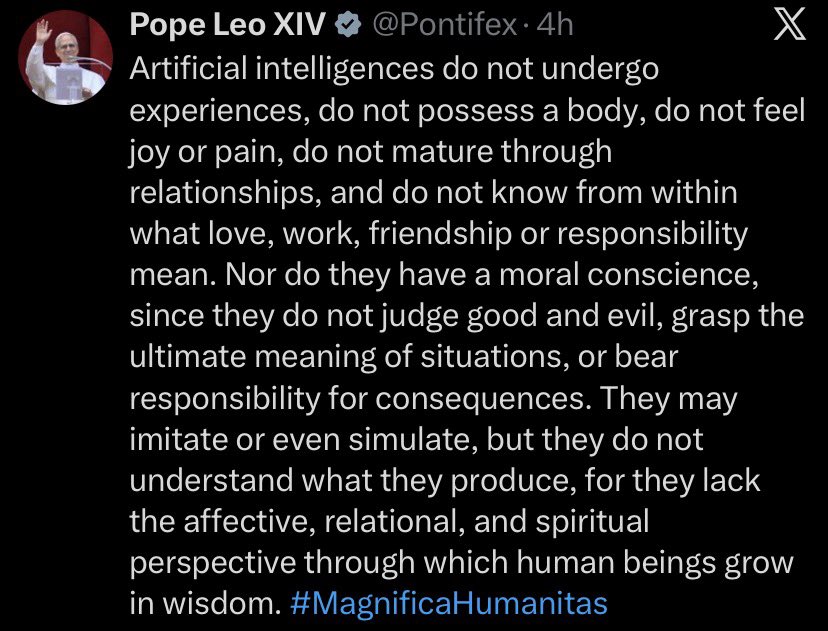
I know I’ll anger some followers with this, but I find this embarrassingly juvenile. Many of these claims are mere technical problems: embodiment, sensors, continual learning. The rest are just special pleading. These systems can already discuss love, friendship, responsibility etc more lucidly than most humans, so the claim must be some sort of totally unfalsifiable human chauvinism. There is no possible set of behaviors AIs could exhibit which would put a dent in his confidence in these assertions. An embodied AI (robot) could be raised (continually learning in context) among humans, exhibiting every conceivable sign of love, compassion, responsibility, and friendship, and the Pope would still say “doesn’t count because silicon instead of meat”.
It would be more respectable if he just said “I don’t care if they can exhibit these traits because humans are my tribe” but instead he makes a giant list of assertions that have either already been proven false, will be proven false soon, or are unfalsifiable.
But I can foresee how, in certain circles anyway, this will run up against the philosophical Imagination Inflation™️ that followed from the long predominance of Kant’s conceptualist theory of understanding.
My most charitable suggestion is that “AI” ought to stand for “artificial imagination,” in that it is an intelligible material process a) governed by (human) intelligence & b) ordered to constellating images that might occasion (human) understanding.
True! Though I do wish Pope Leo would take one more small but absolutely crucial step & recognize that: *Artificial intelligence* is a misnomer since AI is not strictly speaking intelligent at all.* Part of the bewitchment of these tools is to personify them through language!
Lonergan’s break with modern & idealist assumptions about what abstraction involves is a seriously underrated contribution. Glad to see Taylor make it so central here
https://t.co/fQkHTINnjp
@LukeTogni This is one of those insights that, if you pull at the thread, can help you see why Lonergan thought you needed to find a realism on the far side of idealism if you wanted to be a modern thomist
The Pope pretty clearly holds the same position that Aristotle and Augustine and Thomas and MacIntyre and Taylor all hold: that thinking is an action specifically of embodied intellect, that is, of the human organism as a whole. That is, if anything, the opposite of dualism.
I am not, I must admit, entirely convinced by it. The biggest weakness, IMO, is its insufficient phenomenology of the persistent role of intellectual eros in human reasoning unto knowledge. But there's still lots of good stuff in there.
The Lonerganiacs and the Wittgensteinians are sometimes at odds. Stumbled on this from David Burrell, which makes a forceful case for a Wittgensteinian reading of *Insight*: https://t.co/KKwLDHahyL
From “the love of God poured into our hearts by the gift of the Holy Spirit” to cooperation with God’s plan “not to do away with the evils of the human race through power, but to convert those same evils into a supreme good according to the just & mysterious law of the cross.”
Peace begins in the human heart, passes through relationships, takes root in neighborhoods and peripheries, and expands until it embraces the entire city and the world. Peace is built by promoting a culture that rejects violence, through daily gestures, education, and practical acts of justice. #PastoralVisit #Naples
Now that the semester is over, I'm available again for podcasts and shorter writings, especially related to Christological Dogmatics. I was turning down many shorter opportunities for a while.
This is a lecture I gave a couple weeks ago called “Finding a Path in the Dark: Lonergan’s Guidance for Getting Oriented in a Disorienting World.” It’s not overly technical or academic; I tried to write it ‘person-to-person’. I hope it’s helpful: https://t.co/0hvPVBb7km