Markenfield Hall paid for that Mass. The Crown confiscated it for treason, and it became a tenant farm for generations, with farmers who had little money or reason to modernise it. That neglect is often credited with saving the medieval house. Sir Thomas fled to Flanders and never saw it again, but the Grantley family, descended from his relatives, own it today.
A quiet masterpiece that stops you in your tracks: "Young Hare," by Albrecht Dürer, 1502.
On a small sheet, slightly smaller than a piece of copier paper, he paints every single hair -- coarse browns, soft whites, and fuzzy grays. If you look closely, you can even spot what looks like a double-arched window frame reflected in a glossy, pensive eye.
Watercolor, gouache, and paper -- yet the hare looks impossibly alive.
Durer’s “logo” of his initials is just below the animal’s front feet. Albertina Museum, Vienna, Austria
An Anglo-Saxon brooch from the collections of Northampton Museum and Art Gallery. The brooch was discovered in the early nineteenth century at St. Andrew’s Hospital in Northampton. 📸 #FindsFriday#Northampton
Have you ever said something was so bad it stank?
Well, maybe this one thing wasn’t that bad, after all.
German playwright and poet Friedrich Schiller kept a drawer full of rotting apples in his desk, using their pungent odor as a bizarre writing ritual
to spark his creativity.
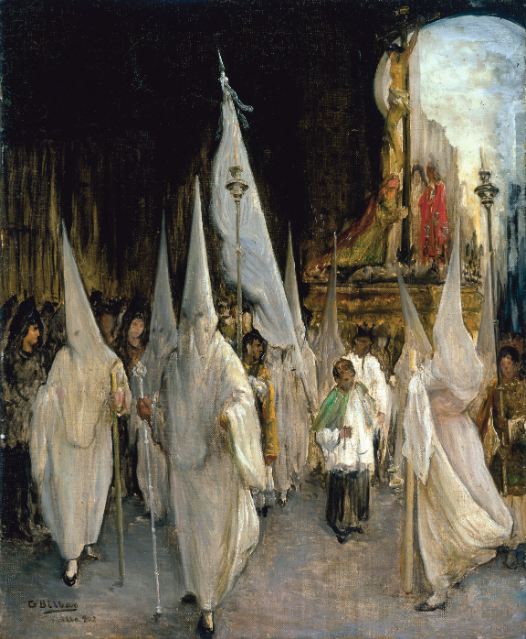
La procesion de las siete palabras (Procession of the seven words).
Gonzalo Bilbao Martínez, 1902 AD.
It's not what it looks like. I can explain it.
These are Good Friday parades held in Spain and Latin America, centered on the seven last words of Jesus Christ on the cross.
Home after 137 years!
The @AmsterdamMuseum has acquired Thérèse Schwartze’s monumental 1889 masterpiece 'The Orphan Girls of the Burgerweeshuis' at the PAN art fair.
Extra special: it was painted on the exact location where the museum is housed.
Of course I'm posting the wonderful Tournai marble font from #Winchester cathedral for #FontsOnFriday! Here we see St Nicholas giving bags of golden coins to a poor man as dowries to his daughters - as he was otherwise going to sell them into prostitution...
Diogenes was known as "the cynic" for a reason.
After hearing Plato define human beings as a "featherless bipeds", he took
a rooster, plucked all its feathers off and flaunted it as Plato's idea of a man.
That forced Plato to append "with broad, flat nails" to his definition.
Look for this in the narthex as you enter St. Mark’s Basilica:
It is a “Deesis.” These are traditional images of blessing in old, Byzantine-influenced churches. The risen Christ in majesty is in the center, with the Virgin Mary and John the Baptist both interceding for humanity. Christ raises a hand in an outward gesture of blessing.
If you were to leave through the basilica’s original exit, you would be ‘blessed’ by another Deesis on your way out. Look for it above the door on the west wall. Only in that Deesis, John the Baptist has been unconventionally replaced with St. Mark. (It is St. Mark’s basilica, after all.) 😉
The Old Courthouse at Hawkshead in Cumbria. Probably dating to the C15th, the building is all that remains of the monastic grange associated with Furness Abbey. It would have served as the ‘local’ centre for managing the abbey’s lands and affairs. 📸 My own. #MedievalMonday
This small (~ 4 inch) intricately carved terracotta figure is a fragment of architectural decoration from an Etruscan temple. It is believed to date from the 3rd to 4th century B.C.
Fiesole, Italy
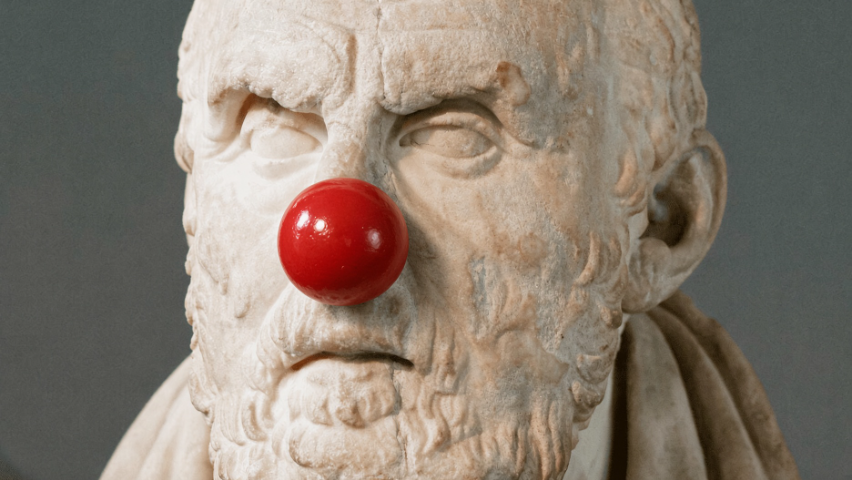
Have you ever pictured Greek philosophers as goofballs?
Ordinary people, always ready to crack a Dad joke?
If you haven’t, remember: Chrysippus died from laughing after seeing
a donkey eating his figs and ordering a slave to give the animal some wine
to help it wash them down.
Ein Wikinger Überfall (A Viking Raid) | Ferdinand Leeke, 1901 AD.
Kidnapped ladies, check;
Leaving destruction and fire behind, check;
Sacked goods, check;
Waving swords and spears up in the air, check.
Yes, it's a viking raid indeed. We're good.
#fine#art#týr#painting