Abu Simbel: what our research found, and what nobody knows yet.
A 3,200-year-old temple was cut into 1,042 blocks and rebuilt about 210 feet higher, so a lake would not swallow it. And twice a year the sun still finds its way in.
WHAT RAMSES BUILT
- In the 13th century BC, Ramses II had two temples cut straight into a sandstone cliff in Nubia, near today's border between Egypt and Sudan.
- The facade of the Great Temple is about 108 feet high. Four seated statues of the king guard the door, each about 65 feet tall.
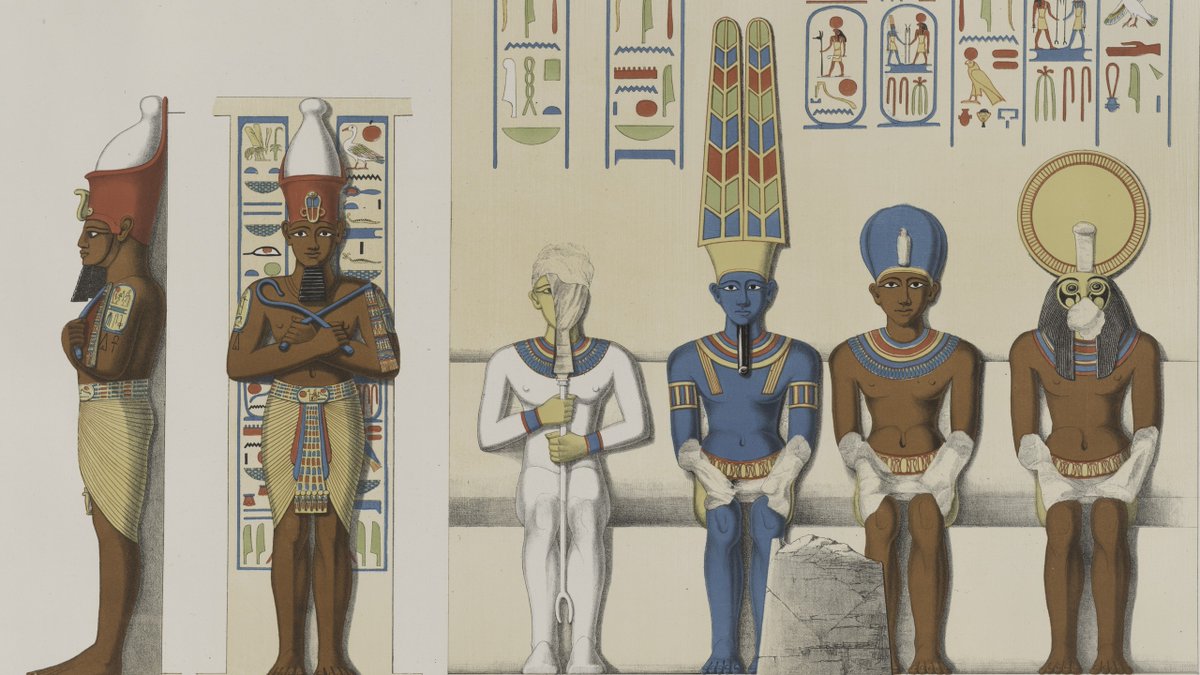
- Twice a year, at dawn, sunlight travels about 200 feet through the mountain and lands on three of the four statues in the sanctuary: Ramses, Amun and Ra-Horakhty. The fourth, Ptah, stays in the dark.
- The walls show Ramses crushing the Hittites at Kadesh (1274 BC). The real result was a draw. About 15 years later the war ended with the oldest peace treaty that survives.
- The smaller temple is for Queen Nefertari. Her statues are the same size as the king's, and the inscription on the facade says the sun shines for her.
LOST AND FOUND
- By the 6th century BC, sand already covered the statues to the knees. The temple was forgotten for more than 2,000 years.
- March 1813: the Swiss traveler Johann Ludwig Burckhardt saw the tops of the statues sticking out of the sand.
- August 1, 1817: Giovanni Belzoni's group dug an opening after 22 days of work. Giovanni Finati, one of the thinnest, went in first. He said the air inside was like a Turkish bath.
- September 14, 1822: drawings of the temple reached Jean-François Champollion in Paris. He read "Ramses" in a cartouche, then "Thutmose". That day he understood how hieroglyphs work. Nobody had read them in about 1,400 years.
THE DAM
- In 1960 Egypt began the Aswan High Dam. Its lake would leave the temples under nearly 200 feet of water.
- French Egyptologist Christiane Desroches Noblecourt convinced Egypt's minister of culture. On March 8, 1960, @UNESCO appealed to the world.
- Four plans competed: a giant dam around the temples ($82M), lifting them in one piece on hydraulic jacks ($62M), leaving them underwater behind glass ($14M), or cutting them into blocks ($36M).
- In June 1963 Egypt chose the Swedish plan: cut them up.
THE CUT
- To save the temples from a dam, they first built another dam: a dike 82 feet high, with pumps removing almost 800,000 gallons of water every hour.
- May 21, 1965: the first block came out. Each cut was a quarter of an inch wide. Blocks weighed 7 to 30 tons.
- Great Temple: 807 blocks. Small Temple: 235.
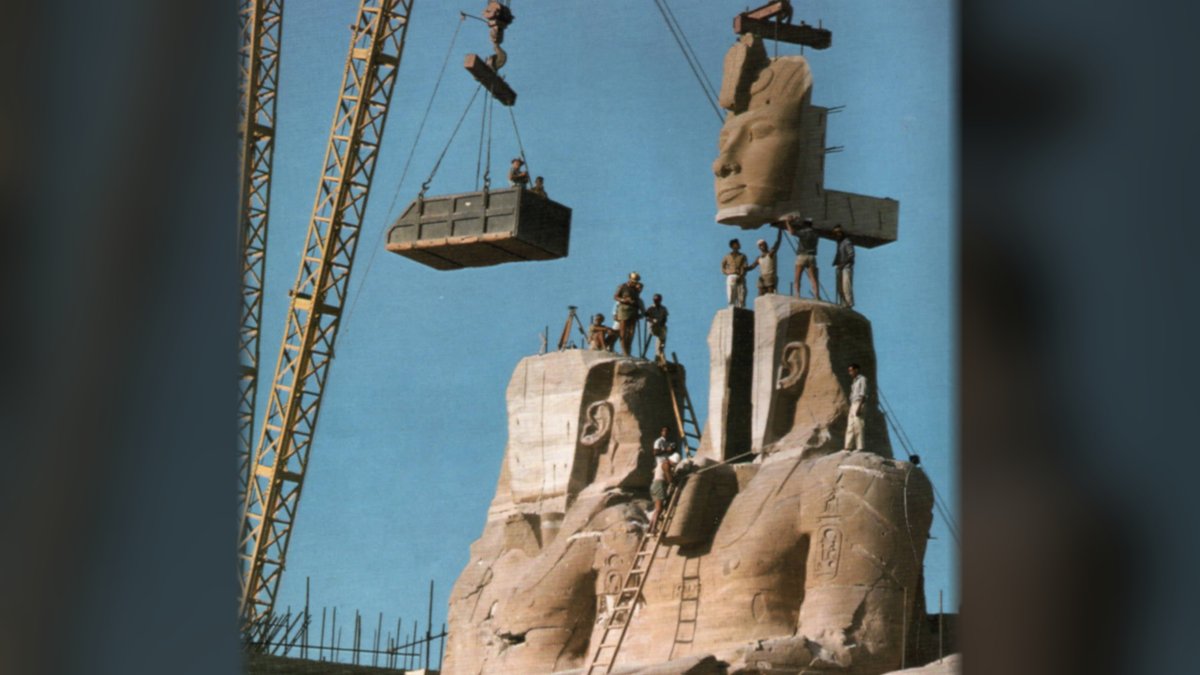
- The faces of the colossi were too heavy for the cranes, so the crown was cut off first. On October 16, 1965, the first face of Ramses, 19 tons, hung in the air from steel cables.
- April 16, 1966: the last block left, two weeks early. No block was seriously damaged. That August the lake covered the old site.
THE REBUILD
- New site: about 210 feet higher and about 650 feet back from the river.
- Every block had to return to its place within a fifth of an inch.
- Behind each temple, a concrete dome. On top, an artificial hill made with 300,000 tons of rock from the original site.
- One colossus had been broken by an earthquake in antiquity. Its head and torso were set back on the ground at its feet, exactly as the world had found them.
- Finished in the summer of 1968, 18 months early. Cost: almost $42 million, half from Egypt, half from about 50 countries.
- As thanks, Egypt gave away whole temples: Debod to Madrid, Dendur to New York, Ellesiya to Turin, Taffa to Leiden.
WHAT WE STILL DON'T KNOW
- Why those two days? Tradition says the king's birthday and his coronation. There is no direct evidence.
- Did the move shift the sun by one day? Today it happens on February 22 and October 22. It is often said that it used to be the 21st. We have not found any measurement that confirms it.
- How did his builders aim a mountain that precisely, more than 3,000 years ago?
- About 100,000 Nubians lost their land under the same lake. Their villages and cemeteries are still down there. Was the price too high?
- Is it still the same temple? Same stone. Different place.
The full story, in three parts:
Part 1: https://t.co/kRqSb1KGQv
Part 2: https://t.co/F2SiEnKbfs
Part 3: https://t.co/vxg6MnB5ot
#AbuSimbel #RamsesII #AncientEgypt #Egyptology #Archaeology #Engineering #History
And the town paid. The scene became Sweden's most famous history painting, Hellqvist's giant 1882 canvas of Visby's burghers frantically filling three great barrels with gold and silver while their mayor clenches his fist at the Danish king. The painter was obsessive about medieval accuracy, and still smuggled in a dachshund at the edge of the square. The breed didn't exist until the 1500s. Five hundred years of careful research, undone by one dog.
@CultureExploreX@Pastpassport He also needed the fake log for the mutinous weeks of early October. By the time the crew almost turned back, the two ledgers were the only thing keeping 90 men calm.
There's an irony inside the irony. Columbus's fake numbers were closer to the truth than his real ones. He measured the degree 25 percent too short and thought Japan was about 2,400 miles from the Canaries. It is closer to 10,000. Pure accident, but the crew heard the most accurate figures on board. And the logbook itself is lost. We only have Las Casas's handwritten copy. Fraud saved by a monk's homework.
That man has a name: General Jean Rapp, Napoleon's aide-de-camp, and the record books credit him with around two dozen wounds. He collected four of them in ninety minutes at Borodino alone. Napoleon once teased him about his "remarkable propensity for collecting injuries". Rapp replied that it was hardly surprising, since they were always fighting. The most polite "duh" in military history. He also refused amputation of a shattered arm, froze his nose, an ear and two fingers in Russia, and saved Napoleon's life twice. Your sunburn is in good company.
And the oldest claw machine is theirs: a clamshell grab designed to fish objects off the bottom of rivers, basically a mechanical arcade claw with a day job. Their party tricks were elite too, like a flask that pours in two colours and swaps them on the way out. The book even tells the operator to distract the guests with conversation while it works, which might be the earliest written record of a magician's patter. Two hundred years later al-Jazari was still name-checking them and fixing their fountains. Even great automation nerds stand on three brothers' shoulders.
Legend has it the idea came from a birdcage. Jenney watched his wife set a heavy book on top of one, and noticed the thin wire frame held the weight without complaint. If a cage could carry the load, walls didn't have to. Almost every great invention starts with someone messing with something ordinary. The building nearly didn't survive its own birth: it weighed a third of a masonry tower, and officials halted construction to check it wouldn't collapse. It stood 46 years, was demolished in 1931, and today the only monument to the world's first skyscraper is a plaque in the lobby of the building that replaced it. They could have aimed higher, honestly.
@whencyclopedia The discovery even annoyed a Kyrgyz cabinet minister, who complained publicly that it was announced right before the tourist season. Even ground zero has a tourism board.
The most haunting part is that the clue was always written in stone. Of the 467 dated tombstones in the Kara-Djigach cemetery, 118 cluster in the years 1338 and 1339, and ten of them say, in Syriac, that the person "died of pestilence". The cemeteries were excavated back in the 1880s, so the answer sat in records for 140 years before scientists finally read the bacteria's DNA from their teeth in 2022. The survivors told us exactly when and what. It just took us six centuries to believe them.
And you can still watch them work. Yazd in Iran is called the City of Windcatchers, with around 700 of them turning over the skyline. The tallest is the one at Dowlat Abad garden, about 33.8 meters, built around 1750, and it still cools the pavilion beneath it today. Paired with the underground qanat channels, measurements have recorded indoor drops of more than ten degrees compared with the street. No motor, just physics.
And you can still watch them work. Yazd in Iran is called the City of Windcatchers, with around 700 of them turning over the skyline. The tallest is the one at Dowlat Abad garden, about 33.8 meters, built around 1750, and it still cools the pavilion beneath it today. Paired with the underground qanat channels, measurements have recorded indoor drops of more than ten degrees compared with the street. No motor, just physics.
@xmuse_ The kid who topped the tower even had a name: il cimiereto, the youngest of the crew, who finished with acrobatics and a leap onto the mattresses. Today's castellers of Catalonia crown their towers with an enxaneta striking almost the same pose. 😉
The tower battles were actually the peaceful option. After the last fistfight on the Ponte dei Pugni turned into a riot of stones and knives in 1705, Venice's Council of Ten banned the bridge wars outright. The Castellani and Nicolotti were only allowed to compete in softer games from then on, and the Forze d'Ercole was one of them. Even that didn't stay gentle. In 1810 a tower contest staged for the anniversary of Napoleon's coronation as King of Italy ended in a riot where ten people died, and the tradition never really recovered.
@KeLebegindansi Even her discovery has a story. Borchardt's 1912 diary says "You cannot describe it with words. You must see it", and a 1924 memo suggests he downplayed the bust so Germany would keep it in the division of finds. She left Egypt wrapped in discretion.
And the mystery may not stay a mystery much longer. In 2015 an Egyptologist proposed her tomb was hidden behind Tutankhamun's walls, and three radar surveys (2015–2018) seemed to kill the idea. But a new geophysical review published just this month reports anomalies again -and drilling a tiny inspection hole behind the painted wall is now seriously on the table. Meanwhile the bust has its own riddle: the empty left eye was never a wound. The inlay was simply never inserted- she was a sculptor's workshop model, 3,300 years old and still technically unfinished.
@GilgameshIQ Even the serpent line has pedigree: "nothing softer than a snake's skin, nothing crueler than its betrayal" could sit in Aesop without changing a word. Two literary traditions on the same wolf, centuries apart, and no one needed to borrow it — wolves are wolves everywhere.
The best part: fables like this one survived by being burned. When Nineveh fell in 612 BC, the fire that destroyed Ashurbanipal's library baked the clay tablets hard — the catastrophe is the reason we can still read the wolf and the goat today. And the king who collected them was no figurehead: Ashurbanipal was a trained scribe who boasted he could read the "dark Akkadian" and even tablets "inscribed before the Flood". The oldest systematically organized library on Earth was built by a king who could actually read it.
@EDICIONESREGION Y el dato que más me llama la atención: los pozos no estaban junto a un río. La ciudad se sostenía del subsuelo, mientras las laderas andinas mandaban agua por canales. Barro sobre agua controlada: por eso duró seis siglos.
Y respondiendo a tu pregunta: más de lo que parece. Los chimú cavaron más de 140 pozos hasta tocar la napa freática para abastecer la ciudad, el 60 % de ellos dentro de las propias ciudadelas, y en los huachaques celebraban ceremonias del agua y la fertilidad en pleno desierto. Un pueblo del mar que literalmente cavó el agua hacia dentro.