@pavyg@jmgmoron@rolandgarros It is not the words themselves that determines what is acceptable or not, it is who the words are directed at and who says them. Its's like verbal clostebol.
Truckload spot rates hit all-time record of $3.69.
RXO comes out with very bullish market update, talking about the significant amount of spot opportunities as shippers scramble for capacity in a tight market.
Tender rejections hit new cycle high.
Enterprise brokers are as bullish as I've seen them on the back of the SCOTUS decision and shippers are doing far more diligence on providers in the wake of increased liability.
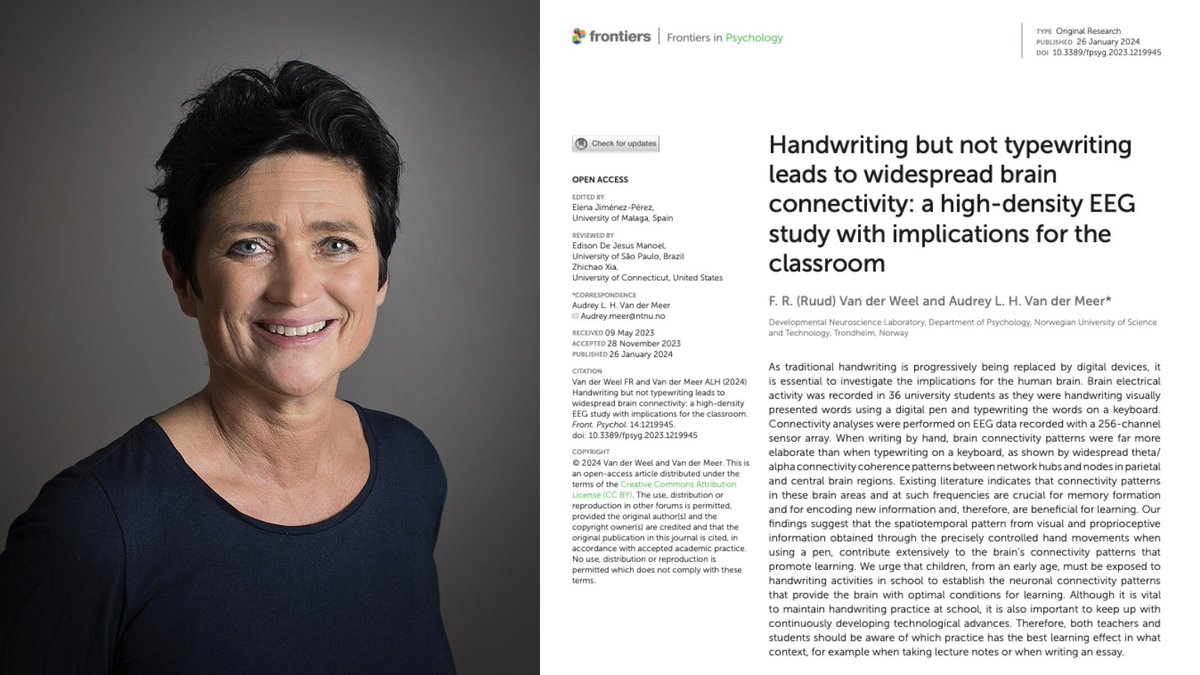
A Norwegian neuroscientist spent 20 years proving that the act of writing by hand changes the human brain in ways typing physically cannot, and almost nobody outside her field has read the paper.
Her name is Audrey van der Meer.
She runs a brain research lab in Trondheim, and the paper that closed the argument was published in 2024 in a journal called Frontiers in Psychology. The finding is brutal enough that it should have changed every classroom on Earth.
The experiment was simple. She recruited 36 university students and put each one in a cap with 256 sensors pressed against their scalp to record brain activity. Words flashed on a screen one at a time.
Sometimes the students wrote the word by hand on a touchscreen using a digital pen, and sometimes they typed the same word on a keyboard. Every neural response was recorded for the full five seconds the word stayed on screen.
Then her team looked at the part of the data most researchers had ignored for years, which is how different parts of the brain were communicating with each other during the task.
When the students wrote by hand, the brain lit up everywhere at once.
The regions responsible for memory, sensory integration, and the encoding of new information were all firing together in a coordinated pattern that spread across the entire cortex. The whole network was awake and connected.
When the same students typed the same word, that pattern collapsed almost completely.
Most of the brain went quiet, and the connections between regions that had been alive seconds earlier were nowhere to be found on the EEG.
Same word, same brain, same person, and two completely different neurological events.
The reason turned out to be something nobody had really paid attention to before her work. Writing by hand is not one motion but a sequence of thousands of tiny micro-movements coordinated with your eyes in real time, where each letter is a different shape that requires the brain to solve a slightly different spatial problem.
Your fingers, wrist, vision, and the parts of your brain that track position in space are all working together to produce one letter, then the next, then the next.
Typing throws all of that away. Every key on a keyboard requires the exact same finger motion regardless of which letter you are pressing, which means the brain has almost nothing to integrate and almost no problem to solve.
Van der Meer said it plainly in her interviews.
Pressing the same key with the same finger over and over does not stimulate the brain in any meaningful way, and she pointed out something that should scare every parent who handed their kid an iPad.
Children who learn to read and write on tablets often cannot tell letters like b and d apart, because they have never physically felt with their bodies what it takes to actually produce those letters on a page.
A decade before her, two researchers at Princeton ran the same fight using a completely different method and ended up at the same answer. Pam Mueller and Daniel Oppenheimer tested 327 students across three experiments, where half took notes on laptops with the internet disabled and half took notes by hand, before testing everyone on what they actually understood from the lectures they had watched.
The handwriting group won by a wide margin on every question that required real understanding rather than surface recall.
The reason was hiding in the transcripts of what the two groups had actually written down.
The laptop students typed almost word for word, capturing more total content but processing almost none of it as they went, while the handwriting students physically could not write fast enough to transcribe a lecture in real time, which forced them to listen carefully, decide what actually mattered, and put it in their own words on the page.
That single act of choosing what to keep was the learning itself, and the keyboard had quietly skipped the choosing and skipped the learning along with it.
Two studies. Two countries. Same answer.
Handwriting makes the brain work. Typing lets it coast.
Every note you have ever typed instead of written went into your brain through a thinner pipe. Every meeting, every book highlight, every idea you captured on your phone instead of on paper was processed at half depth.
You did not forget those things because your memory is bad. You forgot them because typing never woke the part of the brain that would have made them stick.
The fix is the thing your grandmother already knew.
Pick up a pen. Write the thing down. The slower road is the faster one.
When $RXO CEO Drew Wilkerson stated that mid cycle EBITDA was 5%, high cycle ~10% and low (current) ~1%, he inadvertently pointed out what I have long maintained: It's a crappy business and Montgomery just made it worse.
THE SEC JUST BETRAYED EVERY RETAIL INVESTOR IN AMERICA
They formally proposed ELIMINATING mandatory quarterly reporting. Companies would file 2x a year instead of 4.
Trump championed it and SEC Chair Atkins fast-tracked it. The Republican majority on the commission means it will almost certainly pass.
The stated reason: quarterly reporting creates "short-term thinking."
But the REAL beneficiaries are CEOs who don't want investors asking questions every 90 days.
This isn't a new idea either.
Trump mentioned it during his first term in 2018 and the SEC studied it. But their own economists concluded that quarterly reporting increases transparency and reduces the cost of capital for companies raising funds.
They ignored it because the evidence said it was a BAD idea.
Now it's back. And this time the votes are there to push it through.
The argument that quarterly reporting encourages short-termism sounds reasonable until you really think about it:
Jamie Dimon and Warren Buffett wrote a joint op-ed in 2018 calling for the end of quarterly guidance. But guidance and mandatory disclosure are two completely different things. You can stop giving guidance tomorrow - nobody's stopping you.
What this proposal does is let companies stop SHOWING YOU THE NUMBERS.
Think about what that means in practice.
Right now if a company's margins are collapsing or cash is hemorrhaging or debt is quietly ballooning, you find out within 90 days. Under this proposal you might not see those numbers for half a year.
That's 6 months where insiders know the business is deteriorating and you don't. 6 months where management can keep selling you a story while the fundamentals rot underneath it.
America's capital markets became the envy of the world BECAUSE of disclosure requirements, not in spite of them. The quarterly reporting mandate has been in place since the 1970s. Every major economy that weakened its disclosure regime saw transparency deteriorate.
When the European Commission dropped quarterly reporting requirements in 2013, research found that information asymmetry between insiders and outside investors widened almost immediately.
Now ask yourself:
Who benefits from cutting financial disclosure in half?
Not retail investors who already have less information than the institutions trading against them.
Not analysts trying to hold management teams accountable.
The beneficiaries are executives who would rather go 6 months without an earnings call than answer uncomfortable questions about where the money is going. Companies where the gap between the story and the numbers gets wider every quarter. Companies where the CEO's compensation is tied to stock prices that require narratives nobody is allowed to question.
In 45 years on Wall Street I've learned ONE thing about transparency:
Companies that want you to see less are ALWAYS the ones you need to watch most closely.
The SEC is proposing to give them exactly what they want. In the most leveraged, most narrative-driven, most accountability-free market since 1999.
THIS NEEDS TO STOP