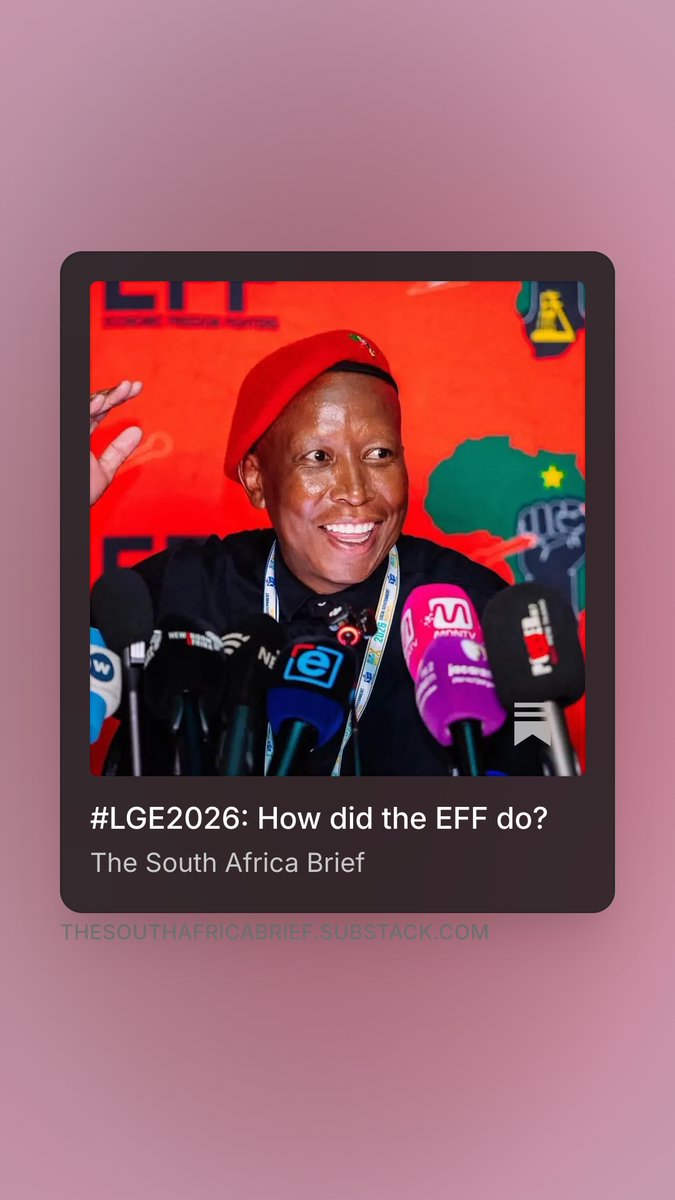
Election 2026 was a bad one for the red berets. After going backwards marginally at the national level for the first time in the 2024 General Election, the party’s slide backwards intensified at the municipal level, and the drop in support is nationwide.
MKP suffered a decline in its key provinces in #LGE2026 but it is positioned well for potential coalitions. Our look at how MKP did in the election is here.
"Unlike the ANC, the DA will be very satisfied with its performance in #LGE2026. The party has grown since 2021, is the biggest party in 5 of the 8 metros and has made some serious gains in terms of votes from black South Africans, the party’s holy grail."
BREAKING: Action SA confirms to #SABCNews it will work with DA to form coalition government in Nelson Mandela Bay. This will happen with the support of other parities that include the UDM.
@SABCNews#LGE2026#NMB
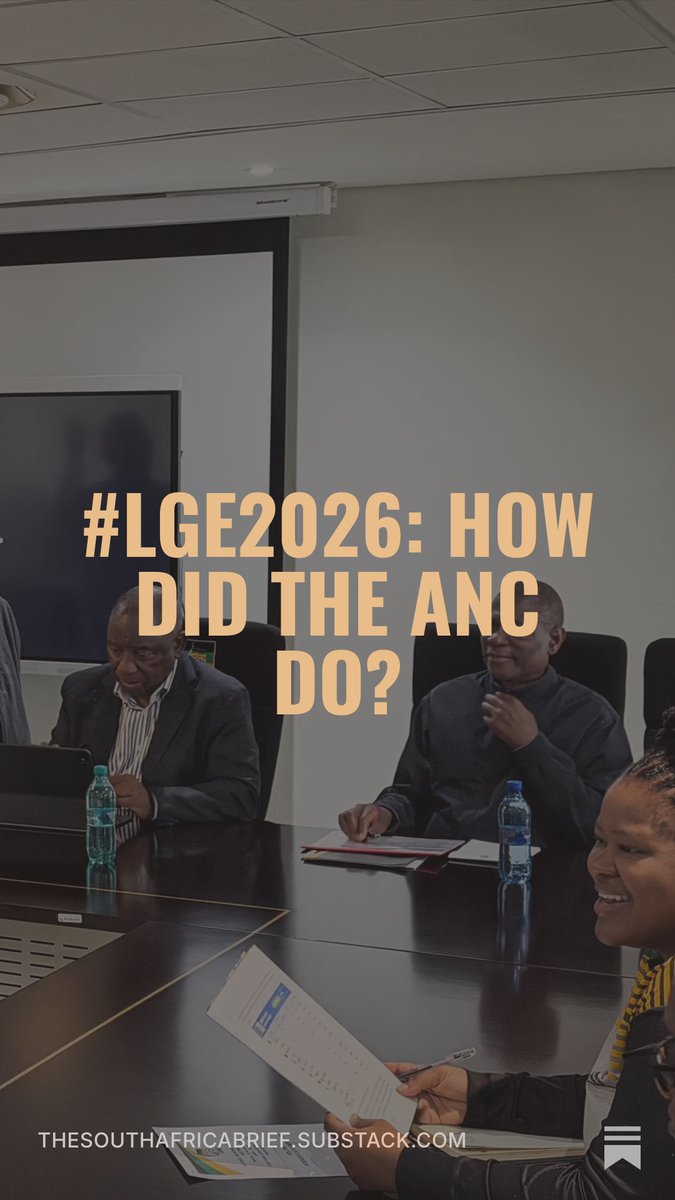
#LGE2026: How did the ANC do?
To borrow from former US President, Barack Obama, the party received a “shellacking” in this election.
Our piece on the ANC as we start to unpack how the main parties did.
PODCAST | UncoveringIT! The puzzle that is the local government coalition talks:
Following fragmented local government election results, Jonathan Moakes unpacks whether coalition talks can produce the stable and effective governance South Africa desperately needs.
Listen to the episode here: https://t.co/ZB0SpxSQRj
Here's the recording of @paulyberk in conversation with @ferialhaffajee and the @dailymaverick team. The discussion looked at "who's in charge, which coalition deals might stick, what changes for local services and what it all means for 2029."
https://t.co/dPIZnUs4VE
"Every single municipality across Gauteng - except Midvaal - will need a coalition. The DA & ANC are the only parties that can anchor any coalitions &, apart from a grand coalition between the 2, ActionSA is needed for a majority"
@paulyberk on GP's coalition scenarios.
Random Monday Tweet: One amusing under-explored topic. The FF+ is now in townships! Amongst all township VDs (FF+ %)
MAN: 2%
CPT: 2%
JHB: 1%
TSH: 1%
EKU: 1%
NMB: 1%
eTH: (-)
BUF: (-)
Here's an idea: someone needs to build a political party accountability tracker. Take every party's 2026 manifesto and election promises, then track what they actually do over the next five years, the good and the bad. Track council decisions, how parties vote, their successes and failures in municipalities, service delivery, coalition agreements, who walks away from coalitions and why, and who is responsible when they collapse. Essentially, a public record of what parties promised, what they delivered, and how they used the power entrusted to them by voters. By 2031, voters should be able to look at the evidence and make informed decisions based on five years of actual performance, not just election campaign promises.
Something I think you should look into: @Jonathan_Moakes@paulyberk@waynesussman@GvanOnselen, it would take a lot of work, but given the work you already do, I think one of you could pull it off.
I have run my full demographic model on the full results, with a view to determining party support by population group. It is complicated but essentially uses a properly weighted voters roll (in other words the population group of registered voters by VD). To do this is a very complicated process that I won’t bore you with, takes months. The model is far more accurate on black voters, due to the overwhelming number of homogenous “black” VDs. There are also strong national samples of homogenous “coloured” VDs, but far less than black. The same trend applies to Indian VDs (a tiny sample). White voters are the hardest. The growth of mixed VDs has been substantial, and there are no homogenous white VDs. That said, these are good solid numbers, and the model has been substantially back checked. So, I would say, while there probably a margin of error of a couple of percent on white and coloured and 3-4% on Indian voters, it would be only a percent or so on black voters.
First, we need to determine the turnout estimate per group. That is as follows:
2026 estimated turnout by population group:
Black African: (10,738,355 votes): 47.54%
Coloured: (1,376,521): 55.63%
Indian/Asian: (386,878):58.62%
White: (2,175,065): 70.74%
Other: (88,786): 42.69%
With that, and the VD profile, along with other parameters, the model can work out the numbers.
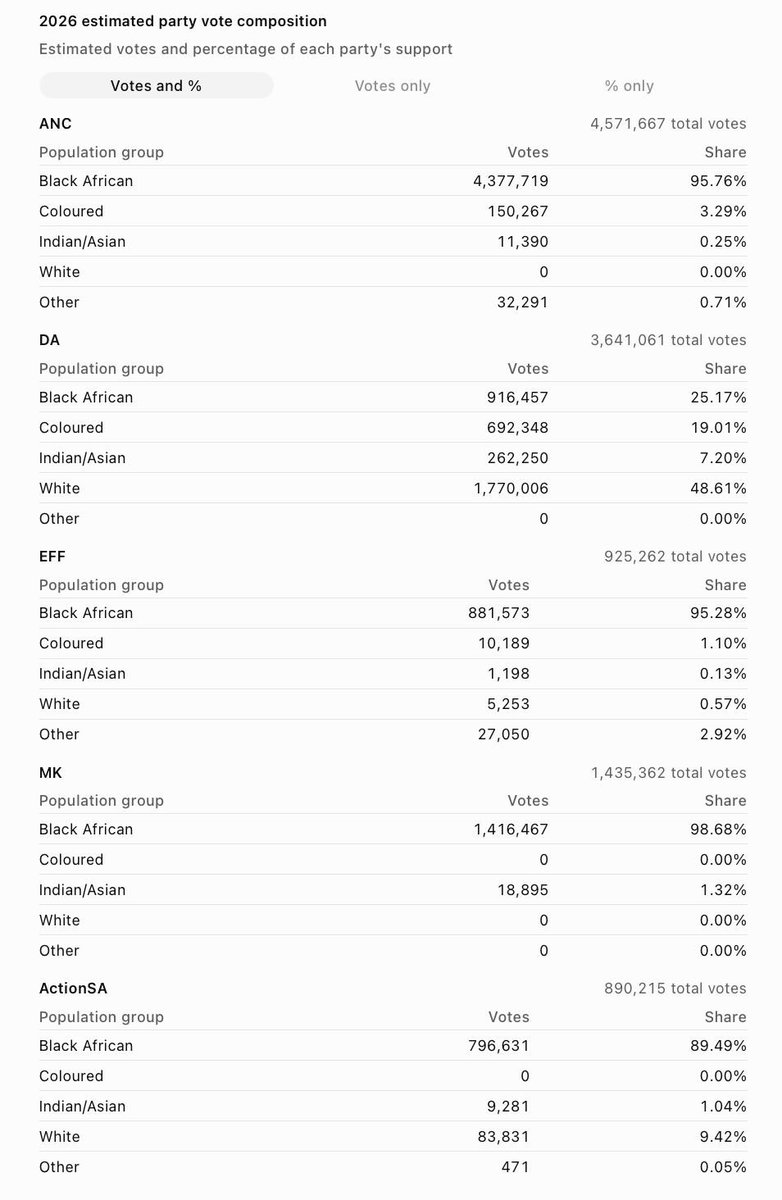
The first small table is the percentage share of each population group each of the top 5 parties is estimated to have received nationally.
The ANC is substantially below 50% among black voters (40.77), followed by MK (13.19), the DA (8.53), the EFF (8.21) and ASA (7.2). The other groups are really all about the DA, with 50.36% of the coloured vote, 67.84% of the Indian vote and 81.5% of the white vote.
We can now turn those into actual numbers per party (the bigger table)
Starting with black voters: ANC on 4.3m (97% of its vote), MK 1.4m (99%), the DA 916k (25%), the EFF 881k (95%) and ASA, 796k (90%).
As for other groups, again, really only about he DA: 19% of its support comes from coloured voters, 7% from Indian voters and 49% from white voters.
All other parties are essentially racially homogenous. ASA did have a far larger share of white voters in 2021, but its support on that front has collapse by more than half.
The DA and ASA’s growth among black voters is the stand out outcome of the election (although ASA’s came at the expense of other groups).
The DA now represents around 920k black voters the third biggest party in this regard - significantly, even bigger than the EFF.
It is also by some considerable distance the most diverse party, the other four parties being essentially racially homogenous in terms of support.
IEC PEO says that where there were no or few party agents they relied heavily on independent observers to help make sure the process was being scrutinised.
Well done to all @gwc_za observers, the thousands of you did amazing work! 🥳
I had a great chat with @Jonathan_Moakes to dig into the data emerging from the election (+ a couple of 2nd order deductions & implications).
See it here: https://t.co/arO6ng60x7
LIVE | 2026 Local Government Elections Results Announcement
Today, the IEC announces the results of the 2026 LGEs, marking another important milestone in South Africa's democracy.
• FB: https://t.co/LzodzsvluJ
• YT: https://t.co/VlIgrFtgT4
• TikTok: @IECSouthAfrica
Had to wash the election out of my mouth and did so with cheap beer and karaoke. I think @Jonathan_Moakes and I scandalised the theatre kids in Craighall Park last night.