On the Cauchy Problem for the Sawada-Kotera Equation: Soliton resolution conjecture, Painlevé transcendents and asymptotic stability
Zheng-Kang Huang, Shou-Fu Tian
https://t.co/hefgC9tR5D [𝚖𝚊𝚝𝚑-𝚙𝚑 𝚗𝚕𝚒𝚗.𝚂𝙸]
“I asked a few AI researchers whether they could name any other real-world software that scales so poorly. None of them could think of any. Even outside the world of software, it’s hard to find a comparable example, given that economy of scale is the principle that has made light bulbs, cars, and clothing so affordable. By economic and engineering measures, generative AI might be the worst technology ever deployed” @_alexreisner@TheAtlantic
In “Generative AI is an engineering disaster” https://t.co/cm7G3yZRcL
The double slit experiment is the probably most misunderstood experiment ever. I have no idea who created the myth that if you 'look' at one of the slits, then the particles (photons/electrons) stop behaving as waves. It's wrong! They of course STILL behave as waves! Because particles are also waves, always.
Photons and electrons make a self-interference EVEN ON A SINGLE slit. Don't believe it? Below an actual measurement from a laser diffracting on a single/double slit from Wikipedia.
What happens if you measure which slit the particle goes through is that you get no interference between BOTH slits. And no, you don't need a conscious observer for this. Believe it or not, there have actually been experiments where they had people literally look at a double slit to see if that makes any difference and the answer is no, it does not.
The entire mystery of the double slit is in the path of the particle TO the double slit. Because it seems that the particle must "know" whether it WILL be measured at one of the slits before it even gets there. It must "know" whether to go through both or just pick one. Seems like the future influences the past? Not really, it just means you have a consistency condition on the time evolution.
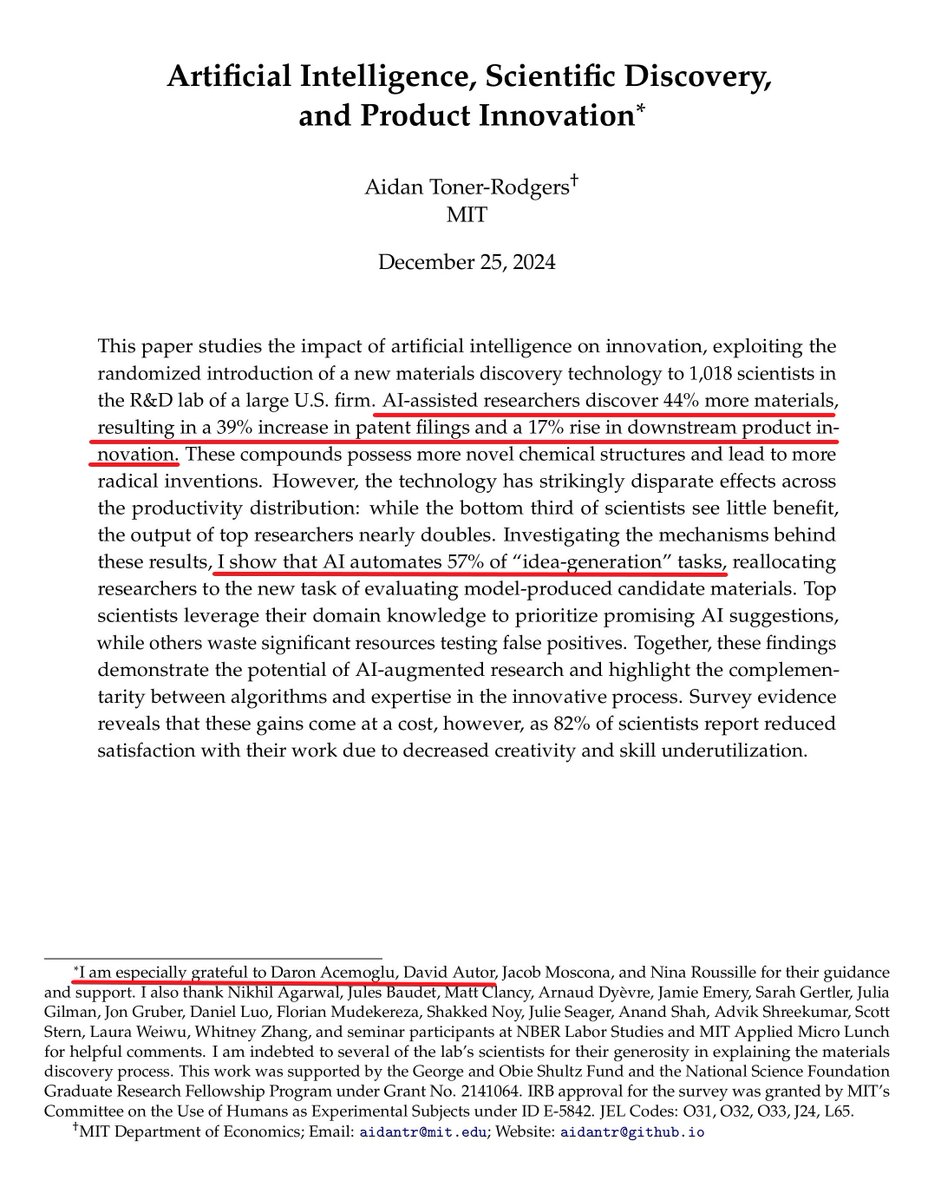
This year's biggest scientific disappointment was the revelation that Aidan Toner-Rodgers' groundbreaking AI paper was fake.
He claimed to show massive advances in materials discovery using AI, but...
He made it all up. This was all fake:
pairs trading for dickheads
when an online “kwant trader” starts writing about pairs trading i usually want to stab myself in the dick.
but, since i am both an enormous hypocrite and a better writer than the rest of you, i am going to talk about pairs trading today.
🚀 Why XGBoost Can Get Clunky and Noisy — and How CatBoost Uses Rocket Science to Fix It
If you’ve ever dug into how gradient boosting really decides which split is worth taking, here’s a fun fact:
🔹 XGBoost treats all training points equally during subsampling.
Each example is kept with the same probability — regardless of whether its gradient is tiny or huge.
This gives you very noisy estimate of split gain:
Small-gradient points (almost irrelevant) get sampled as often as
Large-gradient points (the ones that actually drive the loss down)
It’s like asking 100 random people for investment advice — the noisy majority drowns out the few who know what they’re talking about.
🚀 CatBoost’s MVS: Rocket science where others use coin flips
CatBoost uses a completely different, mathematically sharper approach:
Minimum Variance Sampling (MVS).
Instead of sampling uniformly, CatBoost:
1️ Always keeps the “important” samples — the ones with large gradients
2️ Samples the rest with probability proportional to their gradient magnitude
3️ Applies importance weights chosen to give a provably minimum-variance estimate of the split gain
The result:
Same expected sample size
Much lower variance
More stable split ranking
Faster, more reliable trees
It’s like replacing random street opinions with a weighted panel of experts — and then mathematically optimizing their influence.
TL;DR
XGBoost: “Flip a coin for each sample.”
→ Unbiased, but clunky and noisy.
CatBoost MVS: “Use importance sampling with optimal variance reduction.”
→ Faster, sharper, more stable split decisions.
Sometimes a little math makes a huge engineering difference.
📘 Want to learn Machine Learning properly — and understand CatBoost at a professional level?
Check out my book:
👉 https://t.co/CkduTSNbm0
What’s an E-value (in 15s)?
✅ A betting score against the null. If the null is true, your expected score ≤ 1.
✅ Big e (≫1) ⇒ strong evidence against
✅ Anytime-valid ⇒ you can look/stop whenever without inflating false positives.
✅ Easy to combine ⇒ multiply e’s across studies or time.
1-line example (z-test):
#evalues #statistics #hypothesistesting #openscience
A friend of mine won an IMO gold, went on to obtain a PhD in algebraic topology, and now works at a frontier AI lab. This guy, however, doesn't know how to do integration by parts. He knows the principle, but treats those tricks as below him.
AI models today give the same vibe.
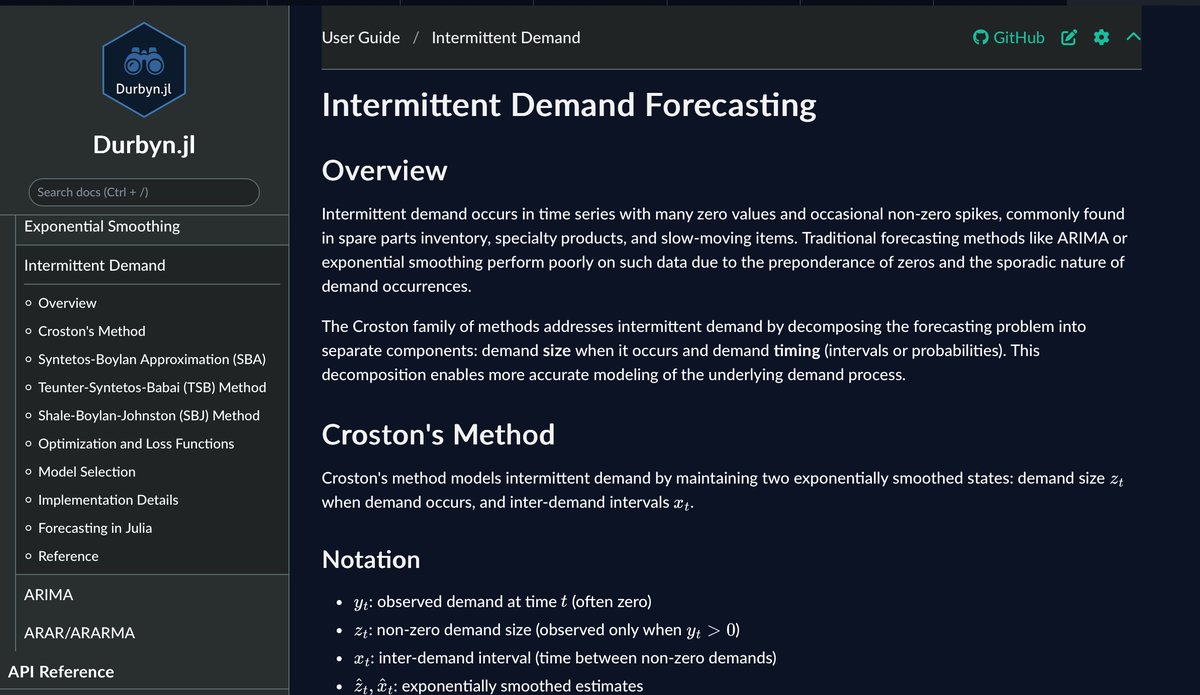
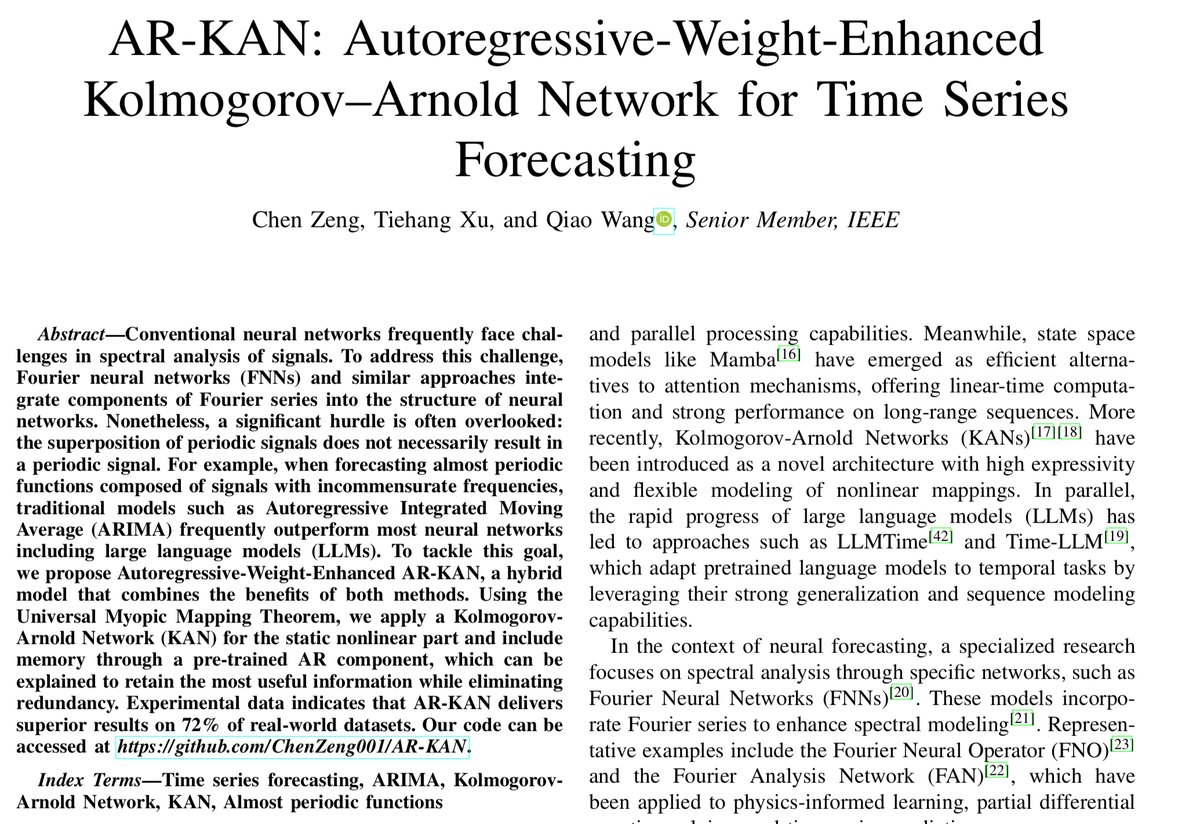
The more forecasting work I take on, the clearer it becomes: the future of forecasting isn’t in Python. 🐍
🚀 Julia has been around for a while, but it’s amazing to see what’s emerging as the most powerful open-source forecasting package in Julia.
What makes it stand out?
Unlike so many tools built by academics or developers with little practical forecasting experience, this one is crafted by people who truly understand the field.
It’s fast, robust, and feels like the real deal.
If you care about forecasting, keep an eye on this — highly recommended! 🔮✨
#JuliaLang #Forecasting #TimeSeries #DataScience #OpenSource #MachineLearning #Statistics #AI
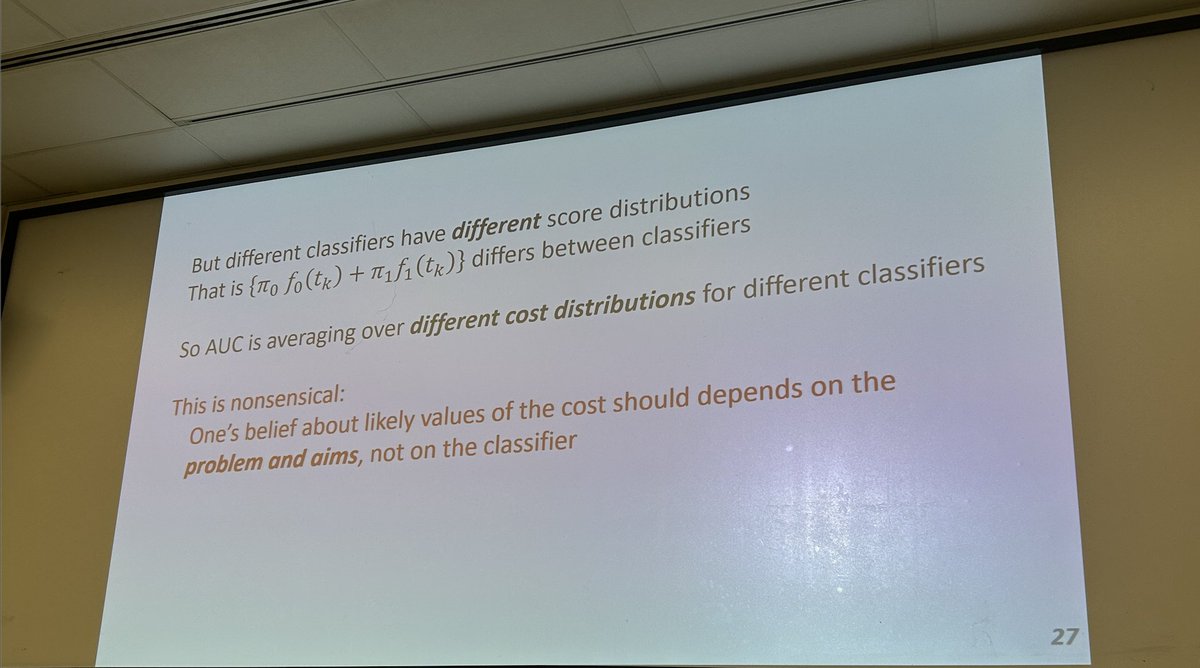
One of the standout talks at the COPA 2025 Conformal Prediction Conference came from David Hand — a leading statistician, author of 300+ papers and 30 books, and former Chief Scientific Advisor at Winton Capital.
To my surprise, although his presentation never touched on calibration issues with ROC AUC, he still had plenty to say about just how problematic the metric really is.
I’ve been arguing for years that ROC AUC is a deeply flawed measure — one that spread widely thanks to uncritical adoption, hype from platforms like Kaggle, and academic hubris from those who borrowed it from other fields and packaged it for data science to basically promote their carrers at the expense of science.
Stay tuned: I’ll break down David Hand’s critiques in detail and show you why you should think twice before ever using ROC AUC again.
#rocauc
📊 Why Your Variance Estimates Are Probably Wrong (Thanks to Dependence)
We all learned the golden rule in stats:
Var(X̄ₙ) = σ² / n
That’s the Central Limit Theorem intuition: collect more data, and the variance of the mean shrinks at rate 1/n.
👉 But this assumes independence. Once you add dependence, things change dramatically.
🔹 The AR(1) Example
Take the simplest autoregressive model:
Xₜ = a Xₜ₋₁ + εₜ
with autocorrelation:
ρ(k) = aᵏ
The variance of the sample mean is no longer σ²/n. It’s inflated by a correction factor:
Var(X̄ₙ) = (σ² / n) · c(a)
where
c(a) = 1 + 2 Σ (1 – k/n) aᵏ , k=1…n-1
🔹 Why it matters
•If a is small, correlations vanish quickly → c(a) is close to 1.
•If a is close to 1, correlations persist → c(a) explodes.
Examples (n large):
•a = 0.2 → c(a) ≈ 1.5
•a = 0.6 → c(a) ≈ 4.0
•a = 0.9 → c(a) ≈ 19.0
That last case means your variance estimate could be 19× too small if you naively use σ²/n.
🔹 Real-world impact
•Finance → persistent volatility means underestimated risk.
•Macroeconomics → inflation & rates show dependence; forecasts get overconfident.
•Climate & engineering → autocorrelation inflates uncertainty.
✅ Takeaway: The CLT is not wrong, but it can mislead. When your data has persistence, your effective sample size is far smaller than n.
🔔 10,000 correlated data points may not give you more certainty than 1,000 independent ones.
#finance #machinelearning




![MathPHYPapers's tweet photo. On the Cauchy Problem for the Sawada-Kotera Equation: Soliton resolution conjecture, Painlevé transcendents and asymptotic stability
Zheng-Kang Huang, Shou-Fu Tian
https://t.co/hefgC9tR5D [𝚖𝚊𝚝𝚑-𝚙𝚑 𝚗𝚕𝚒𝚗.𝚂𝙸] https://t.co/jsb37A04d8](https://pbs.twimg.com/media/HT2wqCWXQAA7JJh.png)