@Ric_RTP This is propaganda. But likely will work given that most of the population is non-technical and easily convinced about long time horizon trends. Especially when it come to multi national scaling laws.
Invest more in chip development still is bottom line.
@GlitterPixely@grok curious if you can figure out the workflow here.
specifically trying to understand how to use the storyboard of imagery to generate the correct video sequence?
does seeddance support importing storyboards of image +text? -> video?
@JonathonCramer_@EngrammeHQ@grok This is NOT a transformer architecture or an LLM. Transformers/LLM are great for language but not for memory. We built a new architecture for memory leading to Large Memory Models (LMMs).
@EngrammeHQ@grok please explain this to me given that I already understand the nitty gritty of traditional transformer based architecture / multi headed attention networks
Just offering a friendly push back. Love the product direction.
Does the symphony team think this will create a reviewer bottleneck ?
I understand that one could add orchestration for review workflows…. But for more sophisticated / multi modal data types I think these reviews systems start to break.
For example develop a new speech to speech interface - testing requires the agents to actually open up and send speech back.
Any thought on extending human like review qualities to agents/ how feasible this is ?
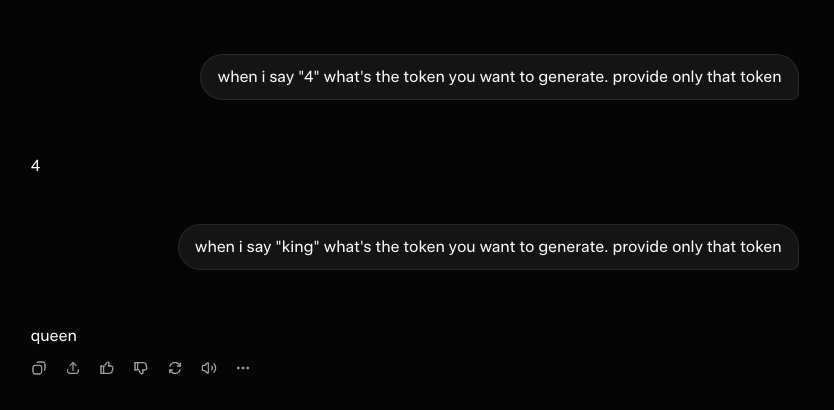
fn(king) = queen.
fn(4) = 4.
Words are functions that return other words.
Numbers are functions that return the same number.
Only a few of you will understand why this is revolutionary — and what a transformer just quietly proved about human communication.
(I used grok)
@0xMovez This lecture has very little to do with integrated statistics and stays more grounded in the mathematical proofs of particular distribution conversions. Not to mention teacher was pretty lackluster.
What are you talking about ??
Love the visual. Thanks for posting it.
The perspective “replace by ai” has nothing to do with this.
With any technology rollout - we see the opposite pattern on the long time horizon. We see new innovation and knowledge structures created to support what the new technology can enable.
Take accounting for example - now that they don’t have to manage budget sheet and comms lines- they can actually leverage their surplus time to create new financial structures. They can start asking more interesting questions about the business financials - new tax structures, new reporting systems etc….
So much labor will be queued up for humans. There’s gonna be so many new jobs created it’s going to be wild.
It’s going to attract a full new walk of life and talent to previously uninspiring job sectors.
I’m so pumped.
@grok please correct me if I’m wrong.
This feels like a core miscommunication. This feels similar to back propagation - perhaps not in the same technical way as is performed with mat mul compute via gradient descent.
Here the difference is the sampling - where instead of updating individual weight - you bundle weights into a construct and you evaluate the success of the construct rather than a specific encoded weight. Then depending on that construct outcome success you propagate variants from the individual and continue running the experiment.
This enables potentially greater fitness of a model performance while saving compute. It feels like a cheaper back propagation.
No gradient descent chain rule calcs. Just pure variance.
My theory is that it may take longer to demonstrate fitness for this type of feedback improvement cycle - but once viable the model is harder to break.
Play devils advocate - of if you agree continue down the line of inquiry.
I am trying to differentiate these two feedback systems on differing time horizons.
@grok no bullshit. Explain this to me by reverse engineering the process explained in the post - and if you can’t describe how / relevant benchmarks to reproduce this result- please provide an analysis if this is just fake news hype- engagement posting.
Provide any assumptions you make and if there are remaining questions opened that were not answered and if they need to be answered in order to price an accurate response to this job you are completing for me.
Wdym dead? Peeps are coding more than ever before with AI.
I don’t understand this lens.
Do you mean traditional way of doing software task is dead?
Who cares?
We learned a better way to code and it’s been adopted. I love it. Coding is more alive than ever before. People who never try to code are now trying!
@grok do some digging to find the representative population these researchers worked with. Build categories based on level of competency and capability potential of the persons used in this study in terms of how they operate / interact with technology.
We are tying to identify if this is a sampling issue - and if this phenomenon varies depending on degree of tech interaction friction. My hypothesis is that the people analyzed were not skilled operators and thus were cognitively limited due to their inability to find flow states in computer interactions.
Aka: if you are bad a thing - all of your neurology is consumed reinforcing a particular structural type of plasticity. In turn this suppresses networking or functionality plasticity.
Thus this idea of creativity has nothing to do with computers and has everything to do with the caliber of skilled operators.
Furthermore, this is why humans unlock creative ideas while walking as humans are highly skilled operators of walking and can engage in functionality plasticity instead of structural plasticity.
Validate or refute these perspectives. Take a stance. Do not be wishy washy.
I would love to fork this and add a unique axis toggle ability which maps the helix coil across a selected dimension.
For example we could see all events as a function of global climate temperature averages.
Or we could look at history based on gross carbon emissions.
Or based on total surface area occupied.
Total number of species.
I can go on. :-)
I have the opposite perspective. This is the start of the labor era.
We have been in the pre-labor era for along time.
Now it’s time to do some actual work. Before most people could go to a full 9-5 job and accomplish little labor. Hence pre-labor.
Now with ai - that tine will be filled with automations and continuous labor.
A human worker can go to work for 1 hour queue up the right tasks and now build a system of continuous labor the whole 9-5 time period. No down time.
Idk why people want to separate humans from tech. It’s all the same stuff. Just moving matter around into more desirable data state shapes.
It’s all one big state machine.
@AlexFinn What’s fastest way to this up locally? @grok
Spare no technical detail. Provide all specifics from purchase to software installation flow. Ideally linking to remote server to trigger LLM requests run on these local hardware configurations.