Guys, this is very serious and you have to read this right now. The Riemann Hypothesis may have just been solved, and if the claim holds, it's an insane achievement.
In mathematics there is a famous problem called the Riemann Hypothesis, and it's about prime numbers. Primes are numbers like 2, 3, 5 and 7 that can only be divided by 1 and themselves. Every other number is built by multiplying them together, so they're the building blocks of all numbers. You can never tell exactly where the next prime will show up, but if you step back, there's a pattern.
Around 1,000, about 1 in 7 numbers is prime. Around a million, about 1 in 14. Around a billion, about 1 in 21. Primes get rarer at a steady, predictable pace.
Because of that pattern, mathematicians can estimate how many primes there are below any number. But the estimate is never exactly right. It's always a little off, and the big question is how far off it can get. Think of flipping a coin 1,000 times. You expect 500 heads, but you'll get something like 480 or 520. It's a little off, but never wildly, and you can predict how far off it will be.
In 1859 a mathematician named Bernhard Riemann found that the prime estimate's error isn't random. It's controlled by a hidden set of special numbers. Where those numbers sit decides how big the error gets. Riemann guessed that every single one of them sits on one straight line. If he's right, the error always stays small, just like the coin, and primes are as orderly as they could possibly be. If even one of those numbers is off the line, the error can grow much bigger, and primes are far messier than we think.
So far computers have found trillions of these special numbers, and every single one is on the line. But there are infinitely many, so checking will never be enough. You need a proof that covers all of them at once. For 167 years nobody has found one. It's one of the seven hardest unsolved problems in mathematics, with a million dollar prize attached.
Now a mathematician has posted a note saying that, working with Claude, he believes he has that proof. He says a computer has already checked every step, and that Claude raced ahead of him near the end. Experts still need to confirm it, but this isn't a random internet claim.
If it holds, it doesn't mean we can predict every prime. It means we finally know the pattern can never go wildly wrong. Thousands of math papers that begin "assuming the Riemann Hypothesis is true" become proven fact overnight. We'd also get firm limits on how far apart primes can be, and a guarantee that a fast method for testing whether a huge number is prime always works. And no, your bank account isn't in danger. Online security depends on how hard it is to break a huge number into its prime factors, and this proof doesn't make that any easier. If anything, it gives the math behind encryption a stronger foundation.
If it holds, this is bigger than one math problem. A question that beat the greatest minds in history for 167 years would have been cracked by a human and an AI in a matter of weeks. If AI can find answers and computers can check them, the limit on science is no longer how smart we are. It's how many good questions we can ask.
Thoughts after talking to lots of engineers in London in last couple of days:
• Everyone's moving into the same direction and getting more and more agent-pilled, but all on individual speed. No group of engineers right now is uniformly agent-pilled.
• Becoming agent-pilled is a one-way door. You only realize this once you've gone through. Many think they "get it" but haven't made the switch yet.
• Wild how many orgs are still treating agents as "thing that writes code on my computer" instead of robot-engineer that can help with whole SLDC.
• Teams are drowning in PRs and code review. No process has been changed yet, even though this is the biggest dev productivity lever of last 30 years, engs still work off tickets like nothing happened. Wild.
• Barely anyone realized yet that, hey, even if the model isn't good enough to write the code the way you'd write it [doubt it], they can surely write all of the peripheral tooling to speed you up.
• Very few engineers have imagination to come up with better tool. Instead of reviewing code in diffs, line by line, think: if I could wave a magic wand and make tooling disappear, what tooling would I want to gain confidence in this change being correct? Full instrumented/traced end-to-end runthrough? Demo videos? In-production probes? High-fidelity and anonymized production data fed through test runs? New testing environments with the greatest debugging MCP support one can imagine so agent can inspect everything?
It's time to dream big.
But seems like most people's dreams don't reach further than "this agent works off the tickets assigned to me 10x faster than I can."
A thousand years ago, I made a dent in dev envs with “Vagrant.” The most popular request always was “I want Vagrant for remote envs.” I’ve been asked this to this day!! I tried and failed many times. I made things that worked but didn’t work right. Well, Rex is done right. Rex is my answer, finally.
It’s always lived in the back of my mind no matter what I did. I would come up with something and try it and it didn’t feel right.
I got really close around 5 years ago to the point I setup a website branding etc (via HashiCorp). But at the last minute I pulled it. It still wasn’t right. I couldn’t explain why and didn’t have a better solution. I just knew it had to be binned.
Well, Rex is it. This is the real deal.
Rex is doing for remote development (and a lot more than just dev) what I think a proper solution should’ve done. It’s far more than just a dev tool but I think part of what I knew is once you reach into remote environments that line isn’t clear anymore. You have to solve both remote dev and remote prod.
Here we go, back to the beginning.
I'm overwhelmed by the response to the trailer. All I can say for now is thank you for watching it and sharing.
I am the sole creator of this project and no one else represents NUREMBERG. Anyone else saying otherwise is a scammer.
Finally, YES this is really in production and I can't wait for you to see it in all of its glory.
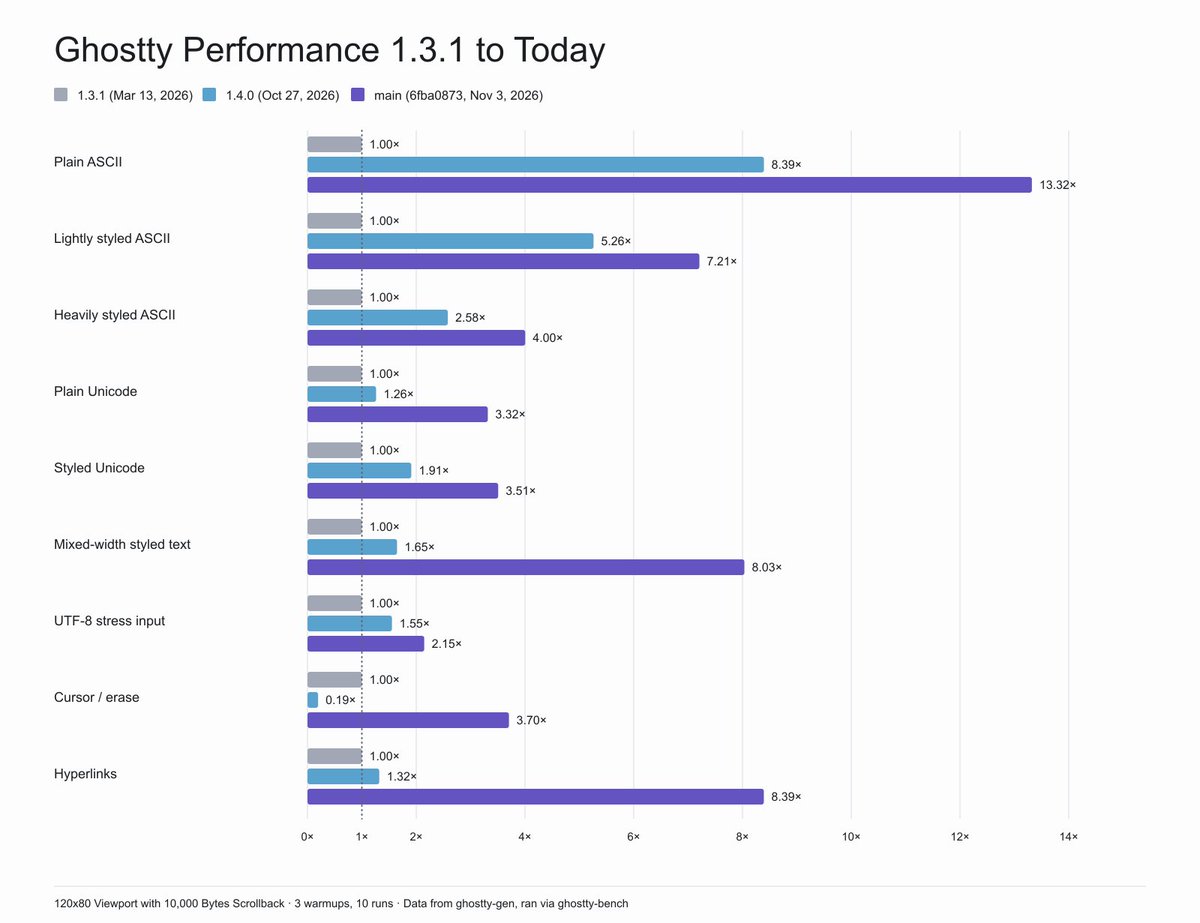
libghostty has always been fast, but it's also been getting significantly faster. Here are IO throughput measurements comparing Ghostty 1.3.1, 1.4.0, and main as of this morning. We'll be backporting most of these to a 1.4.1 release soon.
Here are some highlights of the changes since 1.4:
- Ghostty 1.4 had a fast-path for printing runs of plain text. But the fast-path only applied to limited cases. We now support mixed width characters and hyperlinks in the fast path.
- Our input path always widened the pty data to codepoints (8-bit to 32-bit) as part of UTF-8 decode, which also incurred a memory copy. We now have a SIMD fast path to detect pure-ASCII and we process the run direct from the read buffer (no copy, narrower data).
- New memory pages use most recent two pages actual utilization to pre-size themselves accordingly. This sped up styles, hyperlinks etc.
- When a VM page runs out of capacity for a certain type of data (e.g. hyperlinks, styles), we now project the usage so far to guess what you'll need, then shrink available rows to avoid a realloc. Before we'd naively double. This caused a classic "laddering" problem.
- We recognized "erase" being a slow path for us, and it's a common sequence, so we use another bit in row headers to track blank (we had space).
- Styles are now processed once per SGR. Previously, a sequence like "ESC[1;38;2;r;g;bm" would apply each style as it came in (1, then 38, then 2, etc.). We now apply all attributes at once and write to the cursor atomically.
- Styles are now packed into 128-bit values and use aarch64 and x86_64-specific assembly for minimizing instructions to use it.
- On x86_64, we found that LLVM was lowering some row resets (hot path) to a 4-byte store followed by an 8-byte load which couldn't be store-forwarded. This caused an almost 10% (!!!) slowdown on scroll operations only on x86_64. The fix was to change our reset to build the full header in a register then do a single memmove per row.
Net results are what you see in the graph, but written out main to 1.4: ASCII 1.5x, heavy styling 1.5x, styled Unicode 1.8x, random UTF-8 1.4x, random OSC 8 2.7x, mixed styled text with links 4.8x, cursor/erase 16x, hyperlink-dense text 5.6x.
Very positive and constructive conversation with @elonmusk today.
Italy is looking with great interest at the opportunities offered by assisted driving technologies, with a focus on innovation and road safety, and supports a swift EU approval of Tesla Assisted Driving.
Thanks for the exchange, Elon!
"Une majorité de naissances (2040) et de population (2070) extra-européennes fixent inéluctablement notre horizon. Ce que je sais du monde me permet d’affirmer que pareil scénario ne sera pas imprégné de bienveillance. L’immigration, et les bagages qu’elle a apportés, ont déposé un magma incandescent, sous-jacent à notre société, qui ne s’éteint pas avec les générations, et ne demande qu’à entrer en éruption, sur la base de conflits non négociables persistants (discorde religieuse, hétérogénéité des mœurs, narratif colonial, fléau du racialisme). Ces éruptions ont déjà eu lieu. Elles devraient se reproduire, avec une fréquence et une intensité accrue, dans un climat de plus en plus défiant, au fur et à mesure que l’implacable rouleau compresseur de la démographie produira ses effets. À mes yeux, c’est moins, hélas, un pronostic qu’une certitude."
Pierre Brochand, ancien patron de la DGSE, dans son dernier entretien accordé au Figaro, à découvrir ici :
https://t.co/R2qm6nZ4iN