HERE IS THE FULL SPACEX $SPCX SHARE UNLOCK TIMELINE
Right now only 4.9% of shares are in the free float.
Here is how that changes over the next 14 months:
Early unlock window (Jul - Dec 2026):
Aug 8: 11.8%
Aug 20: 15.2%
Sep 9: 17.7%
Sep 24: 20.1%
Oct 9: 22.6%
Oct 24: 25.1%
Nov: 27.6% → 37.5%
Dec 8: 40.0%
On Day 366, June 12, 2027: Elon's 46.1% stake becomes eligible ... The free float jumps from 50.8% to 96.9% in a single day.
By September 2027 the float reaches 100%.
@BoujeeFinances Unless your house is paid off and your never going to move no, I make substantially more and couldn’t. After saving up for retirement, your kids future ,scam property taxes, and constant dilution of currency I don’t see it
The government has tracked the Personal Savings Rate since the 1950s. It's the percentage of disposable income that Americans save, invest, or use to purchase real assets.
Today's reading was a terrifying 2.6%
Want to know all the times in the history of this stat it was this low?
▶ The 2.5 years running up to the Great Recession
▶ The first 3 quarters of the Great Recession
▶ The middle of 2022 (the 3rd worst year for markets in 50 years)
▶ Right now
🦔New Bloomberg reporting reveals SoftBank has committed roughly $60 billion to OpenAI, and internal advisors who questioned the size of the bet say founder Masayoshi Son shut them down. Former SoftBank insider Habib Imam described the position as "a bet on a worldview about AGI" and added "you can't hedge a worldview."
To fund the commitment, SoftBank sold its remaining Nvidia stake, took out a $40 billion bridge facility, and layered a margin loan on top, all costing around 8% interest. SoftBank's last bet of this scale was WeWork, which imploded in 2019. Insiders also told Bloomberg they worry OpenAI is losing technical ground to Anthropic.
My Take
Son shut down internal disagreement on WeWork before that one collapsed, and the Bloomberg piece describes the same dynamic playing out on a position 15 times larger. Son built his career on contrarian bets that worked, and the Alibaba return covered a lot of subsequent mistakes. The OpenAI position cannot get covered the same way, because no future windfall fits inside the same fund timeline.
The way this is financed is certainly not great in my eyes. SoftBank borrowed against its OpenAI shares to buy more OpenAI shares, paying 8% interest on a private asset with no public price discovery and no short sellers to test the valuation. That works while OpenAI keeps marking up at each private round, and collapses fast if the next round comes in flat. OpenAI's projected $14 billion loss in 2026, the token economics pressure on enterprise customers, and the IPO complications I have written about all week are the kind of catalysts that test private valuations. SoftBank does not need OpenAI to fail. SoftBank just needs the next round to disappoint, and the margin numbers get ugly.
Hedgie🤗
https://t.co/dpDaSoOE2H
BREAKING: Iran directly rejects Trump's claim that Hormuz "will be opened" as part of a "largely negotiated" agreement he just posted on Truth Social, saying Trump's claim is "far from the truth" and that Hormuz "will remain under Iranian management" with Iran retaining exclusive permanent authority over route, timing, method, and permits, per Fars.
Iran also confirms the nuclear file has not been discussed and that American officials themselves have told Iran in multiple messages that "Trump's tweets are primarily for domestic American propaganda and media consumption" and "should be disregarded." The "largely negotiated" deal claim therefore has no basis.
🚨 THE ENTIRE AI BOOM MIGHT BE BUILT ON FAKE REVENUE.
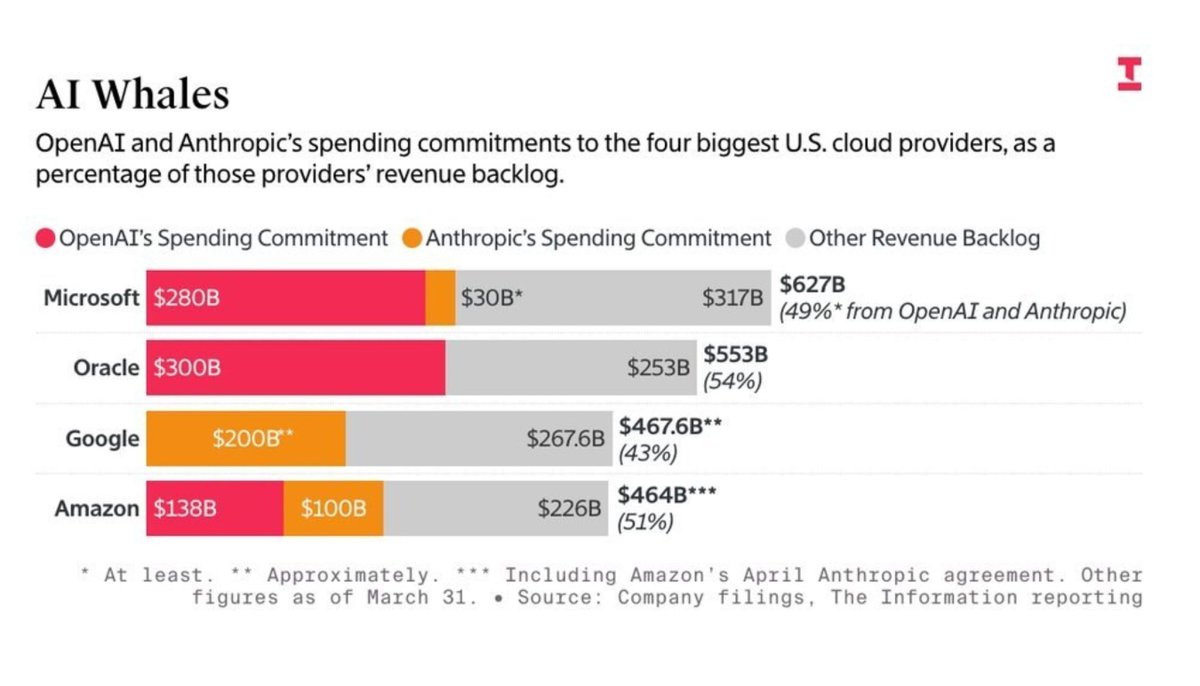
Latest corporate filings show that OpenAI and Anthropic alone make up over half of the entire $2 trillion future cloud backlog held by Microsoft, Oracle, Google, and Amazon.
This massive pipeline is actually being created through a circular accounting trick called a round trip revenue loop.
But how it works ?
A tech giant gives billions of dollars to an AI startup as an "investment". But hidden in the contract is a strict rule forcing the startup to hand that exact same money straight back to the tech giant to rent their computer servers.
Look at the documented case of Microsoft and OpenAI.
When Microsoft invested $13 billion into OpenAI, it didn't just give them cash; it gave them "cloud credits" to use Microsoft servers. OpenAI used those exact credits to train its AI models, and Microsoft then turned around and recorded that server usage as brand new "cloud revenue" from a customer.
The tech giant is literally paying itself with its own money and calling it a sale.
This is why OpenAI’s annual cloud bill has ballooned to over $60 billion, double its actual revenue of $25 billion, kept alive solely by this recycled funding loop.
Anthropic runs the exact same play, spending $2.66 billion on Amazon Web Services in just nine months, which was basically 100% of all the money it earned at the time.
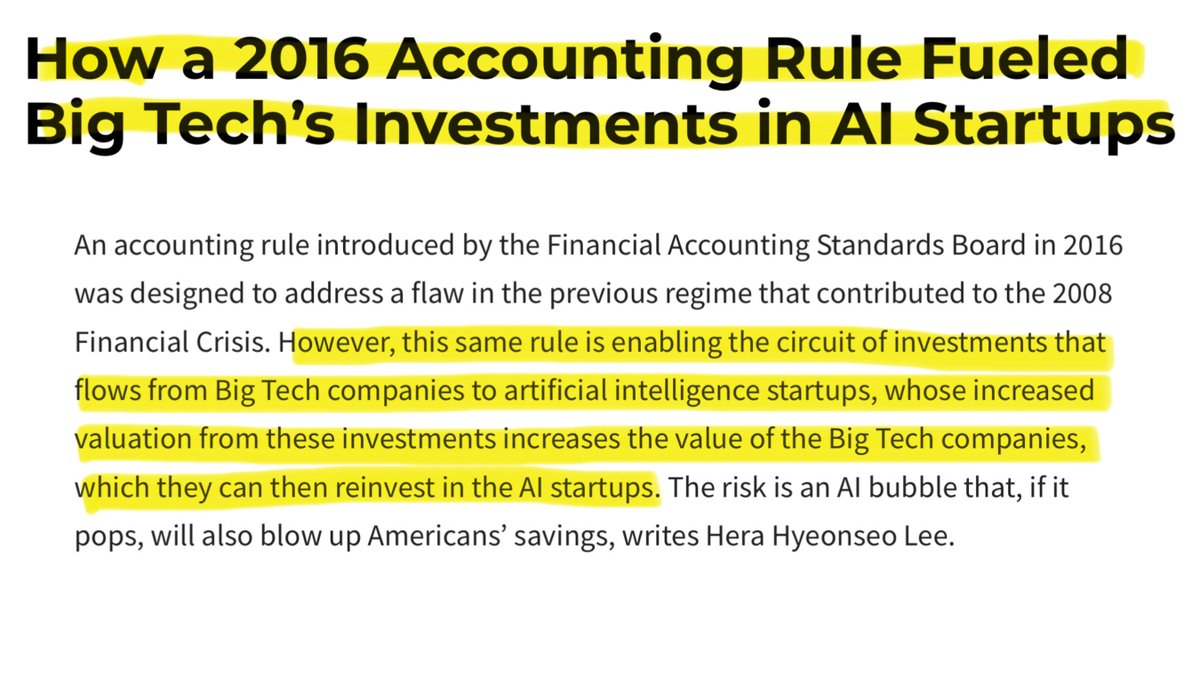
This manufactured demand triggers a second accounting trick where tech giants book massive paper profits. Every time a startup gets a higher value from a new funding round, the tech giant updates the value of its investment on its books and counts that unearned paper gain as direct profit.
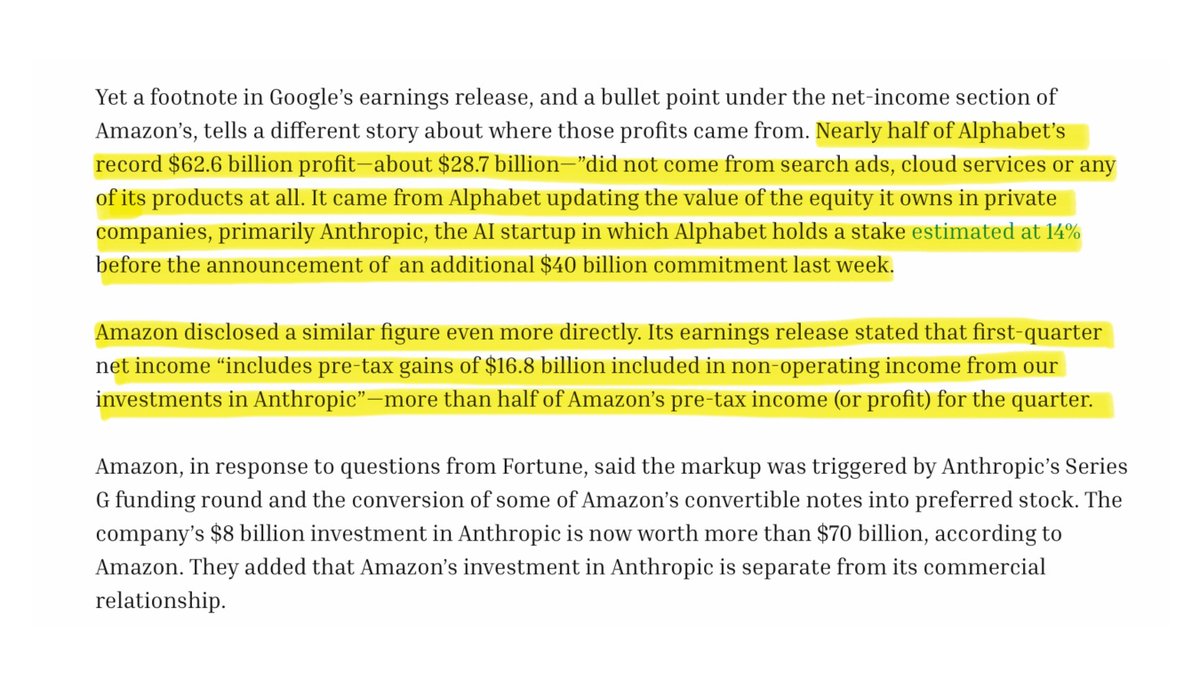
In Q1 2026, Alphabet reported a record $62.6 billion profit, but $28.7 billion nearly half, was just a paper markup on its Anthropic investment. In the same quarter, Amazon reported $30.3 billion in profit, but $16.8 billion of it was just an Anthropic paper gain.
While Amazon reported record profits, its actual free cash flow collapsed 95% to just $1.2 billion because it had to spend $44.2 billion in real cash to build physical data centers.
This has created a massive danger where these giant companies rely heavily on just one or two unstable startups. Microsoft has 49% of its $627 billion future backlog tied to OpenAI, while Oracle has an incredible 54% of its entire $553 billion pipeline relying on OpenAI alone.
This perfectly mirrors the 2001 dot-com crash when Global Crossing and Qwest Communications swapped identical fiber-optic network capacity with each other just to book fake sales.
Qwest had to erase $1.4 billion in fake income, and Global Crossing went completely bankrupt.
The only difference is that the dot-com swaps were illegal, but today's AI loop is fully legal under current accounting rules.
This legal loop inflates tech company stock prices, forcing automatic retirement accounts and index funds to buy even more of these tech stocks. It is a self feeding loop where investments, sales, and stock prices all go up on paper without the AI technology ever making real cash profits.