In 2025, I was traveling through India, experiencing total freedom. But back home, the reality of working for a boss always caught up.
I realized most freelancers and solopreneurs trap themselves in the same loop, drowning in manual admin work instead of enjoying their freedom.
So I launched @Jordiautomates to fix this.
I’m building in public, sharing actionable AI workflows to kill the busywork, and developing tools to solve the 11 PM invoice chase.
If you're a founder, freelancer, or building with AI. let's connect. Drop a reply and let's win together.
The build barrier dropped to zero, which means the distribution tax just went 10x.
Anyone can spin up a functional full-stack micro-SaaS over a weekend.
The real leverage in 2026 isn't clean code or engineering velocity anymore. It's owning the distribution rails and cutting through the noise while building completely in public.
Building InvoiceFlow AI to kill the painful 11 PM invoice chase for solopreneurs.
Most platforms force freelancers to act as human middleware between their CRM, invoice tools, and bank CSVs just to cross-match basic deposits.
I coded a narrow micro-SaaS loop via Lovable that handles the parsing and auto-matching completely in browser memory for zero-risk data privacy, then instantly drafts polite email reminders for the unpaid ones.
The full-stack prototype is operational and running live in my bio.
Inboxes are full of generic AI hype, but completely starved of raw, unedited validation metrics and build-in-public logs.
Relying solely on platform algorithms means renting your audience. Collecting emails at the point of digital conversion is the only insurance policy you actually own.
If you write tactical breakdowns instead of bloated weekly roundups, the open rates follow.
Building a great product without distribution just leaves you with a beautiful repo that nobody visits.
The market is saturated with clean code. The real leverage today is marketing and distribution velocity.
If you can't get your micro-SaaS loops in front of operators while you build in public, you're just writing code in a vacuum.
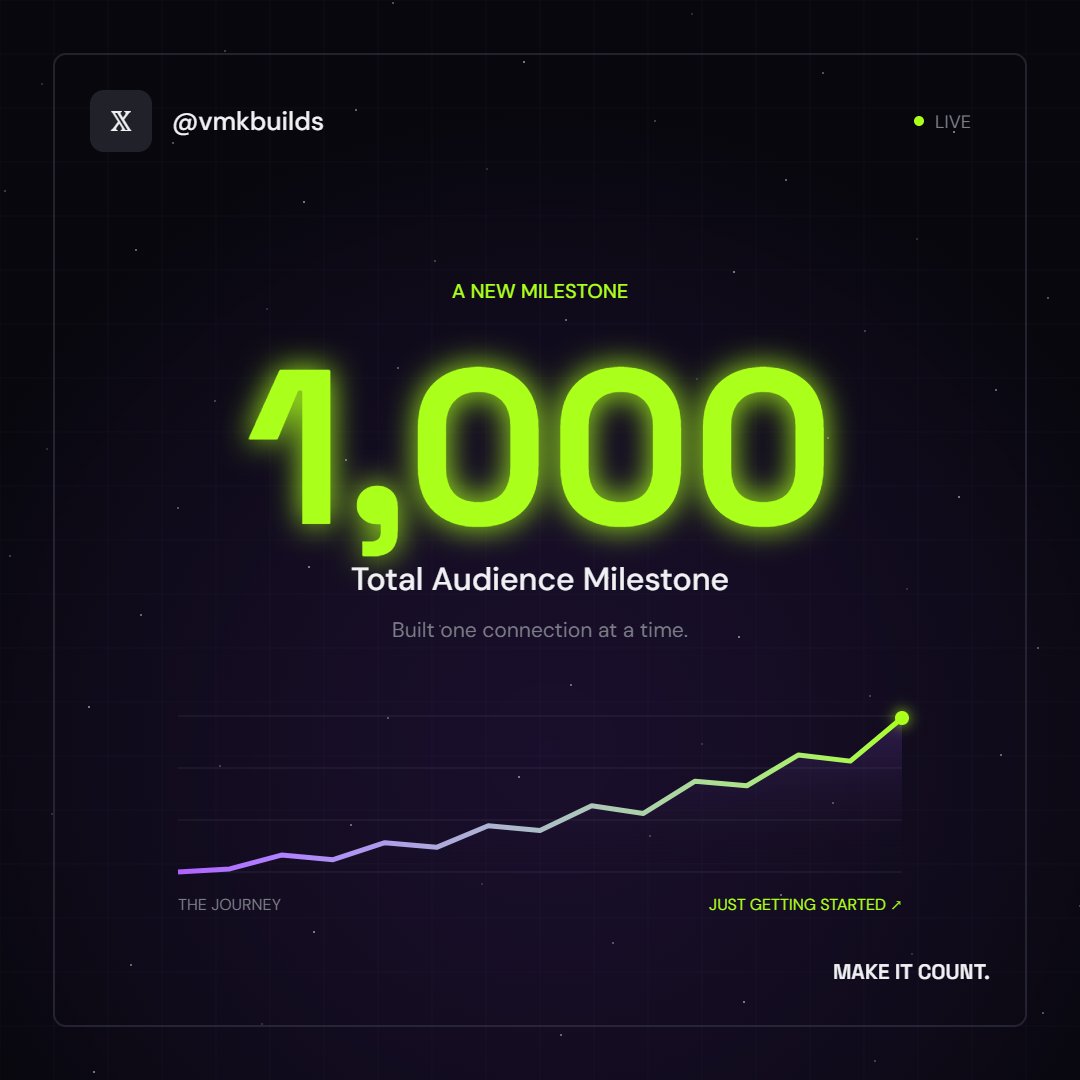
Shipping Vibe Grow Cards completely in public to kill ugly milestones screenshots forever.
Solo founders and creators use it to instantly turn raw data metrics into premium neon graphics that actually drive distribution and profile clicks.
Just dropped the full-stack validation prototype via Lovable this week. Shifting to the checkout layer next. Link is live in my bio.
This is the invisible tax of building in public that the hype threads always skip.
Balancing a day job with software development is heavy operational friction. If you’re burning out, the data you're looking at gets distorted by fatigue.
Take a hard pause for 48 hours. No laptop, no tracking metrics. Protect the operator before you try to protect the product.
Saw you just officially crossed the line and cleared the remaining 15. Massive work on hitting 1k.
Since you officially unlocked the four-figure tier, I generated a clean visual milestone card for you via Vibe Grow Cards instead of letting you celebrate with a dull, standard profile screenshot.
Congrats on the 1k momentum. Let's keep building.
Cursor gives you the models. It does not give you the workflow.
Claude Code and Codex are built around the specific loop of writing, reviewing, and iterating on code without the constant context switch back to a general chat interface. The usage limits matter, but the real difference is the tool is shaped for one job instead of being a general interface that happens to support coding.
Most developers are not paying for the model. They are paying to stop acting as human middleware between their editor, the AI, and the next step.
If the standalone tools remove more friction than they add, people will keep paying. If they do not, the subscriptions will die.
Four months from first video to full-time and $13k/m is real work.
Most people post the journey. Fewer ship the product that actually pays the bills. The followers help. The revenue is what lets you quit.
Consistency only compounds when the thing you're consistent about solves a narrow problem people will pay for. Not another tool in the stack. One loop that removes the manual work.
Glad to see someone actually make the jump. Happy to connect if you're open to comparing notes on what holds up once the early growth settles.
@matthias_mrc Most vibe coders buy tools. Few make money with them.
The stack grows. Revenue stays flat. The tool was never the problem. The missing piece is one narrow loop that removes work instead of adding another tab.
Buying software is easy. Killing the context-switching tax is harder.
The jump from 100 views to 26.9M impressions in three months is rare.
Most accounts never leave the first stage. They post, get silence, and stop. Consistency only compounds when the work itself has a point. Chasing bangers creates temporary spikes. Building something people actually need creates the baseline that makes the spikes useful.
I ship narrow tools for solopreneurs who are tired of acting as human middleware between their own apps. No bloated stack. No context-switching tax. Just the specific loop that removes the manual work.
Happy to connect if you're interested in what actually holds up once the early growth slows.
@cheaf25master The backup plan isn't hoping for the best or waiting around.
It is shipping your own micro-SaaS, validating utility, and locking in your formal business registration to build actual independence.
@aryanlabde Hiding behind code syntax is just a safe way to avoid the reality of the market.
Building micro-SaaS is only half the battle; if you aren't doing direct outreach and validating with real users, you are just writing code for yourself.
@pmitu Building inside Lovable feels safe, but facing the market and shipping real products is where reality hits. That is why distribution and direct user feedback matter more than hiding behind code syntax.
@samongaro_ Spend the ten grand on deep focus and ship micro-SaaS until your company registration goes live.
Travel is just an expensive context switch when you should be eliminating cashflow friction.
@CliftonSellers Running 17 automated bots just to feel powerful is the ultimate vanity metric.
Real leverage is shipping an actual micro-SaaS that fixes cashflow friction for real people before your company registration goes live.
@samongaro_ The person who wins is the one solving actual backend friction instead of hiding behind code syntax.
When code is free, distribution and solving painful local workflows are the only moats left.