🔴 @CNIOStopCancer hecho unos zorros y por arreglar, plan nacional a niveles de hace 1️⃣5️⃣ años, política a largo plazo 0️⃣, inversión en I+D+i por debajo del resto de la UE. Pero, eso sí, sus prioridades son claras. @ASEICAnews
🧬 New paper out in @Nature! We used CRISPR to selectively kill cancer cells based on a single-letter mutation in their RNA. The story I want to highlight: KRAS — one of the most notorious drivers of human cancer. A short thread on what we found 🧵
🚨 Today in @Nature, we report GEMINI—a genetically encoded intracellular memory device that writes cellular dynamics into tree-ring-like fluorescent patterns within cytoplasmic protein assemblies.[1/n]
https://t.co/eVchPCiK6f
🚀 Tomorrow is the big day!
The 1st edition of IIBM PhDay arrives at the #IIBM.
And a special highlight: Merck, one of our sponsors, will raffle two antibodies (€300 value) among visitors to their stand! 🔬🎁
We can’t wait to see you there! 🙌
More info: https://t.co/jxaZrAcKrk
Many people think of the genome as a string of "letters." The human genome, say, has 3.2 billion base pairs of DNA organized across 23 pairs of chromosomes.
But the genome is a 3D object. Genes located on entirely different chromosomes might be clustered together. Mutations in these "distant" genes can lead to disease in surprising ways.
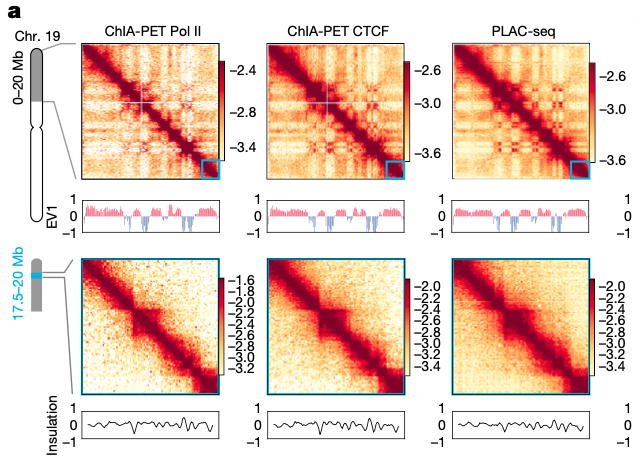
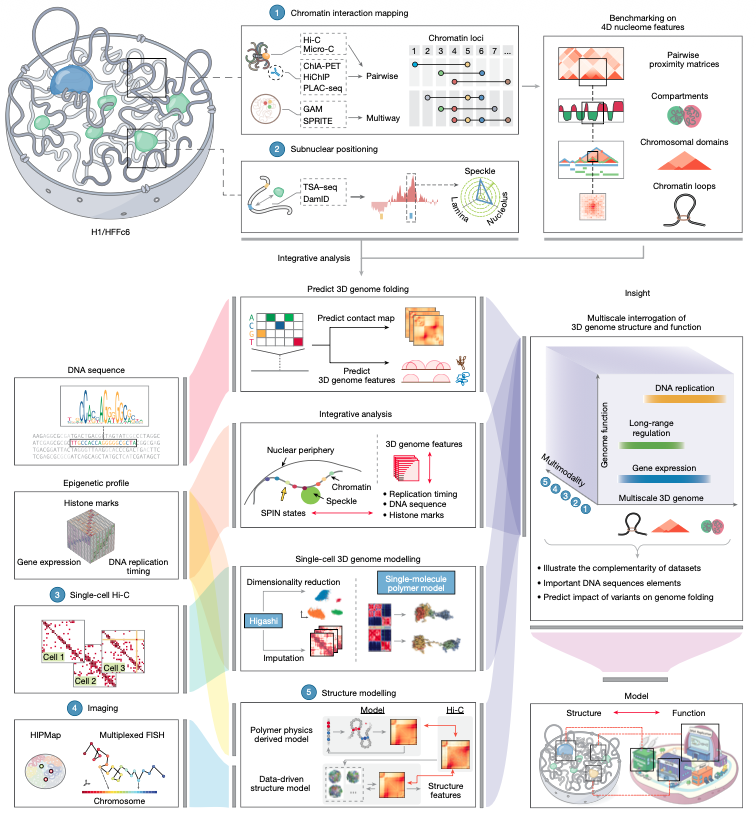
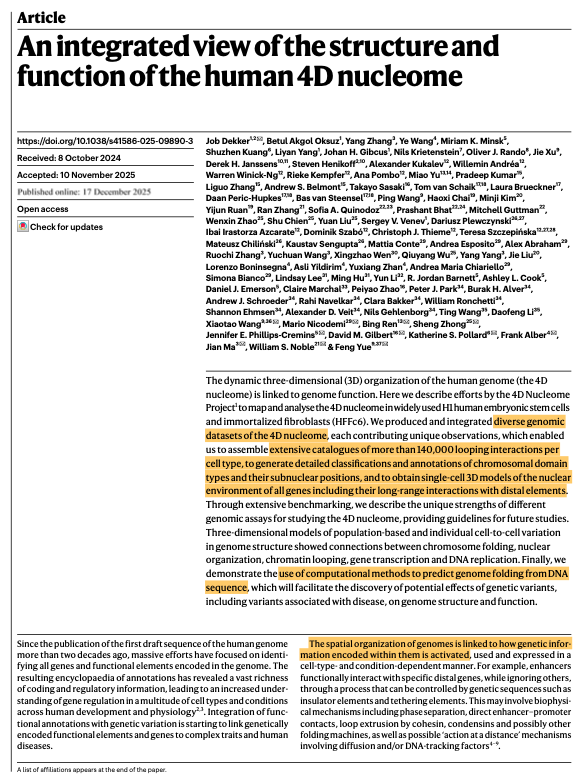
For a new paper in @Nature, researchers released several "maps" of human genomes from two types of cells: embryonic stem cells and fibroblasts. They compared methods to see which ones are least biased, and found many long-range interactions between genes.
The article does a good job explaining how “the genome is organized at different scales”:
> On a single chromosome, histones control which parts of the DNA sequence are accessible and expressed.
> At the scale of hundreds of thousands of bases, “chromatin loops in a dynamic manner,” the authors write, bringing distant genes closer together. > Across chromosomes, sequences "cluster together in space to form subnuclear compartments."
Examples abound. Enhancers, for example, are short DNA sequences that regulate the expression of far away genes. They do this by *physically* touching the genes they control; a protein called cohesin grabs the DNA and tugs it into big loops.
Even promoters, which are thought of as being associated with one gene or operon, can cluster together across many genes! A protein, Ronin, grabs promoters and pulls them together. This is apparently done mostly for genes that tend to be "on," as it helps enzymes find genes faster/not have to diffuse far away to find targets. (This also happens with genes that tend to be "off;" so-called polycomb proteins grab onto promoters, cluster them up, and silence all of them at once. It's a way for the cell to conserve energy.)
One consequence of this spooky "action-at-a-distance" is that diseases might arise from mutations in unexpected locations. Editing these regulatory sequences, in other words, might in turn affect a gene located on an entirely different chromosome that *is* associated with that disease.
Genetic mutations linked to autism, for example, are known to disrupt the 3D organization of the genome. A single deletion at a gene, TAL1, also affects its ability to form long-range chromatin interactions with other genes, leading to leukemia. There are probably many other, as-yet-undiscovered, instances of this.
Como médico de UCI, recuerdo una guardia en la que nos trajeron a las 16h a un señor trasladado de otro hospital con un aneurisma de aorta parcialmente roto y contenido. Llegó despierto al Box Vital, y mientras el cirujano veía el TC y decidía cuál era la mejor opción...
✨ Announcing a new glutamate indicator - iGluSnFR4! ✨
Launched as a pair, iGLuSnFR4s and iGluSnFR4f have high-sensitivity and fast activation/deactivation for recording synapses.
More on the indicators and what they are already revealing: https://t.co/MYJfbQQmAL
🏆En las #NoticiasIIBM celebramos que el IIBM consigue el sello de excelencia ASPIRA-CSIC Sagrario Martínez Carrera y se consolida como un instituto de referencia en la investigación biomédica, comprometido con la excelencia científica
Echa un 👀https://t.co/gIqmT4vN7H
Introducing RAEFISH, our lab's new flagship image-based spatial transcriptomics technology that simultaneously enables single-molecule spatial resolution and whole-genome level coverage of long and short, endogenous and engineered RNA species in cell cultures and intact tissues.
International science media highlight our work! 🌍🧠:The overlooked astrocyte: Star-shaped brain cells may form specialized networks for reward learning https://t.co/ZO0Dhd3h8l via @medical_xpress@SENC_ @InstitutoCajal @CSICdivulga
📢 La Unidad de Cultura Científica de la UAM @UCCUAM se hace eco del reciente artículo publicado por @_SanFranco y el grupo de Neuropatología de la Audición y Mielinopatías @HearingMadrid del #IIBmCSICUAM 👏👏👏
Echad un 👀 https://t.co/IQCnUgGmNp
Do you want to work as a #postdoc in our group in a Hospital Research Institute in Madrid?
Interested in how #mitochondria can influence #stroke outcome and #inflammation?
Apply up to 26 Dec at https://t.co/7Qipu6Cq5n (ref 72/2024)
Full call https://t.co/LCVBW9gEMz
Please RT
¿Has pensado alguna vez en metales con propiedades curativas?
¿Y si te digo que se suelen utilizar en el tratamiento del cáncer?
Abro hilo 🧵#HilandoCiencia2024
¡El @CIBER_ISCIII está de cumpleaños! 🎈🎊
Desde el grupo de Neuropatología de la Audición y Mielinopatías del @IIBmCSICUAM queremos celebrarlo dando las gracias por estos 10 años #10añosCIBER
¿Queréis saber más? No os perdáis este vídeo 📹⬇️









![DingchangLin's tweet photo. 🚨 Today in @Nature, we report GEMINI—a genetically encoded intracellular memory device that writes cellular dynamics into tree-ring-like fluorescent patterns within cytoplasmic protein assemblies.[1/n]
https://t.co/eVchPCiK6f https://t.co/KPmYKFgnZt](https://pbs.twimg.com/media/HCgxFtcWkAAoaPS.jpg)