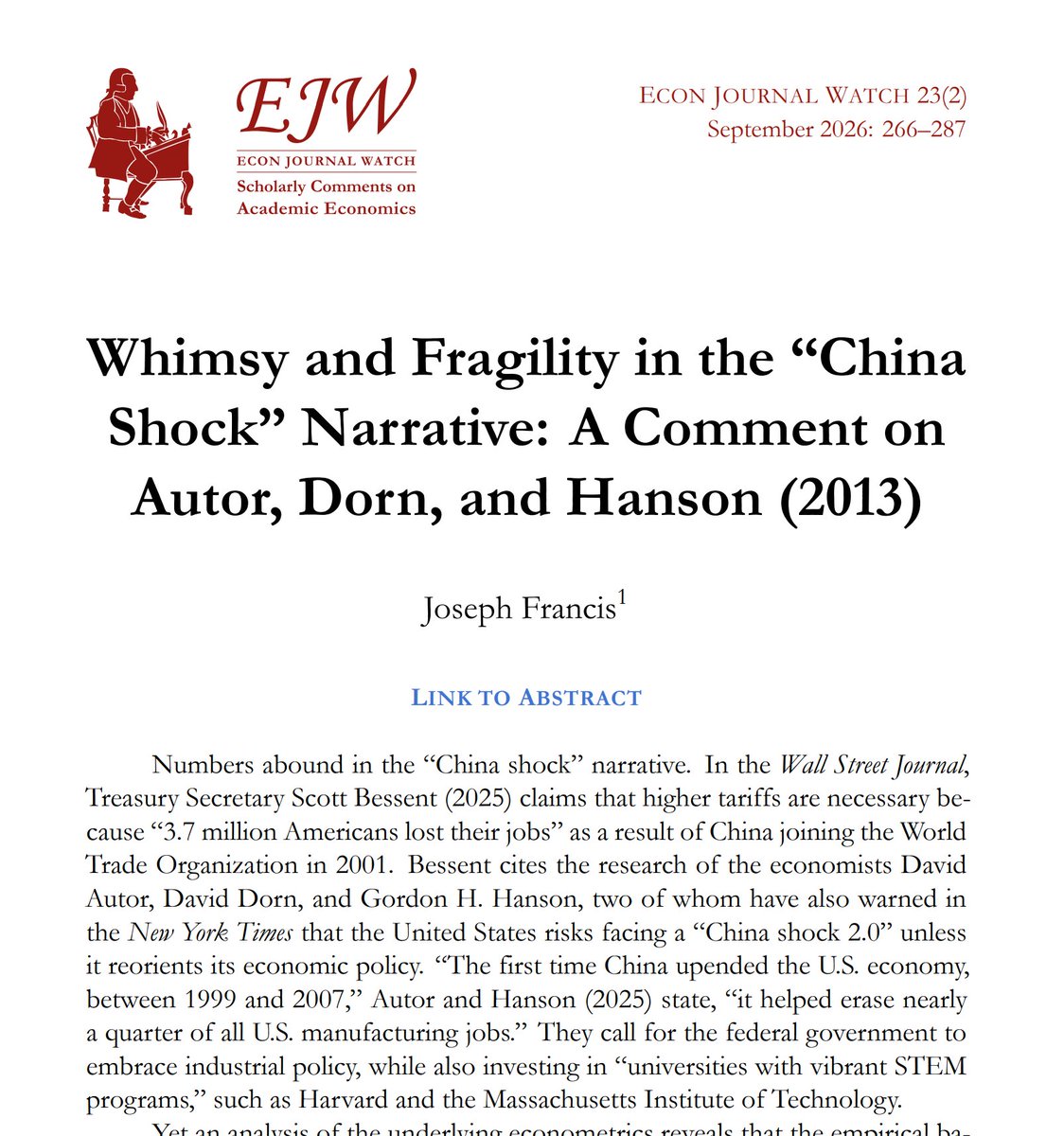
I'm happy to share my job market paper.
It asks a simple but classic question: to what extent are graduate wages affected by the supply of graduate labour in the economy?🧵
Sorry to rain on everyone's parade, but that effect size is obviously implausible. The instrument here is distance to Seattle. Do we think Starbucks or Microsoft and the rest of Silicon Valley are more important for innovation?
Coffee shops boost innovation. 10% more Starbucks in an area --> 3-4% more inventions.
People gather over a cuppa. They share ideas, discuss how to untangle a knotty problem, help see an issue from another perspective. These conversations lead to breakthroughs and inventions.
A very fun paper finds that when Starbucks rolled out to a new county, it fueled a coffee-shop culture, urging more and more people to “grab a coffee” together. The authors compare the counties where Starbucks had rolled out to those where it had not yet arrived. And they find that the number of patents in caffeinated counties is meaningfully higher.
This paper underscores how essential the face-to-face encounter is. Starbucks isn’t that old. People Could have picked up the phone and chatted at any time. People Could have dropped an email. Probably they did. But those connections didn’t yield the same insights and creativity.
Turns out that a Cup of Joe really does help the knowledge flow. We talk about how much in-person connection boosts creativity in In Person. It’s out in just few days, so now is a great time to pre-order.
To see the full research use the link in the comments.
#Innovation #InPerson #FutureOfWork #CoffeeCulture #NewBook
@RenaudFoucart I think there's just a missing link. I was able to find the paper by googling it and the book advertised is real and is coming out next week.
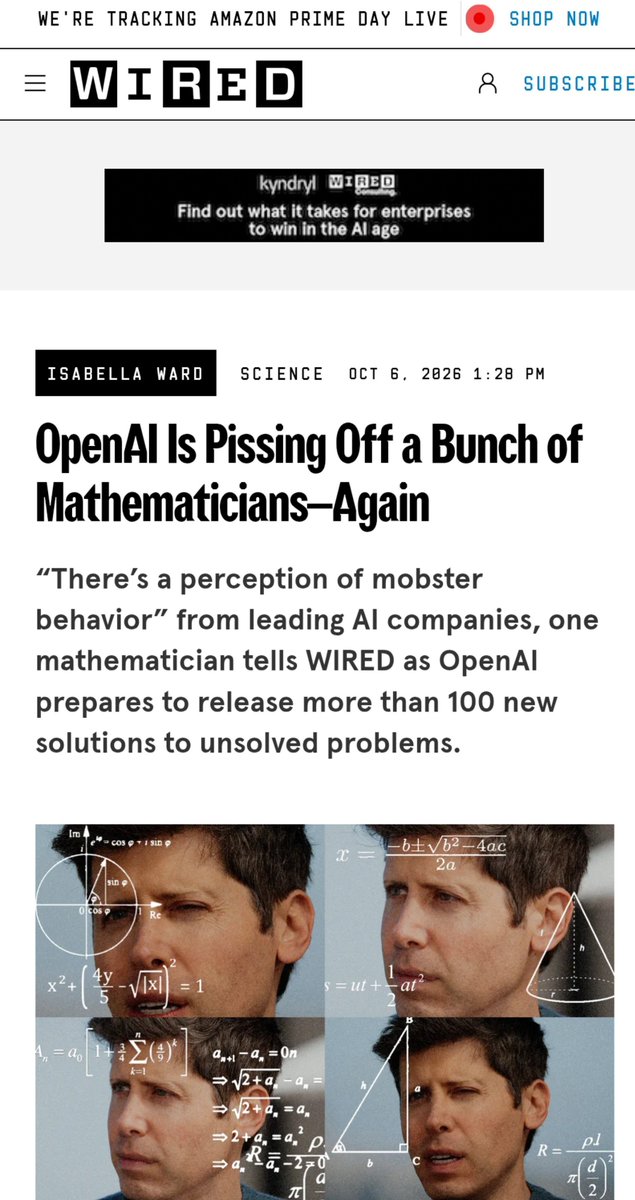
Today in: journalists by and large cover tech in a ridiculous way. This is Wired's - of Kevin Kelly and tech optimism! - framing of the single biggest breakthrough in the history of mathematics with huge implications for practical sciences. No wonder the public is "anti-AI".
So his position is that AI won't even increase productivity by 1% unless it creates new tasks - which would increase demand for labour. And somehow this leads to unemployment tripling?
Nobel Prize-winning MIT economist Daron Acemoglu fears unemployment could triple over the next decade if nothing is done and we stay on our current course. https://t.co/4sahxyfsxj
“Effective Altruism is this century’s biggest idea.” - The Economist
They said it, not us. If you're just hearing about effective altruism for the first time, let us introduce you.
@jdcmedlock@ArmandDoma Some of those statistics are misleading. The pensioner poverty statistics don't include imputed rents from housing. And if they don't own their own home or have substantial savings, then they are usually eligible to have their entire rent paid alongside some other bills.
UPDATE: AIs have achieved the highest *possible* score on the Mensa Norway IQ test - 151
3 years ago: cognitively impaired human (64 IQ)
2 years ago: average human
1 year ago: genius human
Today: literally off the charts
Next year?
@alexolegimas I'm not sure that junior hiring is a good example. The current slowdown in early career hiring probably has little to do with AI so far, but that those jobs are often work from home, which is very bad for junior employees. https://t.co/KhfAwXPq5F
@JohnPeterJerrim I imagine that all countries have some skew for reasons such as attendance and accessibility. The footnote on failed NPD matches is also likely important. NPD matching to other datasets is much more likely to fail for those from poorer backgrounds.
New PISA data out
England is now top ten in all three areas (reading, maths, science) and the second highest performing country outside of east Asia (after Estonia).
This is a huge public policy success.
@captgouda24@tracewoodgrains I think your argument applies much better to fields where success can be determined by the market or is easier to verify e.g., material science or mathematics. Although those are also the fields where there is less concern about epistemic standards.
@captgouda24@tracewoodgrains Education research departments, like Cambridge's, run the teacher training programs that every British teacher has to pass alongside many that university lecturers have to take. They are well positioned to do a lot of damage.
OK folks, Arday is gone now. But we—academics and everyone else who still cares about truth and public trust—cannot let it go yet.
It seems like Cambridge, alongside other mainstream institutions like the BBC that promoted Arday over the years despite all the evidence of fraud, intends to just call Arday an unfortunate bad apple, somewhat unfairly maligned by a "racially motivated" mob, and move on.
But Cambridge can only restore trust by openly investigating how this happened and holding those who promoted Arday responsible. Otherwise, we are all but proving the populists right about woke elites and out-of-touch academics.
And for all the comparisons, this is far worse than all other high-profile cases of plagiarism and misconduct at Harvard and beyond—we're talking about a journalist being investigated by police for months simply for asking questions, while Cambridge refused to investigate the fraud itself until a massive public outcry.
@arpitrage If pass-through occurs in levels (as a recent QJE paper argues) and prices start higher in richer areas, wouldn't you get this result when measuring price changes in logs without needing to invoke competition?
@NielsHoven That slide has a substantive issue as well! He says that there's a lack of black academic leaders and then evidences it with a statistic on non-academics.