Gross margin is what's left after the direct cost of making what you sell.
Software firms often run 70-80%. A grocery retailer might manage 25%.
This just shows that when comparing businesses it’s vital to choose businesses in a similar market to one another.
If you're in the UK, here's how the ISA allowance works this tax year.
You can put up to £20,000 a year into ISAs, tax free. No tax on gains, no tax on dividends.
It resets every 6 April and you can't carry unused allowance over unless you have a flexible account. If you don't use it, it's gone.
One change to know about. From April 2027 the cash ISA limit drops to £12,000 for under 65s. Stocks and shares ISAs keep the full £20,000.
If you're investing for the long term, it's hard to beat.
My favourite is trading 212 which is a flexible ISA, if you use my link you get UP TO £100 in free shares.
https://t.co/Vfe2ncFwHl
I
"Don't look for the needle in the haystack. Just buy the haystack!" Jack Bogle
For most people that's the right advice. Needle hunting is a choice, and you should know what you're signing up for.
@linbo_tang Yeah I was thinking this, a lot of my posts where I go into the actual financials of the business or the balance sheet don’t do super well. However the ones about emotions and progress seem to do well so far.
Week 1 update on my goal to join X's Original Content Rewards Program.
One post did most of the work. The post announcing the goal brought in about 80 new follows in a day which is incredible. The rest of the week was around 5-10 a day.
Where I am⬇️
Verified followers: 27 → 94 / 500
Verified impressions, last 90 days: 295 → 295 / 500K
The best improvement was the follower count which I’m super grateful to everyone who has helped and connected.
What I think worked: Being open about my analytics and a ton of connecting with other creators.
Next week I'll try to connect with even more creators. I’ll update this again next Saturday and we will review the progress.
Starting at 20 instead of 30 can more than double what you end up with.
Say you invest £200 a month until 65, earning 8% a year on average (an assumption).
Start at 20, you end up with roughly £1.05M
Start at 30, you end up with roughly £459,000
The 20 year old only put in £24,000 more. But those extra 10 years at the start get the longest to compound.
If you're young and think you don't have enough to bother investing, you've actually got the most valuable thing of all. Time.
I believe everybody should track their net worth once a month.
It takes ten minutes and shows the direction, which is more motivating than any single balance. Look for the trend, not the monthly noise.
It helps you reflect, helps you to notice how you could improve and what to do differently next month.
My best returns so far have been from when I bought the fear.
$NOW - $81 (AI was gonna kill software stocks)
$META - $530 (CapEx was too high and they were gonna get sued to oblivion)
$ZETA - $17 (Short Report)
$ELF - $45 (Margins were gonna be squeezed by the tariffs)
$NBIS - $75 (AI story is over)
The reasoning sounds ridiculous in hindsight but in the moment it’s tricky to pull the trigger.
Not one time was any of these companies fundamentals crumbling, it was all sentiment.
These were all within the previous year and I doubled my money on the majority of them and made 80+% gains on the rest.
Learn one new financial metric a week.
That's 52 a year. After a few months, annual reports and earnings calls start to make a lot more sense.
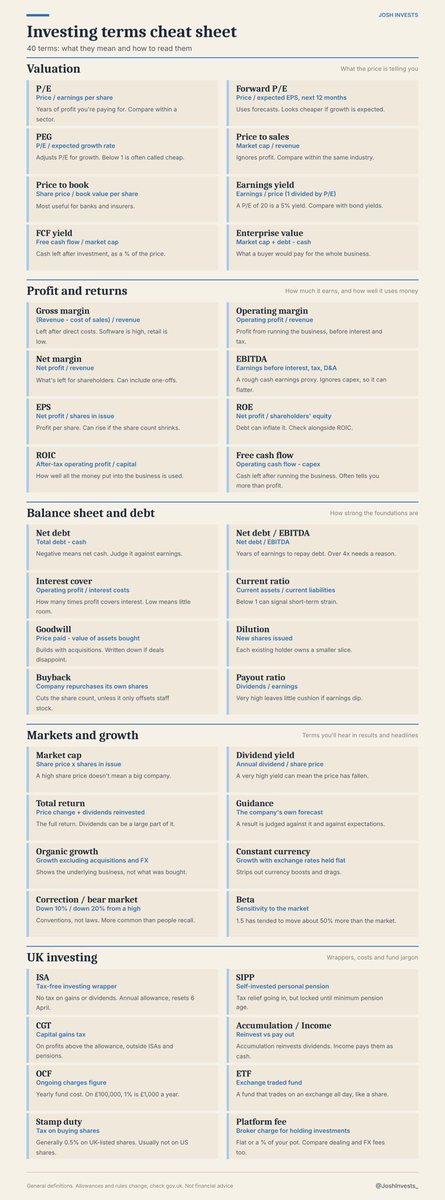
Here’s a useful cheat sheet of some key metrics.
Debt covenants are conditions lenders attach to a loan.
A typical one includes keeping debt below a set multiple of earnings. Break it and the lender can demand repayment or reprice the loan.
The debt note in the annual report lists them. A company close to its limits has much less room for a bad year.