My new blog explores some social and political '-isms' hounding our identities.
It is a true story; an answer to 7 major questions our generations face every day.
It is not politically partisan.
Please read, like & share.
https://t.co/LjGhYdAqkA
Mumbai - A shocking incident occurred inside a lift of the Sheth Irene high-rise tower in Malad West, when a pet dog suddenly turned aggressive and tried to attack three young girls. CCTV footage that has now gone viral on social media, a woman entered the lift with her dog, where three girls were already present. Moments after the lift doors closed, the dog suddenly became aggressive and lunged towards the girls. The women inside the lift panicked as the dog tried to pounce on them. The woman owner was seen desperately trying to control her pet and restrain it. When the lift doors opened, one of the girls tried to rush out, but the dog again attempted to chase her. The owner managed to hold the dog back, preventing a potentially serious incident. Fortunately, no one was seriously injured in the episode. However, the frightening visuals have caused fear among residents of the building.
Unfortunately, you have to be very careful of people that ruin your special days/moments. Insecure/manipulative/immature/jealous people tend to create drama/stress during your birthdays and important times like exams, interviews, awards, promotions etc Any win for you basically.
@pauly99 He passed away on April 15. He could not recover from chemo's damage. It affected his heart muscles that finally killed him. Please get your heart checked regularly through 2D Echo.
My mamaji is on ventilator. He had all his life’s savings within PSU bank in FDs. All his accounts have been sealed as due to being bed ridden he could not do re-KYC in person. His kids asked bank to take humane view. Bank said if he cannot come in person, accounts will not open.
FDs in PSU banks can be useless in time of need due to KYC regulations.
@narendramodi@RBI this KYC mess is draconian. Please help in this time of need
Actual quotes from President Trump:
Trump’s “victory timeline” claims.
Mar 3: "We won the war."
Mar 7: "We defeated Iran."
Mar 9: "We must attack Iran."
Mar 9: "The war is ending almost completely, and very beautifully.
March 10: practically nothing left to target
Mar 11: “You never like to say too early you won. We won. In the first hour it was over.” Mar 12: "We did win, but we haven't won completely yet."
Mar 13: "We won the war."
Mar 14: "Please help us."
Mar 15: "If you don't help us, I will certainly remember it."
Mar 16: "Actually, we don't need any help at all."
Mar 16: "I was just testing to see who's listening to me."
Mar 16: "If NATO doesn't help, they will suffer something very bad."
Mar 17: "We neither need nor want NATO's help."
Mar 17: "I don't need Congressional approval to withdraw from NATO."
Mar 18: "Our allies must cooperate in reopening the Strait of Hormuz."
Mar 19: "US allies need to get a grip - step up and help open the Strait of Hormuz."
Mar 20: "NATO are cowards."
Mar 21: "The Strait of Hormuz must be protected by the countries that use it. We don't use it, we don't need to open it."
Mar 22: "This is the last time. I will give Iran 48 hours. Open the strait"
Mar 22: "Iran is Dead"
Mar 23: "We had very good and productive talks with Iran."
Mar 24: "We’re making progress."
Mar 25: “They gave us a present and the present arrived today. And it was a very big present worth a tremendous amount of money. I’m not going to tell you what that present is, but it was a very significant prize.” Mar 26: "Make a deal, or we’ll just keep blowing them away."
Mar 27: "We don’t have to be there for NATO."
Mar 28: No major quote
Mar 29: Claimed talks were progressing
Mar 30: "Open the Strait of Hormuz immediately, or face devastating consequences."
Mar 31: Claimed a deal was "very close" and that Iran would "do the right thing"
Apr 1: "We’ll see what happens very soon."
Apr 2: Repeated that a deal was likely, while warning of continued strikes if not
Apr 3: "Something big is going to happen."
Apr 4: Said Iran must comply "immediately" or face further consequences.
Apr 5: "Open the fuckin' Strait, you crazy bastards, or you'll be living in Hell - JUST WATCH! Praise be to Allah."
April 6 :a whole civilization will die
April 7: total and complete victory
April8: objectives were met
A true disaster
@pauly99 CTC can also catch dead cancer cells. Papa's lymphs were also negative. There was a bit nodule somewhere but nothing too far. Chemo damaged him severely in just one cycle.
@pauly99 Hello Sir. Yes. The first one that you mention must be MSI or MMR and the second is CTC. Papa has had the same tests. MSI is high showing Immunotherapy would be a good option and CTC had some value, but doctor said that it is not such a definitive test.
@pauly99 Two oncologists have mentioned that since his nodes were negative, chemo may be an overkill for him. Immunotherapy could be a better option in case of any relapse.
@pauly99 Thank you! Yes, I'm familiar with that formula. Papa was given 7 tablets per day. He almost died of the mucositis and incessant diarrhoea that they caused. Chemo had to be completely stopped for him. Was your MSI test done? If you don't mind me asking, were your nodes positive?
@pauly99 Hello. I'm glad to know that you have completed your treatment. This is awesome. I wish you lasting good health. Can I please DM you? My dad's going through the exact same cancer. Thank you.
I hope y'all realize how insane this is. Crocheted blankets take a TON of work and, thanks to rising yarn prices, probably $15-$30 apiece in supplies. This woman is a saint and an absolute crocheting master.
BREAKING NEWS
New reporting and video evidence expose a devastating failure of justice in Georgia: Mahendra Patel, an Indian-American engineer, spent 47 days in jail after a white shopper falsely accused him of trying to kidnap her child at Walmart.
Surveillance footage shows Patel did not abduct, struggle with, or flee with the child. He briefly reached out as the toddler nearly fell, then calmly continued shopping, paid with a debit card, and left. Despite having days to review the video, police arrested Patel anyway. A judge denied him bond. Prosecutors moved forward.
Civil rights advocates say the case reveals a familiar pattern: racialized “stranger danger,” where white fear is treated as evidence and a man of color is presumed guilty. The result was incarceration without proof, reputational damage, and weeks of lost freedom.
Equally damning is the media response. Major outlets reported the timeline while largely avoiding the racial dynamics that made the accusation believable and the arrest possible. Critics argue that omission helped normalize a system where fear outranks facts.
Patel is now suing. The video didn’t just clear him. It exposed a justice system that picked a side before the evidence spoke.
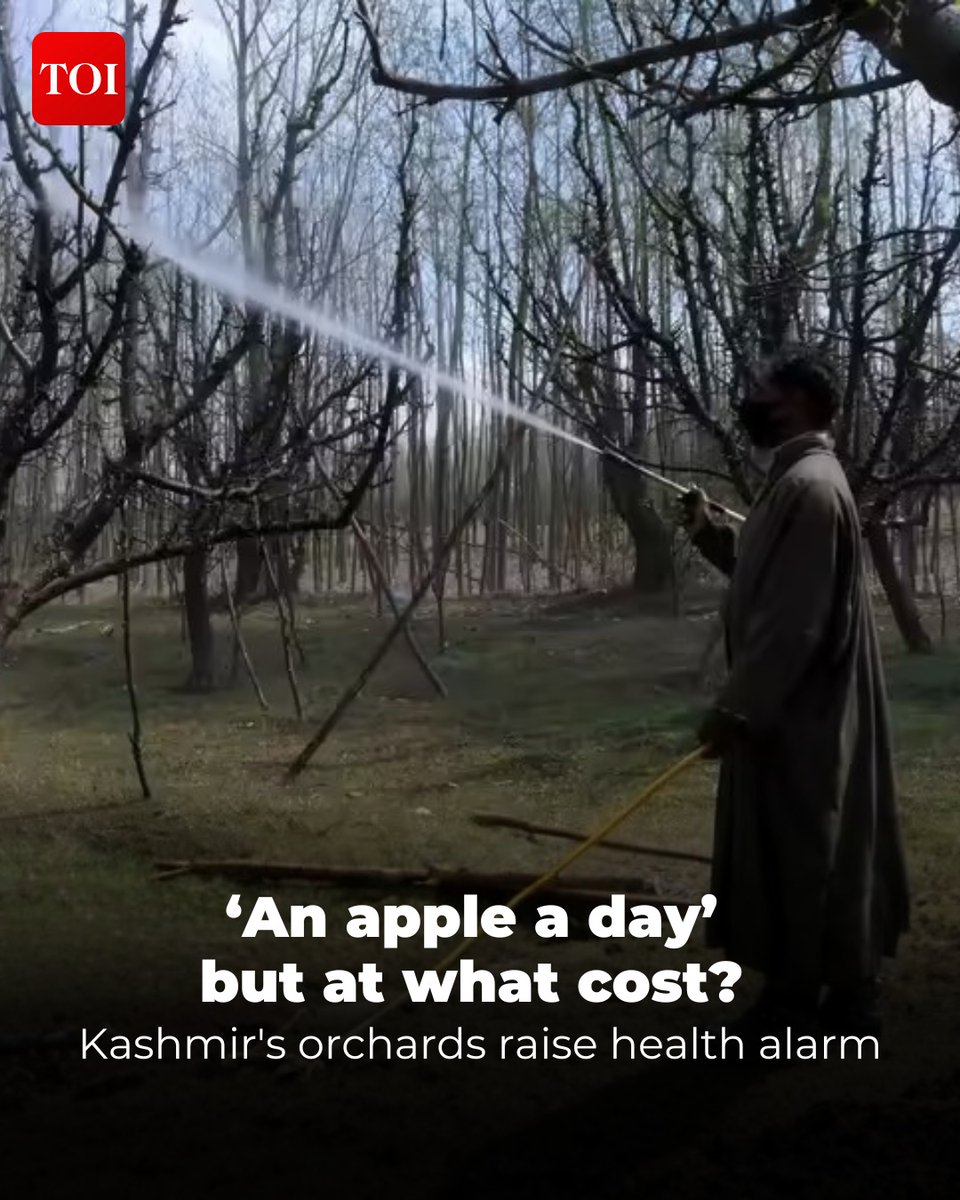
#Kashmir's #apple orchards face scrutiny as lawmakers and medical experts link decades of pesticide use to rising malignant brain tumours among orchard workers. Studies reveal high incidences of #brain cancer in fruit-growing districts, with evidence of pesticide residues found in human blood, demanding urgent policy responses for worker safety.
More details 🔗https://t.co/FaeJFozVUP
I was in fifth grade when I learned to read my parents' silence.
They were talking in the kitchen, late at night, in that particular hush that parents use when they think children are asleep. I caught fragments. Bombay. Tests. Something about a doctor. The next morning, everything was normal. Chai, school, the shop. But I had heard the frequency shift.
It was 2004. My father was 39. We had just moved out of the room behind our kirana store—a chawl on the outskirts of Panaji—into a proper apartment. Our first EMI. Things were looking up in the way they do for Indian middle-class families who have spent years looking at the same ceiling: slowly, carefully, one calculated risk at a time.
Then the diagnosis. Stage 3 follicular lymphoma.
I didn't know what lymphoma meant. There was no internet to tell me, no Google to spiral into. Cancer was a word from movies—something that happened to people in cities, in dramatic hospital scenes with violins. Not to shopkeepers in Goa. Not to fathers who opened shutters at 7 AM and counted change at night.
They kept me in the dark. The logic was simple: don't disturb the boy's studies. So I went to school. I came home. I did homework. And in the margins of this ordinary life, my father was taking buses to Mumbai for chemotherapy.
I still don't fully understand how he did it. A biopsy, then a bus. Chemo, then the overnight journey back. Tata Memorial to Kadamba bus stand. The same man who winced when he cut his finger slicing onions was now traveling eight hours each way with poison in his veins, because what else was there to do? Goa didn't have the facilities. We didn't have the money for flights or hotels. So he sat on buses, probably in pain I can't imagine, probably next to someone complaining about the AC being too cold.
My mother ran the shop. Not "helped out"—ran it. Wholesale orders, inventory, customers, credit books, all while her husband was in the jaws of something that might kill him. New scans kept showing the cancer spreading. The word "spreading" did a lot of work in those days.
And I? I was a child. Which means I was selfish in the way only children can be—not out of cruelty, but out of not knowing. My father was alive and not going bald like he did so I assumed things were now fine. I was still in the dark.
I remember crying for days because I wanted a geared cycle. All my friends had them. The fancy ones with the grip shifters. I needed it for school, I argued. I needed it because everyone else had one. I remember my parents' faces when I wouldn't let it go—that particular exhaustion of people who cannot explain why they're saying no, because the explanation would break something.
Every rupee mattered. I didn't know that yet. I didn't know that they were borrowing money from friends, from family, sometimes from customers at the shop—the same aunties who haggled over soap prices were quietly lending us cash to keep my father alive. That's the thing about the Indian middle class: the safety net is made of relationships. Of people who've known you long enough to trust you'll pay them back, eventually. No paperwork. Just faith, and shame, and gratitude all mixed together.
My father then spent 40 days in Mumbai for radiation. He stayed with my aging grandparents in a small flat while I finished my exams and my mother kept the shop open. I don't know what those 40 days were like for him. He never talked about it. Men of that generation don't. They just endure, and then they come home, and life continues as if nothing happened.
The magnitude of what was happening to my family didn't hit me until years later. No health insurance, of course—it was unheard of for people like us. The treatment, the travel, the lost income from the shop, the interest on loans that weren't from banks. It drained us completely. Not metaphorically. Actually. The kind of drained where you stop going to movies. Where eating out becomes a memory. Where "vacation" is a word other families use.
Miraculously—and I use that word carefully—things stabilized. By 2007, the cancer was in remission. Whether it was the radiation, the medication, or the wheatgrass cow dung milk ayurvedic concoctions my mother sourced from god-knows-where, I don't know. Probably all of it. Probably none of it. Cancer does what cancer does, and we tell ourselves stories about why.
But remission doesn't mean freedom. It means waiting. It means every annual checkup is a held breath. It means the knife never really leaves—it just hangs higher for a while.
It took us until 2015 to recover financially. Eleven years. A whole decade of my adolescence spent in the aftermath of something that happened in three months. That's the part nobody tells you about illness: the medical crisis has a timeline, but the financial crater doesn't. It just sits there, and you fill it in slowly, one repaid loan at a time, one favor returned, one customer you finally pay back.
In 2012, I got admits to colleges abroad. Good ones. The kind of opportunity that I'd dream about for my children.
My mother sat me down and gently suggested I reconsider. She didn't say "we can't afford it." She said: "What if it comes back?"
The knife, always dangling.
She was right to think it. I knew she was right. So I gave the BITSAT, got into BITS Pilani with a generous scholarship from the Goa government, and made it through. It was the practical choice. The safe choice. The choice you make when you've learned that life can pivot on a diagnosis.
It did come back. In 2022, the lymphoma transformed—DLBCL this time, more aggressive—and everything we'd feared for eighteen years arrived all at once. My father went through treatment again. CAR-T therapy, a clinical trial. Brief remission. Then not.
He passed in 2023.
But the thing I think about now, the thing that connects that fifth-grade boy crying about a cycle to the man I became: when it came back, I was ready.
Not emotionally—you're never ready for that.
But financially. I could go all out. Best doctors. Best facilities. No borrowed money from customers. No buses to Mumbai. When the bill came, I could pay it.
The CAR-T didn't work. Cancer won anyway. But I sleep at night. I sleep because I know I did everything that could be done. There's no version of me lying awake wondering: what if I'd had more? What if I could have afforded that other treatment? That guilt would have eaten me alive. It would have been worse than grief.
I think about this when people ask me why I care so much about money. Why I write about financial security. Why I'm building what I'm building.
It's not ambition. It's not greed. It's not even wisdom.
It's trauma response.
The boy who cried about a geared cycle grew up to understand something about money that no finance book teaches: it's not about the stuff. It's about what happens when the phone rings and someone says the word "biopsy." It's about having options when you have no good choices. It's about not borrowing from the aunty who buys soap from your shop.
My father ran a kirana store. He woke up early. He counted change at night. He took buses to chemo because that's what was available to him. He never complained. He came home and opened the shop the next day.
I don't know what he would think about me writing this. He wasn't the type to share. But I think he'd understand why I'm sharing it: because somewhere, there's a family in a small town, getting a diagnosis, doing the math, realizing the numbers don't work.
I want them to know they're not alone. And I want the version of me that comes after them—the child who doesn't fully understand yet—to grow up in a world where this story is a little less common.
That's all. Now go, get some insurance and take your parents out for dinner while they're still around.
Yup. He’s up to 11 pounds. They have to transfer him to another hospital for because the current hospital he’s at cannot meet his complex needs. The family is 100% responsible for the cost even tho the state forced them to keep that poor woman “alive” as a human incubator.
No news outlet is covering this, you know why? Because the fucking experiment on a black woman’s body has FAILED miserably. The only updates are from grandma’s go fund me. They let that woman die for a clump of cells (she was only 9 weeks pregnant at the time) that’s not even doing ok 6 months later. 6 months is a long time to be in nicu!
Adriana Smith is her name. I am so sorry the state did this to you. You were a 30 year old nurse with a kid who was already here who needed you. The state failed you, the very hospital that you worked at who was so supposed to help you failed you…everybody failed you.