A bit of throwback from the last year, but we presented CLASS in CoRL 2025, an action-centric representation learning framework that induces policy invariance to useful properties like camera viewpoints, object visuals, etc.
@jorgeacf The measured force is then sent to the robot gripper, where it is converted into a target PWM command for the left and right fingertips of the gripper.
More details are described in Section III.B of our paper. Thank you for your question!
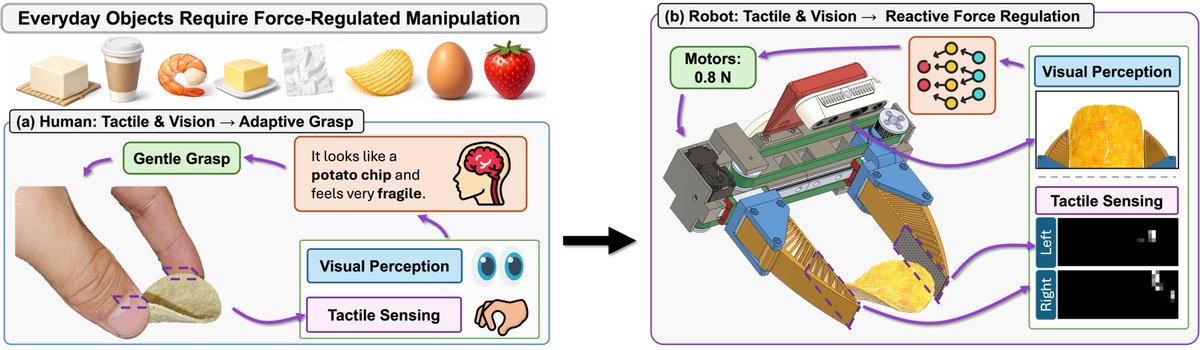
How can robots handle fragile, soft everyday objects like humans do, using vision & tactile to regulate force? 🤖🥚
Introducing our full-stack solution: a low-cost ($150) force gripper (0.45~45N), a force-aware teleoperator, and a reactive policy for learning force control.
@jorgeacf Second, the handheld teleoperator contains two motors. These motors support load-sensing mode, so they can measure the force or torque applied by the user's fingers. We use these measurements to estimate the user's intended grasping force.
@jorgeacf Our teleoperator has two parts.
First, we use a VR controller. The VR controller provides the absolute position and orientation in 3D space. We map this pose directly to the robot end-effector, so the user can control the robot arm pose in space.
🤲Tactile sensing is powerful for robot manipulation, but hardware is still difficult to access, reproduce, and scale.
🎯That’s why we built FlexiTac: an open-source, low-cost, and scalable tactile sensing solution designed for real robotic systems.
• Project page: https://t.co/i3TJxfkHOD
We hope FlexiTac can help democratize tactile sensing for robotics research. (1/n)
We evaluated the system on five tasks like grasping potato chips and tofu. Results show that RETAF significantly improves grasp stability and overall task success rates, outperforming Diffusion Policy baselines even when they are trained to predict force directly.