🚩Human touch can help scale robot dexterity, not just human motion.
🤖Introduce UVTA: a universal system leverage human tactile data for dexterous manipulation.
✉️ Project available at: https://t.co/0tjqqHxjve
Arxiv: https://t.co/R0qJ52dZZG
Introducing OM-1, our first robot foundation model, zero-shot generalizing to any robot: table-top arms, industrial arms and humanoids.
- learned directly from human manipulation data
- no teleop/robot data
- close to human-level dexterity and efficiency
- multi-robot collab
1/5 🚀 Thrilled to introduce AFUN: a step toward an affordance foundation model for functionality understanding. From a single RGB-D image + a language instruction, AFUN predicts where to interact (a task-conditional mask) and how to interact (a 3D motion curve), and can be directly deployed on a real robot with zero fine-tuning. It generalizes across diverse environments, objects, and tasks.
Code & Weights are public.
Paper: https://t.co/nyZUS2Sr1v
Project page: https://t.co/sU6T7WvQ1Z
Code: https://t.co/cziOC9ZC0F
#Robotics #Affordance #EmbodiedAI #Manipulation #AI
Intelligence comes from interaction👇
We introduce PhysMem: a memory system that lets VLM robot planners learn physical principles at test time, through interaction, without updating any parameters. We also see memory as a "non-parametric world model": verified principles let the planner predict outcomes without learned dynamics.
- LLM coding agents write code → execute → read errors → improve.
- Robot planners should be the same: act → observe physics → build understanding → make better decisions.
But even the best VLMs know about friction and stability in the abstract. However, they can't predict how "THIS ball rolls on THIS surface". Because "Declarative knowledge ≠ Physical grounding."
The core ideas:
🔬 Era of experience: the robot learns from its own interaction, not pre-training alone
🧠 Memory: a 3-tier system (episodic → hypothesis → verified principles)
⏱️Test-time learning: all learning happens during deployment
🔤 Symbolic reasoning: physics is translated into language-based principles the planner can reason over
#memory #Robotics #Intelligence
--
📄 https://t.co/CXkOCFi6Mu
🌐 https://t.co/ewDvS6MQPY
🧵👇
Excited to release Minimalist Compliance Control! We achieve robust, compliant robot interaction across robot arms, dexterous hands, and humanoids, with NO force sensors or learning. If you’re wondering what remains, please see the thread below😉
Website: https://t.co/FdEnntwRXr
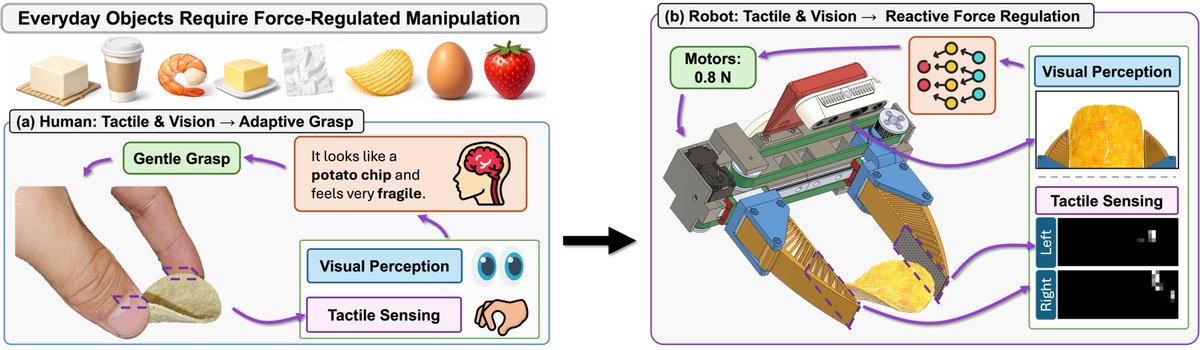
How can robots handle fragile, soft everyday objects like humans do, using vision & tactile to regulate force? 🤖🥚
Introducing our full-stack solution: a low-cost ($150) force gripper (0.45~45N), a force-aware teleoperator, and a reactive policy for learning force control.
Huge thank to the amazing time - to Huge thanks to the amazing team 🙌 — to @Haoyang1i 🔧 for continuous hardware support, @YXiaodi 🖥️ for simulation support, @BoAi0110 & @huang_zhiao 💡 for valuable technical advice, and Prof. @haosu_twitr for his guidance and support.
How to capture complex environment dynamics accurately with partial observations for world modeling? 🧐 Thrilled to share our recent work on world models for robotic manipulation - UniClothDiff: Diffusion Dynamics Models with Generative State Estimation for Cloth Manipulation, accepted to #CoRL2025 🎉.
We target on the challenging task of cloth manipulation, which involves partial observability due to severe self-occlusion, a high-dimensional state space, and highly non-linear dynamics. We enable robots, like humans, imagine the state of cloth through a mental model 🧠 and foresee its future state during folding!
🔗 https://t.co/bP8MYXSx9Y
📜 https://t.co/tsc2X5lcSE
We also demonstrate the seamless integration of our perception model and dynamics model within an MPC framework for complex real-world cloth folding tasks which shows great generalization within object categories!