Privacy should never be something we think about only after our data is exposed.
Onchain finance needs protection from the beginning. Your transactions, balances, and personal details shouldn't be open for everyone to see just because you want to use a blockchain.
That's why privacy by design matters. @primus_labs is building toward a future where information stays confidential while transactions and results remain verifiable.
Because protecting user data shouldn't be an extra feature. It should be part of the foundation.
Making confidential transactions faster is not just about using more powerful hardware. The way encrypted operations are designed matters too.
That's where @primus_labs AutoHoG comes in. It automatically builds custom gates and combines smaller operations into fewer bootstrapping steps, helping encrypted computations run more efficiently.
The results are impressive: a 64-bit confidential transfer now takes around 90ms on 8 consumer RTX 5090s, with throughput above 210 per second.
Even better, everything runs on integer arithmetic, so every node produces the exact same result, byte for byte.
This is the kind of progress that can make confidential onchain finance faster, more practical, and reliable at scale.
Primus is pushing encrypted computation closer to real-world performance.
Privacy on blockchain is not just about hiding transaction details. The real challenge is making sure everything can still work efficiently while the data stays encrypted.
That's what makes @primus_labs interesting.
With AutoHoG, Primus is changing how encrypted operations are processed. Instead of handling every small operation separately, it combines multiple operations into larger ones, reducing the time needed for confidential computation.
The results are impressive. A confidential transfer with 64-bit encrypted balances takes around 90 milliseconds, while eight NVIDIA RTX 5090 GPUs can handle more than 210 transfers per second.
What I find important is that Primus is not only focusing on speed. Its use of exact integer calculations also helps different network nodes produce identical results, which is essential for blockchain consensus.
This is the kind of progress that can make privacy practical for real financial applications.
Private data, useful computation, and performance that can scale. That's the direction @primus_labs is building toward.
Privacy and utility should never have to compete with each other.
Onchain finance needs transparency to build trust, but that doesn't mean every piece of information should be public.
The real challenge is making data verifiable, allowing sensitive information to be used without exposing it, and keeping important details private while everything still works.
That's the balance @primus_labs is working toward.
Not hiding everything. Not revealing everything.
Just making privacy and usability work together.
Trees lose their leaves in November, but their roots stay where they are.
I think privacy on public blockchains should work in a similar way.
Every balance, trade, and transaction detail doesn't have to be exposed just because the network is public.
That's what caught my attention about @primus_labs . It's building privacy and verification infrastructure that allows users to prove facts without exposing sensitive information.
The goal isn't to hide everything. It's to decide what should be visible and what should stay protected.
Because real privacy means having control over what you reveal.
Just started exploring the @primus_labs Points Campaign
Primus is building a privacy focused verification layer that lets users prove information about their online activity without exposing sensitive data.
They’ve raised $6.5M across pre-seed and seed rounds, and now their Points Campaign and Kaito campaign are live.
Getting started is simple. Connect your wallet and social accounts, complete the available tasks, and start earning points.
New users can receive 500 points for joining, according to the campaign details.
Join here: https://t.co/wBLUdJDw7K
It’s free to participate, so if you’re already exploring Kaito campaigns, Primus is worth checking out.
Transparency proves. Privacy protects.
The challenge is building a financial system that can do both without forcing users to choose one over the other.
With @primus_labs, the idea is simple: verify what needs to be trusted while keeping sensitive financial data and strategies private. Not every detail needs to be public for a transaction or claim to be verified.
This becomes even more important as institutional finance moves onchain, where trust and confidentiality must work together.
Proof without exposure. Verification without giving everything away.
That is how privacy and transparency can move forward together.
Good afternoon friends
LLMs had the internet to learn from.
Robots need the physical world.
That is the gap @vangrid_io going after.
Instead of sending expensive mapping equipment everywhere, Vangrid lets people use their phones to capture places that are hard to map.
A bounty gets posted, USDC is funded on Base, someone films the location, and the capture is processed into usable 3D data.
Faces and plates are blurred on the device before the video leaves it.
The capture is then fingerprinted and anchored on-chain.
Vangrid says more than 1M captures have already been recorded on Base in 60 days.
The interesting part is the model:
more requests → more captures → more real-world data → better inputs for Physical AI.
The sensor network is already in our pockets.
The easiest way to understand XP on @PlayOnMint is to watch it build in real time.
You play, your activity gets tracked, and the progress becomes visible instead of sitting behind a delayed dashboard.
The loop is simple:
Play -> Earn XP -> Build loyalty -> Unlock $MNTD + status
Even MintABear connects to this ecosystem through wagering activity.
What stands out to me isn’t bigger bets.
It’s the transparency between your activity, your XP, and the progress you’re building.
Play within your limits. Track the data. Understand the system.
Vangrid is taking a different approach to DePIN.
Instead of asking people to buy special hardware, it turns smartphones into data capture devices.
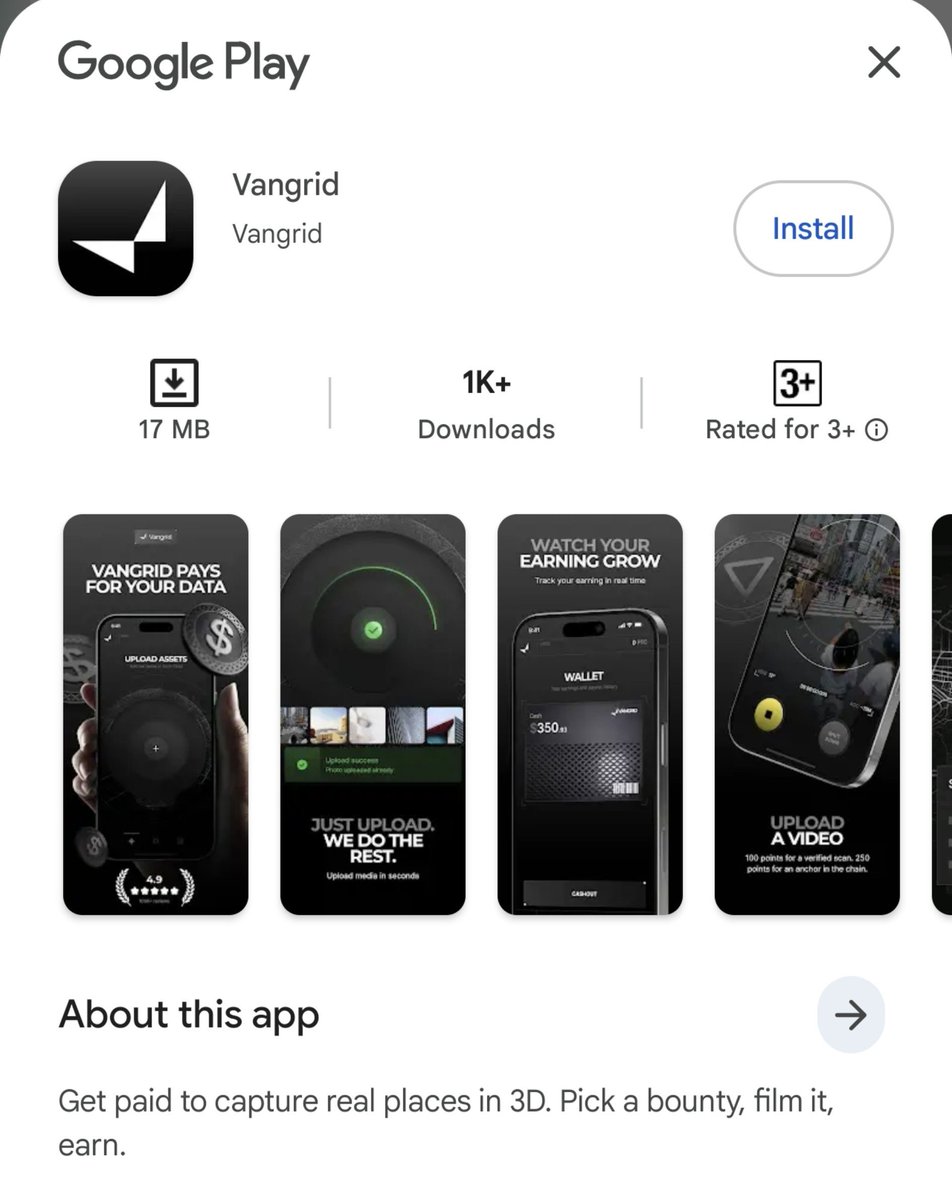
The Android app lets users find nearby bounties, record real-world locations from different angles, and submit the capture. If the requester accepts it, the contributor gets paid. Vangrid says the captured data is reconstructed into 3D models for use cases like robotics, maps and Physical AI.
The part I like about the model is the simple loop :
Find a bounty → capture a place → submit → get paid
It also handles face and license plate blurring on the phone before recording, according to the Play Store listing. Points are used for contribution and ranking, not as a currency.
Android is now live, with iOS coming next.
If @vangrid_io can keep growing both the contributor side and the demand for fresh spatial data, a normal smartphone could become a small piece of a much larger physical data network.
That’s a pretty interesting use of DePIN.
Wtf, what happened with this project? 😤
Well done, Let's see How @clashoAi
Scam with Genuine creators.⚠️❌
Yesterday, I was ranked #9. Today is payout day, and suddenly I’m #12 while almost every genuine creator has dropped out of the leaderboard.
Meanwhile, some accounts with obvious bot like ,bot view are still sitting at the top.
ClashoAi , you said bot activity accout would be removed. So how are these accounts still ranking this high?
And this top 10 ranked account start posting last 7 days with fake engagement and fake view.
If genuine creators are being pushed down while suspicious activity remains, something clearly needs to be explained.
BTW my friends, We should take some action on this issue. Please support me on this, everyone.🙏
✅ Block @clashoAi
✅ And Report for Scam with us.
#SCAM #SCAMCLASHOAI
Good evening 🌆
Another day of learning, building, and moving forward.
Take a moment to slow down, recharge, and appreciate the progress you made today.
For once, the numbers going up on CT actually mean something.
150,000+ real people verified through FaceSign across idOS and @billions_ntwk .
Not wallets.
Not bots.
Actual humans.
@idOS_network isn’t just lining up a TDE on March 5, it’s quietly building the identity rails that compliant Web3 will need.
Privacy-first verification.
Biometric account abstraction.
Seamless access to regulated stablecoin ecosystems.
And it’s not a single chain play either. The consortium model with major ecosystems signals that identity is moving toward shared infrastructure, not fragmented experiments.
If that adoption curve actually kicks in, $IDOS won’t just be another ticker it becomes the coordination layer for how people, not wallets, move through Web3.
Feels like the real story is just starting tbh.
Still watching how some teams just keep building while everyone else chases noise.
@PerceptronNTWK working on human verified AI data, real people contributing and checking quality instead of closed datasets. That kind of structure matters more than hype.
@fasset is taking a different route, making digital assets and tokenized investments easier for everyday users, especially in places where access is still limited.
Then you’ve got @FolksFinance quietly focusing on capital efficiency, real lending, staking, and strategies that actually work in the long run.
And @mwx_ai pushing practical AI tools instead of big promises, helping businesses and creators use AI in daily workflows.
Different directions, but same theme: real utility, real users, real progress.
gn, let’s see what this week brings.
Not gonna lie… the last few months been really rough for me in Web3.🥹💔
While working on Limitless, my wallet got hacked and I lost around $3k. Never recovered anything from @trylimitless. I tried to stay positive, keep building, keep showing up every day.
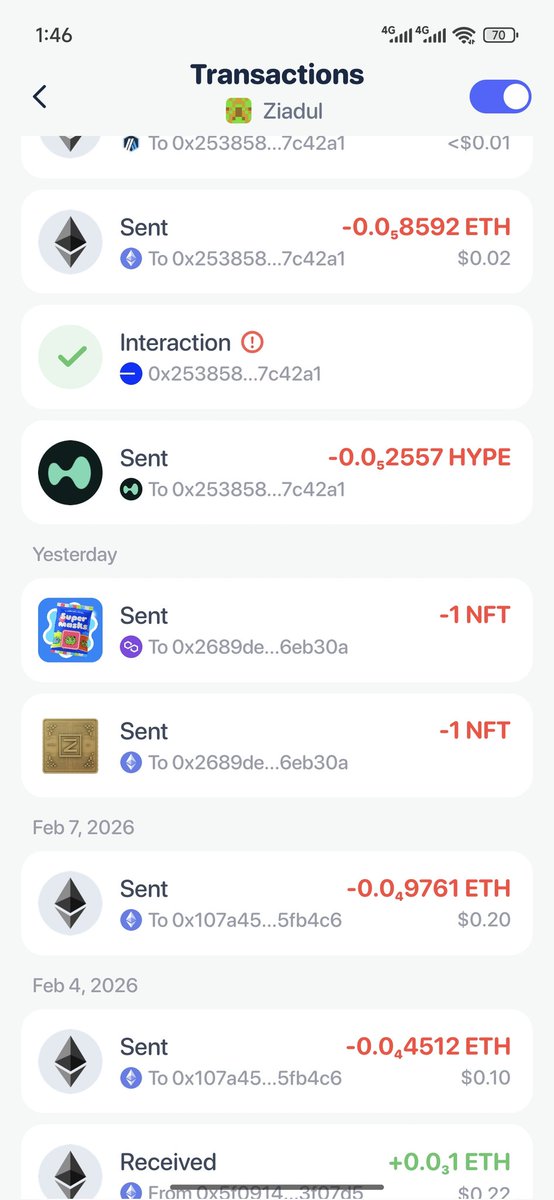
And now it happened again. My wallet got drained and my @zama OG NFT and @billions_ntwk Supermask NFT are gone too.
Feels like every time I try to move forward, something like this hits me again. It’s honestly exhausting… but I guess I’ll just take a deep breath and keep going.
Really tired, but I’ll probably still show up tomorrow and try again. Hope better days are coming.