I make art, read, mend my own clothes & practice PtBr when I’m not being a legal assistant. Here for words and art and people and solidarity and shady tweets.
how zines were used as evidence to sentence Prairieland defendants to decades in prison at 2025 protest at Texas ICE facility
"They didn’t like my book club.” - Elizabeth Soto, mother of three and defendant.
https://t.co/mCJs0uZbkg
The US empire is waging a neocolonial assault all across Latin America.
The US blatantly meddled in Colombia's election. Trump and Marco Rubio backed the far-right, multimillionaire candidate Abelardo de la Espriella (a defender of fascist paramilitaries), and there are serious irregularities in the results.
Colombia's current left-wing President Gustavo Petro has been very pro-Palestine and pro-China. He cut relations with the genocidal Israeli regime and joined China's Belt and Road Initiative.
De la Espriella vows to form a close alliance with the US and Israel, and minimize relations with China. Just a few weeks before the elections, he was in Florida, meeting with far-right US politicians who are close allies of Trump and Rubio.
The same thing is happening across the continent. The US carried out a blatant electoral coup in Honduras, to put a drug cartel-linked, pro-US, pro-Israel, anti-China puppet in power.
The US is currently trying to steal the election in Peru, to put the daughter of the fascist former dictator in power.
The US empire already has far-right puppets in power in Argentina, Chile, and Ecuador. The leader of Chile is the Pinochet-defending son of a Nazi war criminal. The dictator of Ecuador is the son of the country's richest billionaire oligarch.
Brazil is the next target of the US empire's neocolonial assault, in this year's election.
This is the colonial Monroe Doctrine in the neo-fascist era.
Fred Rogers met with a child psychologist every week for 22 years to build his show. She shaped everything: every script, prop, and song. The whole point was to give a child's nervous system time to slow down. In 1984, a single regulatory decision ended all of it.
The psychologist was Dr. Margaret McFarland, who co-founded the Arsenal Family and Children's Center alongside Benjamin Spock and Erik Erikson. She and Rogers understood that the prefrontal cortex in children, the part of the brain that controls impulse, emotion, and attention, takes decades to fully develop. At the start of every episode, Rogers tied his sneakers and changed his sweater while children settled in. Those pauses were intentional, designed to help a child's nervous system shift into a calmer, more focused state.
What ended it had nothing to do with child development science. In 1984, Reagan's FCC chairman Mark Fowler abolished the advertising limits that had protected children's programming from commercial pressure. Toy companies moved within months. Between 1984 and 1985, cartoons tied to toy lines increased by 300%, from a handful of shows to more than 40 animated series. In almost every case, the toy was designed first. The cartoon was built to sell it.
Researchers later put numbers to what parents were already noticing. A 2011 study in Pediatrics from the University of Virginia tested 60 four-year-olds across three groups: one watching SpongeBob, which cuts scene every 11 seconds; one watching a slow PBS show, which cuts scene every 34 seconds; and one drawing. Nine minutes later, all three took tests on attention, impulse control, short-term memory, and problem-solving. The SpongeBob group scored significantly worse across every measure.
In the 1970s, children began watching television around age 4. Research from pediatrician Dimitri Christakis found that by 2009, the average age of first screen exposure had dropped to 4 months, as the content got faster and the audience got younger. Researchers separately found that each additional hour of daily screen time at ages 1 or 3 raised the risk of attention problems at age 7 by 9%.
Video shows Mohammad Abu Giab, a 15-year-old fisherman from Gaza, diving into the sea he loved. He was later shot dead by Israeli forces off Deir el-Balah.
Gaza's Fishermen's Syndicate says at least 238 fishermen have been killed by Israel since October 2023.
Israeli lawyer Ben Marmarelli says Palestinian prisoners he represents beg him not to visit because they're raped each time he is due to meet them.
This is a scene from Al Jazeera's shocking new documentary on Israel's systematic use of rape.
Facilities like Delaney Hall are profitable in part because they can compel detained people to work for otherwise illegal rates.
There’s a lot of profit in paying immigrants a dollar a day to run their own jail—until they refuse. https://t.co/BISqwJsIeo
Rep. Adam Smith (D-Washington), top ranking Democrat on the committee, says that of course he does not like Netanyahu (like all good Democrats say now) but that "we benefit from that technology partnership..Israel's been actually having to fight."
This is known as the "Palestine Laboratory." Israeli weapons are tested in real time on the bodies of Palestinians, which the Israeli weapons industry uses in its marketing. Smith is arguing that we should benefit from that human experimentation too.
Elon Musk: “AI and robots will replace all jobs.”
Mustafa Suleyman, Microsoft: Most white-collar work “will be fully automated" in 12-18 months.
Dario Amodei, Anthropic: AI is a “general labor substitute for humans.”
Congress must act NOW to protect American workers.
A bricklayer in East Yorkshire has spent 35 years putting up barn owl nest boxes on weekends. This year, the region saw 308 owlets hatch.
His name is Robert Salter. He's 56 and does bricklaying full time. In 1990, he saw a piece on the news about a man in Lincolnshire installing barn owl boxes, and decided he'd do the same. He started with five.
He now has more than 350 boxes scattered across fields, farms, outbuildings, and trees in East Yorkshire. Every June, he takes four weeks off from bricklaying and visits them with his wife Sue. Scrambling up ladders, ringing chicks, cleaning boxes, repairing the ones the weather got to. He's a licensed bird ringer for the British Trust for Ornithology.
In 2024, the region ringed 95 owlets. In 2025, the count was 308. The Barn Owl Trust says that nationally, this year was "pretty poor" for barn owl breeding, but east Yorkshire is the exception, and it's the exception because of one man with a ladder.
The barn owl population in the UK was estimated at 4,000 pairs in the mid-2000s and crashed to roughly 1,000 by the early 2010s. The species is still recovering.
Most of conservation is one person who refuses to give up.
Finnish scientists trucked in real forest dirt and grass and laid it over the gravel at four daycare yards. They let the kids dig around in it for a month. The blood tests came back with changes the researchers hadn’t expected to see so fast or so clear.
The study ran at ten daycares in two Finnish cities with 75 kids aged three to five. Four of the yards got the forest treatment: about a tennis court worth of soil and grass laid over the gravel, plus planters and peat blocks the kids could dig and climb on. Three others stuck with their normal gravel yards. The last three were daycares where the kids were already visiting real forests every day.
After one month, the variety of bacteria living on the kids’ skin shot up, and the kind that helps train the skin’s immune defenses jumped the most. Their gut bacteria started to look like the gut bacteria of the forest-visiting kids. Their blood showed more of the immune cells whose job is to keep the body from freaking out at harmless stuff like pollen and peanuts, and overall inflammation dropped. The kids on the plain gravel yards showed none of this.
Childhood asthma in the US doubled between 1980 and 1995. Food allergies in kids jumped 50 percent between 1997 and 2011, then jumped another 50 percent between 2007 and 2021. And peanut allergies in one-year-olds tripled between 2001 and 2017.
The Finnish researchers think one of the reasons is simple: kids today don’t get dirty enough. 37 percent of American preschoolers now spend an hour or less outside on a normal weekday. Their immune systems are getting trained in environments stripped of the bacteria humans have always lived around.
Aki Sinkkonen, who led the study, put it in plain words: “It would be best if children could play in puddles and everyone could dig organic soil.” The Finnish government is now helping pay for daycares across the country to make the same changes.
Erin Brockovich has launched a website and has begun tracking all data centers in America and logging resident complaints
In just 1 week it’s already logged 1,690 resident complaints
For this who don’t remember
Erin Brockovich was the paralegal responsible for winning out a case against PG&E, Hinckley in California, because their wastewater runoff was seeping into rural areas and creating a lot of health issues for, for the surrounding neighborhoods
That case brought in a $333 million settlement that went to the families affected by the situation because a lot of them either had staggering medical bills due to their tap water was no longer safe
So why is this important, well residents all over America are reporting their tap water and river water is being heavily polluted by data centers
Her map of data centers is new, she just launched it
The website features an interactive US map showing operational, under-construction, and proposed AI data centers, overlaid with community-reported complaints
Residents can submit reports with details, photos, and locations. Within days of launch, it received a surge of submissions over 1,600 in the first week, and reports of 1,800+ from 47 states shortly after
Common Resident Complaints Being Logged
- Water usage
- Raising utility bills for residents
- Noise pollution: Constant 24/7 humming from fans, generators, and cooling systems disrupting sleep, daily life, and wildlife.
- E-waste from frequent hardware upgrades, pollution including PFAS concerns
Scraping websites and having AI summarize them, so that no one visits the websites, is theft.
Training AI on videos, so that it can make new videos that compete with them, is theft.
We are witnessing the largest theft of creative work in history.
If covid infections make you *more vulnerable* to almost every other pathogenic infection by multiple mechanisms, then you'd expect increases in almost every other pathogenic infection.
And that's what we see.
Ten completely unsurprising news stories:
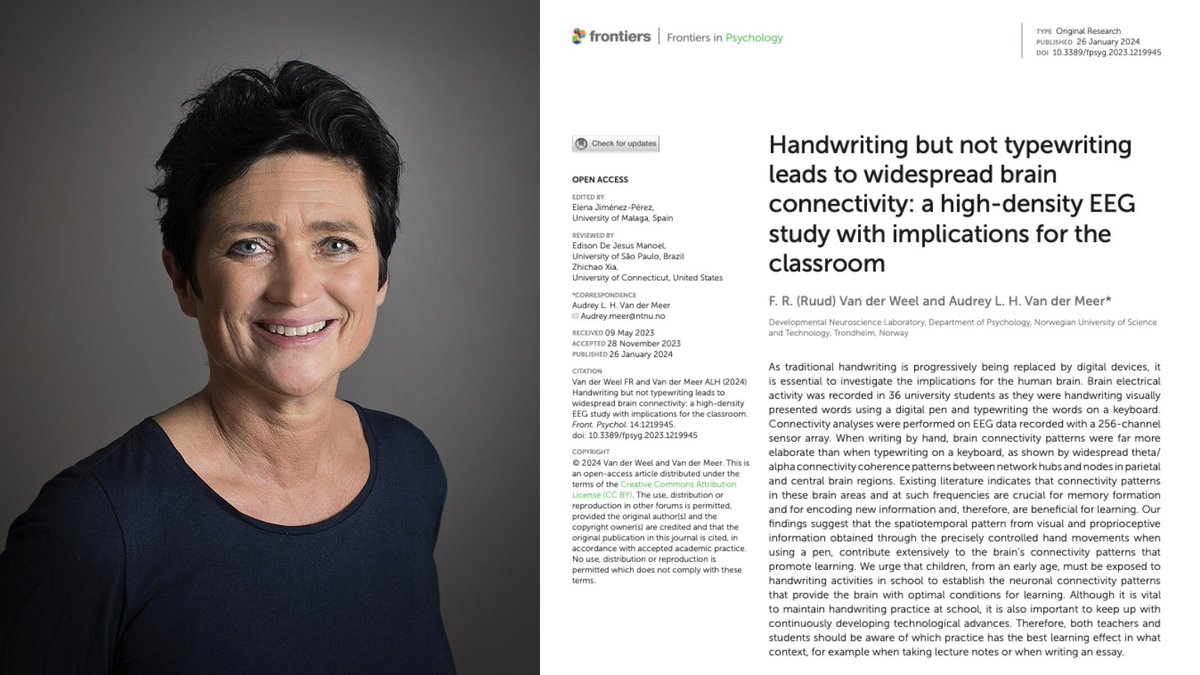
A Norwegian neuroscientist spent 20 years proving that the act of writing by hand changes the human brain in ways typing physically cannot, and almost nobody outside her field has read the paper.
Her name is Audrey van der Meer.
She runs a brain research lab in Trondheim, and the paper that closed the argument was published in 2024 in a journal called Frontiers in Psychology. The finding is brutal enough that it should have changed every classroom on Earth.
The experiment was simple. She recruited 36 university students and put each one in a cap with 256 sensors pressed against their scalp to record brain activity. Words flashed on a screen one at a time.
Sometimes the students wrote the word by hand on a touchscreen using a digital pen, and sometimes they typed the same word on a keyboard. Every neural response was recorded for the full five seconds the word stayed on screen.
Then her team looked at the part of the data most researchers had ignored for years, which is how different parts of the brain were communicating with each other during the task.
When the students wrote by hand, the brain lit up everywhere at once.
The regions responsible for memory, sensory integration, and the encoding of new information were all firing together in a coordinated pattern that spread across the entire cortex. The whole network was awake and connected.
When the same students typed the same word, that pattern collapsed almost completely.
Most of the brain went quiet, and the connections between regions that had been alive seconds earlier were nowhere to be found on the EEG.
Same word, same brain, same person, and two completely different neurological events.
The reason turned out to be something nobody had really paid attention to before her work. Writing by hand is not one motion but a sequence of thousands of tiny micro-movements coordinated with your eyes in real time, where each letter is a different shape that requires the brain to solve a slightly different spatial problem.
Your fingers, wrist, vision, and the parts of your brain that track position in space are all working together to produce one letter, then the next, then the next.
Typing throws all of that away. Every key on a keyboard requires the exact same finger motion regardless of which letter you are pressing, which means the brain has almost nothing to integrate and almost no problem to solve.
Van der Meer said it plainly in her interviews.
Pressing the same key with the same finger over and over does not stimulate the brain in any meaningful way, and she pointed out something that should scare every parent who handed their kid an iPad.
Children who learn to read and write on tablets often cannot tell letters like b and d apart, because they have never physically felt with their bodies what it takes to actually produce those letters on a page.
A decade before her, two researchers at Princeton ran the same fight using a completely different method and ended up at the same answer. Pam Mueller and Daniel Oppenheimer tested 327 students across three experiments, where half took notes on laptops with the internet disabled and half took notes by hand, before testing everyone on what they actually understood from the lectures they had watched.
The handwriting group won by a wide margin on every question that required real understanding rather than surface recall.
The reason was hiding in the transcripts of what the two groups had actually written down.
The laptop students typed almost word for word, capturing more total content but processing almost none of it as they went, while the handwriting students physically could not write fast enough to transcribe a lecture in real time, which forced them to listen carefully, decide what actually mattered, and put it in their own words on the page.
That single act of choosing what to keep was the learning itself, and the keyboard had quietly skipped the choosing and skipped the learning along with it.
Two studies. Two countries. Same answer.
Handwriting makes the brain work. Typing lets it coast.
Every note you have ever typed instead of written went into your brain through a thinner pipe. Every meeting, every book highlight, every idea you captured on your phone instead of on paper was processed at half depth.
You did not forget those things because your memory is bad. You forgot them because typing never woke the part of the brain that would have made them stick.
The fix is the thing your grandmother already knew.
Pick up a pen. Write the thing down. The slower road is the faster one.
They removed CD/DVD drives from devices.
They made physical media harder to buy and use.
They removed expandable storage from phones.
They pushed us into streaming subscriptions.
They made always-online normal.
They made unlimited internet necessary.
Then slowly raised the price of everything.
Ownership quietly became renting.