🚨Transfer Portal LHP🚨
LHP entering the transfer portal with 3 years of eligibility remaining. Thank you Saint Peter's for the opportunity this year.
LHP 6'2 190lbs
FB 88-90
SL 77-80
CH 79-81
GPA 3.63
Summer Ball
@Boyntonbucs
Training @The_BPCsj
Phone : (609) 515-5548
Force plates give incredible insights into the engine of an athlete; however, any number in isolation lacks context.
There are semi trucks and race cars that each have 600 horse power engines, but one goes 200mph and the other goes 90 mph.
Once you are capable of producing elite power for your bodyweight, that is a good sign you are ready to gain more quality mass.
If you produce average power at your body weight, chances are becoming below average at a heavier body weight can skyrocket your on field results
The task constraint of throwing harder than your teammates + environmental constraint of making fun of whoever is throwing the slowest
>
“correcting” the individual constraint of late shoulder external rotation at foot plant
By not creating a hyper-specific throwing program for someone throwing 73mph (they just don't know where their arm is in space), you have saved the real individualized drills for when they are actually needed
A team of 10-12 year olds can do the same throwing program (2 knee, single leg, forward/back walking, and drop step throws), trying to throw harder than their teammates for a few years
And every single one will throw harder
Recovery days = wall ball or fielding grounders at SS
Athletes getting to 85mph on basic programs create higher ceilings than those who have already gone to overly advanced concepts they don't need
Similarly, those throwing <80mph don't need individualized drill work based on slow mo video (with poor analysis that does more harm..)
Individualization harms these athletes by going to the well too early, instead of when advanced concepts are later needed
Their individualization is getting strong enough to not get knocked over by wind, not biasing a FFESS to drive IR in the front leg since they're a wide ISA
Basic exercises (TBDL, RDL, goblet squat, lunges, DB bench, chin ups, rows) for 3-4 x 8-12 with tempo eccentrics are the simplest program
Athletes on the same program push themselves further competing with teammates, which builds strength, hypertrophy, proprioception & intent
In the weight room, underdeveloped kids benefit from the most foundational exercises and consistently driving intent over time
While many would individualize lifts for a team of 11, 12 or 13 year olds, I believe individualization is detrimental for them
Progressive overload is the most tried and true weight room principle, but gets ignored on the throwing side of development
Implementing it prevents coaches from limiting kids development, allowing them to truly reach their potential
Here is how you can do this every time 🧵👇
In early rehab/RTT, ligaments cannot be stretched with high varus torque
Overload implements (if relaxed) help build capacity of the tissue
Then underloads introduce velocity and improve the throw with lower cumulative strain (then crush forearms/shoulders in the weight room)
This can help to manage workload when building throwing programs
Heavy implements will lead to longer, flatter impulse curves; light implements will lead to shorter, sharper impulse curves
This also applies to the specific throwing variations themselves.
In a throw, increasing layback (max shoulder ER) leads to lower peak varus torque, but more total stress on both the UCL and forearm
The forearm counters valgus load to stabilize the medial elbow over a longer duration. More strain limits how much they can stabilize
Not only does this allow coaches to compare output and loading/unloading strategies, but it can help to isolate sticking points to prescribe the exact program an athlete needs
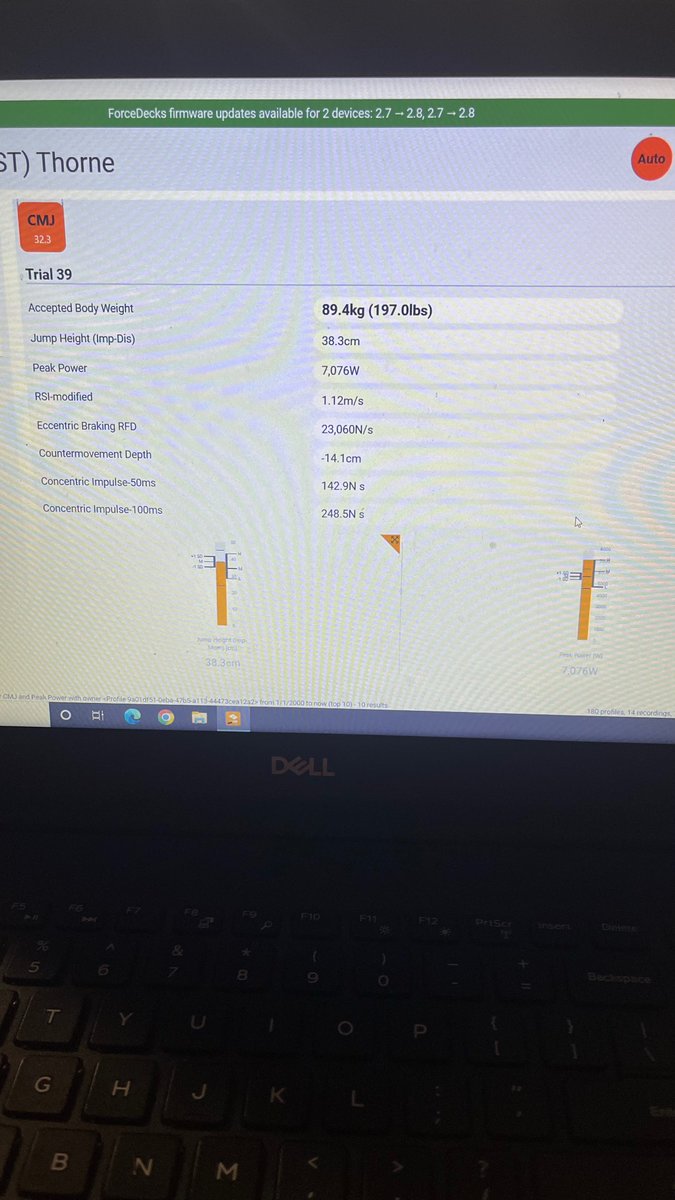
The lower power jump has a -32.2cm counter move compared to -14.1cm. A longer duration leads to a flatter impulse
Peak power is lower but the total work done is higher (Work = Power * Time)
The impulse graph shows the area under the curve. On the X axis is time and on the Y axis is force
These jumps were 38.2 and 41.4cm in the same session
But the first has a peak power of 7,076W and the second was 5,595
This one graph can teach you to program any aspect of player development better than many coaches
This is why a higher jump can have lower power and a throw with less layback leads to higher peak torque
Impulse curves eliminate guessing, to build the perfect program🧵👇
If you throw 82 and are looking to mechanic your way to 95, start by trying to move like someone who deserves to throw 95 (Not 500lb deadlift 1RM @ 0.25m/s)
Then supplement mechanical work as a side, not a main, dish