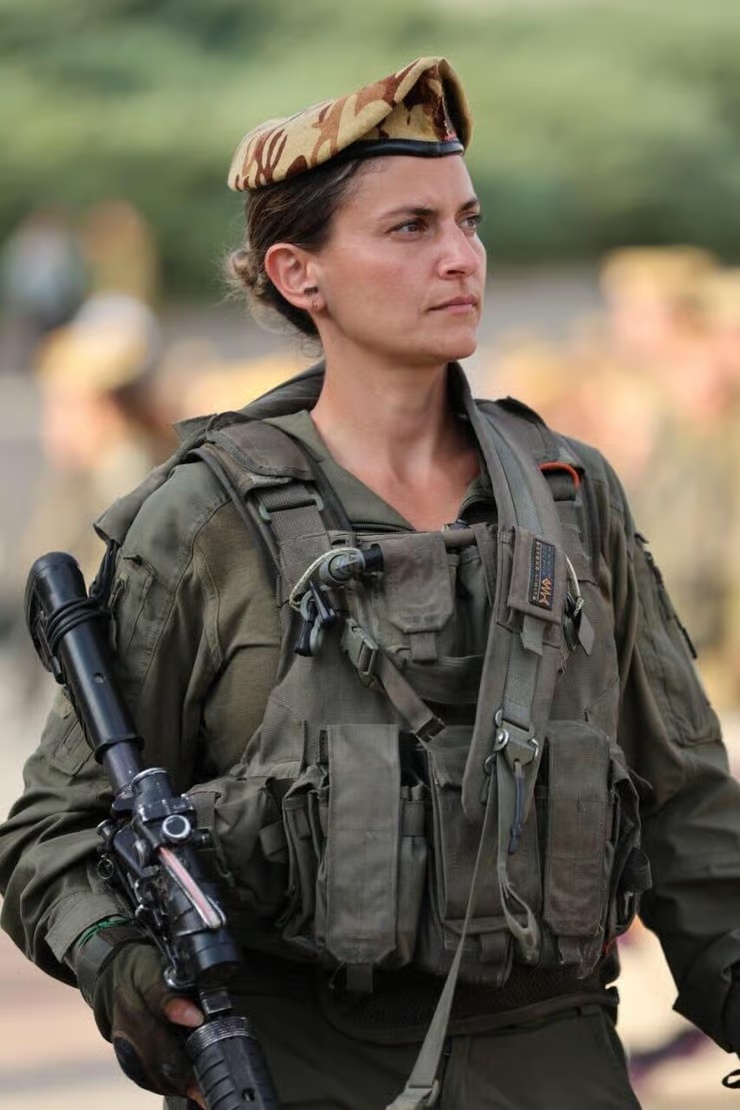
That is Lieutenant Colonel Or Ben Yehuda, commander of the CARACAL unit near Gaza.
On the morning of October 7th, she opened her eyes and saw Hamas in front of her.
“I look up at the sky, then lower my head again, glance to the side, and there are maybe five pickup trucks coming toward me, full of motorcycle riders. There are terrorists leaping between the sand dunes and the trees, all of them wearing vests and uniforms, moving in our direction, and I can’t even count them properly with my eyes. It’s hundreds. Hundreds.
And farther back, on the distant road, I see columns of Gazan civilians simply walking toward us, some armed, some not.
And I say to myself: ‘That’s it. This is where I die. Right here, exactly where I’m standing now. This is where I die.’
Then I said to myself: Fine. If this is the end, then I’ll end it well. I’ll die with honor. I’ll do the best I can. And I’ll fight until my very last drop of blood.
So I turn to my soldiers, a group of twelve heroic fighters waiting for me to tell them what to do. I turn to them with half a smile.
Later, they told me I smiled; I didn’t remember it.
And I tell them: ‘Come on, let’s tear them apart!’
And they all shout back: ‘Yalla!!!’
They come to the embankment with machine guns, with everything they can carry, and we position ourselves there and start firing at everyone approaching the outpost. We’re shooting like mad. At some point, we had a LAU missile with us, so we fired it at one of the Hamas pickup trucks. The truck exploded in a massive blast, something unbelievable. There must have been huge amounts of explosives inside, and the explosion took several of the motorcycle riders with it.
And little by little, I suddenly realize many of them are beginning to retreat, turn around, and flee back the way they came.
And suddenly I understood: yes, we’re doing something significant here.
We were there for about half an hour, and then, in the middle of all the chaos, I suddenly hear the tracks of a tank behind me.
It was an unbelievable sigh of relief.
I told my deputy company commander: ‘Stay here! I don’t know whose tank this is — I’m going to get it!’
It was already around eleven o’clock. I start moving backward, advancing toward the tank through the concrete barriers, and suddenly I realize a terrorist is jumping at me from point-blank range, and in another second, he would’ve been hugging me.
And my luck was that I already had a round in the chamber and my finger on the trigger. It was literally a question of who shoots first, and I shot first.
The terrorist collapsed in front of me.
And I froze for a moment, like, what was that? What just happened?
Then I hear my deputy commander yelling from behind me:
‘Commander! Commander! Are you okay?’
I look at myself, I’m okay.
I turn back toward him and signal with my hand: everything’s under control.
He runs up after me, looks at me, and says, ‘What… what just happened between you two?’
And I tell him: ‘Exactly what’s going through your head right now.’
But the tank!
I remember — I can’t let it leave. We need it.
I ran quickly toward it, and because I’m used to working with my tank crews, I started signaling to them in tank hand signals: ‘Terrorists there, behind me, do this, shell over there!’
And he’s with us, he understands immediately.
And for the first time, I suddenly have additional force joining me.
We make some kind of flanking maneuver, take up a strong position, and simply fire toward wherever the terrorists are coming from. We keep firing and firing, and they start pulling back. And I understand — all of us understand — that if we don’t continue fighting right now, those terrorists will get past us and reach all the communities behind us.
At a certain point, my deputy commander and his radio operator are hit by an RPG and collapse to the ground. So we pull them out of there.
Then I call friends of mine who are pilots flying Yasur and Yanshuf helicopters, and I ask them to come land at the helipad near the outpost, because I’ve evacuated wounded soldiers there and I need them to clear our casualties out. And it actually happens. They arrive, they land, and they evacuate the wounded for me.
Meanwhile, my medical unit is there the entire time treating casualties, loading them up, evacuating them to the helipad. We managed to bring there the wounded from the APC we had seen, the wounded from our battalion, and several civilians we picked up along the way — people who escaped from Kibbutz Sufa, from Pri Gan, and from other places. They all received treatment from my incredible medical team — those angels — and the helicopters I called in evacuated them to Soroka Hospital, where they finally received proper care.
There were also many dead in that battle.
There were dead.
And I remember one moment at the end, when everything was over, just minutes before they came to evacuate the bodies. There was a moment when they were lying there side by side, and I walked between them, gently touching their faces, stroking them softly, telling them I was sorry, and closing their eyes.
And I remember telling myself in that moment that those people, who were now making their final journey, were unbelievable heroes. They fought there like lions to save Kibbutz Sufa. They fought until their last drop of blood."
From Or's book 'book One Day in October'.
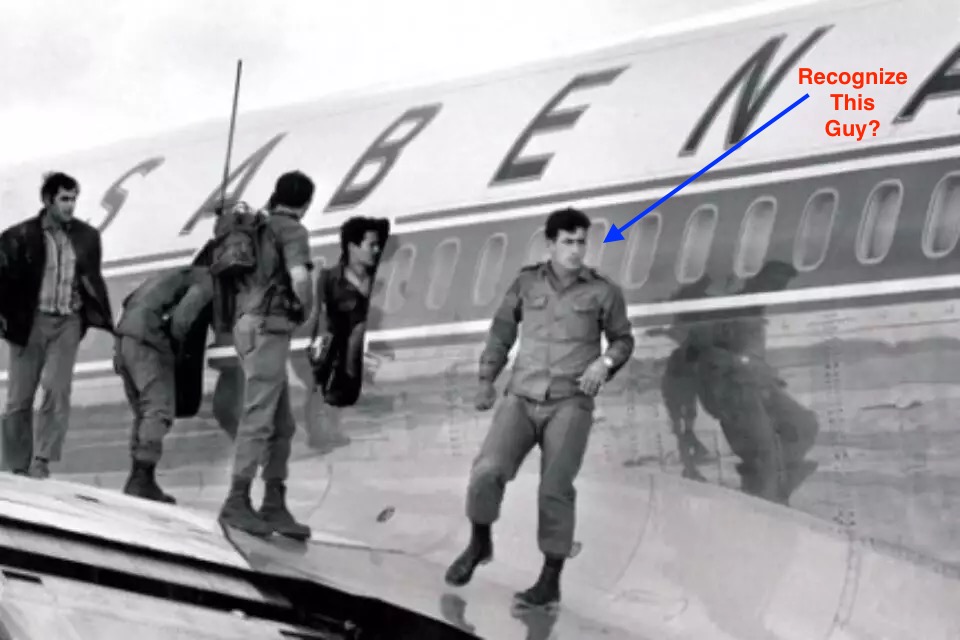
This day (May 8) in 1972, a young Benjamin Netanyahu and another future Prime Minister, Ehud Barak (who was leading the raid), were among the elite Sayeret Matkal commandos who carried out the first successful raid on a hijacked airliner in history.
Sabena Flight 571 was hijacked by four Black September (offshoot of Yasser Arafat’s PLO) terrorists shortly after takeoff from Vienna. They forced the plane to land at Lod Airport (now Ben Gurion) with 90 passengers and crew aboard, demanding the release of 315 convicted Palestinian terrorists — or they would blow up the plane with everyone on board.
What followed was Operation Isotope — one of the most daring and successful counter-terrorism operations in history.
While Moshe Dayan negotiated, Israeli forces quietly disabled the plane’s tires and hydraulics. On May 9, 16 commandos disguised as airport mechanics in white overalls approached the aircraft.
In a lightning 90-second assault, they stormed the plane through multiple entry points. Both male hijackers were killed. The two female terrorists were captured alive.
One passenger was tragically killed in the crossfire. Netanyahu himself was lightly wounded by friendly fire.
This bold operation — planned under Golda Meir, with Ariel Sharon and Shimon Peres also involved — sent an unmistakable message to the world: terrorists could no longer seize Jewish hostages with impunity.
The raid became the blueprint for future operations like Entebbe.
Black September, the group behind the hijacking, would go on to massacre 11 Israeli athletes at the Munich Olympics just four months later. Israel hunted them down for years afterward.
Two future prime ministers — who would later become bitter political rivals — stormed a hijacked plane side-by-side. That’s the kind of history that still gives chills.
@jk_rowling My dear, don't mind these opportunists. Love from Nigeria and always will be grateful for the wonderful job you're doing for women the world over.
@george_paruch@JasonJournoDC This is going too far. Yes Obama made a grave error by doing this if he did but you simply hate him from the trash you just said.
@Yoxat2@MOSSADil Lol. It's not about going to China. It is about doing what is right INTERNATIONALLY. China knows what is right but they practice this at home...alone. 😁