Ritual Symphony: The Architecture Powering Verifiable AI Execution
Understand the magic behind this BlochainTech👇
✅STAGE 1: Commitment (The Replicated Path)
What happens: A user submits a transaction requesting an AI task (for example, generating an image or querying an LLM).
Standard validators do not run the AI model. Instead, they quickly package the transaction request into a block to establish its official order and sequence on the ledger.
The State: The transaction is Committed (locked in history), but its outcome is still Unsettled.
✅STAGE 2: Off-Chain Execution (The Delegated Path)
What happens: Symphony delegates the heavy AI computation to a specialized off-chain execution node.
By pushing this heavy lifting off-chain, the rest of the blockchain validators can keep processing standard transactions at blazing-fast speeds without getting bogged down by massive AI workloads.
✅STAGE 3: Algorithmic Randomness & Verification
What happens: The executor node runs the AI model. However, because generative AI utilizes randomness (for creative variation), we must prove the executor didn't cheat or manipulate the output.
The executor passes a seed and their Secret Key (sk) through a Verifiable Random Function (VRF). This outputs both the random parameters used for the AI model and a mathematical proof. Anyone can now verify that the randomness was perfectly unbiased and genuine.
✅STAGE 4: Settlement (Superposition State Transition)
What happens: The executor submits the AI output along with the cryptographic VRF or hardware (TEE) proof back to the blockchain.
The blockchain run a fast, lightweight verification. If the proof is valid, the state machine merges the delegated AI result back into the main chain state (running them in Superposition). The tracking vector updates (e.g., from [1, 0, 0] to [1, 1, 0]), and the transaction is officially Settled and finalized for the user.
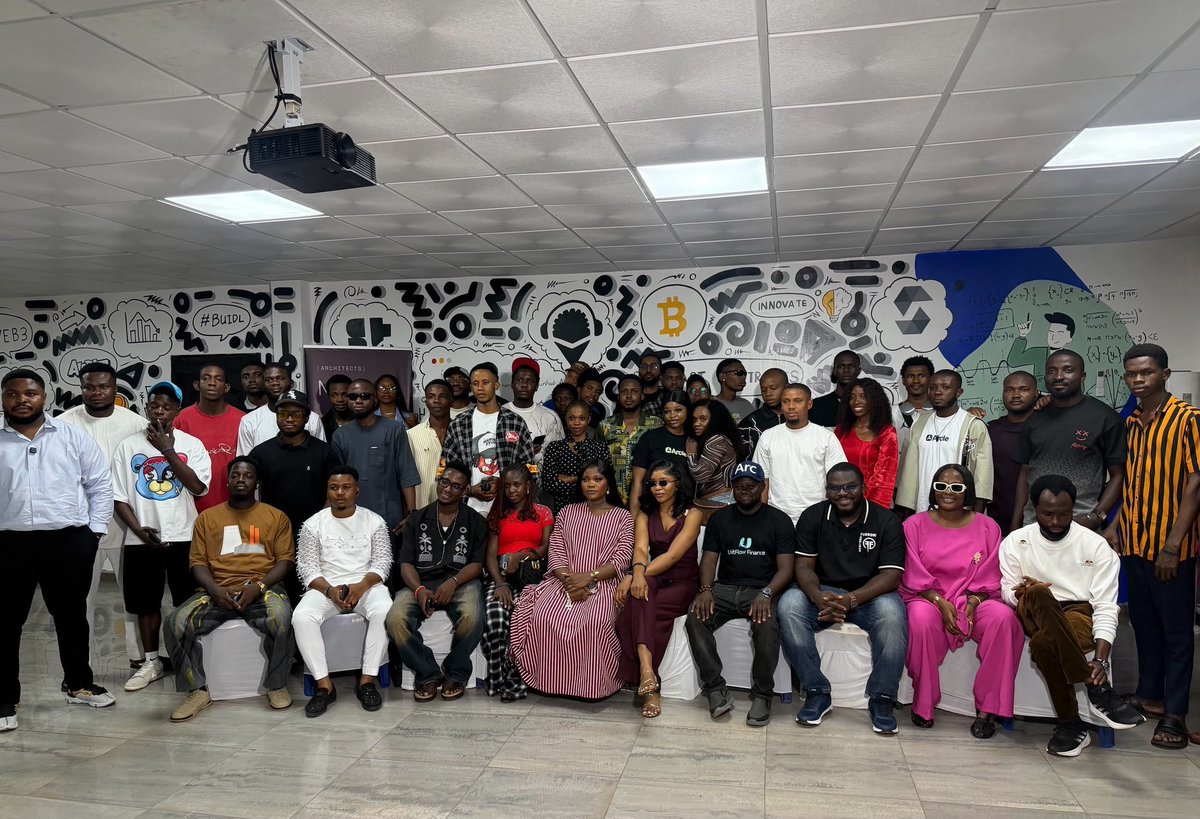
It came to pass and was a successful meetup for Architects and connection between Builders
Slowly and then all at once @arc the Economic OS is taking over the world.
Travelling back now and the journey was worth it. See you on the next one
july @arc community-led global chapter event lineup
🇵🇹 Portugal (July 22, Lisboa):
https://t.co/F289Hv5qwU
🇳🇬 Nigeria (July 22 and 25, Enugu + Lagos): https://t.co/E2uZfgmDOH
🇧🇷 Brazil (July 16 and 25, Rio):
https://t.co/ZWVMT7ro1D
🇦🇷 Argentina (July 25, BA):
https://t.co/vwmh6a9TPS
🇸🇬 Singapore (July 30):
https://t.co/dT3wXOj9kL
🇻🇳 Vietnam (July 23):
https://t.co/Xpc5w6FfY1
and more to come...we told you it's hot Arc summer
HERE'S THE BIG PICTURE
L1s & Stablecoins provide the financial rails for micro-settlement then
Ritual provides the cognitive and execution engine: The decentralized infrastructure where agent logic is evaluated, verified, and linked directly to those financial rails.
Franklin Templeton, with $1.5T in AUM, just published their institutional thesis on agentic AI as the killer use case for blockchain. Their article lays out what agents will need from a chain: autonomous fulfillment, verifiable identity, auditability, access to compute, and settlement speed. In short, what we at Ritual have been saying for 3 years now.
The article stops short of the bigger shift, though. Every era of payments removed friction. Cards meant you stopped carrying cash. Phones meant you stopped carrying cards. Agents mean you stop executing every decision yourself. With an agent, your intent runs at the speed of silicon, weighing a hundred options at once and buying only when the price and terms are right under the rules you have set.
Speed at that scale changes what you can see. You can't personally review a thousand decisions an hour. When an agent pays, the reasoning lives inside a model call on a server somewhere, and the chain only witnesses the receipt, the settled transaction at the very end. That's how the article measures every chain: transactions per second, the speed of settling a decision made somewhere else.
But benchmarking chains on TPS is like judging a trading desk by how fast its wire transfers clear. The process- - the model call, the inputs, the reasoning - and the decision itself can’t be verified by anyone. You get trustless settlement of a decision you have to take on faith.
That might be fine for one agent buying one thing, but if Franklin Templeton's thesis around a fully onchain agentic commerce economy hold true, we can't run it on trust, bubble gum, and duct tape. Our agentic future needs, at minimum, three core attributes that current chains do not offer natively.
❖ End-to-end verification ❖
When inference, keys, and settlement are native to the same chain, every step of an agent's decision is recorded and verifiable.
Regulatory compliance is unlocked when the entire decision making trail is onchain, and iteration and refinement cycles get faster and more precise when every step of a transaction is traceable.
❖ Built-in privacy ❖
Agents work with your most sensitive data. On Ritual, prompts and responses stay encrypted inside TEE enclaves while results settle onchain.
Your data stays yours while your agent works with it, which unlocks agentic use cases for data-sensitive individuals and enterprises who don’t want to give away their edge for free.
❖ Composable Agentic Legos ❖
Agents on Ritual are onchain primitives, just like a token or smart contracts. They hold their own keys, schedule their own execution, and call each other the way contracts call contracts. Coordination between thousands of agents becomes something anyone can build and anyone can verify.
Ritual puts thinking onchain.
The model call and the settlement complete in one transaction, with x402 micropayments enshrined as a native primitive, the same standard the article describes.
When most of the economy runs at machine speed, the chain has to witness more and be trusted with more.
We call it the last layer you will ever need. Franklin Templeton wrote the thesis for where finance goes next, and we’ve already built it.
❖







![JudoChy's tweet photo. Ritual Symphony: The Architecture Powering Verifiable AI Execution
Understand the magic behind this BlochainTech👇
✅STAGE 1: Commitment (The Replicated Path)
What happens: A user submits a transaction requesting an AI task (for example, generating an image or querying an LLM).
Standard validators do not run the AI model. Instead, they quickly package the transaction request into a block to establish its official order and sequence on the ledger.
The State: The transaction is Committed (locked in history), but its outcome is still Unsettled.
✅STAGE 2: Off-Chain Execution (The Delegated Path)
What happens: Symphony delegates the heavy AI computation to a specialized off-chain execution node.
By pushing this heavy lifting off-chain, the rest of the blockchain validators can keep processing standard transactions at blazing-fast speeds without getting bogged down by massive AI workloads.
✅STAGE 3: Algorithmic Randomness & Verification
What happens: The executor node runs the AI model. However, because generative AI utilizes randomness (for creative variation), we must prove the executor didn't cheat or manipulate the output.
The executor passes a seed and their Secret Key (sk) through a Verifiable Random Function (VRF). This outputs both the random parameters used for the AI model and a mathematical proof. Anyone can now verify that the randomness was perfectly unbiased and genuine.
✅STAGE 4: Settlement (Superposition State Transition)
What happens: The executor submits the AI output along with the cryptographic VRF or hardware (TEE) proof back to the blockchain.
The blockchain run a fast, lightweight verification. If the proof is valid, the state machine merges the delegated AI result back into the main chain state (running them in Superposition). The tracking vector updates (e.g., from [1, 0, 0] to [1, 1, 0]), and the transaction is officially Settled and finalized for the user.](https://pbs.twimg.com/media/HNQKcv-XcAAtWyw.jpg)